Introduction
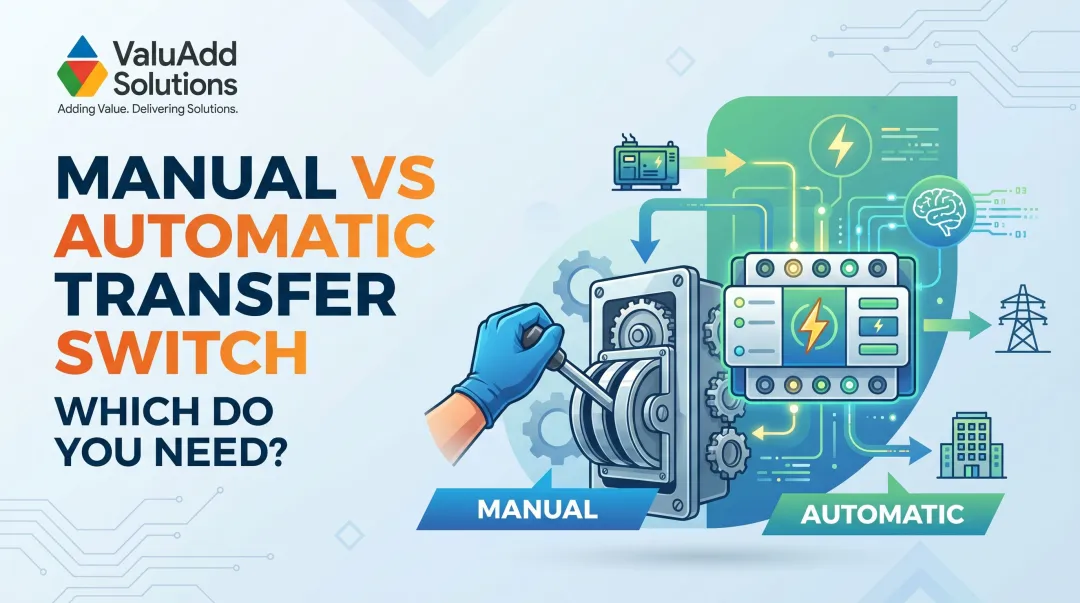
For industrial facilities, an unplanned power outage doesn't just mean the lights go out—it means halted production lines, compromised processes, and staggering financial exposure. In automotive manufacturing, downtime now costs approximately $2.3 million per hour, while oil and gas facilities face losses near $500,000 per hour. That makes choosing between an automatic transfer switch (ATS) and a manual transfer switch (MTS) a critical backup power decision — one facility managers can't afford to get wrong.
The decision carries far more nuance in industrial environments than in residential settings. Several factors shift the calculus:
- Load criticality — whether any process can tolerate even a brief interruption
- Staffing availability — who is on-site and capable of responding during an outage
- Compliance obligations — particularly under NFPA 110 and NEC codes
- Total cost of ownership — upfront hardware, installation, and long-term maintenance
This guide breaks down both switch types across each of these dimensions, so you can match the right solution to your facility's actual risk profile.
Key Takeaways
- An ATS detects utility outages and switches to backup power automatically; an MTS requires manual operator action
- ATS is essential for critical continuous loads where even brief downtime carries high operational or safety costs
- MTS offers cost-effective solutions for lower-criticality loads with on-site staff available during outages
- Choose based on load criticality, staffing availability, upfront vs. lifecycle cost, code requirements, and operating environment
- Both ATS and MTS must meet NEC and NFPA 110 requirements; code compliance applies to either choice
ATS vs MTS: Quick Comparison
The table below breaks down the key differences across the criteria that matter most in industrial selection decisions.
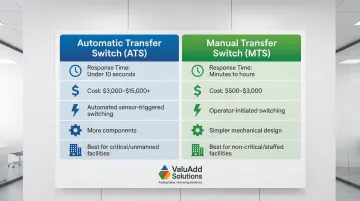
| Feature | Automatic Transfer Switch (ATS) | Manual Transfer Switch (MTS) |
|---|---|---|
| Switching Mechanism | Automated sensor-triggered response | Manual operator action required |
| Response Time | 10 seconds or less (typical) | Minutes to hours (depends on staff availability) |
| Upfront Cost | Higher ($3,000-$15,000+) | Lower ($500-$3,000) |
| Complexity | More components, electronic controls, sensors | Simpler mechanical design, fewer failure points |
| Maintenance | Annual controller inspections, sensor verification | Periodic mechanical inspection, contact exercising |
| Best Fit | Critical continuous loads, unmanned facilities | Non-critical loads, staffed facilities, planned maintenance |
Both types are available in NEMA 4X and NEMA 12 industrial-grade enclosures and require UL 1008 listing for facility use — enclosure and certification ratings carry as much weight as switch type in demanding environments. Transfer switch selection should be evaluated alongside generator sizing, facility load profile, and local code requirements to arrive at the right fit.
What Is an Automatic Transfer Switch?
An automatic transfer switch (ATS) is an electrically operated switching device that continuously monitors incoming utility power and, upon detecting voltage or frequency deviation beyond set thresholds, automatically starts the standby generator and transfers the electrical load. When utility power is restored, the ATS transfers back and shuts down the generator—all without operator intervention.
How ATS Operation Works
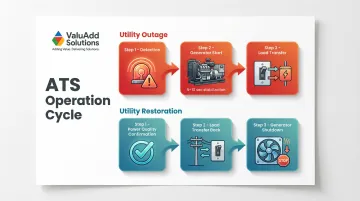
The ATS operation cycle consists of three distinct phases:
During Utility Outage:
- Detection - Sensing circuitry identifies voltage or frequency deviation
- Generator Start - Controller signals generator and waits for stabilization (typically 5-10 seconds)
- Load Transfer - Switch transfers electrical load to generator power
During Utility Restoration:
- Power Quality Confirmation - Controller verifies stable utility voltage and frequency
- Load Transfer Back - Switch returns load to utility power
- Generator Shutdown - Generator enters cool-down period before stopping
Modern ATS units complete the entire transfer in 10 seconds or less to minimize process disruption and meet NFPA 110 Type 10 requirements.
ATS Transition Types
Industrial facilities choose from four transition modes based on load sensitivity and process requirements:
Open Transition (Break-Before-Make):
- Brief 30-50ms interruption occurs during transfer
- Suitable for resistive loads, general lighting, and small motors
- Most common and cost-effective option
Delayed Transition (Center-Off):
- A specific pause (seconds to minutes) occurs in the neutral position
- Allows motor fields to decay before reconnection
- Prevents mechanical damage to large pumps, fans, and inductive loads
Closed Transition (Make-Before-Break):
- Sources parallel for less than 100ms—no interruption to sensitive processes
- Required for healthcare, data centers, and continuous manufacturing
- Ensures zero-blink operation during testing or re-transfer
Soft-Load Transfer:
- Actively synchronizes generator and utility
- Gradually shifts load over time rather than instantly
- Ideal for peak shaving and high-inertia industrial machinery
Industrial Impact of ATS
- Eliminates dependence on operator presence during outages (critical for unmanned shifts)
- Protects automated processes and PLCs from uncontrolled shutdowns
- Reduces risk of production loss from delayed manual intervention
- Maintains continuous operation of safety-critical systems
- Recovers unplanned downtime costs of $125,000 per hour or more — often after just one or two prevented outages
Use Cases of Automatic Transfer Switches
ATS is the standard or code-required choice for these industrial applications:
- Manufacturing facilities with continuous or semi-continuous processes
- Municipal water and wastewater treatment plants where process interruption triggers regulatory reporting
- Oil and gas processing facilities with high-value continuous operations
- Data centers and control rooms requiring zero-interruption power
- Healthcare facilities with life-safety requirements
Two key codes drive ATS adoption in the US. NFPA 110 Level 1 systems—where failure risks loss of life—explicitly require automatic transfer switches.
NEC Article 700 (Emergency Systems) independently mandates automatic transfer equipment that restores power within 10 seconds.
What Is a Manual Transfer Switch?
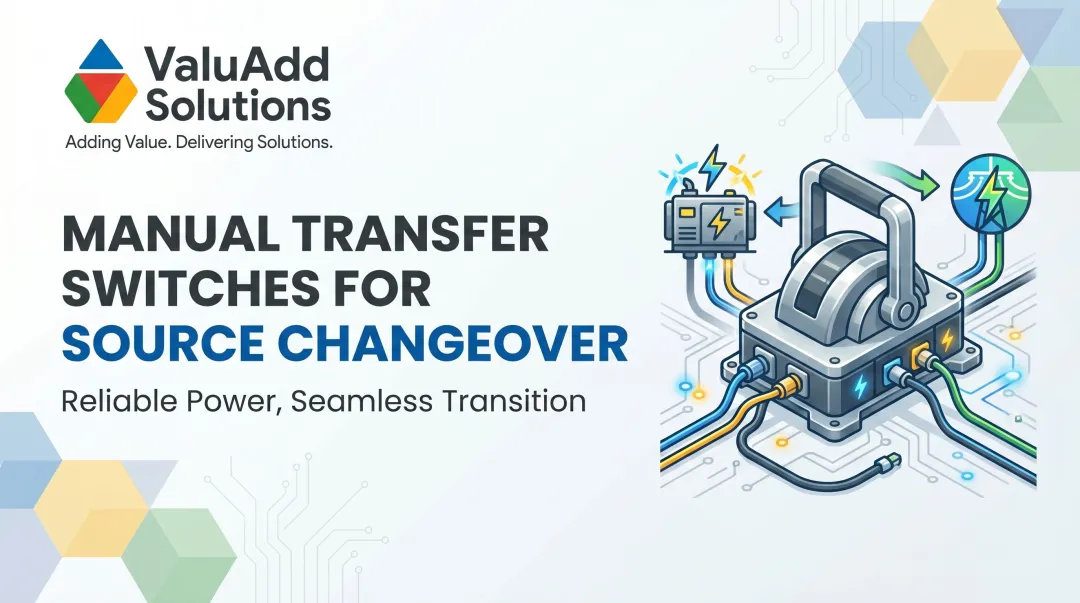
A manual transfer switch (MTS) is a switching device that requires a person to physically actuate the transfer—via lever, rotary handle, or similar mechanism—to move electrical load from utility to generator power.
It contains no automatic sensing or control circuitry. The operator must recognize the outage, start the generator, and perform the transfer manually.
How MTS Operation Works
The typical MTS operation sequence follows these steps:
- Recognize the loss of utility power and confirm the outage is not momentary
- Start the backup generator manually
- Wait for the generator to stabilize at rated voltage and frequency
- Move the transfer switch lever or handle to the generator position
- Verify the load is confirmed on generator power before leaving the panel
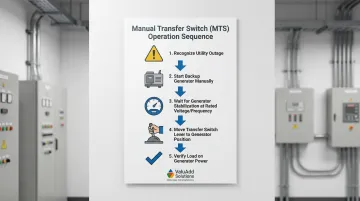
On utility restoration, the process reverses. The operator must manually transfer back to utility power, allow the generator to cool down, then shut it down.
Critical safety requirement: MTS designs must include mechanical interlock mechanisms to prevent simultaneous connection to both sources. This interlock positively prevents inadvertent paralleling of utility and generator, which could backfeed the grid and endanger utility workers.
Core Advantages of MTS
Manual transfer switches offer legitimate benefits for specific industrial scenarios:
- Cost 50-70% less than comparable ATS units in both equipment and installation
- Fewer electronic components reduce potential failure points
- Give maintenance teams direct control during scheduled generator testing
- Eliminate the risk of inadvertent automatic transfers during maintenance windows
Use Cases of Manual Transfer Switches
Those advantages translate directly into the scenarios where MTS performs best:
- Facilities with 24/7 on-site personnel who can respond quickly to outages
- Lower-criticality loads such as non-process lighting, HVAC, and secondary systems
- Temporary or portable generator setups for construction or emergency response
- Generator maintenance bypass applications alongside a primary ATS
Electrical system integrators and maintenance teams use MTS for commissioning, load testing, and scheduled maintenance scenarios — situations where deliberate human control is an operational asset, not a limitation.
According to NEC Article 702, manual switches are permitted for "Optional Standby Systems" where the load is not related to life safety—making them a code-compliant choice when properly specified.
ATS vs MTS: Which Is Right for Your Facility?
The choice between automatic and manual transfer switches hinges on four facility-specific questions:
Decision Framework
1. What is the criticality of your load? Can your process tolerate even a few minutes without power? For continuous manufacturing, water treatment, or process control, the answer is typically no. For office lighting or non-critical HVAC, brief interruptions may be acceptable.
2. Is qualified personnel consistently on-site? Are operators available during nights, weekends, severe weather, and holidays? If your facility runs unmanned shifts or has limited after-hours staffing, manual switching becomes impractical.
3. What are your code requirements? Does NFPA 110, NEC Article 700, or your local authority having jurisdiction mandate automatic transfer for your facility type? Life-safety and emergency systems typically require ATS by code.
4. What is your total cost of ownership? Factor in not just equipment cost but the dollar value of potential downtime avoided. A $10,000 ATS investment is negligible if it prevents one hour of downtime in a facility losing $500,000 per hour.
Situational Recommendations
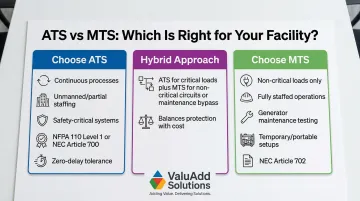
Choose ATS if your facility:
- Runs continuous or semi-continuous processes
- Has unmanned or partially staffed operational periods
- Hosts safety-critical systems (fire pumps, emergency lighting, life support)
- Falls under NFPA 110 Level 1 or NEC Article 700 requirements
- Cannot tolerate response delays measured in minutes
Choose MTS if your facility:
- Operates non-critical loads only
- Has qualified staff reliably present during all operational hours
- Needs a cost-effective solution for generator maintenance testing
- Manages temporary power setups or portable generators
- Operates under NEC Article 702 (Optional Standby) classification
Hybrid Approach: Many facilities deploy both—ATS for critical process loads and MTS for non-critical circuits or maintenance bypass applications. This strategy balances protection with cost control.
Facility Scenario Breakdown
Scenario 1: Municipal Water Treatment Plant (ATS Case)
A 24/7 automated water treatment plant running dosing and pumping processes cannot tolerate uncontrolled shutdowns. Even a 5-minute interruption can disrupt treatment cycles, compromise water quality, and trigger regulatory reporting under EPA requirements.
The EPA's Power Resilience Guide for Water and Wastewater Utilities notes that power loss at unmanned lift stations and booster pumps can lead to sewage overflows and water main depressurization—allowing contaminant intrusion.
The EPA explicitly recommends automatic transfer switches at unmanned facilities because operator dispatch time can exceed the window before system failure.
An ATS with closed-transition capability ensures zero-interruption continuity and integrates with SCADA systems for real-time monitoring of power source and switch position.
Scenario 2: Manufacturing Facility Maintenance Testing (MTS Case)
A manufacturing facility conducts scheduled weekly generator load tests with maintenance staff on-site. During these planned events, the maintenance team needs direct control over the transfer sequence to safely verify generator performance and load response.
An MTS gives the maintenance team predictable control over the transfer sequence, eliminating the risk of inadvertent automatic transfers during maintenance windows. The manual switch complements the facility's primary ATS, which continues protecting critical production loads.
For facilities sourcing transfer switch enclosures and control components, ValuAdd carries UL 1008 Listed, NEMA 4X/12-rated options rated for demanding industrial environments.
Conclusion
Neither ATS nor MTS is universally superior. The right choice hinges on four factors:
- Load criticality — how much downtime your process can tolerate
- Personnel availability — whether trained operators are on-site around the clock
- Regulatory obligations — NEC, NFPA 110, or facility-specific code requirements
- Total operational cost — upfront, maintenance, and failure-event costs combined
For most industrial and process facilities, the ATS's ability to respond instantly without human intervention makes it the lower-risk long-term choice. The MTS remains a practical, cost-controlled option for non-critical applications and planned maintenance scenarios.
Selecting the correct transfer switch type directly affects production uptime, worker safety, regulatory compliance, and backup power reliability. With downtime costs reaching millions per hour in some industries, this is a strategic investment decision — not a line-item procurement call.
Evaluate both options against your specific facility load profile, staffing model, and code requirements before deciding. If your team needs support working through that evaluation, ValuAdd's technical team can assist with transfer switch specification, enclosure selection, and system integration across industrial power applications.
Frequently Asked Questions
What is the difference between an automatic and manual transfer switch?
An ATS automatically detects a power outage and transfers load to a generator without human action, while an MTS requires an operator to manually initiate the switch. This makes ATS suitable for unattended or critical applications and MTS better for lower-criticality or staffed situations.
What are the advantages and disadvantages of automatic vs manual transfer switches?
ATS units offer fast response (under 10 seconds), require no operator intervention, and handle critical loads — but carry higher upfront costs and more maintenance complexity. MTS units are simpler and less expensive, though they depend on personnel availability and are unsuitable for unattended facilities.
Are manual transfer switches code compliant?
MTS units are fully code compliant when properly installed and UL 1008 listed. However, NFPA 110 Level 1 systems and NEC Article 700 (Emergency Systems) may require automatic operation for specific facility types. Compliance depends on your facility classification and applicable jurisdiction.
What is the typical transfer time for an automatic transfer switch?
Most industrial ATS units complete transfer in 10 seconds or less after generator stabilization. MTS transfer time depends entirely on operator response and typically takes several minutes — longer if personnel are not on-site.
Can a facility use both automatic and manual transfer switches?
Many facilities deploy a hybrid approach: an ATS handles critical process loads requiring instant automatic response, while an MTS covers non-critical circuits or serves as a maintenance bypass switch. This gives operations teams flexibility and cost efficiency across different load priorities.
How often should transfer switches be tested and maintained?
NFPA 110 recommends monthly operational testing and annual full-load testing for emergency systems. ATS units with electronic controllers should receive annual inspections of sensors and control boards, while MTS units require periodic mechanical inspection and exercising to prevent contact degradation.