Introduction
Copper busbars carry roughly 60% more current per cross-sectional area than aluminum—yet aluminum costs about one-third as much per pound. For engineers sizing a distribution system, that gap doesn't make the choice obvious. It makes it complicated.
Both materials appear across manufacturing plants, substations, and water treatment facilities. But the right choice shifts depending on your application. A compact motor control center has very different priorities than a utility-scale solar farm running hundreds of meters of bus.
The decision touches current-carrying capacity, installation weight, long-term reliability, and total cost of ownership — and getting it wrong means oversized infrastructure, unexpected downtime, or project costs that spiral past budget.
This article breaks down the key factors—backed by industry data and application case studies—to help engineers, procurement managers, and system integrators make informed busbar material decisions for demanding industrial applications.
Key Takeaways
- Copper delivers 100% IACS conductivity with a smaller cross-section for the same current load; aluminum runs at ~61% conductivity but weighs one-third as much at lower material cost
- Copper wins in tight-space, high-current installs — switchgear panels and substations where current density and compact sizing matter
- Aluminum suits large-scale distribution runs, solar arrays, and weight-sensitive assemblies where lower cost and easier handling outweigh the conductivity gap
- When current rating and space are tight, choose copper; when budget and run length dominate, aluminum is the practical default
Copper vs Aluminum Busbar: Quick Comparison
The table below gives engineers and procurement managers a direct side-by-side reference before the full analysis:
| Feature | Copper (ETP C11000) | Aluminum (Alloy 1350/6101) | Strategic Implication |
|---|---|---|---|
| Electrical Conductivity | 101% IACS | ~61% IACS (1350) / 57–61% IACS (6101) | Copper enables compact, high-density designs |
| Density | 8.96 g/cm³ | 2.71 g/cm³ | Aluminum is ~70% lighter, reducing structural load |
| Cross-Section Required | Baseline (1.0×) | ~1.60× | Aluminum needs 60% more volume for same ampacity |
| Thermal Expansion | 17 μm/m·°C | 23.6 μm/m·°C | Aluminum joints require Belleville washers to prevent loosening |
| Corrosion Resistance | High natural resistance | Good with oxide layer; prone to galvanic corrosion | Copper preferred for harsh/wet environments |
| Approximate Price | Premium (3× aluminum) | Low baseline | Aluminum offers significant CAPEX savings |
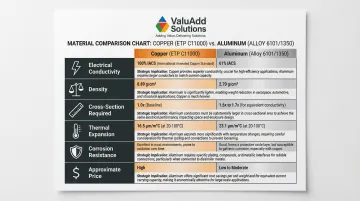
No single property determines the right choice on its own. Copper's conductivity advantage matters most in space-constrained switchgear and high-density panel designs. Aluminum's weight and cost advantages become decisive in large-scale distribution runs, overhead busbars, and projects where CAPEX pressure is real.
The thermal expansion gap — copper at 17 μm/m·°C versus aluminum's 23.6 μm/m·°C — is rarely a dealbreaker, but it does require joint design attention. In aluminum installations, Belleville washers and periodic torque checks are standard practice, not optional. Corrosion exposure follows a similar logic: copper handles humid and chemically active environments with minimal intervention, while aluminum performs well as long as galvanic contact with dissimilar metals is managed through bimetallic connectors or appropriate surface treatment.
What Is a Copper Busbar?
A copper busbar is a solid conducting bar (typically made from Electrolytic Tough Pitch (ETP) or Oxygen-Free Electronic (OFE) copper) used to collect, distribute, and ground electrical power within switchgear, distribution boards, and industrial control panels.
These rigid conductors replace bundled cables where high current density and minimal voltage drop are essential — serving as the backbone of industrial power distribution systems.
Material Advantages and Surface Treatments
Copper's superior conductivity means lower power losses and reduced heat generation — which cuts thermal stress on insulation and connected equipment. In a 3,000A motor control center, copper's higher conductivity allows a smaller busbar cross-section, reducing panel footprint by 30–40% compared to aluminum at equivalent current capacity.
The most widespread grade is ETP copper C11000, governed by ASTM B187 ("Standard Specification for Copper, Bus Bar, Rod, and Shapes"). C11000 is 99.90% pure copper with ~0.04% oxygen, delivering a minimum conductivity of 100–101% IACS in the annealed condition.
Industrial copper busbars often receive surface plating to extend service life and improve contact performance:
- Tin plating (ASTM B545): Improves corrosion resistance and solderability; forms a thin, stable oxide layer that preserves conductivity
- Silver plating (ASTM B700): Preferred for high-frequency or sliding contacts where minimizing contact resistance matters most
Use Cases of Copper Busbar
Copper busbars are the primary fit for high-current industrial applications where compact size and maximum conductivity are non-negotiable:
- Substations and medium-voltage switchgear requiring maximum current density in limited space
- Large motor control centers serving heavy manufacturing operations
- Industrial UPS systems where reliability and efficiency directly impact uptime
- Data centers and critical facilities with strict uptime requirements where copper's performance-per-unit-area advantage justifies the higher cost
Oil and gas processing, heavy manufacturing, and mission-critical facilities consistently specify copper when space constraints or efficiency targets leave no margin for compromise.
What Is an Aluminum Busbar?
An aluminum busbar is a lower-density alternative conductor, most commonly produced from alloys 1350, 1370, or 6101, designed for electrical power distribution where weight reduction and cost efficiency are priorities. While aluminum cannot match copper's conductivity, its significantly lighter weight and lower material cost make it attractive for large-scale installations and budget-sensitive projects.
Core Benefits and Operational Impact
Aluminum's lighter weight eases installation in overhead cable trays and large distribution frames, reducing structural support requirements and labor costs. Lower material and transportation costs make it compelling for projects with extensive bus runs.
Aluminum recycling requires only 5% of the energy needed for primary production—a 95% energy saving that increasingly factors into industrial procurement decisions.
Standard Alloys
Aluminum busbars use specific alloys governed by ASTM B236:
- Alloy 1350: High-purity aluminum (≥99.50%) with 61% IACS conductivity; widely used but lower mechanical strength
- Alloy 6101: Heat-treatable alloy containing magnesium and silicon; offers higher mechanical strength with 57-61% IACS conductivity, suitable for busways and applications requiring structural rigidity
- Alloy 1370: Similar to 1350 but with slightly higher purity (99.7%) and conductivity (62% IACS), often used in transmission
Important Design Consideration
Aluminum busbars require a larger cross-sectional area—approximately 1.56-1.60× that of copper—to deliver the same current capacity. Connection points must be treated carefully to prevent oxidation and galvanic corrosion, requiring anti-oxidant compounds and proper torque maintenance.
Use Cases of Aluminum Busbar
Aluminum busbars are best suited for applications where weight and cost dominate the selection criteria:
- Large low-voltage distribution boards with extensive bus runs where material cost savings are significant
- Building electrical systems where lighter weight reduces structural requirements
- Solar energy installations requiring thousands of meters of conductor
- EV charging infrastructure and light industrial equipment with moderate current requirements
Municipal water treatment facilities and renewable energy projects commonly specify aluminum where long bus runs at moderate current levels make the economics compelling. In 100MW solar farms, aluminum busbars reduce structural weight by 30% and installation costs by 15-20% compared to copper alternatives.
Copper vs Aluminum Busbar: Which Is Better for Industrial Power Distribution?
There is no single winner in the copper versus aluminum debate—the correct choice depends on a combination of technical constraints and project economics. The following breakdown covers the key decision points.
Conductivity and Space Constraints
When panel or enclosure space is limited—such as compact switchgear or motor control centers—copper's higher conductivity allows a smaller busbar to carry the same current, reducing panel footprint and simplifying routing. For a 2,000A application, a copper busbar might require a 4" × 1/2" cross-section, while aluminum would need approximately 6" × 1/2" to achieve the same ampacity.
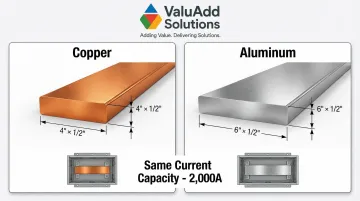
Aluminum's lower conductivity means a larger cross-section must be accommodated, which can be impractical in tight installations. In space-constrained environments, the premium paid for copper is often offset by savings in enclosure size, reduced panel complexity, and simplified installation.
Lifecycle Cost vs Upfront Cost
Copper costs more upfront but typically reduces long-term maintenance costs. Better stability at connection points and lower thermal expansion mean fewer service calls for re-torquing bolted connections.
Aluminum saves significantly on material and installation—lighter handling speeds fieldwork and cuts labor costs. However, it requires periodic re-torquing and anti-oxidation compound at all contact surfaces. Factor these into total cost of ownership, especially for remote sites or facilities with lean maintenance teams.
Environmental and Load Conditions
In corrosive, high-humidity, or chemically aggressive environments—such as oil and gas facilities, coastal installations, or water treatment plants—copper's natural corrosion resistance gives it a clear edge. Copper performs well even in harsh conditions with minimal surface treatment.
Aluminum can perform well with proper surface treatment and bimetallic connectors, but requires more careful specification and installation. Galvanic corrosion becomes a serious concern when aluminum contacts dissimilar metals in the presence of moisture, potentially causing joint failure without proper mitigation.
Regulatory and Certification Considerations
For industrial installations requiring UL Listed, CE Certified, or NEMA-compliant components, confirm that your chosen busbar material and configuration meets the applicable standards. ValuAdd carries UL 508 and CE certified busbar solutions and can assist with specification compliance questions for your application.
NEC Article 366 (Busways) governs busway installations, including support requirements and overcurrent protection. Article 408 (Switchboards & Panelboards) mandates clearances, grounding, and circuit identification. Equipment must be listed for the specific conductor material—if a panelboard is marked "Cu/Al," it is rated for both materials; otherwise, material substitution is non-compliant.
Situational Recommendation Summary
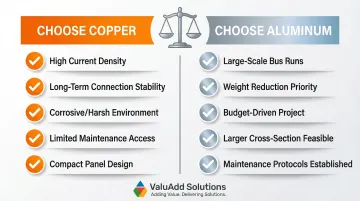
Choose copper when:
- Current density is high and space is constrained
- Long-term connection stability is critical
- The environment is corrosive or chemically aggressive
- Maintenance access is limited or difficult
- Compact panel design reduces overall project cost
Choose aluminum when:
- Project scale is large with extensive bus runs
- Weight reduction matters for structural or handling reasons
- Budget is a primary driver and material cost dominates
- Current requirements can be met with a larger cross-section
- Proper maintenance protocols can be established and followed
Real-World Scenarios: When Each Material Wins
Scenario 1: Heavy Manufacturing Facility (Copper Preferred)
A plant engineer specifying a motor control center for a large automotive manufacturing floor chooses copper busbar to maximize current density in a compact enclosure. The facility requires 3,000A distribution in a space-constrained electrical room where floor space costs $200 per square foot.
Using copper allows the engineer to specify a smaller MCC footprint—reducing panel size by 35% compared to an aluminum solution. The compact design minimizes heat buildup, with thermal modeling showing copper busbars remain within the IEC 61439 limit of 105°C maximum temperature (70°C rise) even under peak load conditions.
- Reduced temperature rise improves component longevity
- Smaller footprint saves $8,000 in floor space costs
- Tighter joints reduce maintenance calls
- Improved system uptime due to stable connections under vibration
Scenario 2: Solar Installation (Aluminum Preferred)
An electrical system integrator working on a 100MW utility-scale solar installation selects aluminum busbars to reduce structural load on cable trays and cut material costs across the project's 12,000+ meters of bus runs.
Aluminum reduces total structural weight by 30% and installation costs by 15–20% compared to copper. For a 1,500A run over 100 feet, the aluminum solution weighs approximately 293 lbs versus 386 lbs for copper—a 24% reduction that simplifies manual handling and support requirements.
Across the full installation:
- Material cost savings reached $180,000
- Reduced structural support requirements added $45,000 in savings
- Lighter handling cut the construction schedule by 3 weeks
- The lower carbon footprint aligned with the project's renewable energy goals
Scenario 3: Oil and Gas Processing (Environment Drives the Choice)
In a coastal oil and gas processing facility with high humidity and hydrogen sulfide exposure, the material decision shifts toward copper — or demands rigorous surface treatment if aluminum is used.
Copper busbars perform in this chemically aggressive environment without additional surface treatment. If aluminum were used, the installation would need tin plating, sealed connections, and bimetallic transition hardware at every copper terminal interface — increasing both complexity and maintenance burden.
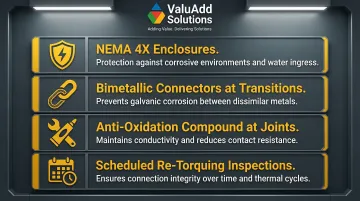
Key specification requirements for this environment:
- NEMA 4X enclosures for corrosion protection
- Bimetallic connectors at any aluminum-to-copper transitions
- Anti-oxidation compound at all aluminum joints
- Scheduled inspection and re-torquing to prevent joint degradation
Each of these scenarios highlights a core truth: the right busbar material depends on the specific demands of the environment, load, and installation constraints. ValuAdd's specialists work through those tradeoffs with engineers and integrators on a project-by-project basis — from component selection to compliant configurations for demanding applications.
Conclusion
Copper busbars deliver unmatched conductivity and long-term connection stability for high-current, space-constrained, and harsh-environment industrial applications. Aluminum busbars offer compelling economics and weight savings for large-scale or budget-sensitive distribution projects where cross-section size can be accommodated.
The right choice comes from evaluating your application against four criteria—not defaulting to one material:
- Current rating and available cross-section in the installation space
- Environment (moisture, vibration, dissimilar-metal contact risk)
- Total lifecycle cost, including jointing, maintenance, and derating
- Compliance requirements for your jurisdiction and industry
A 3,000A motor control center in a compact manufacturing facility demands different material priorities than a utility-scale solar farm with kilometers of overhead bus runs.
ValuAdd's UL Listed and CE Certified busbar solutions cover both materials across a range of current ratings and form factors. The technical team can help engineers and procurement managers match the right specification to the application — before the order, not after commissioning.
Frequently Asked Questions
Can aluminum busbars replace copper busbars in high-current industrial applications?
Aluminum can replace copper in many industrial applications when the busbar cross-section is sized appropriately (approximately 1.56× larger). However, space-constrained, high-current environments like compact switchgear often still favor copper due to its superior current density and smaller footprint requirements.
How much heavier is copper busbar compared to aluminum busbar?
Copper is approximately 3.3× denser than aluminum (8.96 g/cm³ vs 2.71 g/cm³), so a same-sized copper busbar weighs roughly three times more. In large installations or overhead cable tray applications, that weight difference directly affects structural support requirements and manual handling.
What causes galvanic corrosion in aluminum busbars and how can it be prevented?
Galvanic corrosion occurs when aluminum contacts dissimilar metals (like copper) in the presence of moisture, accelerating oxidation at the junction. Prevent it with bimetallic connectors, anti-oxidation joint compound, and proper surface treatment at connection points. Sealed enclosures (NEMA 4X) provide additional protection in humid environments.
What is the typical cost difference between copper and aluminum busbars?
Copper typically costs more than 3× aluminum per unit weight, and aluminum's lower weight further reduces transportation and installation labor. On a large project with 1,000 meters of busbar, the combined material and installation savings can exceed 40–50%, making aluminum the practical choice for cost-conscious projects.
Do aluminum busbars require different connection hardware than copper busbars?
Yes. Aluminum busbars require bimetallic lugs when joining to copper terminals, anti-oxidation compound on contact surfaces, and periodic re-torquing of bolted joints. Its higher thermal expansion coefficient and tendency to creep under pressure make correct hardware selection and scheduled maintenance non-negotiable for long-term reliability.
Are copper or aluminum busbars better for outdoor or harsh industrial environments?
Copper generally performs better in chemically aggressive or high-humidity environments due to its natural corrosion resistance. Aluminum can be used outdoors with proper surface treatment and protective enclosures (such as NEMA 4X rated), but requires more careful specification, bimetallic transition hardware, and regular maintenance to prevent galvanic corrosion and joint degradation.