Introduction
Your assembly line faults mid-shift. A PLC reboots without warning. A motor drive trips repeatedly—and your maintenance team finds nothing wrong with the equipment itself. The real culprit? The power feeding it.
Power quality is one of the most overlooked causes of unexplained downtime in manufacturing facilities. These electrical disturbances—voltage sags, harmonics, transients—are often invisible, lasting mere milliseconds, yet they wreak havoc on sensitive industrial electronics and halt production lines.
This article explains what power quality means, the most common types of problems, how they damage manufacturing operations, and practical steps plants can take to identify and fix them.
Key Takeaways
- Power quality refers to how closely electrical power matches the ideal standard: stable voltage, correct frequency, and clean waveform
- Common problems include voltage sags, harmonics, and transients
- Manufacturing impacts include unplanned downtime, premature equipment failure, energy waste, and process quality issues
- 80–90% of power quality problems originate inside the facility, not from the utility grid
- Targeted mitigation—soft starters, harmonic filters, surge protection—prevents costly disruptions
What Is Power Quality?
Power quality measures how closely the electrical power delivered to your equipment matches what that equipment actually needs: a smooth sinusoidal AC waveform at the correct voltage, frequency, and amplitude. When power quality is good, equipment runs as designed — no more, no less.
Poor power quality means deviations in voltage level, waveform shape, or frequency that cause equipment to malfunction, degrade, or fail prematurely. These deviations are often brief and invisible. They won't trip a breaker or flicker a light, but they still damage sensitive industrial electronics over time.
Governing Standards
Three primary standards define acceptable power quality thresholds in industrial settings:
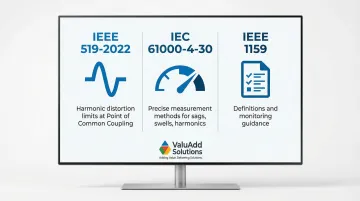
- IEEE 519-2022: Establishes harmonic distortion limits at the Point of Common Coupling (PCC) between utility and user
- IEC 61000-4-30: Defines precise measurement methods for power quality parameters (sags, swells, harmonics)
- IEEE 1159: Provides consistent definitions and monitoring guidance for electromagnetic phenomena
The 7 Most Common Power Quality Problems in Manufacturing
The Most Common Power Quality Problems in Manufacturing
Power quality problems fall into distinct categories, each with different causes, durations, and equipment impacts. Knowing which type you're dealing with is the first step toward protecting your operation.
Voltage Sags and Swells
A voltage sag is a brief drop in RMS voltage—typically 10-80% below nominal—lasting from half a cycle to one minute. Voltage swells are temporary increases above nominal.
Sags are by far the most common power quality event in manufacturing. EPRI studies show typical industrial sites experience 50 events per year where voltage drops below 90%, and 20 events dropping below 70%. These brief events frequently cause controller faults, dropped relay coils, and system resets.
Transients and Surges
Transients are sudden, short-duration spikes in voltage or current lasting less than one cycle. They're caused by capacitor bank switching, lightning strikes, or motor contactors opening under load.
These events destroy semiconductors, power supply components, and control boards—often leaving no diagnostic trace except failed components.
Harmonics and Waveform Distortion
Harmonics are non-fundamental frequency voltages and currents generated by non-linear loads such as VFDs, switch-mode power supplies, and welding equipment.
High total harmonic distortion (THD) causes:
- Overheating in transformers and motors
- False tripping of protective relays
- Reduced overall system efficiency
- Accelerated insulation degradation
IEEE 519-2022 Voltage Distortion Limits:
| Bus Voltage at PCC | Individual Harmonic (%) | Total Harmonic Distortion (%) |
|---|---|---|
| ≤ 1.0 kV | 5.0 | 8.0 |
| 1 kV - 69 kV | 3.0 | 5.0 |
| 69 kV - 161 kV | 1.5 | 2.5 |
Exceeding these limits puts your equipment at risk and can trigger utility penalties at the point of common coupling (PCC).
Undervoltage, Overvoltage, and Interruptions
These steady-state conditions differ from sags and swells by duration:
- Undervoltage: Sustained operation below 90% nominal for more than one minute
- Overvoltage: Sustained operation above 110% nominal for more than one minute
- Interruptions: Complete loss of supply voltage
Consequences include data corruption, component damage, erratic equipment behavior, and unplanned shutdowns. Root causes range from utility feed instability to undersized distribution infrastructure within the facility itself—both of which require different corrective approaches.
How Poor Power Quality Hurts Your Manufacturing Operation
The costs of poor power quality are often hidden — because the problems show up as equipment failures, not electrical events. By the time a pattern is recognized, the financial damage is already compounding.
Unplanned Downtime and Production Losses
A single voltage sag lasting milliseconds can trip a PLC, reset an HMI, or cause a motor drive to fault—halting an entire production line.
The numbers are hard to ignore:
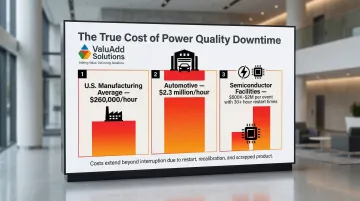
- U.S. manufacturers lose an average of $260,000 per hour of downtime
- In automotive, downtime costs have surged to $2.3 million per hour
- Semiconductor facilities can lose $500,000 to $2 million per event, with restart times exceeding 30 hours
What makes these figures worse: the downtime clock doesn't stop when power returns. Restart procedures, re-calibration, and scrapped product extend the true cost well beyond the interruption itself.
Premature Equipment Failure and Repair Costs
Sustained exposure to harmonics, transients, and voltage imbalance causes cumulative damage across your electrical system:
- Degrades winding insulation in motors
- Accelerates capacitor wear and failure
- Overheats transformers beyond rated capacity
- Stresses power supplies in PLCs and drives
Transformers exposed to 20% THD can see their expected life cut from 30-35 years to just 15-20 years due to increased heating. Plant engineers often recognize this pattern: repeatedly replacing the same components, or receiving equipment back from repair with "no fault found."
Reduced Efficiency and Energy Waste
Poor power factor and harmonic distortion waste energy. A low power factor means the electrical system carries more current than necessary to deliver the same real power, increasing conductor losses and utility demand charges.
The efficiency losses add up quickly:
- Harmonics cause 3-10% energy losses in industrial facilities through increased heat in wiring and transformers
- Motor efficiency can drop 5-10% from harmonic distortion alone
- Utility demand charges rise when reactive current inflates apparent power draw
Process Quality and Safety Risks
In precision-dependent processes (CNC machining, automated assembly, food processing), even minor voltage fluctuations affect process consistency, leading to out-of-spec products, scrap, or rework.
Harmonics and waveform distortion also generate excessive heat in cables and components — a genuine fire risk, especially in older facilities where wiring may not be rated for the additional thermal load.
Where Do Power Quality Problems Come From?
Power quality problems originate from two directions: external (the utility grid) and internal (equipment within the facility itself). Many plants only look outward, missing that their own production equipment is generating disturbances.
External Sources
Utility-side causes include:
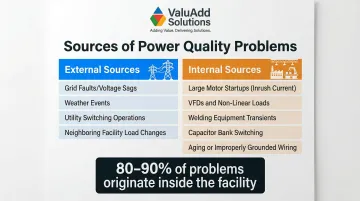
- Voltage sags from grid faults
- Weather events (lightning, ice storms)
- Utility switching operations
- Load changes from neighboring facilities on the same distribution feeder
These events are largely outside a plant's control but can be mitigated.
Internal Sources
80-90% of power quality problems originate within the facility itself.
Large motor startups are one of the most significant internal sources of voltage sags. An induction motor typically draws 600% (6x) of its full-load current during across-the-line starting, creating a massive voltage drop that affects other equipment.
Other internal culprits:
- VFDs and other non-linear loads generating harmonics
- Welding equipment creating transients
- Capacitor bank switching
- Aging or improperly grounded wiring
That means the fix often starts on your own plant floor — not with a call to the utility.
Warning Signs Your Plant May Have a Power Quality Problem
Treat these symptoms as red flags for power quality issues:
- Unexplained PLC faults or system resets
- Motor drives tripping without clear electrical overload
- Components (especially drives, relays, power supplies) failing repeatedly or returned from repair with "no problem found"
- Nuisance tripping of circuit breakers
- Overheating of panels, transformers, or motors
If any of these patterns sound familiar, the challenge is that they rarely point back to power quality on their own.
Why Power Quality Events Are Easy to Miss
Power quality events are often sub-cycle or extremely brief — measured in milliseconds. They may not cause visible effects like light flicker, and they don't always leave diagnostic information in equipment fault logs.
Install a power quality monitor (PQM) at key points in your facility — at the service entrance and near critical equipment — to capture event data, timestamps, and waveform information that can be correlated with production disruptions.
How to Mitigate Power Quality Problems in Manufacturing
The right approach involves two stages: first identify and characterize problems through monitoring, then apply targeted mitigation at the appropriate level (facility-wide vs. equipment-level). What works for a facility running multiple VFDs may be unnecessary for a plant with mostly resistive loads.
Monitoring and Measurement
Power quality monitors and analyzers capture voltage sags, swells, transients, harmonic distortion (THD), power factor, and frequency deviations over time.
IEC 61000-4-30 Class A monitors provide:
- Voltage measurement uncertainty of ±0.1%
- Contiguous, non-overlapping 10-cycle (50Hz) or 12-cycle (60Hz) intervals
- Precise time synchronization to correlate events across different meters
Monitoring at the service entrance identifies utility-side issues, while monitoring closer to specific equipment pinpoints internal sources.
Equipment-Level Protection
Targeted solutions for specific problems:
- UPS systems: Bridge brief interruptions and sags on critical control equipment
- Surge protection devices (SPDs/TVSS): Transient suppression at panels and sensitive equipment
- Harmonic filters (passive or active): For facilities with high VFD or non-linear load density
- Voltage regulators or sag correctors: Protect entire production lines from sag events
Among these equipment-level solutions, motor startup inrush deserves particular attention—it's one of the most common internal sources of voltage sags on the plant floor.
Controlling Motor Startup Inrush with Soft Starters
Addressing inrush current during large motor startups is one of the most impactful mitigation steps available to manufacturing facilities. When motors start across-the-line, the sudden current draw creates voltage sags that affect other equipment on the same bus.
Soft starters reduce inrush current from a typical 600% to approximately 150-450% of full-load amps, dramatically lessening the voltage drop at the Point of Common Coupling.
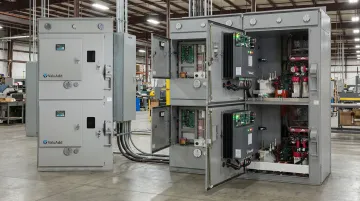
ValuAdd's soft starter solutions provide smooth, stepless acceleration for industrial motor applications. This reduces peak current demand on the electrical system and lowers mechanical stress on connected equipment during each startup cycle.
IEEE 519 Compliance and System Design
For facilities with significant non-linear load density (multiple VFDs, rectifiers, etc.), achieving compliance with IEEE 519 harmonic limits requires a system-level approach:
- Selecting IEEE 519 compliant drives and components
- Adding line reactors or harmonic filters
- Ensuring proper distribution design
Active front-end (AFE) drives can achieve Total Harmonic Distortion of Current (THDi) as low as 3%, compared to ~40% for standard 6-pulse drives, often eliminating the need for external filters.
ValuAdd carries IEEE 519 compliant drives, line reactors, and harmonic filter components—giving facilities a direct path to compliance without redesigning their entire distribution system.
Frequently Asked Questions
What does power quality mean?
Power quality refers to how closely the electrical power supply matches the ideal standard of stable voltage, correct frequency, and a clean sinusoidal waveform. Deviations from this ideal cause equipment malfunction, downtime, and damage.
What does a PQM do?
A Power Quality Monitor (PQM) continuously measures and records electrical parameters such as voltage sags, swells, transients, harmonics, and power factor. This data helps facilities identify when and where power quality events occur and correlate them with production disruptions.
What are power quality products?
Power quality products fall into three categories:
- Monitoring equipment: power quality analyzers and PQMs
- Protection devices: UPS systems, surge protectors, and sag correctors
- Mitigation equipment: harmonic filters, soft starters, and power factor correction capacitors
What is IEC 61000-4-30 power quality measurement?
IEC 61000-4-30 is the international standard that defines how power quality parameters must be measured and classified. It establishes the measurement methods and accuracy requirements that compliant power quality instruments must meet, including how events are detected and recorded.
What are the most common signs of power quality problems in a manufacturing facility?
Key warning signs include unexplained PLC resets or drive faults, repeatedly failing components, overheating panels or transformers, and nuisance circuit breaker trips—all of which can occur without any visible cause at the equipment level.
How do motor startups affect power quality?
Large motors draw significantly higher current during startup—typically 600% of full-load current—known as inrush current. This creates a momentary voltage sag that can affect other equipment on the same electrical bus. Soft starters or VFDs can dramatically reduce this effect.