](https://file-host.link/website/gush-ja3yyx/assets/blog-images/b52cb91b-9663-4766-ba1b-41d8c5de000e/1771945972360870_f0b8324d48e746c09e2425eb45aa0565/360.webp)
Introduction
Choosing the wrong manufacturer's rep for industrial electrical components carries serious operational consequences. A misstep in product specification, compliance verification, or technical support can trigger unplanned downtime costing $10,000 to $500,000 per hour in manufacturing plants, water treatment facilities, or oil and gas operations. Safety failures in these environments add regulatory penalties and liability on top of the production losses.
Not all manufacturer's reps deliver equal value. Some carry broad line cards with shallow technical knowledge, taking orders without adding guidance. The better ones bring application-specific expertise that helps buyers specify and source the right component the first time, cutting specification errors and compliance gaps before they become equipment failures.
This guide helps industrial buyers understand what a manufacturer's rep actually does, which evaluation criteria matter most, and how to make a confident selection decision before committing to a long-term relationship.
Key Takeaways
- A manufacturer's rep is an independent agency representing complementary product lines in a defined territory, bridging manufacturer expertise and industrial buyer needs
- The right rep affects specification accuracy, regulatory compliance, post-sale support quality, and equipment uptime
- Evaluate reps on technical depth, portfolio fit, territory coverage, compliance knowledge, and long-term stability
- Avoid reps who cannot discuss application engineering or who carry conflicting product lines
- The best reps function as long-term technical partners — invested in your application outcomes, not just the sale
What Is a Manufacturer's Rep for Industrial Electrical Components?
A manufacturer's representative is an independent agency—not a direct employee of any single manufacturer—that sells on commission, representing multiple manufacturers' product lines within a defined geographic territory. This model differs fundamentally from distributors, who purchase inventory, take title to goods, and earn margin on resale.
Core Function in Industrial Electrical
In the industrial electrical space, a rep's role extends far beyond order-taking. They match products to application requirements—motor control, power distribution, automation, machine protection—and help engineers and procurement teams navigate technical specifications. Reps serve as the field-level connection between manufacturer engineering teams and end-users, translating technical requirements into specific product recommendations.
Typical products a rep might represent include:
- Soft starters and reduced voltage starters
- Variable frequency drives (VFDs) with harmonic control
- Industrial control components and automation systems
- High-brightness industrial displays with environmental protection
- Switchgear and protection relays
- Power distribution and circuit protection devices
Deep familiarity with these product categories matters because specification errors in industrial electrical components lead directly to equipment failures, safety incidents, and costly downtime.
Why Industrial Buyers Use Manufacturer's Reps
Working with a qualified rep offers distinct advantages over direct manufacturer sourcing. Key advantages include:
- Aggregates complementary product lines under one point of contact — no juggling multiple factory sales teams on multi-system projects
- Provides localized market knowledge and customer relationships that manufacturer inside sales teams can't replicate at the territory level
- Delivers application-specific guidance that generic catalog support doesn't offer
Those advantages only materialize when the rep relationship is well-matched from the start. The Manufacturers' Agents National Association (MANA) reports that only 40% of rep-principal relationships qualify as an "ideal match," with 60% classified as marginal or dysfunctional — which makes the upfront evaluation process essential for industrial buyers who depend on consistent sourcing and technical guidance.
What to Look for When Choosing a Manufacturer's Rep for Industrial Electrical Components
Selecting a rep for industrial electrical components requires evaluating both sales capability and technical depth. The factors below help industrial buyers move beyond reputation and gut-feel to make a structured, defensible decision that connects directly to operational outcomes: reduced specification errors, fewer compliance issues, faster lead times, and lower risk of unplanned downtime.
Technical Expertise and Application Engineering Capability
Application engineering depth is the most critical differentiator for industrial electrical components. A qualified rep must understand load characteristics, environmental conditions, and system architecture before recommending a product—not simply quote from a catalog.
Key application-level questions a qualified rep should answer:
- What motor protection scheme is appropriate for this specific load type (pump, compressor, conveyor)?
- Which drive topology meets IEEE 519-2022 harmonic limits at the Point of Common Coupling for this harmonic-sensitive site?
- What enclosure rating (NEMA Type 4X, 12, or IP65/66/68) is required for this wet or corrosive environment?
- How do we size soft starter current ratings for high-inertia loads with extended acceleration times?
- What communication protocols and integration requirements exist for this control system architecture?
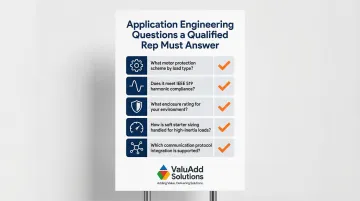
A rep who cannot articulate these technical considerations or who defers all engineering questions to the manufacturer is a liability in high-uptime industrial environments.
Product Portfolio Fit and Line Card Synergy
The rep's line card (the collection of manufacturers they represent) should include products that are complementary and non-competing. A rep whose lines conflict or overlap creates divided loyalty and potential misrepresentation of the best product for your application.
Evaluate whether the rep carries a coherent set of products across the full control and automation stack:
- Circuit protection and power distribution (breakers, disconnects, distribution blocks)
- Motor control (soft starters, reduced voltage starters, VFDs)
- Automation systems (PLCs, motion controllers, I/O modules)
- Human-machine interface (HMI displays, operator panels)
- Protection components (relays, monitoring devices)
A rep with coherent line coverage can handle multi-system projects without requiring buyers to manage separate agencies for each product category. Conversely, a rep with too many lines may lack deep commitment to any single manufacturer, while too few lines limit their ability to solve complex application needs.
Territory Coverage and Local Market Presence
Territory-based coverage matters in industrial electrical procurement because on-site visits for application review, commissioning support, and troubleshooting are often necessary. A rep with shallow territory presence or excessive geographic coverage may not provide timely field support when equipment failures threaten production.
Evaluate the rep's "feet on the street":
- How many outside sales engineers cover your facility's region?
- What inside technical sales staff support quoting and application questions?
- Does the rep have established relationships with regional distributors who can fulfill orders quickly?
- Are they familiar with key engineering firms and OEMs in your industrial sector?
Local market presence translates to faster response times, better understanding of regional compliance requirements, and relationships that facilitate rapid parts sourcing during emergencies.
Compliance and Certification Knowledge
Industrial electrical components for demanding environments must meet specific regulatory and performance standards. A qualified rep must navigate and verify these requirements rather than leaving compliance verification entirely to the buyer.
Critical certifications and standards the rep should understand:
- UL Listing for safety certification (particularly UL 508A for Industrial Control Panels)
- NEMA enclosure ratings (Type 4X for corrosion resistance, Type 12 for indoor dust protection)
- IP protection ratings (IP65, IP66, IP68 for varying degrees of water and dust ingress protection)
- IEEE 519 compliance for harmonic distortion control at the Point of Common Coupling
- CE marking for European market conformity
- Class E2 load break ratings for medium voltage motor control applications
Ask reps directly which certifications their represented product lines carry and whether they can provide documentation. Reps who are unfamiliar with certification requirements or who cannot supply spec sheets with compliance data present reliability risks in regulated industries like water treatment, oil and gas, and municipal infrastructure.
Post-Sale Technical Support and Responsiveness
In high-uptime industrial environments, post-sale support is as important as pre-sale specification guidance. The rep should have a clear process for handling field issues, warranty claims, replacement parts sourcing, and rapid response to equipment failures that risk production downtime.
Evaluate the rep's support infrastructure:
- What is their average RFQ response time?
- Do they offer after-hours support for critical equipment failures?
- What is their escalation path to manufacturer engineering teams when field issues arise?
- Can they facilitate fast shipping through their distributor network for critical replacement components?
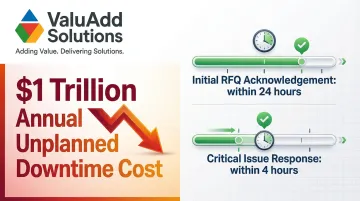
Industry benchmarks indicate expectations for initial RFQ acknowledgement within 24 hours and critical issue response within 4 hours. Given that ARC Advisory Group estimates unplanned downtime costs process industries approximately $1 trillion annually, a rep who cannot respond within those windows is a direct operational liability.
Agency Organization, Stability, and References
An agency's organizational depth determines whether the relationship will hold up over time, especially as contacts change or the business scales.
Evaluate organizational indicators:
- Inside sales staff and technical support team size
- CRM systems and business process maturity
- Business continuity planning and succession plan
- Financial stability and years in business
Request references from both current principals (manufacturers the rep represents) and existing industrial customers. Ask specifically how long those relationships have been in place: tenure is a strong proxy for rep reliability and ethical conduct. MANA research shows that succession planning gaps are a major disruption risk. Manufacturers cite lack of continuity plans as a "huge risk" that forces them to find alternative coverage unexpectedly.
How ValuAdd Can Help
ValuAdd is a territory-based manufacturer's representative focused on industrial control, automation, and electrical components for demanding applications. Served industries include industrial manufacturing, oil and gas, water treatment, and system integration.
Represented products carry the certifications demanding applications require:
- Products represented carry UL Listing, CE and FCC certification
- NEMA Type 4X and 12 compliance for environmental protection
- IP68, IP66, and IP65 ratings for harsh environments
- IEEE 519 compliance for harmonic-sensitive installations
- Class E2 load break ratings for medium voltage applications
- Halogen Free certification for safety-critical environments
Where ValuAdd stands out from generalist reps:
- Covers soft starters, VFDs (including H-Bridge multi-level technology), programmable control systems, and high-brightness industrial displays
- Provides custom engineering support for complex, application-specific requirements
- Ships quickly through established distributor relationships — no waiting on allocation
- Offers both outside and inside technical sales support within its territory
- Maintains deep manufacturer partnerships for consistent supply and direct technical access
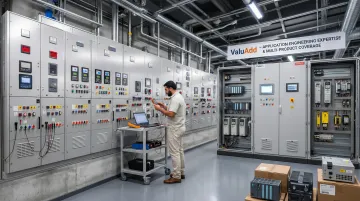
If the criteria in this guide matter to your project — technical depth, certified products, and a rep who stays engaged past the sale — ValuAdd is worth a conversation.
Conclusion
Choosing a manufacturer's rep for industrial electrical components is a decision with direct operational consequences. The right rep reduces specification errors, ensures compliance, and provides the application support that keeps industrial systems running reliably. The wrong rep introduces risk through inadequate technical knowledge, poor territory coverage, or inability to support post-sale issues.
The goal is finding a rep whose technical expertise, line card, territory presence, and support infrastructure align with your specific industrial environment. That requires structured evaluation across several areas:
- Line card synergy with your application requirements
- Verified compliance knowledge (UL, NEMA, IEEE standards)
- Reference checks with facilities in comparable industries
- Organizational stability and post-sale support capacity
Rep selection also demands periodic review. As product technology evolves and compliance requirements shift, the rep that served your facility well two years ago may no longer meet its current needs. The strongest rep relationships are built through consistent technical performance over time — and re-evaluating that performance is part of managing industrial operations responsibly.
Frequently Asked Questions
What is the difference between a manufacturer's rep and a distributor for industrial electrical components?
A manufacturer's rep does not take title to or stock inventory but earns commission by matching buyers to the right products and providing technical support. A distributor purchases and resells inventory, earning margin on the transaction. Reps often work alongside distributors, providing technical specification while distributors handle fulfillment.
How do manufacturer's reps get paid, and does their commission structure affect what they recommend?
Reps earn commission from the manufacturer upon completed sales, typically 5%–15% for industrial products. A rep with a well-organized, non-competing line card is incentivized to recommend the best product for the application. Buyers should flag any rep who consistently steers toward higher-margin lines regardless of fit.
How many product lines should a manufacturer's rep carry?
The right number varies by agency size and territory, but lines should be complementary and non-competing. Too few lines may limit the rep's ability to solve multi-system needs, while too many can indicate shallow commitment to each manufacturer. Focus on line card synergy rather than absolute count.
What certifications should I verify when evaluating a rep's product portfolio for industrial applications?
Buyers in industrial environments should verify UL listing, NEMA enclosure ratings (Type 4X, 12), IP protection ratings (IP65/66/68), IEEE 519 harmonic compliance, and CE marking as applicable to their environment and jurisdiction. A qualified rep should provide documentation upfront, without requiring repeated requests.
What questions should I ask a manufacturer's rep before committing to work with them?
Ask these questions before committing:
- What industries and applications do you specialize in?
- What certifications do your represented product lines carry?
- What is your RFQ response time?
- Can you provide references from industrial customers in my sector?
- What is your escalation process for field failures?
- How long have you maintained your current manufacturer relationships?
How long does it typically take to evaluate and onboard a manufacturer's rep for industrial electrical components?
A proper evaluation covering phone screening, line card review, reference checks, and an in-person meeting typically takes several weeks and should not be rushed. The cost of a poor selection — lost time, wrong specifications, compliance gaps — far exceeds the cost of a thorough upfront process.