Introduction
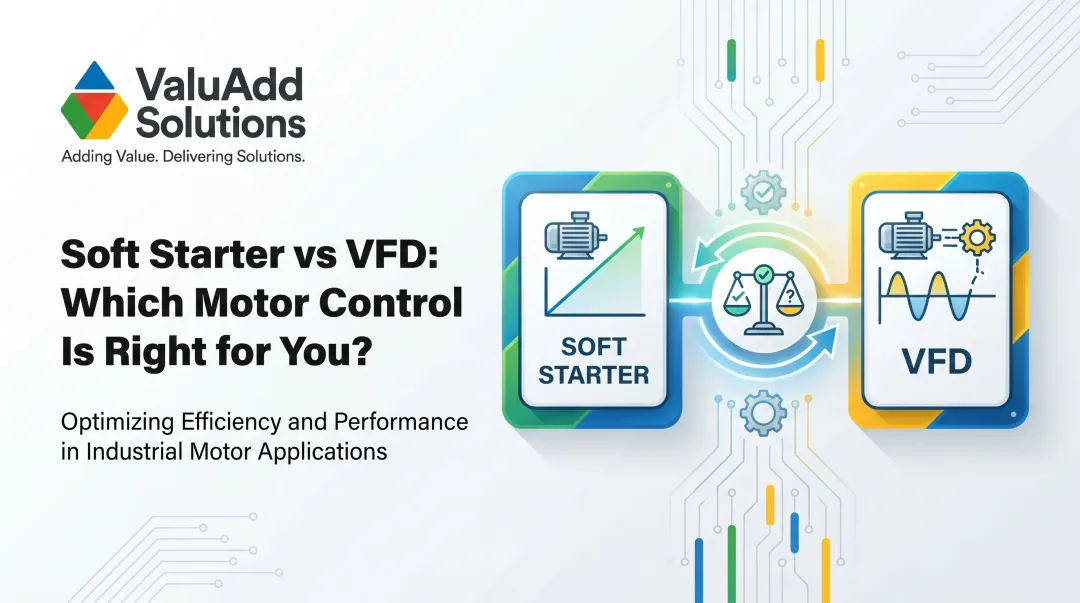
Plant engineers and system integrators face a critical decision when specifying motor control solutions: both Variable Frequency Drives (VFDs) and soft starters reduce inrush current and mechanical stress during motor startup, yet they serve fundamentally different operational roles. Choosing the wrong technology leads to premature equipment failure and energy costs that compound silently over years of operation.
Upgrading from Direct-On-Line (DOL) starting is rarely the debate. The harder question is which technology fits your specific application. A VFD on a constant-speed conveyor wastes money on complexity you'll never use. A soft starter on a variable-flow pump leaves thousands of dollars in energy savings on the table every year.
What follows breaks down how each device works, compares them across cost, efficiency, footprint, and speed control, and gives you a clear framework for making the right call.
Key Takeaways
- A VFD controls motor speed continuously throughout start, run, and stop by varying output frequency and voltage
- A soft starter only manages startup and shutdown by ramping voltage — at full speed, the motor runs directly on line power
- Soft starters cost less upfront and take up less panel space; VFDs run 2-3x higher in initial cost but recover that through energy savings on variable-torque loads
- Use a VFD when the application requires continuous speed control, full torque at zero speed, or energy savings across the full operating cycle
- Choose a soft starter when your motor runs at fixed full speed and you only need controlled start and stop
VFD vs Soft Starter: Quick Comparison
Understanding the core differences between these technologies helps narrow your selection before diving into application-specific requirements.
Primary Function
Soft starters manage voltage ramp-up and ramp-down only during the transition phases. They use back-to-back Silicon Controlled Rectifiers (SCRs) to gradually increase voltage from zero to full line voltage, then engage a bypass contactor for normal operation. Once bypassed, the motor runs directly on utility power with no active control.
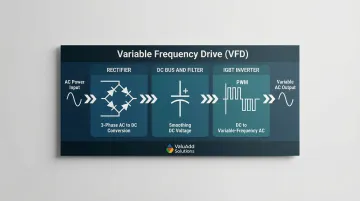
VFDs adjust both frequency and voltage continuously across the entire operating cycle. They convert incoming AC power to DC, filter it, then invert it back to variable-frequency AC using Pulse Width Modulation (PWM). This gives you full speed control from near zero to above base frequency.
Cost
The price gap is significant:
| Motor Rating | Soft Starter Price Range | VFD Price Range | Cost Multiplier |
|---|---|---|---|
| 10 HP | $800 – $1,200 | $2,300 – $3,500 | ~2.8x |
| 50 HP | $2,500 – $3,000 | $6,500 – $8,000 | ~2.6x |
| 100 HP | $4,000 – $5,000 | $12,000 – $15,000 | ~3.0x |
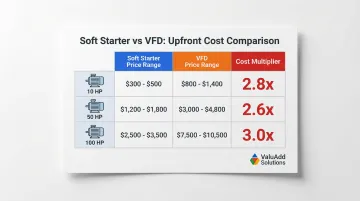
VFDs cost two to three times more upfront than comparably rated soft starters. However, for variable-torque applications like pumps and fans, VFDs can deliver 30–50% energy savings, often achieving payback in under two years.
Energy Efficiency
Soft starters with integrated bypass achieve greater than 99.5% efficiency at full speed because the SCRs are completely removed from the circuit once the bypass contactor closes. The motor runs on direct line power with only negligible contact resistance losses.
VFDs operate at approximately 97% efficiency during steady-state operation due to continuous switching losses in the IGBT inverter and conduction losses in the rectifier stage. Despite this 3% loss, VFDs reduce overall energy consumption dramatically on variable-torque loads by matching motor speed to actual demand.
For constant-speed applications, soft starters win on efficiency. For variable-torque loads, the system-level energy savings from a VFD far outweigh its slightly lower component efficiency.
Physical Size and Installation
Soft starters are compact, require minimal auxiliary equipment, and simplify installation. Standard motor cables, basic control wiring, and standard enclosures are all you need. Standard installations need no special cable or EMC provisions.
VFDs are larger and often require:
- Line reactors to reduce harmonic distortion
- EMC filters to meet electromagnetic compatibility standards
- Shielded cables for long motor runs (typically >50 feet)
- Additional cooling and ventilation in the control panel
Speed Control
Speed control is where the two technologies diverge most sharply. Soft starters offer little to no control during the run phase — some advanced models allow brief slow-speed operation (1–15% of rated speed) at start or stop, but sustained low-speed running risks overheating the SCRs.
VFDs provide continuous, adjustable speed from near zero to 120% of base frequency (or higher with field weakening), with real-time adjustments based on process feedback, setpoints, or automated control logic.
What is a VFD?
A Variable Frequency Drive (VFD)—also called an inverter, AC drive, or adjustable speed drive—is a motor control device that converts incoming AC power to DC, filters it, then inverts it back to AC at an adjustable frequency. This frequency adjustment directly controls motor speed using the formula:
N = 120 × F / P
Where:
- N = Speed in RPM
- F = Frequency in Hz
- P = Number of motor poles
By varying frequency from 0 Hz to 60 Hz (or beyond), a VFD controls motor speed from zero to full speed and above.
How VFD Technology Works
The core technology consists of three stages:
- Rectifier: Converts incoming three-phase AC power to DC using a diode bridge
- DC Bus and Filter: Smooths the rectified DC voltage using capacitors to create a stable DC supply
- IGBT Inverter: Uses Insulated Gate Bipolar Transistors (IGBTs) with Pulse Width Modulation (PWM) to simulate a sinusoidal AC output at the desired frequency and voltage
ValuAdd's VFDs use H-Bridge multi-level technology, which reduces harmonic distortion and improves output waveform quality compared to standard two-level drives. This topology creates multiple voltage steps that more closely approximate a pure sine wave, producing less than 8% voltage THD and 5% current TDD. These figures meet IEEE 519-2022 compliance standards for harmonic limits at the point of common coupling.
Key Operational Advantages
VFDs deliver several capabilities that soft starters cannot:
- Delivers full torque at zero speed — essential for incline conveyors, hoists, and precision positioning
- Programmable ramp times prevent mechanical shock during acceleration and deceleration
- Supports dynamic braking via regenerative or resistive methods for controlled deceleration
- Can hold rotor position for servo-like applications requiring placement accuracy
Common VFD Types and Configurations
Low-voltage vs. medium-voltage drives:
- Low-voltage drives (208V–480V) serve general industrial applications up to several hundred horsepower
- Medium-voltage drives (2.3kV–15kV) handle large motors from 300 HP to 12,000 HP in utility and heavy industrial applications
Volts-per-Hz vs. vector control:
- Volts-per-Hz (V/Hz) control is the most common, suitable for general-purpose applications
- Vector control provides superior performance for demanding low-speed/high-torque applications requiring precise torque control
Single-phase vs. three-phase input:
- Three-phase input is standard for industrial applications
- Single-phase input options exist for smaller drives (typically under 5 HP)
Use Cases of a VFD
VFDs are best suited for applications requiring variable speed during the run cycle.
Centrifugal pumps and fans represent the highest-value VFD applications. These follow the Affinity Laws (Cube Law), where power consumption varies with the cube of speed. Reducing fan speed by 50% cuts power consumption to roughly 12.5% (one-eighth) of full-speed power. Even a 20% speed reduction cuts power consumption by nearly 50%.
Industry data confirms these theoretical savings. Retrofitting VFDs on centrifugal pumps typically yields 20–40% energy savings, with some marine applications demonstrating energy reductions as high as 60%.
Industries and processes where VFDs dominate:
- HVAC systems with variable air volume requirements
- Variable-speed conveyors matching production line speeds
- Mixers and grinders requiring different speeds for different materials
- Oil and gas production pumps managing variable flow rates
- Water treatment plants with demand-based flow control
What is a Soft Starter?
A soft starter (also called Reduced Voltage Soft Starter or RVSS) is a solid-state device that uses back-to-back Silicon Controlled Rectifiers (SCRs or thyristors) to gradually ramp supply voltage to the motor during startup. This reduces inrush current and limits starting torque. Once the motor reaches full speed, a bypass contactor engages and the SCRs stop firing, putting the motor directly on line voltage.
Operational Efficiency Advantage
With the bypass contactor active during the run phase, the soft starter draws virtually no energy and generates minimal heat. This makes soft starters with integrated bypass highly efficient at full-speed steady-state operation—exceeding 99.5% efficiency.
Soft starters also generate fewer harmonics than VFDs during running. The transient harmonic distortion during the 5–30 second ramp-up phase is significant, but once bypassed, harmonic contribution becomes negligible, simplifying electromagnetic compatibility (EMC) compliance.
Key Limitations vs. VFDs
Soft starters cannot control speed during the run phase. Full torque is available only at full voltage. Some advanced models support slow-speed capability at 1–15% of rated speed for short durations, but extended slow-speed operation risks overheating the SCRs due to thermal limits.
This makes soft starters unsuitable for applications requiring continuous variable speed or prolonged operation at reduced speeds.
Use Cases of a Soft Starter
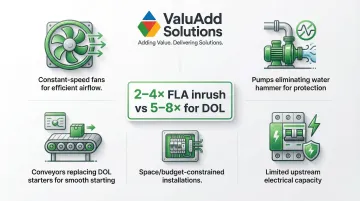
Where those limitations don't apply — motors that run at full speed continuously after startup — soft starters excel. Common applications include:
- Constant-speed fans in drying or ventilation systems, where controlled starting eliminates mechanical shock and bearing wear without needing variable speed
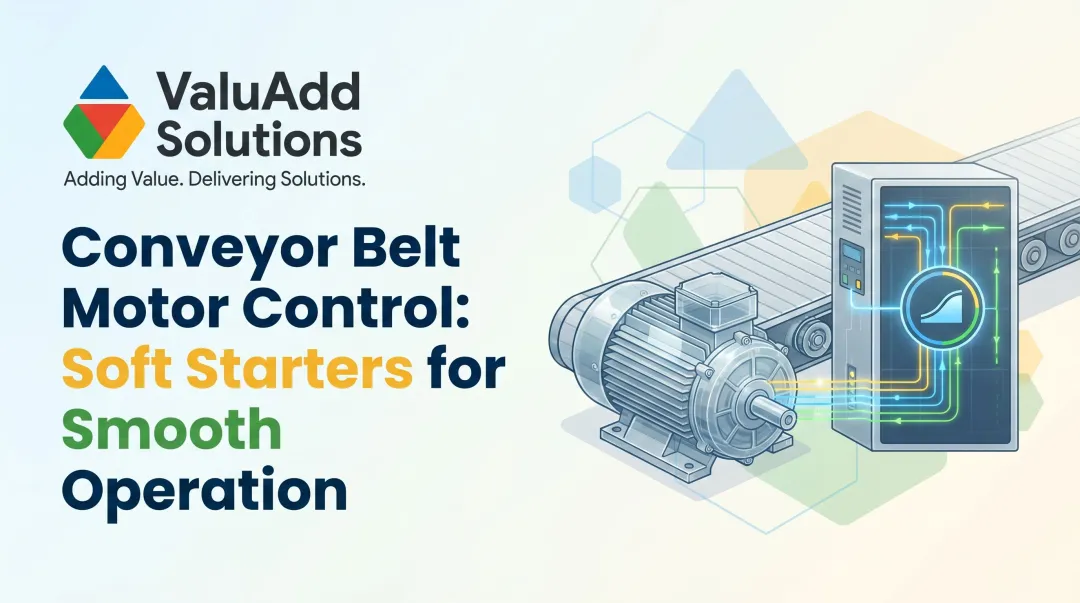
- Conveyors transitioning away from DOL starters, preventing material spillage; soft starters reduce gearbox shock vibration by 40% compared to across-the-line starting
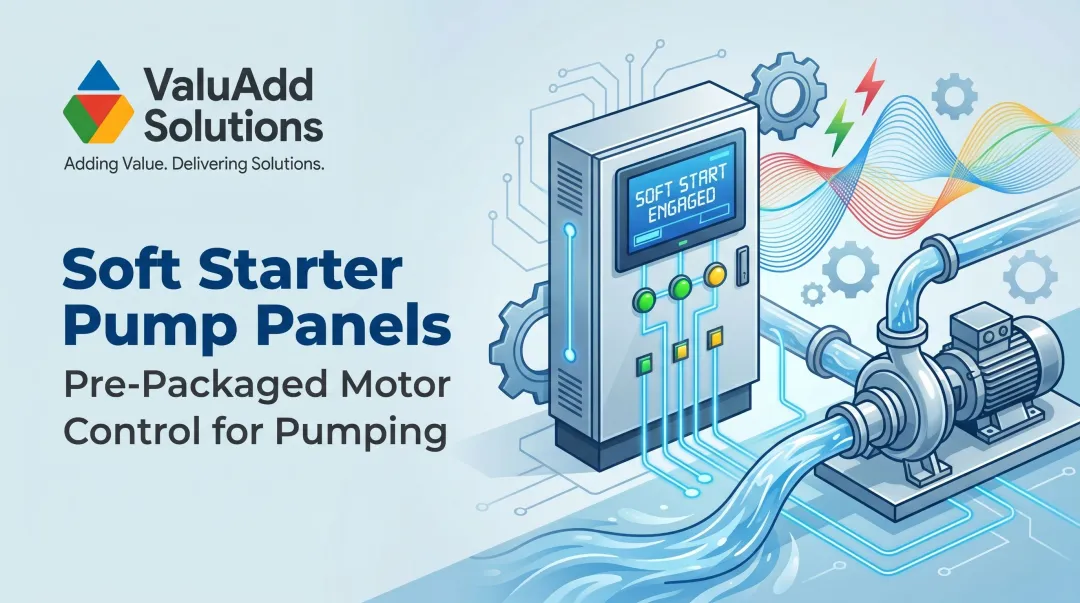
- Pumps where gradual voltage ramping eliminates water hammer — the destructive pressure shock that occurs when pumps start at full voltage
- Budget- and space-constrained installations requiring less auxiliary wiring, no special cable types for long runs, and fewer supplemental components than VFDs
- Applications where upstream electrical capacity is limited: soft starters limit inrush current to 2–4× Full Load Amps versus 5–8× for DOL starting, allowing smaller upstream circuit protection
For high-voltage applications in these categories, ValuAdd's MVE-P Series medium voltage soft starters cover mains voltages from 2.3kV to 15kV with current ratings from 110A to 1200A nominal — providing controlled starting without the added complexity of a full VFD installation.
VFD vs Soft Starter: Which is Right for Your Application?
The right choice comes down to three factors: what the load demands during the run phase, how much mechanical stress matters at startup, and what the total cost picture looks like over the equipment's life.
Decision Framework: Key Questions to Ask
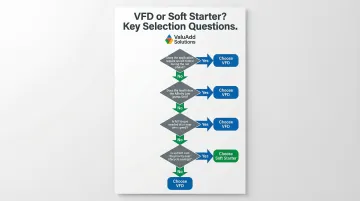
Before selecting, answer these questions:
- Does the application require speed adjustment during the run phase? If yes, you need a VFD.
- Does the load follow the Affinity Law? Centrifugal pumps, fans, and blowers yield massive energy savings at partial speed—favoring VFDs.
- Is full torque needed at or near zero speed? Applications like loaded incline conveyors or hoists require VFDs.
- Is upfront budget constrained or is total cost of ownership the priority? Soft starters win on initial cost; VFDs often win on lifecycle cost for variable-torque loads.
Choose a VFD When:
- Continuous speed control is required during the run cycle to match process demand
- Variable-torque loads (fans, centrifugal pumps) are involved — energy savings over time justify the higher upfront cost (one municipal wastewater plant cut energy use 30% and saved $150,000 annually with an 1.8-year payback)
- Precise start/stop timing is required for synchronized processes or positioning control
- High-torque starting conditions exist that a soft starter cannot reliably manage, such as positive displacement pumps or loaded incline conveyors
Choose a Soft Starter When:
- The motor runs at a single fixed speed and control is only needed at startup and shutdown
- Panel space is limited and installation complexity must be minimized
- The primary goal is reducing mechanical stress and inrush current without the complexity of a VFD
- Total cost of ownership favors lower upfront investment — a constant-speed pump with fixed flow requirements gains no ROI from a VFD's added cost
Real-World Application Examples
Manufacturing facility conveyor: A plant replaced a DOL starter on a constant-speed conveyor with a soft starter to eliminate load surges at startup. Controlled acceleration reduced gear wear and bearing failures, cutting maintenance costs — without the overhead of a VFD the application never needed.
Oil and gas centrifugal pump: An oil production site installed a VFD on a centrifugal pump to match flow to variable demand. Trimming pump speed during low-demand periods delivered 35% energy reduction, recovering the VFD investment in under two years.
Not sure which solution fits your process? ValuAdd's engineering team can help you evaluate your application and select the right motor control technology. Reach out to discuss your requirements.
Conclusion
VFDs and soft starters are complementary tools, not interchangeable substitutes. The right choice depends on whether speed control during the run cycle matters, what the torque profile of the load looks like, and how upfront cost compares to long-term energy savings in your specific application.
For variable-torque loads like pumps and fans, VFDs deliver energy savings that dwarf their higher initial cost. For constant-speed applications where the primary concern is limiting inrush current and mechanical stress, soft starters provide a simpler, more efficient, and more economical solution.
Map your application requirements against the decision framework in this guide. The strongest indicators for each technology:
- Reduced mechanical stress and extended motor life in manufacturing drives the case for soft starters
- Energy savings in pump and fan applications for water treatment and oil and gas favor VFDs
- Constrained panel space tips the balance toward soft starters where speed control isn't needed
Match the technology to the load — that single decision determines whether you recover your investment in months or spend years compensating for the wrong choice.
Frequently Asked Questions
What is the difference between a VFD and a soft starter?
A soft starter controls only the motor's startup and shutdown by ramping voltage using SCRs, then bypasses to put the motor directly on line power. A VFD adjusts both frequency and voltage continuously throughout the entire operating cycle—giving full speed control from start to stop.
Can you use a VFD as a soft starter?
Yes, a VFD can be programmed to ramp voltage and frequency gradually during startup. However, using a VFD solely for this purpose is rarely cost-effective. If you don't need continuous speed control during the run phase, a dedicated soft starter is the more economical choice.
Which is more expensive, a VFD or a soft starter?
VFDs typically cost two to three times more upfront than comparable soft starters, and require additional components like line reactors and EMC filters. On variable-torque applications, energy savings over the equipment's life cycle can offset that higher initial cost.
When should I use a soft starter instead of a VFD?
Use a soft starter when the motor runs at a fixed full speed during operation and you only need to control startup inrush current and torque, or when budget and panel space are constrained and continuous speed adjustment provides no process benefit.
Do soft starters save energy?
Soft starters reduce inrush current during startup, but once the bypass contactor engages at full speed, they provide no energy savings during the run phase. On variable-torque applications, only a VFD can cut energy consumption while the motor is running.
Can a soft starter control motor speed?
Soft starters have very limited speed control capability. Some models can operate at slow speeds (typically 1–15% of rated speed) for brief periods during start or stop, but they cannot provide continuous variable speed control, and extended slow-speed operation risks overheating the SCRs.