

What happens when a remote pump station suddenly reports “overheat alarm”, and that warning needs to reach a control room 20 km away in milliseconds so a valve can shut off the flow? It’s not magic. It’s the communication protocol underneath the automation system doing the heavy lifting.
In modern industrial automation, from OEM machines to municipal water systems, communication protocols enable sensors, actuators, PLCs, and SCADA systems to speak a common “language.” Among these, Modbus remains one of the most widely adopted standards.
To give a sense of scale: the global market for Modbus communication modules is valued at over USD 2.0 billion in 2024.
In this blog, we’ll explore how Modbus fits into larger industrial automation architectures, connecting field-level devices (PLCs, sensors, actuators) with HMIs/SCADA systems, and forming part of complex networking infrastructures.
We’ll also examine why, even with newer protocols available, Modbus continues to hold a central place on the plant floor.
Key Highlights
• Modbus is a simple, open, vendor-neutral protocol that enables PLCs, HMIs, drives, sensors, and SCADA systems to communicate reliably across industrial networks.
• Its client/server (master/slave) model and lightweight request–response structure make troubleshooting easy and ensure predictable, stable communication.
• Supports RTU, ASCII, and TCP, giving flexibility across legacy serial wiring to modern Ethernet networks used in SCADA, utilities, OEM machines, and municipal systems.
• Remains dominant because of low cost, broad compatibility, easy integration, and seamless coexistence of legacy + modern devices, despite faster protocols existing.
• ValuAdd enhances Modbus-based systems by offering Modbus-ready hardware, network design support, register mapping guidance, and integration help for OEMs, panel builders.
What Is Modbus?
Modbus is a widely used industrial communication protocol that enables automation equipment to exchange data reliably and efficiently. Originally developed in 1979 by Modicon (now Schneider Electric), it was created to standardize how programmable logic controllers (PLCs) communicate with other devices on the plant floor.
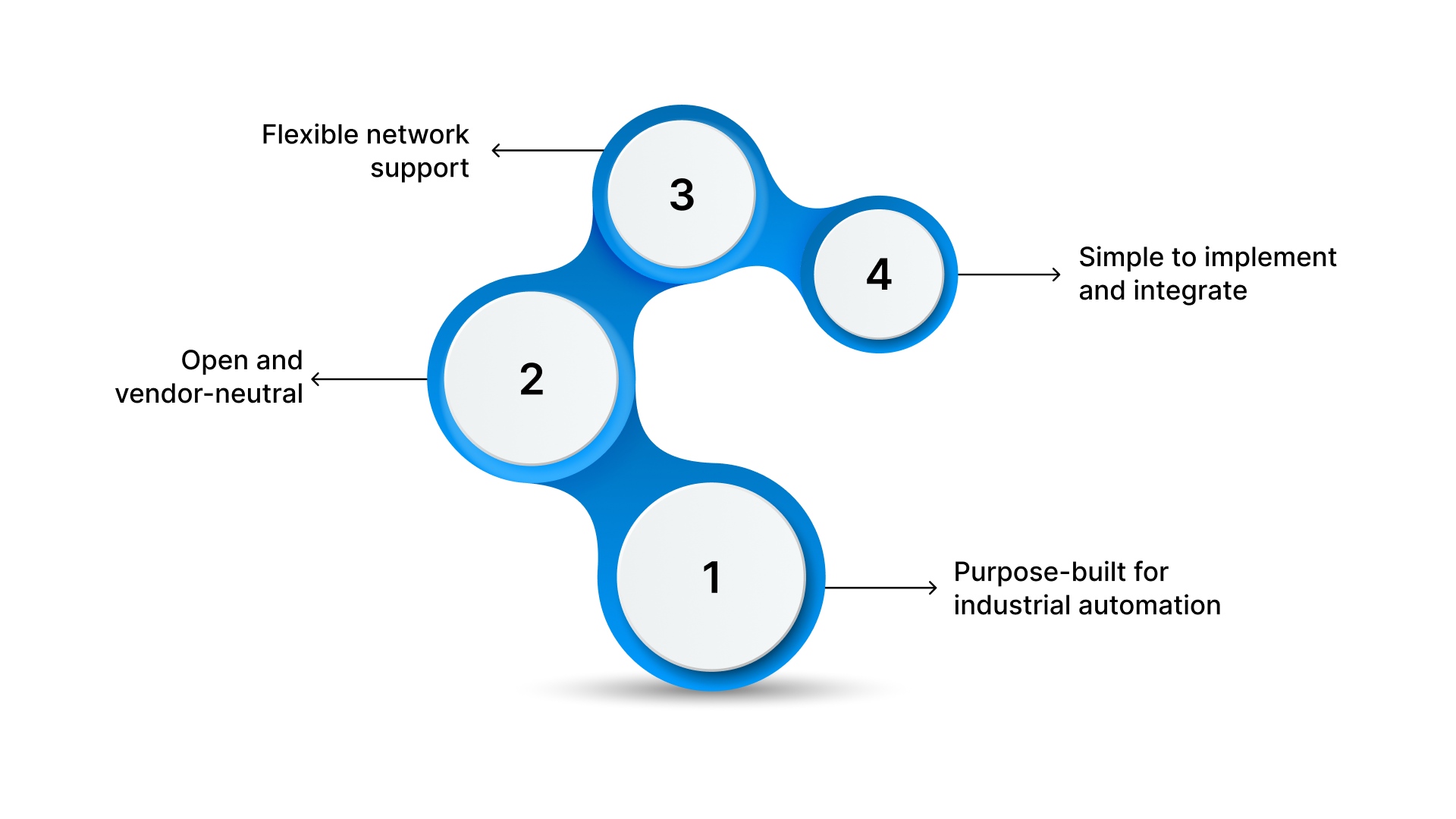
Purpose-built for industrial automation — enables communication between PLCs, HMIs, VFDs, energy meters, sensors, and remote I/O
Open and vendor-neutral — royalty-free and supported by virtually every major automation manufacturer
Flexible network support — available in serial formats (Modbus RTU/ASCII) and Ethernet-based (Modbus TCP)
Simple to implement and integrate — lightweight message structure and minimal hardware requirements
Because of its openness, simplicity, and broad compatibility, Modbus has become one of the most widely adopted industrial communication standards across OEM equipment, manufacturing plants, building automation systems, and municipal utilities.
Modbus Architecture & How It Works
Modbus operates on a straightforward and highly reliable communication structure designed for deterministic industrial control. At its core, Modbus uses a master/slave (or in modern terminology, client/server) model to exchange data between automation devices.
Master / Slave (Client / Server) Model
One device acts as the master (client), typically a PLC, RTU, or SCADA system.
Other devices act as slaves (servers), such as drives, meters, sensors, or remote I/O modules.
The master initiates all communication, sending read/write requests to specific slave devices.
Slaves do not communicate with each other directly and only respond when queried.
This deterministic polling model makes Modbus predictable and easy to troubleshoot, ideal for industrial environments where timing and clarity matter.
Request–Response Message Structure
Modbus uses a simple request/response pattern:
Master sends a request specifying function type, device address, and register location.
Slave processes the request, reads or writes data internally.
Slave replies with a response containing the requested data or confirmation of an action.
If a device cannot process a request, it returns an exception response, helping quickly diagnose errors such as invalid addresses or unsupported functions.
Registers & Addressing Basics
Data in Modbus systems is organized into register groups representing different types of I/O values:
Register Type | Address Range | Read/Write? | Typical Use |
|---|---|---|---|
Coils (0xxxx) | Digital Outputs | Read/Write | Start/stop commands, relays |
Discrete Inputs (1xxxx) | Digital Inputs | Read Only | Switches, alarms, status bits |
Input Registers (3xxxx) | Analog Inputs | Read Only | Sensor values (pressure, temp, flow) |
Holding Registers (4xxxx) | Analog Outputs / Parameters | Read/Write | Setpoints, scaling factors, configuration |
These registers allow Modbus to represent everything from on/off states to 32-bit analog values like energy readings or process variables.
3 Modbus Communication Types

Modbus supports multiple communication formats that allow it to be deployed across a wide range of industrial environments, from legacy serial wiring to modern Ethernet networks. Each version offers different performance characteristics and installation considerations.
1. Modbus RTU (Serial)
Modbus RTU is the most widely used form of Modbus communication in industrial systems.
It transmits compact binary data frames over serial links, making it ideal for real-time field-level control.
Runs over RS-485, RS-422, or RS-232 wiring
Supports multi-drop configurations with up to 32 devices per segment (expandable with repeaters)
Low-cost implementation, minimal hardware requirements
Highly noise-resistant and reliable in electrically harsh industrial environments
Commonly used in water & wastewater, factory floors, energy metering, and OEM machines
2. Modbus ASCII
Modbus ASCII is a variant that uses human-readable hexadecimal characters instead of binary data.
It is typically used for troubleshooting or older systems where readability is more important than speed.
Easier to interpret manually during testing or diagnostics
Slower transmission speeds compared to RTU
Less common in modern deployments
More overhead due to character-based encoding
3. Modbus TCP
Modbus TCP brings Modbus communication into the Ethernet world.
It packages Modbus messages inside TCP/IP, enabling fast and scalable network connectivity.
Runs over standard Ethernet, supports switching, routing, VLANs, and IT/OT integration.
Much faster data rates and lower latency compared to serial Modbus.
Supports hundreds of devices on large network architectures.
Ideal for SCADA, large municipal systems, IIoT gateways, building automation, and distributed control.
Integrates easily with cloud and modern industrial networking technologies.
Modbus over UDP & Other Variations
Modbus can also run over UDP as an alternative to TCP, offering lower overhead and faster transmission in applications where reliability checks are handled externally.
Useful for broadcast applications and high-speed sensor networks.
Supported by some industrial devices and gateways, though less standardized.
Other implementations include Modbus over radio, cellular, and fiber for long-distance communication.
Modbus vs. Other Industrial Protocols
Industrial automation offers many communication standards, each designed for different performance, scalability, and application needs. Modbus remains popular not because it is the most advanced, but because its simplicity, cost-effectiveness, and broad compatibility make it practical for countless real-world systems.
Below is a high-level comparison of Modbus with other widely used industrial protocols:
Protocol | Network Type | Typical Speed / Performance | Primary Use Cases | Strengths | Limitations |
|---|---|---|---|---|---|
Modbus RTU / TCP | Serial / Ethernet | Low–Medium | SCADA, utilities, OEM equipment, sensors/meters | Simple, low cost, interoperable, widely supported | Limited real-time performance, small data packets |
EtherNet/IP | Ethernet | High | Factory automation, motion control | Real-time CIP communications, scalable | More expensive, complex configuration |
PROFINET | Ethernet | High / real-time | Manufacturing, robotics, synchronous control | Deterministic I/O, advanced diagnostics | Higher engineering effort and licensing |
Profibus | Serial Fieldbus | Medium | Legacy industrial systems | Reliable fieldbus, proven long-term operation | Declining adoption, slower than Ethernet |
CAN / CANopen | Serial | Medium | Mobile machines, automotive, compact controls | Robust, fast message priority handling | Shorter distances, limited scalability |
BACnet | Ethernet / Serial | Medium | Building automation (HVAC, access, lighting) | Standard in HVAC/BMS industry | Not optimized for heavy industrial control |
When Modbus Is the Better Choice
Although higher-performance protocols like EtherNet/IP and PROFINET dominate advanced motion and high-speed manufacturing, Modbus remains the preferred option in many deployments, especially where simplicity, cost, and compatibility are more important than speed.
Modbus is often the best fit when:
Cost sensitivity matters — RTU/TCP hardware and setup are very inexpensive.
Multi-vendor interoperability is needed — nearly every industrial device supports Modbus.
Low-bandwidth data is sufficient — such as setpoints, alarms, flow/pressure readings.
Legacy and modern devices must coexist — Modbus RTU and Modbus TCP integrate easily through gateways.
Ease of troubleshooting and maintenance is important, readable registers, and a simple message structure.
Advantages of Modbus
Modbus offers several key benefits that have kept it relevant for more than four decades in industrial automation. Its strength lies in simplicity, flexibility, and broad industry adoption.
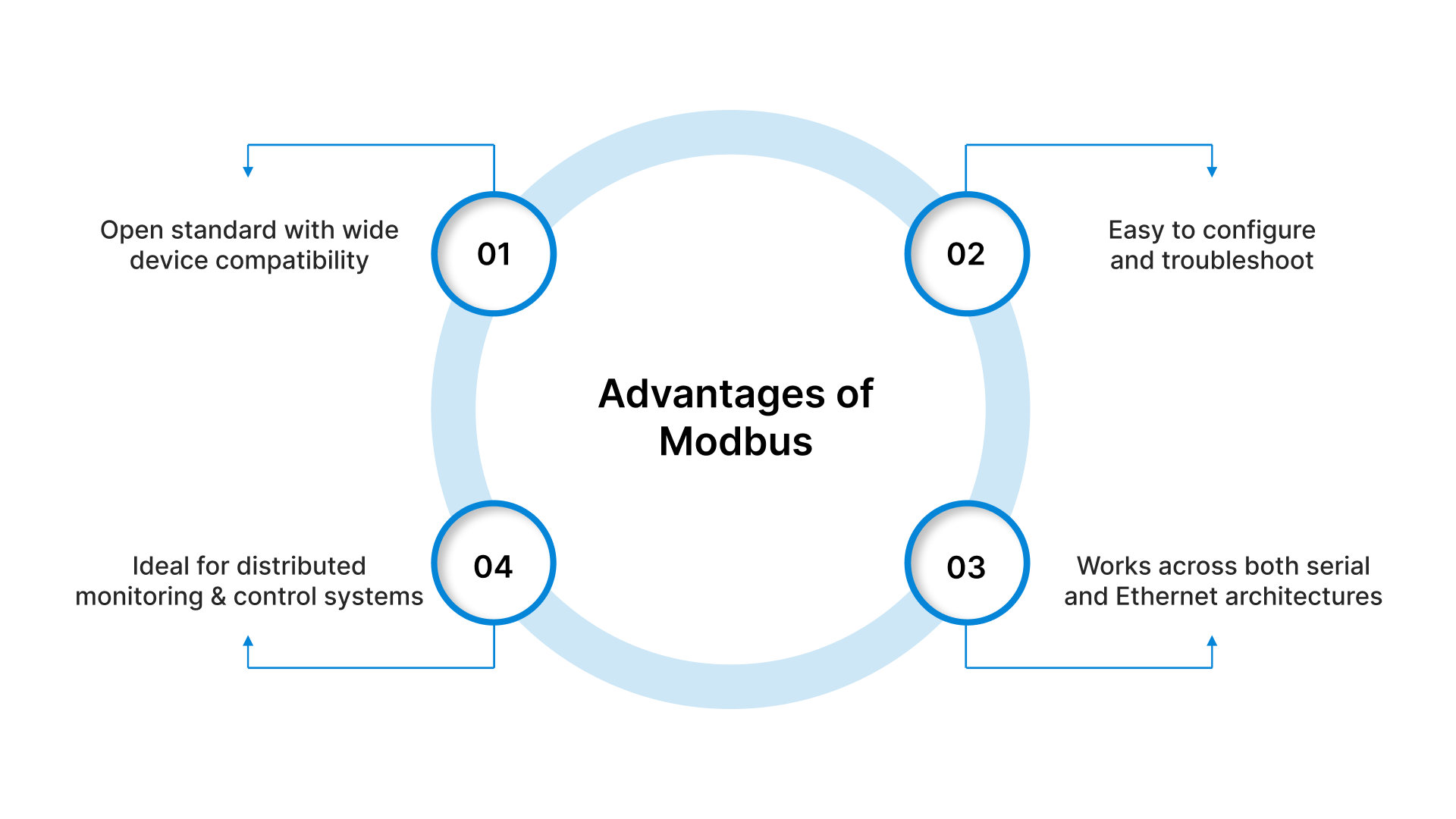
Open standard with wide device compatibility — Supported by virtually all major automation vendors, allowing seamless integration across mixed hardware environments without licensing fees.
Easy to configure and troubleshoot — Straightforward addressing and simple request–response messaging make diagnostics and commissioning faster and less complex compared to many real-time fieldbus systems.
Works across both serial and Ethernet architectures — Available in Modbus RTU, ASCII, and TCP, enabling legacy equipment and modern network infrastructure to communicate easily within hybrid systems.
Ideal for distributed monitoring and control systems — Efficient for transmitting sensor values, setpoints, alarms, and status information across SCADA, utilities, OEM equipment, energy management systems, and building automation networks.
Together, these advantages make Modbus a dependable choice for industrial connectivity where reliability, interoperability, and cost control are critical.
Limitations & Considerations
While Modbus is widely used and extremely versatile, it is not without constraints, especially in high-speed or large-scale industrial networks. Understanding these limitations helps ensure systems are designed appropriately and perform reliably.
1. Polling structure can limit performance
Modbus relies on a master-initiated polling cycle, meaning only the master requests data and devices respond in sequence.
As the number of nodes increases, scan times grow, which can lead to latency in large networks or time-critical processes.
2. Security considerations
Traditional Modbus (RTU/TCP) does not include encryption, authentication, or message integrity checking.
Traffic can be intercepted or modified if networks are not isolated, requiring secure network design practices (e.g., firewalls, VPNs, segmentation).
3. Possible bottlenecks with high-speed motion or large data sets
Limited packet size and slower serial speeds make Modbus less suitable for real-time motion control, robotics, or rapid data acquisition.
Ethernet versions improve throughput but still lack deterministic timing compared to industrial Ethernet protocols designed for real-time control.
4. Device addressing and network wiring best practices
Serial Modbus nodes require unique addresses and proper termination, grounding, and shielding to avoid communication errors.
Long cable distances, incorrect baud rates, or poor wiring practices can lead to timeouts and unstable communication.
Real-World Applications
Modbus remains a foundational protocol across many industrial and municipal environments due to its reliability, low cost, and universal device support. It is widely used anywhere equipment needs to exchange control data, status information, and real-time measurements.
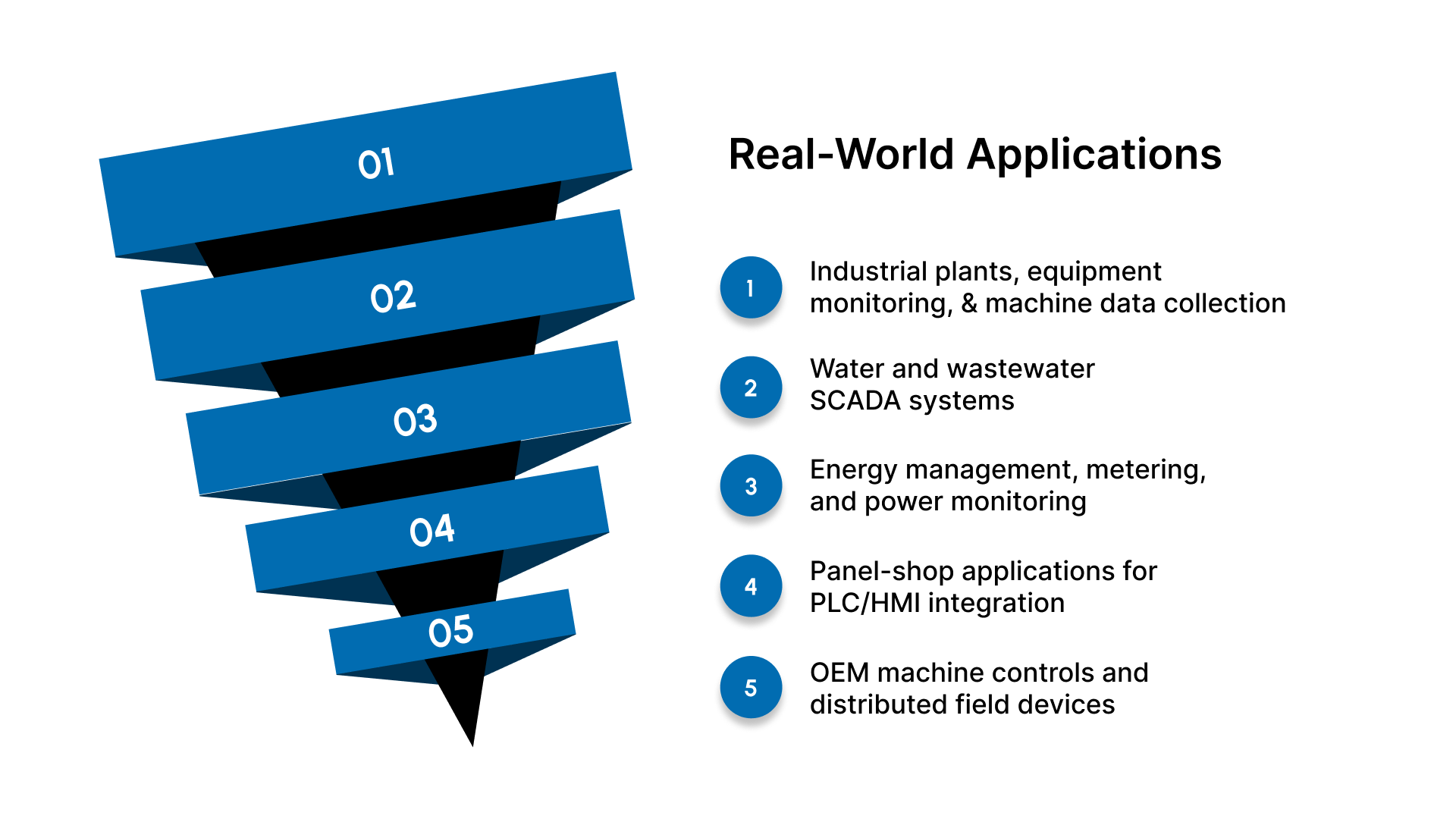
Industrial plants, equipment monitoring, and machine data collection
Used to connect PLCs, drives, sensors, and analyzers for production status, predictive maintenance, and power quality data across manufacturing lines and process facilities.Water and wastewater SCADA systems
Enables communication between RTUs, lift stations, chemical dosing systems, flow meters, generators, and remote pump sites over long-distance serial or Ethernet links.Energy management, metering, and power monitoring
Common in electrical switchgear, power meters, protective relays, and distributed solar or generator systems for demand management, fault detection, and load optimization.Panel-shop applications for PLC/HMI integration
Frequently used to link PLCs, HMIs, and I/O modules in control panels where quick commissioning and multi-vendor compatibility are essential.OEM machine controls and distributed field devices
Ideal for skid systems, packaging equipment, compressors, chillers, HVAC controls, and smart instruments where simple and reliable communication is needed without complex networking.
These use cases demonstrate why Modbus continues to be a dependable backbone protocol across both legacy and modern automation systems.
How ValuAdd Strengthens Modbus-Based System Integration
Modbus works best when diverse devices need reliable communication, and ValuAdd makes that possible with a coordinated portfolio of Modbus RTU/TCP-ready products and practical application support.
As a technical solutions partner, ValuAdd helps OEMs, panel builders, facilities, municipalities, and distributors across North Carolina, South Carolina, and Virginia design systems where Modbus becomes a seamless integration backbone, not a configuration hurdle.
Providing a complementary product ecosystem where automation hardware, power quality equipment, UPS systems, relays, and protection devices can share data through a common communication standard.
Supporting engineering and application decisions, helping customers map Modbus registers, address structure, network design, device selection, and commissioning strategies.
Reducing integration friction and BOM complexity by offering product lines that are proven to work together in SCADA networks and control panels.
Improving visibility and diagnostics through Modbus-enabled power meters, UPS systems, monitoring relays, and automation hardware, and centralizing system performance data.
Supporting modernization and expansion projects by bridging legacy serial Modbus RTU systems with new Modbus TCP/Ethernet devices.
Enabling standardization for OEMs and panel shops, reducing engineering hours, field troubleshooting, and long-term maintenance effort.
Conclusion
Modbus has remained a cornerstone of industrial communication for more than four decades for a simple reason: it works. Its interoperability, simplicity, affordability, and widespread device support continue to make it the protocol of choice for OEM equipment, SCADA systems, municipal infrastructure, and industrial automation networks around the world.
By enabling seamless data exchange across mixed hardware environments, Modbus delivers the real-time visibility needed to support smarter operations, proactive maintenance, and confident decision-making on the plant floor and in the field.
Whether you’re upgrading legacy networks, designing new control panels, implementing SCADA connectivity, or standardizing OEM machine communication, leveraging Modbus effectively can significantly simplify your architecture and improve performance. Contact us to explore how Modbus-enabled solutions can enhance your automation strategy and system design.
Frequently Asked Questions (FAQ)
1. What types of data can be exchanged over Modbus?
Modbus supports digital and analog values such as status bits, setpoints, alarms, and process measurements. Data is organized into registers such as coils, discrete inputs, holding registers, and input registers.
2. What is the difference between Modbus RTU and Modbus TCP?
Modbus RTU runs over serial networks like RS-485, while Modbus TCP operates over Ethernet. RTU is ideal for cost-sensitive field networks, while TCP offers faster speeds and scalability for modern architectures.
3. Is Modbus still relevant with modern industrial Ethernet protocols available?
Yes, Modbus remains widely used because it’s simple, affordable, and supported by nearly every automation device. It integrates legacy equipment with new systems, making it valuable for modernization projects.
4. How many devices can be connected on a Modbus RTU network?
A standard RS-485 bus supports up to 32 devices per segment, expandable using repeaters. This makes it ideal for distributed field installations and remote I/O networks.
5. Is Modbus secure?
Traditional Modbus has no built-in encryption or authentication, so it should be deployed on protected networks. Security is typically achieved with segmentation, VPNs, and firewalls.