Introduction
In manufacturing plants, oil and gas facilities, and processing environments, a wrongly specified cable tie can trigger bundle failures that halt production lines, violate electrical safety codes during audits, or create hazardous conditions near energized systems. The consequences are serious — and preventable.
Yet cable ties are routinely treated as commodity purchases, ordered by price per bag rather than evaluated as engineered fasteners with specific mechanical, environmental, and compliance ratings.
This guide provides a technical framework for cable tie selection across demanding industrial and commercial applications. We'll cover material properties that determine service life, sizing methodology based on bundle dimensions and load requirements, and the certification requirements that govern use in specific environments.
Key Takeaways
- Type selection comes down to three factors: load, environment, and any applicable regulatory requirements
- UV-stabilized nylon extends outdoor service life from 1-2 years to 7-10 years; 316 stainless steel is the right call for marine and chemical exposure
- Size by bundle circumference plus 10-15%, then choose tensile strength at 2x expected load — 3x for high-vibration machinery
- UL listing, plenum ratings, and metal-detectable variants are required in regulated installations, not optional upgrades
- Standardizing ties by application zone cuts SKU count and simplifies MRO procurement
What Are Cable Ties and Why Does the Right Choice Matter?
Cable ties—also called zip ties or wire ties—are one-directional mechanical fasteners consisting of a toothed flexible strap and a ratcheting locking head. They bundle, secure, route, and support cables, wires, hoses, and components across industrial installations, control panels, and infrastructure systems.
The IEC 62275 standard distinguishes between securing (maintaining position) and supporting (bearing weight). This distinction carries regulatory weight: the 2026 National Electrical Code requires that cable ties used for support must be listed specifically for that purpose, meeting UL 62275 Type 2S or 21S standards.
Incorrect cable tie selection directly affects:
- Cable routing integrity – Undersized ties fail under load; oversized ties leave sharp protruding tails that snag or injure
- Bend radius compliance – Overtightened ties crush insulation on sensitive cables (fiber optic, data, instrumentation)
- Enclosure airflow – Improper bundling blocks ventilation in control panels, causing thermal failures
- Code compliance – Non-listed ties in load-bearing applications violate NEC 300.13(E), creating audit and insurance liability
Types of Cable Ties
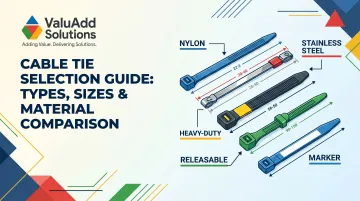
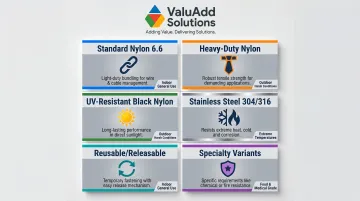
Six categories cover the range of industrial applications:
- Nylon 6.6 (standard) handles general-purpose indoor bundling in control cabinets and panel shops
- Heavy-duty nylon meets load-bearing requirements above 175 lb tensile strength
- UV-resistant black nylon is rated for outdoor exposure — rooftop equipment, solar arrays, and any sunlight-exposed routing
- Stainless steel (304 or 316 grade) handles extreme environments: marine, corrosive chemical exposure, and temperatures from -80°C to 538°C
- Reusable/releasable ties suit temporary installations and maintenance-heavy systems where bundles are adjusted regularly
- Specialty variants address niche compliance needs — metal-detectable for food and pharma, plenum-rated for air-handling spaces, halogen-free for enclosed environments
Benefits of Cable Ties in Industrial Settings
Correctly specified ties deliver measurable operational value:
- Reduced cable damage – Consistent routing eliminates strain points and abrasion from cable movement
- Improved thermal management – Organized bundles maintain airflow separation in enclosures, preventing hotspot formation
- Installation efficiency – Standardized tie specifications reduce installer decision time and eliminate field errors
- Audit readiness – Code-compliant ties with proper certifications simplify safety inspections and insurance reviews
- Maintenance visibility – Proper bundling allows technicians to quickly trace circuits and identify components
Cable Tie Material Comparison: Nylon, Stainless Steel, and Specialty Options
Material selection determines every critical performance parameter: tensile strength, flexibility, UV resistance, chemical compatibility, temperature range, and regulatory compliance. Research shows that material degradation is the leading cause of premature cable tie failure, so getting this right from the start prevents costly field replacements.
Nylon 6.6 (Natural and UV Black)
Nylon 6.6 (polyamide 66) is the most widely specified material for general-purpose cable ties. It delivers reliable tensile performance and installation flexibility across a temperature range of -40°C to 85°C, covering the majority of indoor industrial environments.
However, material color determines outdoor performance dramatically:
- Natural (clear/white) Nylon 6.6 – Indoor use only; UV exposure causes degradation within 1-2 years
- UV-stabilized black Nylon 6.6 – Carbon black additive extends outdoor life expectancy to 7-10 years under continuous sunlight exposure
ValuAdd offers Nylon 6.6 cable ties that maintain 100% tensile strength after 1000 hours of xenon arc testing, equivalent to 10 years of solar irradiation, making them reliable for photovoltaic installations and outdoor routing.
Stainless Steel (304 and 316 Grades)
When environmental conditions exceed polymer capabilities, stainless steel provides extreme durability:
| Grade | Temperature Range | Salt Spray Resistance | Chemical Resistance | Best Applications |
|---|---|---|---|---|
| 304 Stainless | -80°C to 538°C | Good | Better | General industrial, high-heat zones |
| 316 Stainless | -80°C to 538°C | Best | Best | Marine, coastal, chemical processing, chloride exposure |
316 stainless steel's enhanced molybdenum content provides superior resistance to pitting and crevice corrosion, making it the preferred grade for oil and gas platforms, wastewater treatment, and any chloride-rich environment. The higher upfront cost pays back through service life that often exceeds 20 years in harsh conditions, compared to 2-3 years for standard materials.
ValuAdd stocks both 304 and 316 grade stainless steel cable ties with tensile strengths up to 1080N, suitable for offshore systems, petrochemical plants, and naval installations requiring DNV marine approvals.
Specialty Materials: Polypropylene, Halogen-Free, and Metal Detectable
Where stainless steel handles temperature and corrosion extremes, specialty polymer ties solve a different set of problems: chemical exposure, fire safety, and contamination control. Three categories cover these needs:
- Polypropylene (PP): Superior chemical resistance to acids, solvents, oils, and basic salts; continuous use temperature to 115°C; ideal for chemical processing environments where Nylon 6.6 would degrade
- Halogen-free: Critical for enclosed or poorly ventilated spaces where toxic fume generation during fire presents life safety risks; meets rail transit standards (UNI EN 45545-2:2020) and enclosed facility requirements. ValuAdd's halogen-free cable ties carry certification for railway, marine, and critical infrastructure applications.
- Metal detectable: Iron oxide-impregnated polymers visible to in-line metal detectors and X-ray systems; required for HACCP compliance in food, beverage, and pharmaceutical processing to prevent physical contamination hazards
Material Comparison Summary:
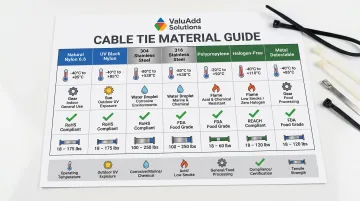
| Material | Temperature Range | Best Environment | Compliance Features | Typical Tensile Range |
|---|---|---|---|---|
| Natural Nylon 6.6 | -40°C to 85°C | Indoor only | UL Listed | 80N to 1080N (18-243 lb) |
| UV Black Nylon 6.6 | -40°C to 85°C | Outdoor, sunlight exposure | UL Listed, UV-resistant | 80N to 1080N (18-243 lb) |
| 304 Stainless Steel | -80°C to 538°C | High-heat, general industrial | Fire-resistant | 890N to 2000N (200-450 lb) |
| 316 Stainless Steel | -80°C to 538°C | Marine, chemical, corrosive | Fire-resistant, salt-resistant | 890N to 2000N (200-450 lb) |
| Polypropylene | Up to 115°C | Chemical exposure | Solvent/acid resistant | Varies by size |
| Halogen-Free | -40°C to 85°C | Enclosed, transit, rail | Low toxic fume emission | 80N to 540N (18-121 lb) |
| Metal Detectable | -40°C to 85°C | Food/pharma processing | HACCP compliant, detectable | 80N to 540N (18-121 lb) |
How to Select the Right Cable Tie: Size, Tensile Strength, and Environmental Fit
Selecting the right cable tie means getting three variables right: physical dimensions, tensile strength, and environmental compatibility. A mistake in any one of them creates premature failure — often in the field, under load.
Sizing: Length and Bundle Diameter
Cable tie length must accommodate the maximum bundle diameter with sufficient closure allowance:
- Measure the maximum diameter of the cable bundle at its widest point
- Calculate circumference: π × diameter
- Add 10-15% minimum to ensure the locking head fully engages
- Select the next standard tie length above this calculated value
Example: A bundle with 50mm diameter requires:
- Circumference = 3.14 × 50mm = 157mm
- Plus 15% = 157mm × 1.15 = 180mm minimum tie length
- Specify a 200mm tie to ensure proper engagement
Undersized ties fail to lock properly or strip under tension. Oversized ties waste material and create protruding tails that snag clothing, scratch equipment, or cause personnel injuries.
Width selection affects clamping pressure distribution:
- Narrow ties (2.5-4.5mm) – Concentrate pressure; avoid on sensitive cables (fiber, instrumentation)
- Standard ties (4.6-7.5mm) – General-purpose bundling with balanced pressure
- Wide ties (7.6-12.5mm) – Distribute clamping force over larger surface area; required for data cables and bundles with soft insulation
ValuAdd's cable tie portfolio spans widths from 2.5mm to 12.5mm and lengths from 98mm to 1000mm — from miniature control panel wiring up to heavy industrial cable tray runs.
Tensile Strength: Matching Load Requirements
Tensile strength is the maximum pull force a tie withstands before failure under controlled test conditions. Published ratings don't reflect long-term static load-bearing capability, because environmental factors degrade in-service strength well below laboratory values.
Common Tensile Strength Tiers:
| Classification | Tensile Range | Typical Applications |
|---|---|---|
| Miniature | 80-100N (18-22 lb) | Light electronics, control panel wiring, identification tagging |
| Standard | 220-250N (50-56 lb) | General cable bundling, indoor routing, conduit support |
| Intermediate | 440-535N (99-120 lb) | Heavy bundles, outdoor installations, vibration-prone equipment |
| Heavy-Duty | 780-1080N (175-243 lb) | Industrial machinery, load-bearing support, large cable trays |
| Extra Heavy (Stainless) | 890-2000N (200-450 lb) | Extreme environments, primary structural support, offshore platforms |
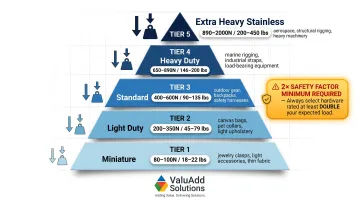
Critical Safety Factor Rule: Specify tensile strength at least 2x the expected load as a minimum safety margin. Industry guidance recommends safety coefficients between 2 and 10 depending on conditions.
Increase safety factors to 3:1 or higher for:
- High-vibration machinery — compressors, pumps, rotating equipment
- Temperature cycling environments such as outdoor installations or heated enclosures
- Safety-critical bundles (emergency systems, fire alarm circuits)
- Chemically aggressive atmospheres that degrade polymer strength over time
Environmental Compatibility
Evaluate four primary environmental stressors before specifying:
1. UV/Sunlight Exposure
- Indoor, enclosed environments → Natural Nylon 6.6 acceptable
- Any outdoor or window-adjacent routing → UV-stabilized black nylon mandatory
- Extreme solar exposure (desert, high-altitude) → Consider stainless steel
2. Temperature Extremes
- -40°C to 85°C → Nylon 6.6 (natural or UV black)
- Up to 115°C → Polypropylene
- Up to 150°C → Specialty high-temp nylon (verify with manufacturer)
- -80°C to 538°C → Stainless steel (304 or 316 grade)
ValuAdd's UV-resistant cable ties maintain full tensile strength at temperatures as low as -40°C, proven in harsh winter installations.
3. Chemical or Fluid Exposure
- General industrial environments → Standard Nylon 6.6
- Oils, solvents, inorganic acids → Polypropylene
- Saltwater, chlorides, marine atmospheres → 316 stainless steel
- Chemical processing, corrosive fumes → 316 stainless steel or specialty polymers
4. Vibration and Mechanical Stress
Standard pawl locking works for stationary installations. For dynamic environments, the mechanism choice becomes critical:
- High-vibration environments → Metal-tooth or punch-lock mechanisms prevent pawl release
- Aerodynamic forces (HVAC systems) → Stainless steel with barb locking
Over 80% of cable tie failures occur due to pawl release rather than strap breakage — making locking mechanism selection the most consequential decision for vibration-heavy machinery.
Compliance and Certification Requirements
Certain environments mandate specific certifications. Review each requirement against your installation type before specifying:
UL Listing (UL 62275) Required for electrical installations per NEC 300.13(E). Specify Type 2S or 21S for load-bearing support applications. Commercial construction and system integrator projects typically require UL recognition.
Plenum Rating (UL 2043) Mandatory for air-handling spaces under NEC 300.22 and NFPA 90A. Standard UL 94 V-0 flammability testing is not sufficient — ties must pass UL 2043 smoke and heat release testing to achieve AH-2 rating for environmental air spaces.
Halogen-Free Required in enclosed transit systems (rail, marine), tunnels, and facilities where toxic fumes during fire create life safety risks. ValuAdd's halogen-free cable ties meet UNI EN 45545-2:2020 railway fire safety standards with minimal toxic emissions.
Food/Pharmaceutical Compliance FDA 21 CFR Part 117 doesn't mandate metal-detectable ties by name, but regulations require physical hazard controls. Metal-impregnated ties function as verifiable Critical Control Points under HACCP frameworks, giving facilities a documentable defense against plastic fragment contamination and the recalls that follow.
ValuAdd's detectable cable ties comply with HACCP standards and are visible to standard in-line metal detectors and X-ray systems used in food processing facilities.
How ValuAdd Can Help
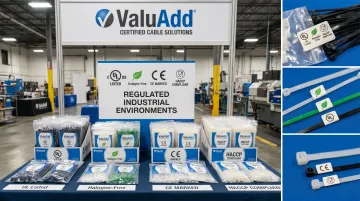
ValuAdd supplies industrial cable ties and cable management components built for demanding certification requirements. The product line covers UL Listed and Halogen Free rated ties for manufacturing facilities, processing plants, oil and gas installations, and system integrators who need compliant solutions without managing multiple suppliers.
Territory-based technical service means local representation with application engineering support to match the right tie to your conditions. That could mean UV-resistant ties for outdoor solar arrays, stainless steel for coastal wastewater treatment, or metal detectable variants for food processing lines.
Key advantages for industrial cable tie procurement:
- UL Listed, Halogen Free, CE marked, and HACCP-compliant variants in a single catalog
- Technical specialists match material, tensile rating, and certifications to your specific conditions
- Pair cable ties with mounting bases, identification systems, and electrical distribution components in one order
- Shipping options that support MRO replenishment cycles and project-critical timelines
- Engineering assistance for complex installations including control panels, cable trays, and hazardous location systems
Tensile ratings span 80N miniature ties for electronics work up to 1080N heavy-duty variants for load-bearing runs, with specialty options including self-extinguishing fire-safe ties and reusable mounting systems. Contact ValuAdd to discuss your application requirements.
Conclusion
Cable tie selection is a technical specification decision, not a commodity purchase. The right tie—properly matched to material properties, physical dimensions, tensile requirements, and environmental stressors—directly protects cable system integrity, reduces maintenance burden, and supports regulatory compliance in demanding industrial environments.
Incorrect specification creates measurable risk: premature failures trigger unplanned downtime, code violations complicate audits and insurance renewals, and failed bundling systems become direct safety hazards. Getting the specification right reduces installation time, eliminates field errors, and extends service life by years—sometimes decades—depending on material choice.
Document and standardize your specifications by application zone:
- Indoor general-purpose
- Outdoor/UV-exposed
- High-temperature
- Chemical exposure areas
- Vibration-prone machinery
- Food-safe environments
Revisit specifications periodically as facility conditions evolve, load requirements change, or regulatory codes update—the 2026 NEC support requirement updates are a recent example of code changes that directly affect product selection.
Frequently Asked Questions
What are the different types of cable ties?
Six main categories cover most applications:
- Standard nylon — indoor bundling and general-purpose use
- Heavy-duty nylon — load-bearing industrial installations
- UV-resistant black nylon — outdoor and sun-exposed runs
- Stainless steel (304/316) — extreme temperatures and corrosive environments
- Reusable/releasable — temporary or frequently adjusted bundles
- Specialty types — metal detectable (food processing), plenum-rated (HVAC spaces), halogen-free (fire safety)
What are the strongest cable ties?
Stainless steel cable ties offer the highest tensile strength (200–450 lb) and hold up best across temperature extremes and corrosive conditions. Within nylon, extra heavy-duty ties rated around 240 lb are the strongest polymer option — though final strength depends on material grade, width, and thickness.
How to size cable ties?
Measure the bundle diameter, calculate circumference (π × diameter), then add 10–15% to find the minimum tie length. Select the next standard length up to ensure proper locking head engagement. For sensitive cables like fiber optic or data lines, choose a wider tie to distribute clamping pressure more evenly.
What material cable ties are best for outdoor or harsh industrial environments?
UV-resistant black nylon handles general outdoor exposure with a service life of 7–10 years. For corrosive atmospheres, extreme temperatures, or long-term outdoor installations, use stainless steel — 304 grade for most industrial sites, 316 grade for marine, coastal, or chemical environments. Where solvents, acids, or oils are present, polypropylene offers superior chemical resistance.
Do cable ties need to meet any compliance or certification standards?
Yes. UL listing (UL 62275 Type 2S or 21S) is required for load-bearing electrical applications under the 2026 NEC, and UL 2043 plenum-rated ties are mandatory in HVAC air-handling spaces per NEC 300.22. Food and pharmaceutical facilities should use metal detectable or HACCP-compliant ties to prevent contamination.