Introduction
When a large AC motor starts without protection, the damage spreads fast. Inrush current spikes to 7–10 times running current, mechanical torque jolts the drivetrain, and voltage sags hit the broader electrical system. Startup stress is a primary driver of premature motor failure in industrial facilities.
Those failures carry a steep price. 83% of industry decision-makers estimate unplanned downtime costs at least $10,000 per hour, with 76% reporting costs up to $500,000 per hour. Motor failures driven by startup stress account for 16% of stator winding failures and 5% of rotor bar failures.
This guide covers what a soft starter is, how it works, the key benefits it delivers, real-world applications, how it compares to a VFD, and how to choose the right one for your facility.
TLDR:
- Soft starters reduce motor inrush current by up to 60% and eliminate mechanical shock during startup
- They extend equipment life by preventing electrical and mechanical stress on motors and drivetrains
- Ideal for fixed-speed applications like pumps, conveyors, and fans where smooth starting matters
- Cost 50–70% less than VFDs for constant-speed applications
- Medium voltage soft starters handle 2.3kV to 15kV for high-demand industrial environments
What Is a Soft Starter?
A soft starter is a device placed in series with an AC motor that controls the voltage—and therefore the current and torque—supplied to the motor during startup and shutdown. This allows the motor to accelerate and decelerate smoothly rather than abruptly, protecting both the motor and connected equipment from damaging stress.
Two Main Types
- Mechanical soft starters (fluid couplings, clutches) use physical mechanisms to gradually engage the motor with the load
- Electronic/solid-state soft starters use silicon-controlled rectifiers (SCRs) or thyristors to electronically control voltage
Solid-state electronic soft starters dominate modern industrial use due to their precision, reliability, and compact footprint.
Not a Speed Controller
A critical distinction: a soft starter is not a speed controller. Once the motor reaches full speed, a bypass contactor typically engages and the soft starter steps out of the circuit. The motor then runs at full voltage and full speed. This makes soft starters fundamentally different from Variable Frequency Drives (VFDs), which continuously control motor speed throughout operation.
How Does a Soft Starter Work?
The Core Problem
When an AC induction motor starts across-the-line at full voltage, the stationary armature's low resistance causes inrush current that can reach 5 to 8 times the rated current, with instantaneous peaks up to 1.8–2.8 times the RMS locked-rotor value.
That surge doesn't just stress electrical infrastructure. Starting torque can spike to over 300% of running torque, delivering sudden mechanical shock that damages shafts, couplings, and gearboxes over time.
High-efficiency motors (IE3/IE4) compound the problem — lower internal resistance means even higher inrush currents than standard motors, making soft starters especially critical for modern installations.
SCR/Thyristor Voltage Control
Solid-state soft starters use pairs of reverse-parallel-connected SCRs (thyristors) on each phase to progressively increase the RMS voltage applied to the motor windings. The standard design employs six SCRs — two per phase — in a reverse-parallel configuration.
By adjusting the firing angle of these SCRs, the starter "chops" the AC waveform to gradually increase effective voltage from a low initial value up to full line voltage over a controlled ramp time.
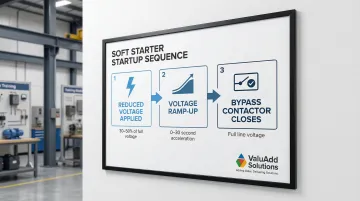
Startup Sequence Step-by-Step
- Apply reduced initial voltage to the motor — user-set as a percentage of full voltage, typically 30–50%
- Ramp voltage upward over a programmed acceleration time, adjustable from 0 to 30 seconds
- Once full speed is reached, a bypass contactor closes and routes power directly to the motor at full line voltage, removing the SCRs from the circuit to eliminate heat generation
Soft Stop Feature
Most modern soft starters can also ramp voltage down gradually on shutdown, preventing abrupt motor stops. This controlled deceleration is particularly valuable for:
- Pump systems, where sudden stops create destructive water hammer and pressure surges
- Conveyor and fan applications with high belt and coupling stress
- Piping systems prone to check valve slamming
2-Phase vs. 3-Phase Control
| 3-Phase Control | 2-Phase Control | |
|---|---|---|
| How it works | Controls all three phases | Leaves one phase uncontrolled |
| Performance | Balanced voltage reduction; smooth torque | Can create current imbalance |
| Cost | Higher | Lower |
| Risk | Minimal | Potential motor heating; reduced effectiveness |
Key Benefits of Using a Soft Starter
Reduced Inrush Current and Electrical System Stress
Soft starters typically reduce starting current to 2 to 4 times the rated current, compared to 6-8 times seen in conventional starting. Case studies have demonstrated reductions of up to 60% in inrush current for specific applications.
This delivers multiple benefits:
- Prevents voltage sags that can affect sensitive equipment (PLCs, sensors) on the same electrical network
- Reduces stress on cables, switchgear, and transformers
- Helps avoid utility demand charges triggered by current spikes during peak usage intervals
- Stabilizes the local grid in facilities with shared electrical infrastructure
Reduced Mechanical Stress and Extended Equipment Life
Smooth torque ramp-up eliminates the sudden mechanical jolt that strains motor shafts, couplings, gearboxes, and connected machinery. By smoothing the torque curve, soft starters directly reduce wear on drivetrain components and extend service intervals.
In pump and compressor applications, this translates directly to fewer bearing replacements, longer coupling life, and extended intervals between scheduled maintenance — measurable outcomes that reduce both parts costs and labor hours.
Soft Stop Protecting Downstream Systems
Controlled deceleration prevents:
- Water hammer in pipe systems, protecting pipes and valves from pressure transients
- Belt slippage in drive systems, preventing premature wear
- Shock loading on mechanical components at shutdown
This benefit is often overlooked but highly valuable in pump and conveyor applications where abrupt stops cause cascading damage.
Lower Total Cost of Ownership
By reducing the frequency and severity of mechanical and electrical stress events, soft starters extend motor and equipment lifespan, decrease unplanned downtime, and reduce maintenance costs.
The cost impact compounds over time. Longer motor life means deferred capital replacement. Fewer stress-related failures mean less emergency maintenance labor. And reduced demand charge exposure — from controlled inrush current — lowers ongoing utility costs. For facilities running motors continuously, these savings add up quickly.
Simplified Operation and Programming
Compared to VFDs, soft starters require fewer user adjustments and have a smaller footprint. For fixed-speed motor applications, they're straightforward to install, commission, and maintain. Key usability advantages include:
- Door-mounted LCD keypads for on-site parameter adjustment without a laptop
- Simplified programming interfaces that reduce commissioning time
- Smaller panel footprint compared to VFD enclosures
Common Applications of Soft Starters
Pumps and Water Systems
Pumps are among the most common soft starter applications. The gradual torque buildup prevents water hammer—pressure surges caused by sudden flow changes—protecting pipes, valves, and fittings.
Why soft stop matters: When a pump stops abruptly, the check valve slams shut and the fluid column's kinetic energy creates a destructive pressure wave. Soft starters with controlled deceleration eliminate these surges, more cost-effectively than mechanical surge reduction techniques like specialized control valves.
Key applications:
- Municipal water treatment facilities
- Industrial process water systems
- Wastewater pumping stations
- Irrigation systems
Conveyors, Fans, and Compressors
Beyond fluid-handling equipment, mechanical and rotational loads see some of the biggest gains from controlled starting.
Conveyors take the hardest hits from direct starts — high starting torque snaps chains and causes belt slippage. Soft starters provide torque-controlled starts that keep belt tension within safe operating limits, preventing product spillage and reducing chain fatigue.
Fans present a different problem: centrifugal fans carry high rotational inertia, so across-the-line starts generate belt squeal, premature wear, and air pressure surges in ductwork. Limiting torque to match the load requirement eliminates all three.
Compressors — particularly scroll and screw types — benefit from reduced inrush current and lower mechanical stress at startup, which matters most for units that cycle frequently.
Industrial Manufacturing and Processing Plants
Any application with large induction motors on shared electrical infrastructure benefits from soft starters:
- Manufacturing lines where voltage sags can disrupt sensitive equipment
- Processing plants with multiple large motors starting at different times
- Oil and gas pumping stations requiring reliable motor protection
- Mining operations with heavy-duty equipment
Soft starters maintain power quality across the facility and reduce stress on electrical distribution equipment, protecting the entire plant from startup-induced disruptions.
Soft Starter vs. VFD: Which One Do You Need?
The Fundamental Difference
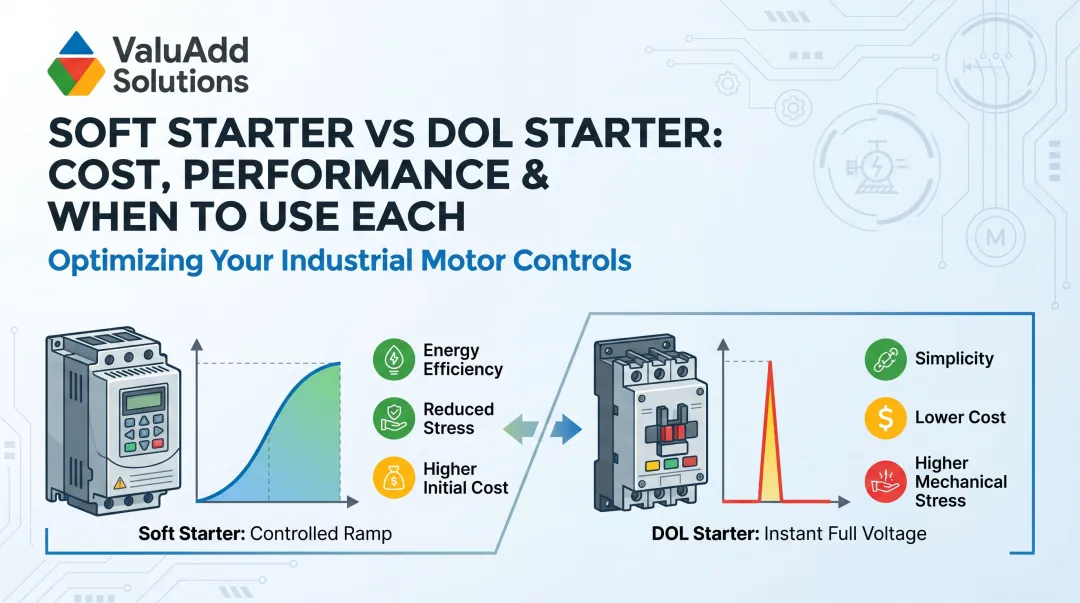
A soft starter only controls voltage (and therefore torque and current) during the startup and shutdown phases. Once running at full speed, it is bypassed. A VFD (Variable Frequency Drive) controls both voltage and frequency continuously, enabling full variable speed operation at any point during the motor's run cycle.
When a Soft Starter Is the Right Choice
If the motor runs at one fixed speed and the only concerns are startup current, mechanical shock, and smooth stopping, a soft starter is the right tool.
Ideal applications:
- Fixed-speed pumps running continuously at one speed
- Direct-drive fans with constant airflow requirements
- Conveyors running at one speed throughout operation
- Compressors with on/off cycling but no speed variation
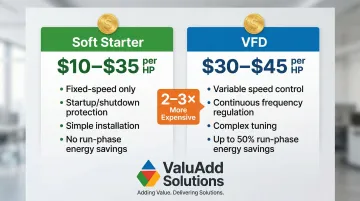
Cost advantage: A VFD can cost two to three times more than a soft starter for the same horsepower rating. For mid-size motors, soft starters range from $10-$35 per HP, whereas VFDs range from $30-$45 per HP.
When a VFD Is the Better Choice
Choose a VFD for applications requiring continuous variable speed control, precise speed regulation, or measurable energy savings during the run phase.
Ideal applications:
- Variable-load pumps where reducing speed saves energy proportionally (following affinity laws)
- Fans with varying airflow requirements based on temperature or process demands
- Applications requiring regenerative braking
- Processes needing precise speed control for quality or throughput
- Water treatment and HVAC systems where flow demand varies by shift or season
Run-phase energy savings: On variable-torque loads, VFDs reduce motor speed to match actual demand. Because power consumption drops with the cube of speed, even a 20% speed reduction can cut energy use by nearly 50%. Soft starters don't offer this benefit. Once bypassed, the motor runs at full voltage and standard operating efficiency for the rest of its cycle.
Quick Comparison Summary
| Feature | Soft Starter | VFD |
|---|---|---|
| Function | Controls voltage during start/stop only | Continuous voltage and frequency control |
| Cost | $10-$35 per HP | $30-$45 per HP (2-3x more expensive) |
| Energy Savings (Run Phase) | None (motor runs at full speed) | Significant (up to 50% on variable loads) |
| Speed Control | No (fixed full speed operation) | Yes (infinitely variable speed) |
| Complexity | Simple, fewer adjustments | More complex, requires tuning |
| Typical Applications | Fixed-speed pumps, conveyors, fans | Variable-speed pumps, fans, precision processes |
How to Choose the Right Soft Starter
Start by matching the soft starter to your motor's electrical requirements, then layer in environmental and compliance needs. Here's what to evaluate at each step.
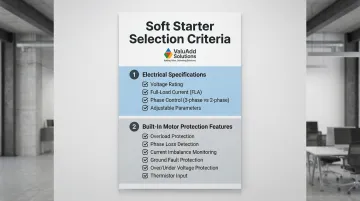
Key Electrical Specifications
The following specifications determine whether a soft starter is physically and electrically compatible with your motor:
- Voltage rating: Low voltage covers 480V and below; medium voltage covers 2.3kV up to 15kV. ValuAdd's MVE-P Series supports the full 2.3kV–15kV range.
- Full-load current (FLA): The soft starter must be rated at or above the motor's FLA. Medium voltage units in the MVE-P Series handle 110A to 1200A nominal.
- Phase control: 3-phase control provides balanced voltage reduction and better overall performance. 2-phase control is simpler but risks current imbalance.
- Adjustable parameters: Confirm ramp time (0–30 seconds), initial voltage (30–50% of full voltage), and soft stop are all adjustable for your application.
Modern soft starters also include built-in motor protection. Key features to verify:
- Overload protection (class 1 to 40)
- Phase loss detection
- Current imbalance monitoring (5–40%)
- Ground fault protection
- Over/under voltage protection
- Thermistor input for direct motor temperature monitoring
Compliance and Certification Requirements
For demanding industrial environments, verify that the soft starter meets relevant standards:
- UL Listed: In North America, look for UL 60947-4-2 (harmonized with IEC) or the legacy UL 508 standard. The "cULus" or "UL Listed" mark confirms compliance.
- CE Certified: Required for European installations; confirms compliance with the Low Voltage Directive and EMC Directive.
- NEMA enclosure rating: Match the enclosure to your environment:
- NEMA 1 — standard indoor, general industrial
- NEMA 12 — dust-tight and drip-tight for industrial settings
- NEMA 4X — corrosion-resistant for washdown or chemical environments (food processing, wastewater, chemical plants)
ValuAdd's MVE-P Series carries both UL Listed and CE Certified marks, making it a straightforward fit for North American and European compliance requirements.
Environmental and Application-Specific Considerations
Two operational factors are easy to overlook during selection but matter significantly in the field:
- Duty cycle: High-cycle applications — conveyors, compressors, pumps with frequent restarts — require a unit rated for more starts per hour. Exceeding thermal limits accelerates SCR degradation.
- Bypass contactor: Confirm whether the unit includes a built-in bypass contactor. Once the motor reaches full speed, the bypass shunts current around the SCRs, eliminating heat buildup and extending the soft starter's service life. Most industrial-grade units include this; it's worth verifying before purchase.
Frequently Asked Questions
What is the purpose of a soft starter?
A soft starter's purpose is to limit inrush current and torque during motor startup, protecting both the motor and the connected electrical system from stress. It also enables smooth controlled stopping when needed, preventing water hammer in pumps and reducing mechanical shock in conveyors and fans.
What is the difference between a soft starter and a VFD?
A soft starter only controls voltage during startup and shutdown—the motor runs at full speed once up to speed. A VFD continuously controls both voltage and frequency to vary motor speed throughout the entire operating cycle, enabling energy savings and precise speed control.
How long do soft starters last?
Solid-state soft starters are long-lasting devices. Manufacturer MTBF data suggests theoretical service life of 20–50 years, with practical installations typically reaching 10+ years. Actual lifespan depends on proper sizing, duty cycle, operating environment, and whether the unit is bypassed after startup to reduce SCR thermal stress.
Can a soft starter be used with any AC motor?
Soft starters are designed for standard AC induction motors and are not suitable for DC motors or synchronous permanent magnet motors without special consideration. The soft starter must be properly matched to the motor's voltage and current rating to function correctly and safely.
Does a soft starter save energy?
Soft starters save energy during startup by reducing peak current demand and can help avoid utility demand charges. However, they do not reduce energy consumption during the run phase—unlike VFDs. Once bypassed, the motor runs at full voltage and its standard operating efficiency.
What happens if a soft starter fails?
Common failure modes include SCR/thyristor degradation from overheating, incorrect sizing, or exceeding the rated starts per hour. Many installations include a bypass contactor for emergency across-the-line starting, though this sacrifices soft-start protection until the unit is repaired or replaced.