Control panels fail more often from environmental mismatch than from component defects, and that becomes a real problem when maintenance teams are already stretched thin, and uptime targets keep rising. Selecting an enclosure without understanding NEMA ratings introduces risks like moisture ingress, corrosion, and unexpected service calls, issues that disrupt schedules for OEMs, panel shops, and industrial plants alike.
According to a U.S. market estimate for 2025, the electrical enclosures market is expected to reach approximately US $2.13 billion, reflecting how central these products have become in reliability planning. A clearer understanding of NEMA ratings helps align enclosure choice with operating conditions, supply-chain realities, and long-term performance goals.
Quick Overview
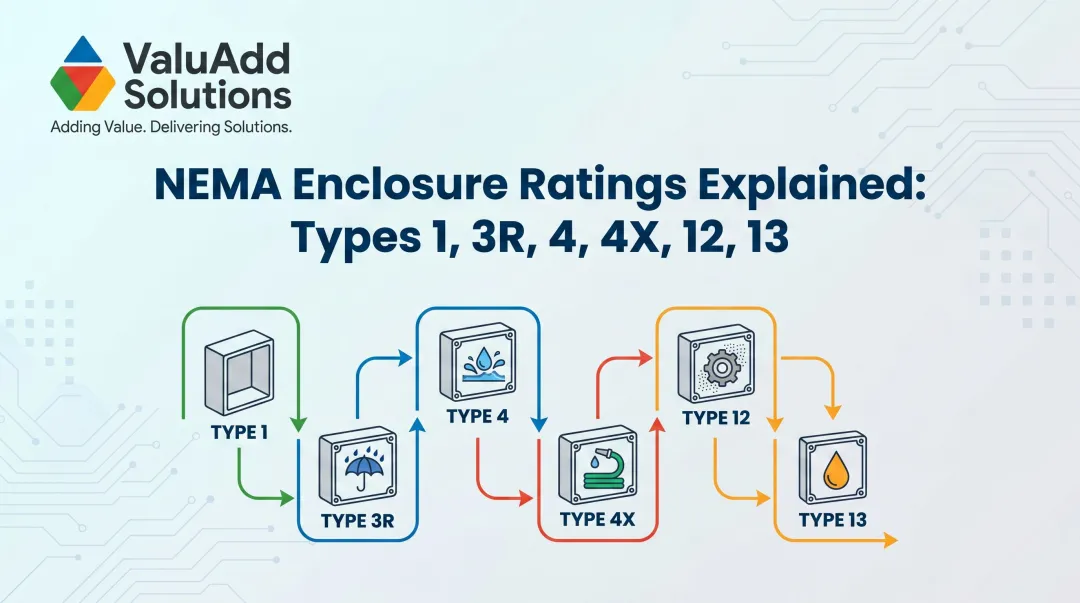
NEMA types range from 1 and 2 for clean indoor areas to 3/3R/3X for outdoor weather, 4/4X for wash-down and corrosion, and 6/6P for submersion, with 12 and 13 used in dusty, coolant-heavy industrial zones.
The right rating is chosen by checking exposure to water, dust, chemicals, corrosion, or flooding, and matching those risks to the rating’s actual protection level.
Frequent mismatches, like using NEMA 1 outdoors, 12 in wash-down, or 4 instead of 4X in corrosive areas, cause failures, downtime, replacement delays, and stocking confusion.
Consistent rating choices help OEMs and panel shops simplify BOMs, reduce enclosure variations, stabilize lead times, and avoid respecifying panels when environments change.
What are NEMA Ratings?
NEMA ratings describe how effectively an enclosure protects internal electrical components from environmental hazards commonly seen in industrial settings. These classifications come from the National Electrical Manufacturers Association and provide a structured way to match protection levels with operating conditions. Engineers and OEM teams use these ratings to prevent moisture, dust, or corrosion issues that drive unplanned downtime or maintenance strain.
Once the fundamentals are clear, the next step is understanding why these ratings matter so much in real operating environments, especially where uptime and maintenance windows are tight.
Why Are NEMA Ratings Important?
NEMA ratings are important because they determine how reliably an enclosure can protect critical electrical components in real operating conditions. Here are the core reasons they matter:
NEMA ratings help prevent environmental failures that often lead to unplanned downtime, equipment interruptions, and costly maintenance responses.
They provide a consistent benchmark that simplifies specification decisions across OEM platforms, panel standards, and multi-site industrial operations.
Correct ratings support long-term reliability by reducing issues linked to moisture ingress, dust accumulation, and corrosion exposure in demanding environments.
They reduce procurement and project risks by ensuring that enclosures match performance needs without over-engineering or creating unnecessary lead-time delays.
Knowing why the system exists sets the stage for looking at the ratings themselves, so the following section outlines the types most commonly used across North American facilities.
Key NEMA Rating Types
NEMA ratings span multiple protection levels, so grouping them by environment makes selection clearer for engineering teams, OEMs, and panel shops.
Here is a breakdown that reflects how most North American facilities standardize enclosure choices across typical applications.
NEMA Type | Environment | Protection Level | Typical Industrial Use |
|---|---|---|---|
Type 1 | Indoor | Basic protection against contact and limited dust | Control cabinets in clean, dry rooms |
Type 2 | Indoor | Drip-resistant | Light-duty offices, equipment rooms |
Type 3 | Outdoor | Dust, rain, sleet | General outdoor enclosures with no corrosive exposure |
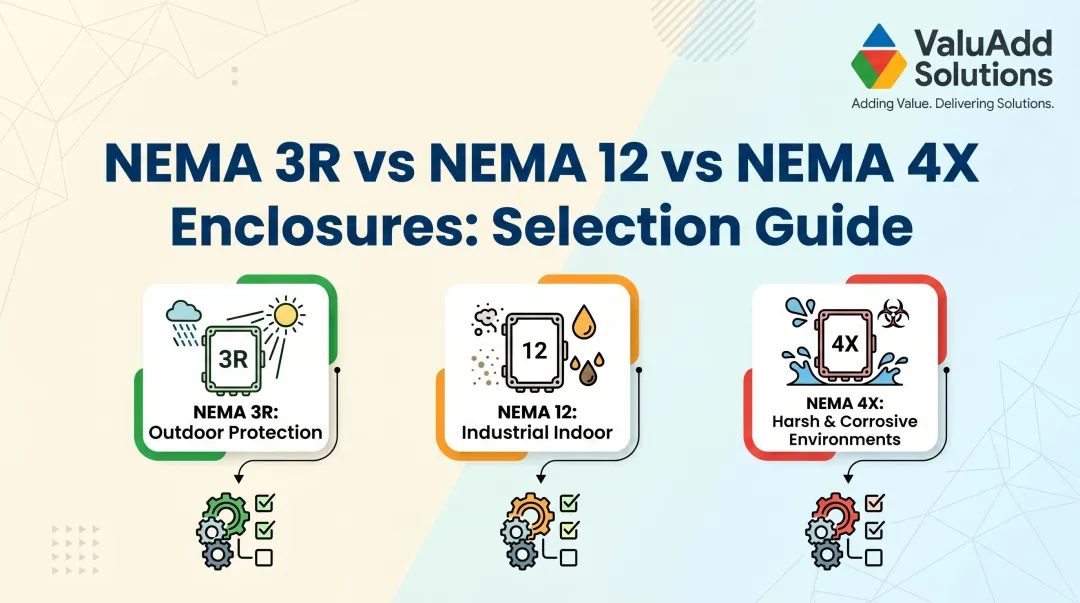
Type 3R | Outdoor | Rain, sleet, drainage | Pump stations, outdoor disconnects |
Type 3S | Outdoor | Operable under ice | Outdoor controls where functionality is required during freezing |
Type 3X | Outdoor | Corrosion-resistant + dust/rain | Coastal areas, chemical-adjacent zones |
Type 4 | Indoor/Outdoor | Hose-directed water | Wash-down areas without chemical exposure |
Type 4X | Indoor/Outdoor | Hose-down + corrosion resistance | Food & beverage, chemical plants, caustic wash-down |
Type 6 | Indoor/Outdoor | Limited submersion | Areas prone to incidental flooding |
Type 6P | Indoor/Outdoor | Prolonged submersion | Harsh, moisture-heavy industrial sites |
Type 12 | Indoor | Dust, dirt, fibers, coolant/oil drip | Panel shops, machinery, and packaging lines |
Type 13 | Indoor | Dust + noncorrosive coolant spray | Light industrial cooling/processing equipment |
Commonly Confused NEMA Pairs
NEMA 4 vs NEMA 4X
Type 4: Hose-down environments, no corrosion requirement.
Type 4X: Adds corrosion resistance for chemical, coastal, and food-grade wash-down.
NEMA 1 vs NEMA 12
Type 1: Clean, dry indoor spaces; minimal dust.
Type 12: Industrial indoor spaces with dust, fibers, coolant, or oil mist.
NEMA 3R vs NEMA 1
Type 3R: Designed for weather exposure, rain, and sleet.
Type 1: Indoor only; not for outdoor conditions.
NEMA 3 vs NEMA 3X
Type 3: General outdoor rating.
Type 3X: Outdoor with added corrosion resistance.
NEMA 12 vs NEMA 13
Type 12: Dust and industrial coolant/oil protection.
Type 13: Dust + noncorrosive coolant spray.
Sorting out these differences makes selection smoother, and the next part turns that clarity into practical steps for choosing the right enclosure for your environment.
Industrial Selection Criteria: How to Pick the Right Rating
Industrial projects demand enclosure choices that match real operating conditions, so picking the right NEMA rating depends on how your equipment will be exposed over its lifetime.
Here are the factors that help guide your decision without slowing engineering, procurement, or panel-build timelines:
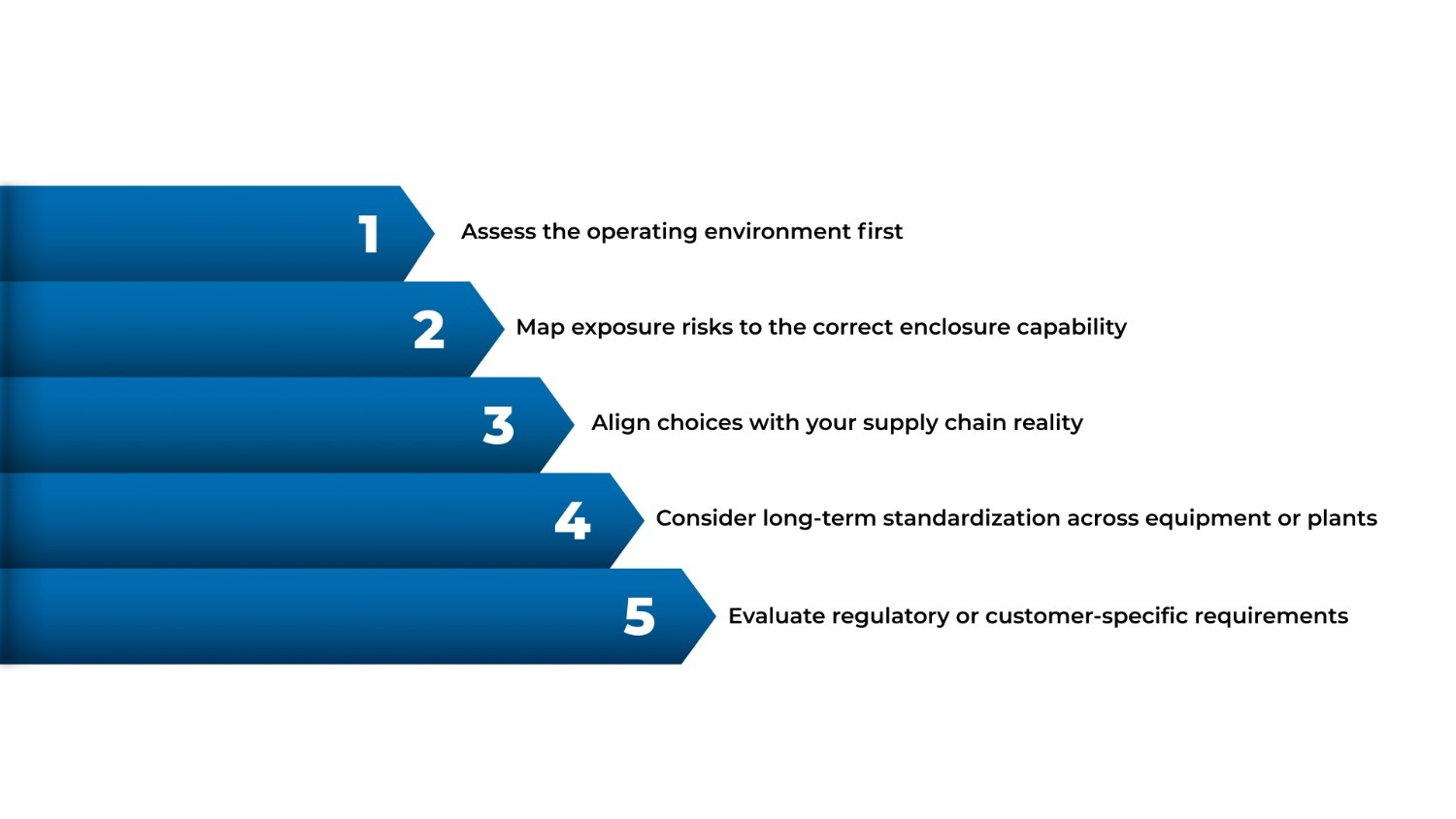
Assess the operating environment first
Understanding whether your panel lives indoors or outdoors helps narrow the baseline rating immediately.
Considering exposure to wash-down, rain, or airborne particles ensures your enclosure choice aligns with actual field conditions.
Accounting for high-moisture or immersion risks allows your team to choose a rating that prevents ingress-related failures.
Map exposure risks to the correct enclosure capability
Selecting a rating that handles dust, oil mist, or particulate buildup protects your controls from contamination-related downtime.
Choosing a rating built for water spray or sanitation cycles prevents gasket wear and avoids repeat maintenance calls.
Evaluating corrosive or coastal conditions helps your team decide whether corrosion-resistant options like 4X are necessary.
Align choices with your supply chain reality
Relying on ratings that distributors stock consistently keeps your builds moving without last-minute delays.
Utilizing rep support in your territory ensures your choices match both technical needs and availability expectations.
Standardizing on a commonly available rating minimizes procurement bottlenecks and reduces substitution risk across projects.
Consider long-term standardization across equipment or plants
Keeping enclosure ratings consistent simplifies your BOMs, drawings, and panel templates for repeat builds.
Establishing a standard rating helps your maintenance team stock fewer spares and respond faster during equipment issues.
Creating predictable enclosure requirements reduces engineering effort across multiple machines, skids, or facilities.
Evaluate regulatory or customer-specific requirements
Confirming project specifications early protects your team from redesign cycles triggered by minimum rating mandates.
Checking municipal or utility requirements ahead of time avoids procurement rework and documentation issues.
Verifying client expectations upfront ensures your enclosure rating aligns with both environmental and compliance needs.
For teams that want a second set of eyes on their enclosure choices, ValuAdd can review operating conditions and recommend the NEMA ratings that best match each environment.
Even with good selection habits, common mistakes still show up in the field, so the following section points out where teams usually go wrong and how it affects performance.
Common Specification Mistakes & Their Operational Impact
Selecting the wrong NEMA rating often leads to hidden failures, unplanned maintenance, and avoidable project costs.
To make the risks clear, here are the most frequent mistakes seen in industrial and OEM environments, and how they directly affect operational KPIs.
Specification Mistakes That Create Downstream Problems
Choosing NEMA 1 for outdoor environments, exposing components to rain, moisture, and wind-driven debris.
Using NEMA 12 in areas with wash-down or continuous water exposure can lead to premature seal failures.
Selecting NEMA 4 instead of 4X, where corrosive agents or chemicals are present, accelerates enclosure degradation.
Treating kitchen, chemical, or wastewater environments as “general indoor”, which often requires higher protection.
Mixing multiple enclosure types for similar machines or panels increases stocking complexity and training time.
Relying on distributor availability alone, rather than verifying application-environment needs first.
How do These Mistakes Affect Operational KPIs?
Higher unplanned downtime due to moisture ingress, corrosion, or premature component failures.
Increased scrap rates when electrical faults interrupt automated processes or damage work-in-progress.
Lead-time instability when teams must reorder the correct enclosure after a mis-specification.
Greater inventory risk from carrying too many enclosure variations across jobs or OEM builds.
More training overhead for technicians and panel builders due to inconsistent specifications.
Higher maintenance workload when improperly rated enclosures require frequent field interventions.
Once these pitfalls are understood, it helps to look at how NEMA choices affect the broader supply chain and how reps and distributors support the process.
NEMA Ratings in the Supply Chain & Specification Process
Correct NEMA selection affects far more than enclosure performance; it influences stocking, lead times, and how smoothly OEM and panel shop workflows run. To understand where issues typically arise, here’s a streamlined view of how NEMA ratings interact with the supply chain and the specification process.
Distributors shape stocking decisions and help teams understand which enclosure ratings are readily available in the region.
Technical sales partners such as ValueAdd guide the specification early, aligning the rating with real operating conditions and compliance needs.
Local rep involvement reduces mis-specification by validating whether a panel requires 3R, 4X, 12, or other industrial ratings before the BOM is locked.
Certain ratings, especially 4X, 6, and 6P, can carry longer lead times, influencing project schedules and, at times, cost per unit.
Lead-time fluctuations can create downstream risk when OEM builds follow rigid production cycles or when maintenance teams need fast replacements.
Aligning enclosure choices with the types distributors keep in stock across NC, SC, and VA helps prevent delays during installation, maintenance, or retrofit.
Standardizing on a smaller set of NEMA ratings streamlines BOMs, simplifies panel layout and assembly, and reduces supplier and training complexity.
Fewer variations in enclosure types mean lower inventory requirements and more predictable purchasing for OEMs and panel shops.
With the supply-chain perspective covered, the next section introduces how ValuAdd supports teams who want dependable guidance on selecting the right enclosure ratings.
Get Expert Support for NEMA-Rated Enclosure Choices
Selecting the right NEMA rating is easier with a technical partner that understands both application demands and the products built for them.
ValuAdd supports engineering teams, OEMs, and panel shops with practical guidance and proven solutions.
Product portfolio covering industrial enclosures, control components, power distribution, and thermal management suited for NEMA 1, 12, 3R, 4/4X, and 6/6P applications.
Technical sales support to match enclosure ratings with real operating conditions—dust, wash-down, corrosion, outdoor exposure, or submersion.
On-site assistance to review panel design, environmental risks, and compatibility across enclosure families and accessories.
Access to trusted manufacturers offering reliable, compliant solutions for industrial, OEM, and automation environments.
Advisory support to help standardize enclosure choices, simplify BOMs, and reduce supplier risk.
Wrapping Up
Understanding NEMA ratings makes it easier to choose enclosures that actually fit the environment, protect components long-term, and avoid the downtime and rework that come from mis-specification. Making the right choice upfront strengthens reliability, simplifies maintenance, and keeps industrial systems running smoothly. ValuAdd helps engineering teams, OEMs, and panel shops navigate NEMA requirements with technical clarity and product options suited to real operating conditions.
Have a project that needs the right NEMA-rated enclosure? Connect with ValuAdd’s technical team for guidance and product recommendations.
FAQ
What is a NEMA rating?
A NEMA rating defines the level of protection an electrical enclosure provides against environmental conditions such as dust, water, and corrosion. It is established by the National Electrical Manufacturers Association and is widely used in the U.S. industrial market.
What is the difference between NEMA and IP ratings?
NEMA ratings cover a wider range of conditions, including corrosion and indoor/outdoor use, while IP ratings focus mainly on dust and water ingress. They are related, but not interchangeable, and direct conversions aren’t always one-to-one.
Is NEMA 4 or NEMA 4X better?
NEMA 4 protects against hose-directed water and wash-down conditions, while NEMA 4X adds corrosion resistance for harsh or chemical-heavy environments. 4X is better when stainless steel or corrosion-resistant materials are needed.
Can NEMA 1 enclosures be used outdoors?
No, NEMA 1 is designed only for clean, dry indoor environments. Outdoor use requires a rating such as 3, 3R, 4, or 4X, depending on exposure.
What is a NEMA 3R enclosure used for?
NEMA 3R protects against rain, sleet, and outdoor weather, making it common for disconnects, pump stations, and utility applications. It’s often chosen when basic outdoor protection is needed without full wash-down capability.