Introduction
Imagine this: A facility manager at a chemical processing plant selects a standard NEMA 1 disconnect switch for a pump station exposed to corrosive vapors. Within six months, the enclosure corrodes through, moisture invades the switching mechanism, and a critical process line shuts down unexpectedly.
The resulting downtime costs tens of thousands of dollars, an OSHA inspection uncovers lockout/tagout violations, and the entire electrical installation fails code compliance. This scenario happens more often than it should. It's entirely preventable.
Enclosed disconnect switches are safety devices that isolate electrical circuits by housing the switching mechanism inside a protective enclosure. The National Electrical Manufacturers Association (NEMA) establishes standardized enclosure ratings that define which environmental hazards each type can withstand, ranging from basic indoor dust protection to explosion-proof containment for hazardous gas atmospheres.
This guide covers the main switch types, what each NEMA rating means in real-world conditions, and how to match the right enclosure to your facility's voltage, amperage, environment, and code requirements.
Key Takeaways
- Enclosed disconnect switches combine circuit isolation with NEMA-rated environmental protection
- Ratings range from NEMA 1 (indoor/dry) through NEMA 4X (watertight) to NEMA 7/9 (explosion-proof)
- Fusible models provide overcurrent protection; non-fusible models offer isolation only
- Selection depends on load type (motor vs. resistive), environment, and NEC/OSHA compliance
- Mismatched NEMA ratings in oil and gas, water treatment, or manufacturing can trigger equipment failures and code violations
What Are Enclosed Disconnect Switches and Why Do They Matter?
An enclosed disconnect switch is a manually operated device that physically interrupts electrical circuits to enable safe maintenance or emergency shutoff. Unlike open disconnect assemblies mounted on exposed busbars, enclosed switches house all live components inside a protective enclosure that shields internal parts from environmental hazards and prevents accidental human contact with energized conductors.
Why enclosures are critical:
- Protect switching components from dust, moisture, corrosive chemicals, and explosive atmospheres
- Prevent personnel from contacting live parts during operation or maintenance
- Meet OSHA and NEC safety mandates for physical isolation and environmental suitability
Core Function: Lockout/Tagout and Motor Disconnect Compliance
Industrial facilities use enclosed disconnect switches to comply with two foundational safety regulations:
OSHA 29 CFR 1910.147 (Lockout/Tagout): Requires an "energy isolating device" that physically prevents energy transmission. OSHA explicitly lists disconnect switches as acceptable devices. Any device installed after January 2, 1990, must be designed to accept a lockout mechanism.
NEC Article 430.102 (Motor Disconnect Location): Mandates that motor disconnects be located "in sight from" the motor controller and driven machinery—meaning visible and within 50 feet. This ensures workers can visually confirm isolation before maintenance.
Both regulations also dictate enclosure selection. A NEMA 1 enclosure installed outdoors or in a corrosive process area will fail prematurely—triggering electrical hazards, regulatory violations, and unplanned downtime. Matching the enclosure rating to the actual environment is as critical as the switch specification itself.
Enclosed Disconnect Switches vs. Safety Switches
These terms get used interchangeably, but there's a real difference:
- Non-fusible disconnect switches provide circuit isolation only
- Fusible safety switches integrate fuses for combined disconnect and overcurrent protection
Fusible models eliminate the need for a separate circuit breaker in many branch circuit designs—a practical advantage when panel space or installation cost is a constraint.
NEMA Enclosure Ratings Explained: Which One Does Your Application Need?
The National Electrical Manufacturers Association publishes NEMA 250-2020, Enclosures for Electrical Equipment (1000 Volts Maximum), which defines standardized protection levels. NEMA ratings evaluate not just water and dust ingress (like IP ratings), but also corrosion resistance, gasket performance, door securement, and icing conditions.
NEMA vs. IP Ratings:
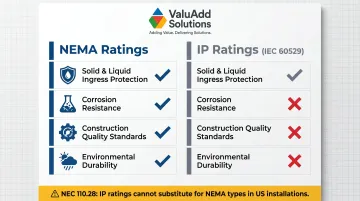
NEMA and IEC 60529 (IP ratings) are not interchangeable. IP ratings only measure solid and liquid ingress. NEMA standards add construction quality, corrosion testing, and environmental durability. NEC 110.28 explicitly states IP ratings cannot substitute for NEMA enclosure types in US electrical installations.
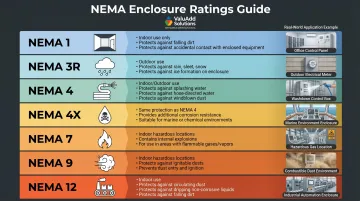
NEMA 1 and NEMA 3R: Indoor and Basic Outdoor
NEMA 1:
- Baseline indoor protection against incidental contact and falling dirt
- Suitable only for clean, dry, climate-controlled environments like electrical rooms
- Not appropriate for any outdoor, wet, or dusty location
When the installation moves outside, NEMA 3R covers the basics without over-engineering the solution.
NEMA 3R:
- Outdoor-rated for rain, sleet, snow, and external ice formation
- Does not provide dust-tight or watertight sealing
- Common for outdoor panels where hose-directed water or submersion is not a concern
NEMA 4 and NEMA 4X: Watertight and Corrosion-Resistant
NEMA 4:
- Watertight and dust-tight protection against hose-directed water, windblown dust, and splashing
- Suitable for wet industrial environments: washdown areas, outdoor enclosures in non-corrosive climates
Add corrosion resistance to those same requirements, and you move to NEMA 4X.
NEMA 4X:
- Everything NEMA 4 provides, plus corrosion resistance
- Must pass a 600-hour salt spray test plus an additional 200-hour corrosion test
- Essential for chemical plants, food processing, coastal marine environments, and wastewater treatment
- Most are built from 304 or 316 stainless steel
In environments with aggressive chemicals or chlorine exposure, under-specifying the enclosure rating leads to rapid corrosion, water intrusion, and electrical faults — failures that routinely cost far more than the stainless steel premium.
NEMA 7 and NEMA 9: Hazardous Location Protection
NEMA 7:
- Rated for Class I, Division 1 hazardous locations (flammable gases or vapors)
- Enclosure must contain any internal explosion and prevent ignition of surrounding atmosphere
- Required by NEC Articles 500-501 for oil refineries, gas processing, and chemical plants with volatile organic compounds
Where the hazard shifts from gas to airborne combustible dust, NEMA 9 takes over.
NEMA 9:
- Rated for Class II, Division 1 hazardous locations (combustible dust)
- Prevents dust ingress and ignition of external combustible dust clouds
- Mandatory for grain handling, coal processing, and pharmaceutical powder production
Installing a non-rated enclosure in a classified hazardous location violates NEC Articles 500-501 and can trigger arc flash events, equipment destruction, or facility-wide explosion — not a specification shortcut worth taking.
NEMA 12 and NEMA 12K: General Industrial Duty
NEMA 12:
- Dust-tight and drip-tight for non-corrosive liquids
- Designed for machine tool areas, general manufacturing, and indoor applications with coolant mist, oil, or airborne dust
- Uses painted carbon steel with gasketed doors and no knockouts
For installations requiring conduit entry without sacrificing dust-tight integrity, NEMA 12K adds that flexibility.
NEMA 12K:
- Same as NEMA 12, but includes gasketed knockouts for conduit entry
- Provides greater installation flexibility without compromising dust-tight integrity
NEMA Rating Comparison Table
| NEMA Rating | Key Protection Features | Typical Application |
|---|---|---|
| NEMA 1 | Indoor, dry; protects against falling dirt | Clean control rooms, electrical closets |
| NEMA 3R | Outdoor; protects against rain, sleet, snow | Outdoor panels, non-corrosive climates |
| NEMA 4 | Watertight, dust-tight; hose-directed water | Washdown areas, wet industrial zones |
| NEMA 4X | NEMA 4 + corrosion resistance | Chemical plants, food processing, marine |
| NEMA 7 | Class I hazardous (explosive gas) | Oil refineries, gas processing |
| NEMA 9 | Class II hazardous (combustible dust) | Grain handling, coal processing, pharma |
| NEMA 12 | Dust-tight, drip-tight (non-corrosive) | Machine shops, general manufacturing |
Types of Enclosed Disconnect Switches for Industrial Use
Fusible vs. Non-Fusible Disconnect Switches
Fusible Enclosed Disconnects:
- Integrate fuses inside the enclosure for combined disconnect and overcurrent protection
- Preferred when branch circuit protection is required at the disconnect point
- Reduces panel complexity by eliminating the need for separate upstream breakers
- Fuse sizes typically range from 30A to 800A, supporting fuse classes CC, J, and L
ValuAdd's Enclosed FUSERBLOC line is UL Listed under UL 98 and UL 489, supporting frame sizes from 30A to 800A with breaking capacity up to 200 kA rms.
Non-Fusible Enclosed Disconnects:
- Provide isolation only; no built-in overcurrent protection
- Used when upstream breakers or motor starters already provide circuit protection
- Simpler construction, lower cost, faster installation
Both types come in heavy-duty configurations suited for demanding industrial environments — the right choice depends on where overcurrent protection already exists in the circuit.
Heavy-Duty Safety Switches
Heavy-duty safety switches are built to handle higher mechanical and electrical stress, including frequent operation cycles. Standard amperage ratings range from 30A to 1200A at 600 Vac.
Motor-Rated (Horsepower-Rated) Disconnect Switches:
NEC 430.109 mandates motor-circuit disconnects to be horsepower-rated, capable of safely interrupting locked-rotor current. Using a non-motor-rated switch on an inductive motor load introduces real risks:
- High inrush currents can weld contacts shut, preventing the switch from opening under fault conditions
- Opening an inductive load generates voltage spikes that create plasma arcs, eroding contacts and creating fire hazards
Always specify motor-rated switches for motor circuits. Using the wrong switch type violates NEC code and creates genuine safety hazards.
Specialty and Combination Disconnect Types
Combination Motor Starters with Integrated Disconnect:
Combine a disconnect switch, motor starter, and overload protection in one enclosure. ValuAdd's RX2E and RX3E Enclosed Combination Soft Starters include built-in motor protection, emergency bypass contactors, and door-mounted Start/Stop controls in NEMA 12 or NEMA 3R enclosures.
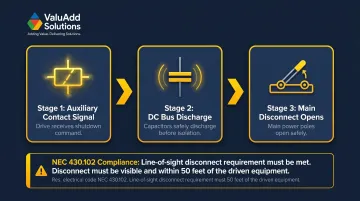
Disconnect Switches for VFD Applications:
Variable frequency drives require specific disconnect considerations beyond standard motor circuits. Key requirements include:
- DC bus discharge risk: VFD capacitors can hold dangerous voltage even after main power is removed — disconnects must account for safe discharge sequencing
- NEC 430.102 placement: Disconnects must be located in sight from the controller for motors with adjustable-speed drives
- Auxiliary contacts: Disconnects should signal the drive to shut down before main power poles open, preventing switching transients that can damage drive components
Key Factors for Selecting the Right Enclosed Disconnect Switch
Primary Selection Variables
- Environmental conditions: Indoor/outdoor, dust, moisture, corrosive agents, explosive atmospheres
- Electrical load characteristics: Voltage, amperage, resistive vs. inductive (motor) loads
- Applicable codes: NEC, OSHA LOTO, UL listing requirements
Importance of UL Listing
NEC 110.3(B) mandates that listed equipment be installed per listing instructions. UL listing confirms third-party testing against established safety standards. Most industrial facilities and insurance policies require UL Listed equipment.
UL 98 vs. UL 508:
- UL 98 (Enclosed and Dead-Front Switches): Covers switches for branch circuits, feeders, service, and motor disconnects
- UL 508 (Industrial Control Equipment): Covers manual motor controllers but cannot serve as primary supply disconnects unless marked "Suitable as Motor Disconnect"
ValuAdd's Enclosed Disconnect Solutions
ValuAdd supplies enclosed disconnect switches with UL listing, NEMA Type 4X and NEMA 12 compliance, and Class E2 load break ratings. The application engineering team works directly with system integrators and facility managers to match the right enclosure to your voltage, amperage, and site conditions — whether that's a washdown environment, a corrosive chemical facility, or a standard industrial panel room.
Industrial Applications: Matching NEMA-Rated Enclosures to Real Environments
Manufacturing Facilities
General manufacturing environments with dust, coolant mist, and machine oils typically require:
- NEMA 12 enclosures for interior machine tool areas and dry production zones
- NEMA 4 or 4X enclosures for washdown zones, CIP (clean-in-place) systems, or areas with caustic cleaning agents
Cost vs. Risk Consideration:
Over-specifying a NEMA 4X enclosure for a dry indoor environment wastes budget. Under-specifying a NEMA 12 enclosure in a wet or corrosive zone leads to premature failure, equipment damage, and unplanned downtime that costs far more than the initial upgrade.
Oil and Gas and Chemical Processing
OSHA 1910.307 and NEC Articles 500-502 require equipment to be approved for the specific hazardous location Class, Division, and ignitable properties. Hazardous location ratings are non-negotiable:
- NEMA 7 for Class I (flammable gas/vapor) locations
- NEMA 9 for Class II (combustible dust) locations
Using standard enclosures in classified areas violates code, voids insurance coverage, and exposes facilities to significant liability. ValuAdd serves oil and gas, chemical processing, and other industries requiring hazardous-location-rated solutions with appropriate NEMA 7 and NEMA 9 enclosures.
Municipal Water Treatment and Outdoor Installations
Municipal guidelines and USACE standards mandate NEMA 4X (316 stainless steel) for outdoor pump stations and corrosive environments. Water treatment facilities expose electrical equipment to chlorine vapors, saltwater, high humidity, and UV degradation. Minimum requirements:
- NEMA 3R for basic outdoor exposure with no corrosive conditions
- NEMA 4X preferred where chlorine, saltwater, or aggressive chemicals exist
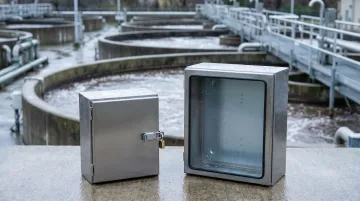
The City of San Diego mandates NEMA 4X Type 316 stainless steel for outdoor or corrosive indoor panels, recognizing that lower-rated enclosures fail rapidly in these environments.
For water treatment applications, the higher upfront cost of stainless steel NEMA 4X enclosures is offset by decades of reliable service — lower-rated alternatives corrode faster and trigger unplanned replacements that erode any initial savings.
Frequently Asked Questions
What are the different types of disconnect switches?
Disconnect switches include fusible (with integrated fuses for overcurrent protection), non-fusible (isolation only), motor-rated (designed for inductive loads), heavy-duty safety switches (30A to 1200A), and specialty types like combination motor starters. Selection depends on load characteristics and whether circuit protection is required at the disconnect.
Is an enclosed switch a disconnect?
An enclosed switch and a disconnect switch are closely related but not identical. An enclosed disconnect refers to a disconnect switch housed in a NEMA-rated protective enclosure, which is the standard configuration for industrial use. Not all enclosed switches function as disconnects — some are control or transfer switches.
Are safety switches normally open or closed?
Safety (disconnect) switches are normally closed during operation, allowing current to flow, and are manually opened to de-energize the circuit for maintenance or emergencies. Note that this differs from control circuit terminology, where "normally open" and "normally closed" describe relay contact states.
What is a NEMA switch?
A "NEMA switch" refers to an enclosed switch whose enclosure meets a specific NEMA rating (1, 3R, 4, 4X, 7, 12, etc.). The NEMA designation defines the environmental protection level the enclosure provides, not the switch mechanism itself.
What is a NEMA 1 disconnect?
A NEMA 1 disconnect is housed in the most basic NEMA-rated enclosure, designed for indoor use in clean, dry environments. It provides protection against incidental contact and falling dirt but is not appropriate for wet, dusty, corrosive, or outdoor locations.
What is a NEMA 7 disconnect?
A NEMA 7 disconnect is housed in an enclosure rated for Class I hazardous locations where flammable gases or vapors may be present. The enclosure is constructed to contain any internal explosion and prevent ignition of the surrounding atmosphere, making it essential for oil refineries, gas processing, and chemical plants.