Introduction
Most production facilities track energy costs, but few catch the issues hiding in their meter readings. Misreading a 3-phase energy meter can mean billing disputes, missed demand peaks, or undetected electrical faults that accelerate equipment wear — problems that compound quietly until something fails.
The stakes are real: a 2.5% voltage unbalance can increase motor losses by approximately 20% and reduce winding insulation life by 50% for every 10°C rise in operating temperature. Accurate meter reading is a first-line defense against those failures.
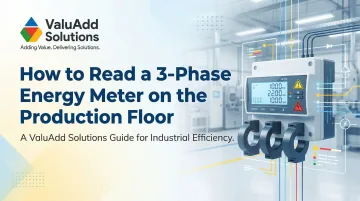
This article walks through the parameters displayed on a 3-phase energy meter, how to navigate the display step by step using two practical methods, how to interpret readings, and what common mistakes to avoid.
Key Takeaways
- 3-phase meters display voltage, current, kW, kVAr, kVA, power factor, and peak demand; use the scroll button to cycle through each reading
- Always apply the CT (current transformer) ratio multiplier to current and power readings
- Normal readings show phase voltages balanced within ±2% and power factor above 0.90
- Use the LCD display for on-site reading; use Modbus/RS485 or software for remote data
- Meter reading is non-intrusive, but always wear PPE and never open panel covers when accessing panel areas
What You Need to Read a 3-Phase Energy Meter on the Production Floor
Reading a 3-phase energy meter is a non-intrusive task requiring no disconnection of equipment. The key preparation steps are confirming access, identifying meter type, and locating the CT ratio before approaching the panel.
Tools and Access Requirements
Bring the following:
- Notepad or tablet to record readings
- Flashlight or headlamp for poorly lit panel areas
- PPE (safety glasses and voltage-rated gloves minimum)
- Panel schedule or single-line diagram to confirm CT ratio
Most modern 3-phase digital meters feature backlit LCD displays that auto-cycle through parameters. Before starting, confirm the meter model and locate its display navigation guide or label — navigation behavior varies between manufacturers and panel-mount configurations.
Preconditions
- Meter status: Confirm the display is active and the meter is energized before recording any values
- CT ratio: Locate the ratio printed on the current transformer, meter label, or panel schedule before recording any current or power readings
Missing or unlabeled CT ratios are the most common source of drastically wrong readings on industrial floors. If the ratio isn't documented, resolve it before proceeding — don't estimate.
Understanding Your 3-Phase Meter Display: Key Parameters
3-phase energy meters cycle through multiple screens, each showing a different electrical parameter. Understanding what each parameter represents before reading prevents misidentification and data recording errors.
Voltage (V)
Two voltage types appear on most meters:
- Phase-to-neutral (L1-N, L2-N, L3-N): voltage between each phase and the neutral conductor
- Line-to-line (L1-L2, L2-L3, L1-L3): voltage measured between any two phases
Typical values for common industrial systems:
- 480V line-to-line / 277V phase-to-neutral (US industrial)
- 208V line-to-line / 120V phase-to-neutral (smaller US systems)
- 400V line-to-line / 230V phase-to-neutral (IEC standard international)
Current (A)
Per-phase current readings (I1, I2, I3) reveal load distribution across the three phases. Significant differences between phase currents indicate load imbalance, which can stress motors and transformers. NEMA MG1 warns that a relatively small voltage unbalance causes a current unbalance 6 to 10 times larger.
Active, Reactive, and Apparent Power
- kW (Active Power): Real power that does actual work — runs motors, lights, and equipment
- kVAr (Reactive Power): Power stored and released by inductive/capacitive loads (motors, transformers); performs no net work but stresses the electrical system
- kVA (Apparent Power): Total electrical load the system must supply, calculated as the vector sum of kW and kVAr
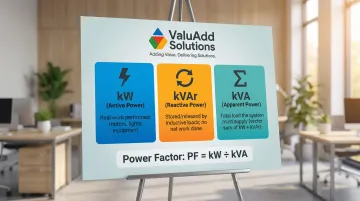
Utilities bill based on kVA or penalize high kVAr usage because they must size infrastructure for total Apparent Power — not just Active Power. That's why industrial facilities track all three.
Power Factor (PF)
Power factor is the ratio of kW to kVA (PF = kW ÷ kVA). A PF below 1.0 means the system draws more current than the useful work requires — increasing utility charges and stressing wiring and switchgear on the production floor.
Utility penalty thresholds:
- Duke Energy penalizes power factors below 96.5%
- PG&E applies adjustments for PFs below 85%
Peak Demand (kW or kVA Demand)
Demand is the highest average power draw recorded over a set interval — typically 15 or 30 minutes — during the billing period. Utilities bill this separately from energy consumed (kWh). It's often the most expensive line item on an industrial bill: demand charges can represent 30% to 70% of total electricity costs.
Step-by-Step: How to Read a 3-Phase Energy Meter
Two practical methods are available depending on the meter type and facility setup: reading the built-in LCD display directly on the meter (most common for routine floor checks) and pulling readings through a communication interface or energy management software (for logged or remote data). Choose based on the meter's capabilities and the level of detail required.
Method 1: Reading via the Built-In LCD Display
Use this method for any digital 3-phase meter with an LCD panel. No additional tools beyond PPE and a recording device are needed.
Steps:
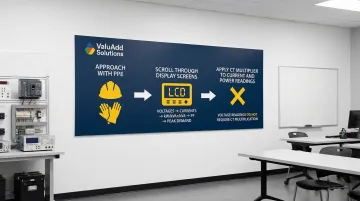
Approach the meter panel wearing PPE. Do not open covers — the display is readable through the panel window or meter face. Press the scroll button (labeled "Display," "Scroll," or an arrow symbol) to wake the display if needed.
Allow the display to cycle through its screens, or press the scroll button to advance manually. Record each parameter in sequence:
- Voltages (L1-N, L2-N, L3-N, then line-to-line)
- Current per phase (I1, I2, I3)
- kW, kVAr, kVA
- Power factor
- Peak demand
- Note the screen label or code alongside each value
If the meter shows a CT multiplier code or "×CT" indicator, multiply the current, kW, kVAr, kVA, and demand readings by the CT ratio before recording final values. Voltage readings do not require CT multiplication.
When to use this method:
- Best for routine on-site checks with no software dependency
- Limited to real-time snapshots — no trend or historical data
If a reading seems anomalous, repeat the scroll cycle once to confirm it was not a display transition artifact.
Method 2: Reading via Communication Interface or Energy Management Software
Many modern 3-phase industrial meters include an RS485 (Modbus RTU) or Ethernet port for remote data access. This method provides time-stamped logs, historical demand data, and multi-parameter exports in a single pull.
Steps:
Connect to the meter's communication port using a USB-to-RS485 adapter or network connection. Open the energy management software and confirm the meter's Modbus address and baud rate match the configured settings.
Initiate a data poll or read request through the software. The system returns all parameters (voltages, currents, power, PF, demand, kWh totals) simultaneously in a readable table. Export or log the values with a timestamp for records.
When to use this method:
- Ideal for periodic reporting, energy audits, or meters in hard-to-access locations
- Requires initial communication setup and compatible software — not available on basic non-communicating meters
ValuAdd's energy monitoring products support Modbus RTU communication for direct integration with plant SCADA or BMS systems.
How to Interpret 3-Phase Meter Readings
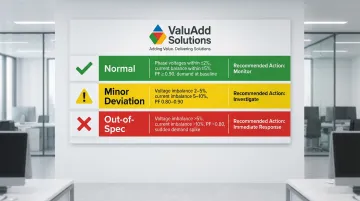
Recording numbers is only the first step—interpreting what those numbers mean determines whether the system is operating correctly, whether action is needed, or whether a more serious electrical problem is developing. Readings fall into three tiers: normal, minor deviation, and out-of-spec—each with a different response.
Normal / Acceptable Readings
Healthy readings look like this:
- Phase voltages: all three phase-to-neutral readings within ±2% of each other
- Per-phase currents: balanced within ±5% across phases
- Power factor: 0.90 or above (0.95+ is excellent)
- Peak demand: consistent with historical baselines
Log the reading and compare it with the previous interval before moving on.
Minor Issues: Slight Deviations
Moderate warning signs include:
- Phase voltage imbalance: between 2–5%
- Current imbalance: between 5–10%
- Power factor: between 0.80 and 0.90
Xcel Energy applies adjustment charges when PF drops below 90%. Investigate load distribution, schedule a review with the maintenance team, and increase monitoring frequency.
Out-of-Spec Readings
Serious fault indicators include:
- Voltage imbalance above 5%: can cause overheating and failure in 3-phase motors
- Current imbalance above 10%
- Power factor below 0.80
- Sudden unexplained spike in peak demand
NEMA MG1 explicitly states that operation of a motor above 5% voltage unbalance is not recommended. A single-phase fault or a failing motor will often appear first as a current or voltage imbalance on the meter display.
Notify the electrical maintenance team immediately and investigate before the next production shift.
Common Errors and Safety Precautions
Common Reading Errors
1. Failing to apply the CT multiplier
The display will show a fraction of actual current and power, leading to underreporting that distorts energy audits and billing reconciliation. A documented case revealed a customer was under-billed for 12 years due to a multiplier of 20 being used instead of 40, resulting in a back-bill of over $6,300.
2. Recording kVA instead of kW
Confusing power factor with efficiency or mixing up kVA and kW distorts both operational analysis and utility billing. Remember: kW is what does work, kVA is what the utility must supply, and the ratio determines your power factor penalty.
3. Reading demand without noting the interval
Different meters use different intervals (15 vs. 30 minutes). Comparing them without this context produces misleading trend analysis.
Safety Precautions
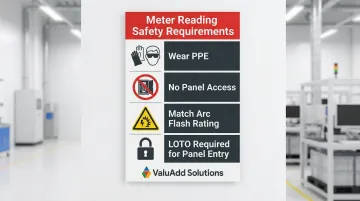
- Wear PPE: Safety glasses and minimum voltage-rated gloves are required when accessing any electrical panel area, even for visual reading only
- No panel access: Never open a metering panel enclosure, remove covers, or touch internal wiring. Meter reading is a non-intrusive task and does not require panel interior access
- Arc flash rating: PPE must match the incident energy level calculated for the specific panel
- LOTO first: If the panel door must be opened for any reason, a qualified electrician must complete a proper lockout/tagout assessment per OSHA 29 CFR 1910.147
Conclusion
Reading a 3-phase energy meter correctly—understanding each parameter, applying CT ratios, and checking for phase balance and power factor—gives production floor personnel direct visibility into electrical system health and what's driving energy costs.
That visibility has practical payoff. Regular, accurate readings speed up detection of equipment issues, support demand management decisions, and build the case for energy efficiency investments where they matter most.
Frequently Asked Questions
What is the difference between kW, kVA, and kVAr on a 3-phase energy meter?
kW is real power (what does useful work), kVAr is reactive power (drawn by inductive loads like motors), and kVA is apparent power (the total load the electrical system supplies). Power factor is the ratio of kW to kVA.
How do I know if my 3-phase meter uses a CT ratio multiplier?
The CT ratio is typically labeled on the current transformer itself, on the meter nameplate, or in the panel schedule. If the meter displays a "×CT" indicator or the readings seem far too low for the connected equipment load, a multiplier is definitely in use.
What does phase voltage imbalance look like on a 3-phase meter reading?
Imbalance appears as a noticeable difference between L1-N, L2-N, and L3-N (or line-to-line) readings. Calculate it as: (max deviation from average ÷ average) × 100. Values above 2% warrant investigation.
Can I read a 3-phase energy meter while equipment is running?
Yes. The display shows live system data without interrupting equipment operation, and readings taken under normal load give you the most useful baseline for comparison.
How often should 3-phase energy meters be read on the production floor?
At minimum, read monthly for billing reconciliation and weekly during energy efficiency programs or after equipment changes. If your meters support communication output, set up daily automated logging.
What is kW demand and why does it affect my facility's electricity bill?
kW demand is the peak average power draw over a set billing interval (typically 15 or 30 minutes). Most industrial utility tariffs charge separately for this peak — so even a brief surge in load can drive up your monthly bill regardless of overall kWh consumption.