Introduction
You're reviewing the spec sheet for a new junction box to mount on your facility's outdoor processing line. The vendor markets it as "waterproof" and "weatherproof," but the actual datasheet lists IP66. Meanwhile, another supplier offers an IP67 unit at a similar price. A third option carries IP65 but costs 20% less. Which one do you actually need?
Vague marketing terms like "waterproof" or "weatherproof" tell you nothing definitive. Without standardized criteria, you're left guessing whether your equipment will survive the environment—or fail within months, triggering costly downtime and replacement cycles.
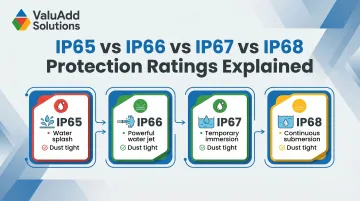
IP ratings exist to replace that ambiguity with testable, standardized criteria defined under IEC 60529. This post breaks down what IP65, IP66, IP67, and IP68 actually mean and how each rating is verified under standardized test conditions. You'll also get a practical framework for matching the right rating to your environment—so you don't pay for protection you don't need or cut corners where it counts.
Key Takeaways
- IP ratings quantify protection against solids and liquids using standardized IEC 60529 tests—not marketing claims
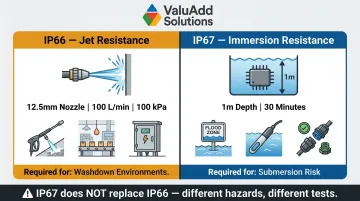
- IP67 does NOT replace IP66; immersion and jet tests measure different hazards
- Dual ratings like IP66/IP67 cover multi-hazard environments—but only when explicitly certified for both
- Match the rating to your actual hazard: rain → IP65, washdown → IP66, submersion → IP67/IP68
- Over-specifying increases cost and limits product options without adding real-world value
What Is an IP Rating and Why Does It Matter?
IP (Ingress Protection) is a classification system standardized under IEC 60529 that quantifies how well an electrical enclosure resists intrusion of solid particles and liquids. Each rating reflects a verified test result issued by an accredited independent laboratory — Intertek, UL Solutions, TÜV SÜD, and Nemko are among the most recognized — not a self-reported manufacturer claim.
Why This Matters for Industrial Applications
Choosing the wrong IP rating in environments like manufacturing floors, oil and gas facilities, or water treatment plants can lead to:
- Equipment failure from dust contamination or water ingress
- Electrical shorts and fire hazards
- Corrosion of internal components
- Unplanned downtime and expensive emergency replacements
- Safety incidents involving personnel
The financial exposure is real. According to FM Global, escaped liquids and liquid damage accounted for 58% of losses in finished facilities between 2012 and 2022. IP rating selection is a risk management decision — one that belongs in the engineering specification, not as an afterthought.
Understanding the "X" Notation
When a digit is replaced by X (e.g., IPX7), it means that specific protection category was not tested—not that protection is zero, but that no certification exists for it. In industrial settings, avoid X ratings whenever possible. Equipment operating in demanding or safety-sensitive environments requires certified dual-digit ratings with verified test results for both solid and liquid ingress.
Decoding the IP Code: What Each Digit Means
The IP code consists of two numerals: IP [First Digit] [Second Digit]
First Digit (0–6): Protection Against Solid Ingress
The first digit rates protection against solid objects and dust:
- 0 — No protection
- 1 — Protected against objects >50mm (such as hands)
- 2 — Protected against objects >12.5mm (such as fingers)
- 3 — Protected against objects >2.5mm (such as tools, thick wires)
- 4 — Protected against objects >1mm (such as most wires, screws)
- 5 — Dust-protected (ingress not entirely prevented but insufficient to interfere with operation)
- 6 — Dust-tight (no ingress of dust; complete protection)
For industrial and outdoor applications, a first digit of 6 is the baseline requirement. Anything lower risks dust contaminating sensitive electronics, motors, and control systems.
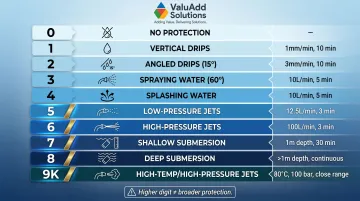
Second Digit (0–9K): Protection Against Liquid Ingress
The second digit rates protection against water and liquids:
- 0 — No protection
- 1 — Dripping water (vertical drops)
- 2 — Dripping water (up to 15° tilt)
- 3 — Spraying water (up to 60° from vertical)
- 4 — Splashing water (any direction)
- 5 — Water jets (low pressure, 12.5 L/min)
- 6 — Powerful water jets (high pressure, 100 L/min)
- 7 — Temporary immersion (up to 1m depth, 30 minutes)
- 8 — Continuous immersion (depth/duration specified by manufacturer)
- 9K — High-pressure, high-temperature steam jets (80°C, 8,000–10,000 kPa)
Test conditions shift dramatically between levels — spraying tests (IP65/IP66) and immersion tests (IP67/IP68) measure fundamentally different failure modes. That distinction leads to one of the most common specification mistakes in industrial equipment selection.
Critical Misconception: IP Ratings Are NOT Cumulative
IEC 60529 explicitly states that IP67 and IP68 enclosures are not rated for water jet exposure unless they carry separate IP65 or IP66 certifications. An IP67-rated device is tested for immersion — not jet resistance. A device that passes the IP67 immersion test can still fail an IP66 jet test when pressure forces water through seals.
Quick Reference Table
| IP Rating | Dust Protection | Water Test Type | Test Conditions | Typical Use Case |
|---|---|---|---|---|
| IP65 | Dust-tight (6) | Low-pressure jets (5) | 6.3mm nozzle, 12.5 L/min, 3m distance | Outdoor rain, light hose-down, general splash |
| IP66 | Dust-tight (6) | Powerful jets (6) | 12.5mm nozzle, 100 L/min, 100 kPa, 3m distance | High-pressure cleaning, marine spray, washdown zones |
| IP67 | Dust-tight (6) | Temporary immersion (7) | 1m depth, 30 minutes | Accidental submersion, flood-prone areas |
| IP68 | Dust-tight (6) | Continuous immersion (8) | Manufacturer-specified depth/duration (such as 1.5–3m, 24+ hours) | Underwater sensors, submersible pumps |
IP65 vs IP66 vs IP67 vs IP68: Side-by-Side Comparison
IP65 — Dust-Tight + Low-Pressure Water Jets
Test Conditions:
- 6.3mm nozzle
- 12.5 liters/min flow rate
- ~30 kPa pressure
- 2.5–3 meters distance
- Any direction
IP65 covers outdoor rain exposure, light hose-down, and general industrial splash environments. This meets the minimum requirement for outdoor industrial enclosures in non-washdown environments. It is not suitable for high-pressure cleaning or direct washdown procedures.
IP66 — Dust-Tight + Powerful Water Jets
Test Conditions:
- 12.5mm nozzle
- 100 liters/min flow rate
- 100 kPa pressure (14.5 psi)
- 2.5–3 meters distance
- Any direction
IP66 is required where high-pressure cleaning, heavy rain, marine spray, or industrial washdown is routine. It corresponds approximately to NEMA 4/4X in North American standards.
Typical applications include:
- Manufacturing washdown zones
- Food processing equipment (non-steam)
- Outdoor control panels in coastal areas
- Equipment subject to pressure washing
ValuAdd carries IP66-rated HMI displays (including the CM-eXT2-12W-R-DE) and control system enclosures built for demanding manufacturing environments.
IP67 — Dust-Tight + Temporary Immersion
Test Conditions:
- Up to 1 meter depth
- 30 minutes duration
- Hydrostatic pressure (not jets)
IP67 is designed for accidental submersion risk, not high-pressure cleaning. It suits connectors, sensors, and equipment in flood-prone areas.
Critical Limitation: IP67 does NOT imply IP66 protection. An IP67 device may fail a powerful jet test because the test methods are fundamentally different. Immersion creates uniform hydrostatic pressure, while jets create localized kinetic force that can lift seals.
IP68 — Dust-Tight + Continuous Immersion
Test Conditions:
- Manufacturer specifies depth and duration (commonly 1.5m–3m for 24+ hours)
- More severe than IP67 requirements
- Manufacturer and user agree on the specific depth and duration
IP68 is designed for permanently or regularly submerged equipment: underwater sensors, submersible pumps, and below-waterline controls.
It is not a replacement for IP66 or IP69K in washdown environments. IP68 tests for hydrostatic pressure, not high-velocity water jets.
ValuAdd offers IP68-rated HMI displays, including the CM-eXT2-07-R-DF and CM-eXT2-15W-RH-DF, for applications where submersion protection is required.
The IP67 vs IP66 Decision Trap
The ratings above make one thing clear: a higher second digit does not mean broader protection. Many engineers assume IP67 supersedes IP66 — it doesn't.
- IP67 certifies immersion resistance
- IP66 certifies jet resistance
These are different hazard scenarios. Equipment in a food processing plant that gets hose-washed daily needs IP66 (or IP69K), not IP67. Specifying IP67 in a washdown environment can result in equipment failure despite the higher second digit.
Dual Ratings: IP66/IP67 or IP66/IP68
Some products carry dual certifications, meaning they passed both jet and immersion tests independently. This is not automatic — it must be explicitly listed on the spec sheet.
To identify dual-rated products:
- Look for notation like "IP66/IP67" or "IP66/IP68" in the protection class specification
- Request test certificates showing both ratings
- Verify that both tests were conducted by accredited laboratories
Multi-hazard environments — outdoor equipment exposed to both pressure washing and flooding, for instance — require dual certification. A single rating leaves one hazard unaddressed.
Well-known dual-certified products include:
- SICK photoelectric sensors (IP66/IP67/IP69K)
- Phoenix Contact Ethernet switches (IP65/IP66/IP67)
- Rittal enclosures (IP66/NEMA 4X)
Real-World Applications Across Industrial Environments
Manufacturing Facilities and Processing Plants
Control panels, HMI displays, and VFD enclosures on factory floors typically require IP65 as a minimum for dust and light splash. In washdown zones or areas with coolant spray, IP66 becomes the baseline.
ValuAdd supplies IP65- and IP66-rated industrial components, including displays and control system enclosures, for factory floor use. The CM-eXT2-15W-R-DE (IP66) and CM-eXT04-D (IP65) HMI panels cover the most common manufacturing requirements.
Oil and Gas
Outdoor instrumentation, junction boxes, and control equipment on wellheads or refineries face:
- Driving rain
- Wind-blown particulates
- Occasional pressure washing
IP66 is typically the baseline. IP67 or IP68 may be required for subsurface or submerged sensing equipment such as tank level monitors or downhole sensors.
Municipal Water Treatment
Pump controls, level sensors, and monitoring displays are frequently installed near water contact surfaces, wet wells, or submerged in tanks.
IP66 covers above-water panels subject to hose-down; IP67 or IP68 is required for below-waterline installations.
Marine and Outdoor Installations
Salt spray, wave splash, and constant moisture require IP66 at minimum. For equipment on vessel decks or in tidal zones with submersion risk, IP67 or dual IP66/IP67 is the appropriate specification.
Food, Beverage, and Pharmaceutical
Daily or shift-end washdowns with hot water and detergents make IP69K the minimum for equipment in direct contact with the cleaning process. IP66 is adequate for equipment that is cleaned with a standard hose but not high-pressure steam jets.
ValuAdd offers IP69K-rated control and signaling devices (22mm and 30mm) specifically designed for food processing and pharmaceutical washdown applications.
How to Choose the Right IP Rating for Your Application
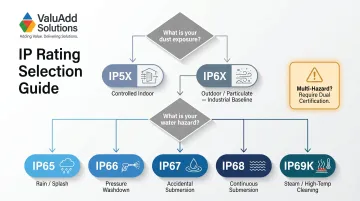
Step 1 — Identify the Dust Exposure Level
- Indoors with controlled air? IP5X may suffice
- Outdoor, construction, or any environment with fine particulate (e.g., cement, grain dust, metal filings)? Require IP6X (dust-tight) as a non-negotiable baseline
Step 2 — Identify the Water Hazard Type
Use this decision framework:
- Rain or splash → IP65
- Routine pressure washing or heavy outdoor spray → IP66
- Accidental or incidental submersion risk → IP67
- Continuous submersion → IP68
- High-pressure, high-temperature steam cleaning → IP69K
Step 3 — Avoid Over-Specifying
Specifying higher than necessary creates real drawbacks:
- Increases unit cost
- Narrows available product options
- Adds no real-world protection benefit for the actual hazard present
Example: An indoor control cabinet in a dry facility does not need IP68. Match the rating to the real environmental risk, not the highest number available.
Step 4 — Verify the Certification Is Genuine
IP ratings require third-party laboratory testing under IEC 60529. Self-declared ratings without test documentation cannot be trusted.
What to request:
- Test certificates from accredited labs (Intertek, UL, TÜV, Nemko, SGS)
- Compliance marks (UL, CE, FCC)
- Verification that both digits were tested (not X notation)
ValuAdd's enclosures and components carry UL, CE, and FCC certifications — with documentation available to confirm tested ratings across IP65, IP66, and IP68 designations.
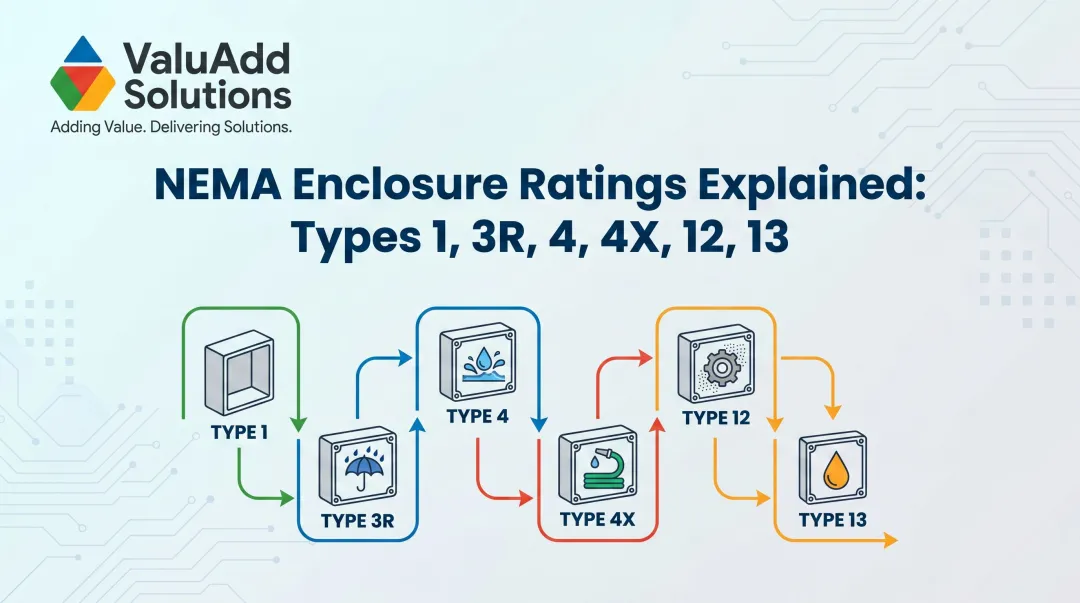
NEMA Equivalents and Additional Rating Context
NEMA 250 vs IEC 60529
In North America, electrical enclosures are frequently rated using NEMA 250 standards rather than (or alongside) IP codes. NEMA ratings account for additional factors IP ratings do not:
- Corrosion resistance
- Ice loading
- Hazardous atmosphere suitability
Industrially Relevant NEMA-to-IP Equivalents
| NEMA Type | Approximate IP Equivalent | Key Differences |
|---|---|---|
| NEMA 4 | IP66 | Adds external icing tests; protects against hose-directed water |
| NEMA 4X | IP66 | Same as NEMA 4 + corrosion resistance (200-hour salt spray test) |
| NEMA 6 | IP67 | Adds icing tests; protects against temporary submersion |
| NEMA 6P | IP68 | Adds corrosion resistance; protects against prolonged submersion |
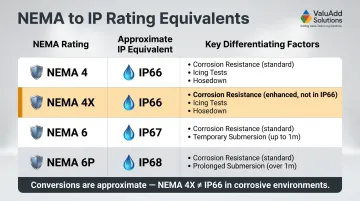
Critical Limitation: Conversions Are Approximate
A product meeting NEMA 4X has corrosion resistance requirements that IP66 does not mandate.
Example: Specifying an IP66 enclosure in a coastal or chemical environment is a specification mistake that can lead to corrosion failure. IP66 guarantees water jet protection but offers zero guarantee against rust. In these environments, NEMA 4X must be specified. When writing specs for US industrial installations, verify whether the NEMA or IP standard is referenced—do not assume one automatically satisfies the other.
ValuAdd offers products with dual IP and NEMA certifications, such as the CM-eXT2-12W-R-DF (IP68 + NEMA Type 4X and 12).
IP69K Context
Beyond the NEMA/IP overlap, a separate rating applies where washdown intensity exceeds what IP67 or IP68 tests address. IP69K (derived from DIN 40050-9, now superseded by ISO 20653) is the highest water ingress rating, designed for high-pressure/high-temperature steam jet cleaning.
Test Conditions:
- 80°C ± 5°C water temperature
- 80–100 bar pressure (8,000–10,000 kPa)
- 14–16 L/min flow rate
- 100–150mm distance
Important: IP69K does not imply submersion capability. For food processing, pharmaceutical, and heavy washdown industries, IP69K is the benchmark—distinct from IP67 or IP68 in both test method and use case.
Frequently Asked Questions
What IP rating is waterproof?
IP65, IP66, IP67, and IP68 all carry degrees of "waterproof" protection, but the term is relative. IP65 resists low-pressure jets, IP66 resists high-pressure jets, IP67 handles temporary immersion, and IP68 handles continuous immersion. True "waterproof" without qualification is a marketing term—always check the specific IP digit and test conditions.
Which IP waterproof is best?
"Best" depends entirely on the hazard. IP66 is best for washdown and jet exposure, IP67 is best for accidental immersion, IP68 is best for continuous submersion, and IP69K is best for steam-cleaning environments. There is no single best rating—the correct one matches your specific environment and hazard profile.
Is IP66 enough for heavy rain?
Yes. IP66 is more than adequate for heavy rain and is rated to withstand powerful water jets at 100 liters/min and 100 kPa pressure—conditions far exceeding even severe rainfall. It is the recommended minimum for outdoor industrial equipment exposed to weather.
Can IP68-rated equipment be used in submerged industrial applications?
IP68 is rated for continuous immersion at a manufacturer-specified depth—commonly 1–3 meters—making it suitable for submerged sensors, underwater instrumentation, and wet-area control components. The declared depth and duration vary by manufacturer, so always verify test conditions before deployment.
Does IP67 eliminate the need for IP66 in industrial environments?
Not necessarily. IP67 confirms immersion resistance but does not guarantee protection against sustained high-pressure water jets—the specific test IP66 covers. For washdown stations, outdoor spray environments, or food processing areas, IP66 (or IP66/67 dual-rated) enclosures are the more appropriate choice.