Introduction
OEM panel builders face a persistent challenge: specifying control panels across different markets often means encountering both NEMA and IP protection ratings—sometimes on the same project. Conflating these two standards can result in compliance failures, costly rework, or panels that are over-engineered for their environment.
Industry data shows that 25–40% cost overruns occur when equipment is rejected due to incorrect enclosure specifications, and approximately 18% of industrial equipment failures stem from inadequate water and dust protection.
This guide breaks down both rating systems—when each applies, how to read the equivalence table, and how to make the right call whether you're supplying domestic facilities, exporting to Europe, or managing a dual-market product line.
Key Takeaways
- NEMA ratings (NEMA 250) are the North American standard, covering corrosion, icing, oil resistance, and hazardous locations—beyond basic ingress protection
- IP ratings (IEC 60529) are the international standard, using a two-digit code specifically for solid and liquid ingress protection
- No direct conversion exists: NEMA generally meets or exceeds comparable IP ratings, but IP-certified products don't automatically satisfy NEMA requirements
- North American industrial builds typically require NEMA; export panels or globally specified equipment often mandate IP ratings instead
- Dual-certified components are the most practical choice for OEM panel builders supplying both markets
NEMA vs IP: Quick Comparison
Two dominant standards govern industrial enclosure ratings globally, but they serve fundamentally different regulatory frameworks and protection philosophies.
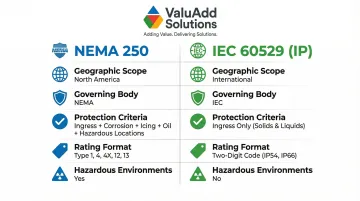
| Attribute | NEMA 250 | IEC 60529 (IP) |
|---|---|---|
| Geographic Scope | Primarily North America | International (EU, Asia-Pacific, Middle East) |
| Governing Body | National Electrical Manufacturers Association | International Electrotechnical Commission |
| Standard Number | NEMA 250-2020 | IEC 60529:2013 (Edition 2.2) |
| Protection Criteria | Ingress (solids/liquids) + corrosion + icing + oil exclusion + hazardous locations | Ingress protection only (solids and liquids) |
| Rating Format | Type designation (1, 4, 4X, 12, 13, etc.) | Two-digit code (IP54, IP65, IP66, etc.) |
| Hazardous Environments | Yes (Types 7, 8, 9, 10 for explosive atmospheres) | No (separate standards required) |
The Critical Equivalence Issue
NEMA ratings "meet or exceed" comparable IP ratings because NEMA testing includes additional protocols not required by IEC 60529. A NEMA 4X panel may legitimately carry an IP66 label, but an IP66-only panel does not automatically satisfy NEMA 4X requirements. The reason: NEMA 4X requires a 600-hour salt spray corrosion test, external ice formation testing, and oil exclusion testing—none of which are evaluated under IP66.
That one-way equivalence is where specification errors happen. OEM builders exporting panels to the EU under IP66 compliance, then selling the same enclosure domestically under NEMA 4X claims, face a compliance gap that neither standard's documentation will flag automatically. Both systems coexist across multi-geography projects—knowing which one governs your end-use environment prevents costly redesigns after the fact.
What Is the NEMA Rating System?
NEMA ratings are developed by the National Electrical Manufacturers Association under NEMA Standard 250. These ratings classify electrical enclosures by the environments they can withstand, covering ingress of solids and liquids, corrosion resistance, atmospheric gases, icing conditions, and hazardous location classifications.
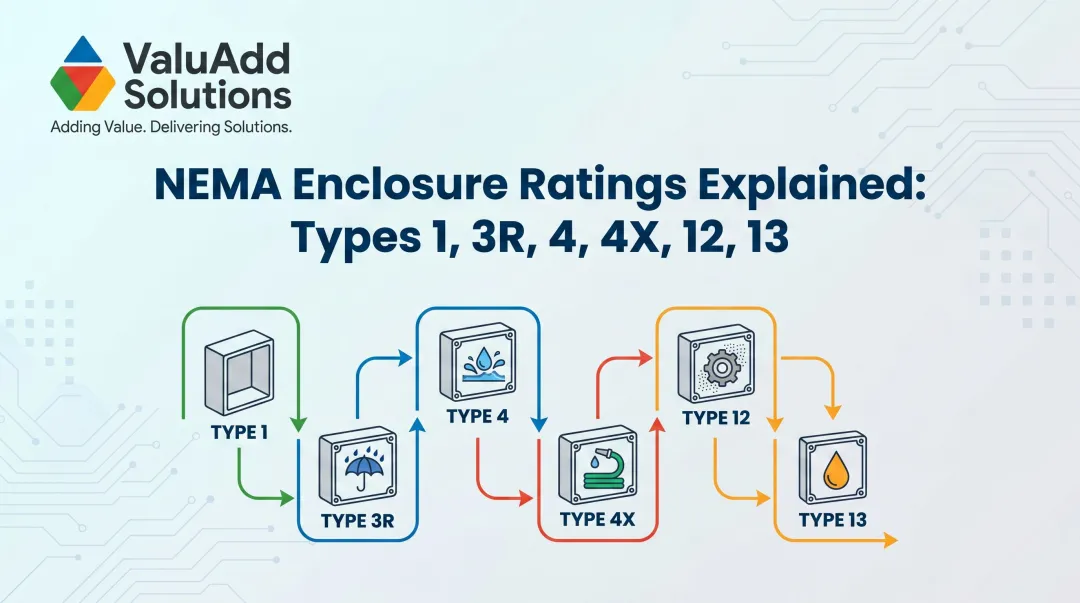
NEMA Types Most Relevant to OEM Panel Builders
Type 1 (Indoor, General Purpose):
- Protects personnel from hazardous parts and equipment from falling dirt
- Indoor use only, no outdoor or washdown protection
Type 4 (Indoor/Outdoor, Hose-Down and Windblown Dust):
- Protects against windblown dust, rain, splashing water, and hose-directed water
- Must remain undamaged by external ice formation
- Suitable for outdoor industrial installations
Type 4X (Type 4 + Corrosion Resistance):
- Requires 600-hour salt spray testing on top of all Type 4 protections
- Typically requires stainless steel or composite materials
- Ideal for coastal, chemical processing, food and beverage, and marine applications
Type 12 (Indoor Industrial, Dust and Drip Protection):
- Protects against circulating dust, falling dirt, and dripping non-corrosive liquids
- Includes protection against oil and coolant seepage
- Common in machining environments and manufacturing floors
Type 13 (Indoor, Oil and Coolant Spray):
- Protects against dust, spraying water, and oil/coolant spraying and splashing
- Designed for machine tool environments with active coolant systems
What NEMA Tests That IP Does Not
NEMA 250 includes mandatory tests that IEC 60529 does not evaluate:
- Icing Condition Testing: External mechanisms must operate when ice-laden (Types 3, 3S, 4, 4X, 6)
- Corrosion Resistance Testing: 600-hour salt spray test for Type 4X enclosures
- Oil Exclusion Testing: Gasket tests for oil resistance (Types 12, 13)
- Hazardous Location Ratings: Class I/II/Division classifications for explosive atmospheres defined in NFPA 70
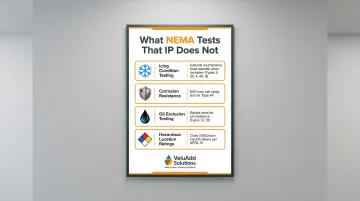
These additional criteria explain why NEMA remains the preferred standard for North American industrial panels, particularly in oil and gas, chemical processing, and outdoor installations.
The UL Connection
In North America, NEMA-rated enclosures are typically UL Listed under UL 508A for industrial control panels. While NEMA publishes the standard, it does not certify products. UL (Underwriters Laboratories) tests enclosures to UL 50/50E, which mirrors NEMA 250 requirements.
That distinction has direct consequences at the job site. OEM panel builders should verify both NEMA type compliance and UL listing when sourcing components. The Authority Having Jurisdiction (AHJ)—defined by NFPA 70 as the organization or individual responsible for enforcing code—typically requires third-party certification (UL Listed) rather than a manufacturer's self-declared NEMA rating. This matters for inspection sign-off and project commissioning.
This component-level verification is where OEM builders often get tripped up. An enclosure may be rated Type 4X, but displays, operator interfaces, and control devices mounted through panel cutouts must carry their own independent ratings. ValuAdd sources and supplies components with NEMA Type 4X and 12 compliance alongside UL Listed certification specifically to address this gap.
What Is the IP Rating System?
The International Electrotechnical Commission establishes IP ratings under IEC Standard 60529. An IP rating uses a two-digit code where the first digit (0–6) rates protection against solid particle ingress and the second digit (0–9) rates protection against liquid ingress. Both digits must be read together to understand the full protection level.
Breaking Down the IP Digit Scale
First Digit (Solid Particle Protection):
- IP5X (Dust Protected): Limited ingress allowed; does not interfere with equipment operation
- IP6X (Dust Tight): No ingress of dust; complete protection against contact
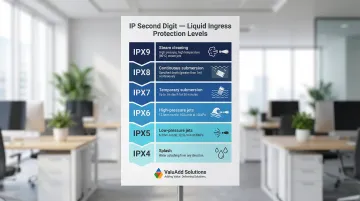
Second Digit (Liquid Ingress Protection):
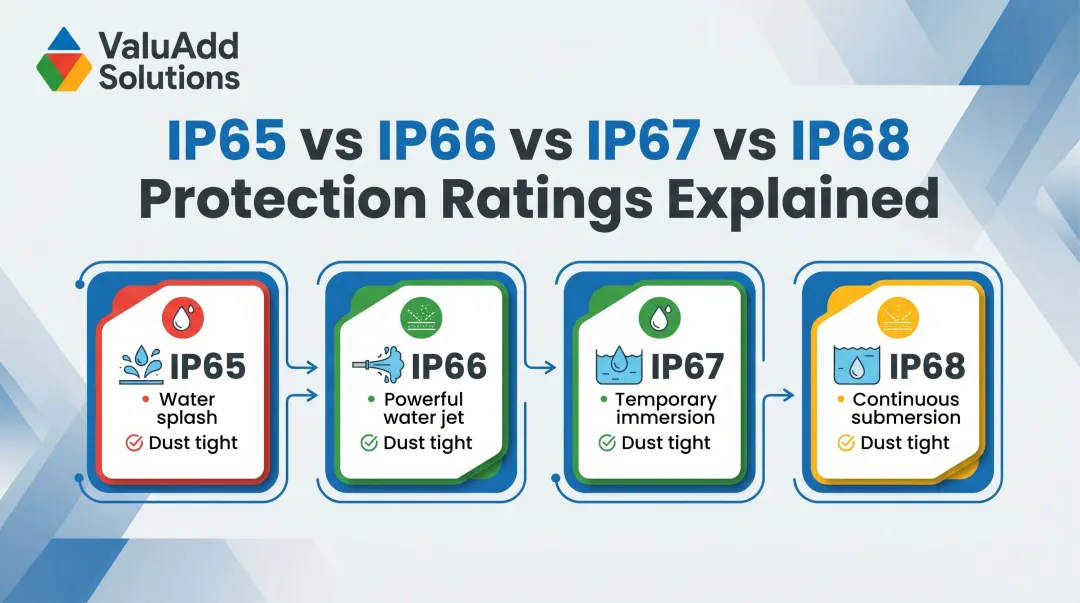
- IPX4 (Splash from Any Direction): Protection against water splashing from any direction
- IPX5 (Low-Pressure Jets): Protection against water jets (12.5 L/min at 30 kPa)
- IPX6 (High-Pressure Jets): Protection against powerful water jets (100 L/min at 100 kPa)
- IPX7 (Temporary Submersion): Immersion up to 1 meter depth for 30 minutes
- IPX8 (Continuous Submersion): Continuous immersion beyond 1 meter (manufacturer-specified conditions)
- IPX9 (High-Pressure, High-Temperature Jets): Withstands high-pressure steam cleaning at 80°C and 8–10 MPa — the most demanding liquid test in the scale
IP Ratings Common in Industrial OEM Panel Applications
| Rating | Protection Level | Typical OEM Application |
|---|---|---|
| IP54 | Dust protected, splash resistant | Indoor enclosures with incidental washdown exposure |
| IP65 | Dust-tight, low-pressure jets | Food and beverage processing, light hose-down areas |
| IP66 | Dust-tight, high-pressure jets | Outdoor industrial enclosures, pressure-wash environments |
| IP67 | Dust-tight, temporary submersion (1 m / 30 min) | Marine, water treatment, hazardous washdown |
| IP68 | Dust-tight, continuous submersion (manufacturer-defined depth) | Submerged equipment, flood-prone installations |
Geographic Relevance
IP ratings are the standard required for CE-marked equipment sold in the European Union under the Low Voltage Directive (2014/35/EU) and Machinery Directive (2006/42/EC). They are widely used in Asia-Pacific and Middle Eastern markets. OEM panel builders exporting panels or integrating globally sourced components will routinely encounter IP ratings on datasheets and customer specifications. That global reach, however, comes with a critical gap that catches many builders off guard.
The Key Limitation
IP ratings do not evaluate corrosion resistance, performance under icing conditions, protection against atmospheric gases (like acetylene or gasoline vapors), or hazardous location safety classifications. OEM builders who mistake a high IP number for full environmental suitability risk selecting components that fail in corrosive or explosive-atmosphere environments.
One documented case illustrates the cost directly: a coastal facility replaced its IP66 panels after just 18 months due to salt-air corrosion, at a cost exceeding $50,000 in parts and downtime.
The specifier had assumed IP66 was equivalent to NEMA 4X. It isn't — IP ratings do not test for corrosion resistance at all.
NEMA vs IP: Which Standard Should OEM Panel Builders Specify?
The choice between NEMA and IP depends on four factors: end-use geography, installation environment, regulatory compliance requirements, and product line scope — single customer vs. multi-market.
When to Specify NEMA
Use NEMA ratings for:
- Panels destined for North American industrial facilities
- Manufacturing floors, oil and gas sites, water treatment plants
- Any application requiring UL-listed compliance
- Environments with corrosion risk (coastal, chemical processing)
- Installations subject to icing conditions
- Hazardous location classifications (Class I/II/Division)
Specific recommendations:
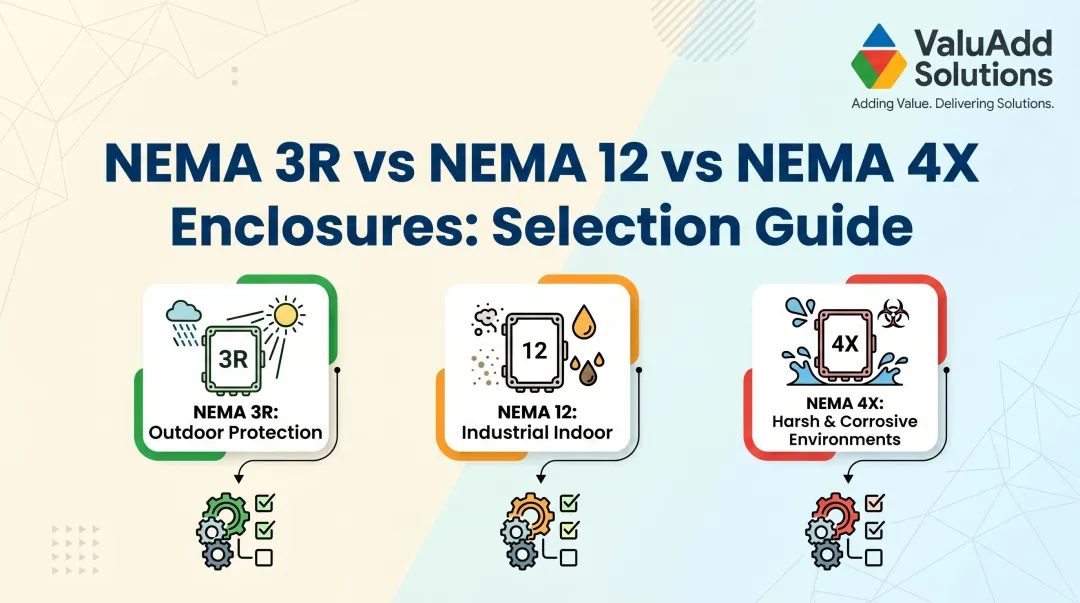
- NEMA 4X: Outdoor or corrosive environments (salt air, chemical exposure, food processing washdown)
- NEMA 12: Indoor industrial environments with dust and drip exposure (machine shops, manufacturing floors)
- NEMA 13: Indoor environments with oil and coolant spray (CNC machining centers, metalworking)
When to Specify IP
Use IP ratings for:
- Panels exported to Europe, Asia-Pacific, or globally
- Customer specifications that explicitly call out IP ratings
- CE marking compliance requirements
- Food and beverage, pharmaceutical, and marine sectors with international standards
Specific recommendations:
- IP65 minimum: Light industrial wash-down scenarios (food processing, pharmaceutical clean rooms)
- IP66 or higher: High-pressure cleaning environments (dairy processing, beverage production)
- IP67/IP68: Submersion risk applications (marine, water treatment, outdoor harsh environments)
When You Need Both
Most OEM builders don't serve just one market. When your panel platforms ship to both North American and international customers, sourcing components with dual certification (for example, NEMA 4X / IP66) eliminates the need for separate BOM versions. This approach:
- Reduces SKU complexity across product lines
- Simplifies documentation packages for different markets
- Ensures panels can be sold to any market without requalification
- Eliminates the risk of specification errors during order entry
ValuAdd's Cimon HMI displays carry both NEMA Type 4X and IP68 ratings, making them a practical fit for OEM builders who need a single component spec to cover multiple markets.
Situational Recommendations
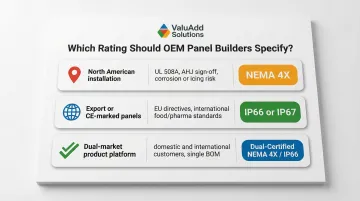
| Scenario | Recommended Rating |
|---|---|
| North American outdoor or corrosive install; UL 508A / AHJ sign-off required | NEMA 4X |
| Export panels, CE marking, or international food safety standards (IEC) | IP66 or IP67 |
| Standard panel platforms sold across domestic and international markets | Dual-certified (NEMA 4X / IP66 or higher) |
Real-World Application Scenarios for OEM Panel Builders
Scenario 1: North American Washdown Application
An OEM panel builder specs a control panel for a food processing facility in the United States. The customer requires NEMA 4X due to daily high-pressure washdown procedures and exposure to cleaning chemicals.
The enclosure rating alone does not guarantee the panel rating if cutout-mounted components are rated lower. Every panel-mount component — operator interfaces, displays, cable glands — must independently carry NEMA 4X or minimum IP66 ratings.
A common failure: installing standard IP65 pushbuttons in a NEMA 4X enclosure. Water enters through button cutouts during washdown and shorts internal controls. The panel effectively degrades to its lowest-rated component.
Components to verify before specifying:
- Operator pushbuttons and selector switches (minimum IP66/NEMA 4X)
- HMI displays — ValuAdd's Cimon displays carry IP68 front protection and NEMA Type 4X compliance
- Cable glands and conduit fittings rated for high-pressure wash
- Door-mount instruments and indicators
Scenario 2: Export Panel for European Customer
An OEM builds a motor control panel for a European pharmaceutical customer. The specification requires IP65 minimum with CE marking for compliance with EU directives.
Every component — not just the enclosure shell — must meet IP65. NEMA-only rated components cannot satisfy this requirement without independent IP verification.
The most common mistake here is assuming a NEMA 12 component automatically qualifies. NEMA 12 is approximately equivalent to IP52, which falls well short of the IP65 threshold for directed water jets. Source components with verified IP65 or higher ratings and retain documentation — declarations of conformity and test reports — for CE marking technical files.
Scenario 3: Dual-Market Product Platform
An OEM builds a standard control panel platform sold to both North American and European industrial customers. Maintaining separate BOMs for each market creates engineering overhead, documentation burden, and inventory complexity.
The cleaner path is sourcing components certified across both standards. ValuAdd's industrial-grade components carry NEMA 4X/12 and IP65/66 ratings, letting a single BOM cover both markets and cut the compliance documentation burden in half.
For dual-market builds, ValuAdd's technical team can help match component specifications to both NEMA and IP requirements before the design is finalized — avoiding costly substitutions during production.
Conclusion
Neither NEMA nor IP is universally superior. NEMA is the appropriate choice for North American industrial compliance and offers broader environmental protection criteria — including corrosion resistance, icing, and hazardous location classifications. IP is the correct framework for international builds and IEC-compliant specifications required for CE marking.
OEM panel builders must apply the right standard based on geography, environment, and customer requirements. The consequences of getting it wrong are concrete:
- Premature component failure in mismatched environments
- Regulatory non-compliance blocking product approval
- Costly field replacements and unplanned production downtime
Speccing the correct rating upfront costs far less than fixing it post-commissioning. Documented failures have cost facilities $15,000 to $50,000 in replacement equipment and lost production.
Frequently Asked Questions
Is NEMA 4X equivalent to IP66?
NEMA 4X generally meets or exceeds IP66 requirements, but equivalency is approximate. NEMA 4X includes additional tests for corrosion resistance (600-hour salt spray) not evaluated in IP66, so a NEMA 4X panel satisfies IP66 requirements but not necessarily the reverse.
Can an IP-rated enclosure meet NEMA standards?
An IP-rated enclosure does not automatically satisfy NEMA standards because NEMA testing includes criteria—icing, corrosion, oil resistance, hazardous location ratings—that IP ratings do not address. OEM builders should verify NEMA compliance independently rather than assuming it from the IP rating.
Do OEM panel builders need both NEMA and IP ratings on their panels?
It depends on the target market. North American panels typically require NEMA ratings; international or CE-marked panels require IP ratings. Builders targeting both markets should specify dual-certified components to avoid separate qualification processes.
What is the difference between NEMA 4 and NEMA 4X?
Both protect against windblown dust, rain, splashing water, and hose-directed water for indoor and outdoor use. NEMA 4X adds corrosion resistance via 600-hour salt spray testing—the right choice for coastal, chemical processing, food and beverage, and marine environments.
Which IP rating corresponds to NEMA 12?
NEMA 12 is approximately equivalent to IP52. It is designed for indoor industrial use, protecting against circulating dust, falling dirt, and dripping non-corrosive liquids, but is not rated for outdoor use or hose-directed water.