Introduction
AC motors run at a fixed speed determined by supply frequency and pole count. That works fine when a process never changes — but most industrial processes aren't that simple. Pumps need to match flow demand. Fans need to modulate airflow. Conveyors need to adjust throughput. Running a motor at full speed regardless of actual load wastes energy and accelerates wear.
The U.S. Department of Energy has consistently estimated that electric motors account for roughly 60–65% of all industrial electricity use in the U.S. — a figure that has held steady for decades. Speed control is one of the most direct levers available to cut that consumption.
This guide covers the three primary AC motor speed control methods — Variable Frequency Drives, voltage/phase control, and pole changing — how each works, where each fits, and what to evaluate before selecting one.
Key Takeaways
- AC motor speed control adjusts RPM to match actual process demand rather than running at fixed full speed
- The three primary methods are VFDs, voltage/phase control (TRIAC-based), and pole changing
- VFDs deliver continuous variable speed with the best energy savings; phase control suits small single-phase loads; pole changing provides fixed discrete speeds with no electronics required
- The right method depends on motor type, speed range needed, load characteristics, and operating environment
- Mismatching control method to application causes motor stress, energy waste, and premature failure
What Is AC Motor Speed Control?
AC motor speed control refers to any method that intentionally alters a motor's rotational speed away from its natural synchronous speed. That synchronous speed is fixed by two variables: supply frequency and pole count.
The standard formula: Ns = (120 × f) / P
A 4-pole motor at 60 Hz runs at 1,800 RPM. Change the frequency, change the poles, or reduce the voltage — and the speed shifts. Speed control is about using that relationship deliberately to match motor output to what the process actually needs at any given moment.
This isn't a niche controls concept. Speed control applies directly to:
- Pumps and fans, where flow demand shifts continuously throughout operation
- Compressors, where output pressure must track process setpoints
- Conveyors, where line speed must sync with upstream and downstream equipment
- Process machinery, where consistent speed directly affects material quality and yield
In each of these applications, running a motor at full speed regardless of actual load wastes energy and accelerates wear. The methods covered in this guide each address that problem differently — with trade-offs in cost, precision, and complexity.
Why AC Motor Speed Control Matters in Industrial Applications
How Speed Reduction Cuts Energy Costs
Running a motor at full speed when the process only needs 80% output carries a steep power penalty. DOE's Variable Frequency Drive Evaluation Protocol shows that for variable-torque loads like fans and pumps, power varies approximately with the cube of speed. A 20% speed reduction can yield nearly 50% energy savings.
For facilities running multiple large motors — pumps, fans, compressors — that compounding effect adds up fast on the utility bill.
Consequences of Running Motors at Fixed Speed
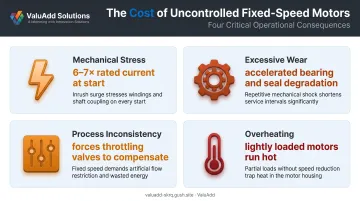
Beyond energy waste, the operational damage from uncontrolled motors compounds over time:
- Mechanical stress — direct-on-line starting draws 6–7× rated current (per ABB), creating electrical and mechanical shock loads every start cycle
- Excessive wear — abrupt starts and stops accelerate bearing, coupling, and seal degradation
- Process inconsistency — a motor locked at full speed can't respond to changing demand, forcing throttling valves and dampers to do the work inefficiently
- Overheating — motors running lightly loaded without thermal management run hot
Broader Industrial Impact
Beyond energy, speed control ties directly to:
- Process repeatability in manufacturing and batch processing
- Flow regulation in water treatment and oil & gas applications
- Compliance with IEEE 519-2022 harmonic limits — relevant wherever VFDs share infrastructure with sensitive equipment
- Equipment longevity by eliminating thermal and mechanical stress cycles
Types of AC Motor Speed Control Methods
No single method fits every application. The right choice depends on motor type (single-phase vs. three-phase), load characteristics, required speed range, and how much system complexity the installation can support. Here's how the three primary methods compare. Each section covers how it works, where it fits best, and where it falls short.
Variable Frequency Drive (VFD)
How it works: A VFD converts incoming AC to DC through a rectifier, then uses a PWM inverter to reconstruct AC output at an adjustable frequency and voltage. Motor speed follows output frequency directly. Voltage scales proportionally with frequency to maintain constant torque (constant V/Hz ratio).
What sets it apart: VFDs control both frequency and voltage simultaneously. That's what enables smooth, continuous speed variation across a wide range — something neither phase control nor pole changing can do.
Best suited for: Three-phase induction motors in pumps, fans, compressors, and conveyors where wide speed ranges, process precision, and energy efficiency matter. Common applications include water treatment, oil and gas, and manufacturing.
Key strengths:
- Widest speed control range of any method
- Maintains stable torque across speed range via constant V/Hz
- Substantial energy savings at partial loads — especially on centrifugal equipment
- Supports soft start/stop, dynamic torque boost, and closed-loop PID process feedback
- Advanced models like ValuAdd's H2 519/519P Series achieve less than 8% THDv and 5% TDDi, meeting IEEE 519-2014 Table 1 and Table 2 compliance — critical for facilities with shared power infrastructure or sensitive equipment
Limitations:
- Higher upfront cost and installation complexity
- Standard motors may not handle PWM switching stress — inverter-duty rated motors are strongly recommended (per NEMA MG 1 Part 31)
- Can introduce harmonics into facility power systems without proper specification
- Requires careful sizing based on motor characteristics and load type
Voltage/Phase Control (TRIAC-Based)
A TRIAC (bidirectional semiconductor switch) "chops" portions of the AC waveform, reducing the effective RMS voltage delivered to the motor. Lower voltage shifts the motor's speed-torque curve, producing a lower operating speed. This method only modulates voltage — not frequency. Speed change is an indirect result of the torque-speed curve shifting under reduced voltage, making it inherently less precise than frequency-based control.
Best suited for single-phase AC induction motors in lower-power, cost-sensitive applications — small fans, light machinery, lab equipment, and appliances — where a modest speed reduction within a narrow range is acceptable and load torque stays relatively stable.
Key strengths:
- Simple, low-cost circuitry
- Lower electrical noise than high-frequency PWM switching
- Adequate for applications where exact speed precision isn't required
Limitations:
- Narrow effective speed range — too much voltage reduction risks instability and stalling
- Motor torque drops with the square of applied voltage (per ABB), severely limiting performance at lower speeds under load
- Speed accuracy degrades without a feedback device (such as a tachogenerator or encoder)
- Not appropriate for three-phase motors or variable-torque industrial applications
Pole Changing
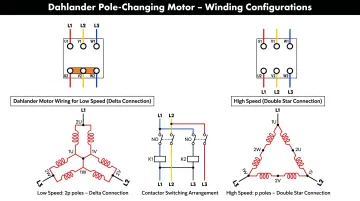
Pole-changeable motors use special multi-winding designs — either Dahlander connection or separate windings — that allow external switching contactors to change the number of active magnetic poles. Since synchronous speed is tied directly to pole count, switching from 4 poles to 8 poles halves the speed — at 60 Hz, that means dropping from 1,800 RPM to 900 RPM. No power electronics are involved; speed changes happen through electromechanical switching alone, but only to pre-set discrete steps.
Best suited for applications requiring two or three fixed operating speeds — multi-speed conveyor systems, HVAC fans with high/medium/low settings, and older industrial machinery where simplicity and robustness outweigh flexibility.
Key strengths:
- Highly robust — no sensitive power electronics to fail
- Low maintenance requirements
- Straightforward operation and low cost for fixed-speed applications
Limitations:
- Only discrete, preset speed steps — no intermediate speeds possible
- Requires a specially wound multi-speed motor (more expensive than standard)
- Inflexible when process requirements change
- VFDs increasingly replace pole-changing in new installations requiring variable or precise speed
How to Choose the Right AC Motor Speed Control Method
The right method comes from application fit, not from familiarity or which technology is most advanced. Here's how to work through the decision.
Motor Type and Configuration
Start with motor type — it immediately eliminates incompatible methods:
- Single-phase motors → voltage/phase control is the primary option; VFDs are available with derating but add cost
- Three-phase motors → VFDs and pole changing both apply; phase control is not appropriate
Required Speed Range and Precision
| Requirement | Best Method |
|---|---|
| Continuous variable speed across wide range | VFD |
| Modest variation within a narrow band | Voltage/phase control |
| Two or three fixed preset speeds | Pole changing |
Load Characteristics
Load type is one of the most decisive factors:
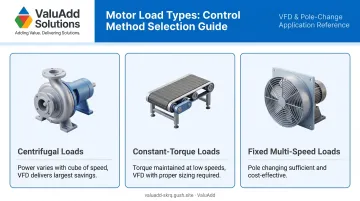
- Centrifugal loads (pumps, fans): Power follows the cube of speed — VFDs deliver the largest energy savings here
- Constant-torque loads (conveyors): Torque must be maintained at low speeds — VFDs with proper sizing handle this; phase control cannot
- Fixed multi-speed loads (multi-speed HVAC fans): Pole changing may be sufficient and cost-effective
Budget and Total Cost of Ownership
Don't evaluate cost on purchase price alone:
- Phase control — lowest upfront cost, but limited application scope
- Pole changing — moderate motor cost, minimal electronics cost, but requires a purpose-built motor
- VFD — highest upfront investment, but energy savings on variable-load applications typically pay back within 2–3 years
For sizing reference, ValuAdd's H2 Series spans 0.5 HP to 800 HP, with medium-voltage drives reaching 12,000 HP for large industrial applications.
Operating Environment and Compliance
- Wet/washdown environments: Require IP65, IP66, or IP68 ratings (per IEC 60529). ValuAdd's SW Series Washdown Drives carry IP66/UL Type 4X certification specifically for high-pressure washdown settings
- Harmonic-sensitive facilities: Require IEEE 519-compliant drives or supplemental mitigation; shared power infrastructure with sensitive equipment demands this review
- Municipal and mission-critical installations: Often specify drives with 18-pulse or multi-level topology for clean power output
Matching method to environment from the start avoids costly retrofits and compliance gaps down the line.
What to Check Before Finalizing Your Speed Control Method
A few verification steps prevent expensive mistakes after installation:
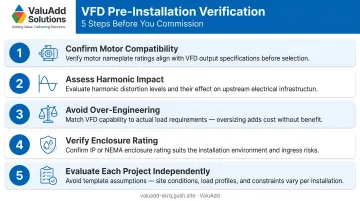
Confirm motor compatibility. Standard AC motors may not handle the PWM switching stress from a VFD. NEMA MG 1 Part 31 covers inverter-duty ratings for motors up to 5,000 HP and 7,200 V — confirm the motor carries this rating before specifying a VFD.
Assess harmonic impact. VFDs introduce harmonics at the point of common coupling. Facilities with shared electrical infrastructure or sensitive equipment on the same bus need a harmonic study before drive installation. IEEE 519-2022 is the governing standard.
Don't over-engineer the solution. A full VFD installation on a small single-phase fan application where phase control would perform adequately adds cost and complexity without operational benefit.
Verify enclosure rating for the environment. IP20 is fine for a clean control room; IP66 or higher is required for washdown or outdoor environments. Specifying the wrong rating creates compliance and reliability issues.
Don't default to what's familiar. The most common technology at a facility isn't always the best fit for the next application. Evaluate load type, speed requirements, and environment for each project independently.
These five checks handle most straightforward applications. Where requirements go beyond them — particularly in water treatment, oil and gas, or large manufacturing facilities where multiple motor control technologies coexist on the same system — consult an application engineer before locking in specifications. A mismatched drive or enclosure rating discovered after installation can mean unplanned downtime, equipment replacement, and rework costs that far exceed the original component price.
Conclusion
AC motor speed control isn't a single solution — it's a toolkit. VFDs, voltage/phase control, and pole changing each serve distinct needs. VFDs handle variable-speed, energy-critical applications on three-phase motors. Phase control suits single-phase, low-power applications with modest speed range requirements. Pole changing delivers fixed discrete speeds where simplicity and robustness matter more than flexibility.
Matching the method to the motor type, load behavior, speed range, and environment is where the real engineering work happens. The right match returns the investment through lower energy bills, reduced maintenance intervals, longer motor life, and fewer unplanned shutdowns. The wrong one introduces inefficiency and wear that no amount of advanced technology can offset — no matter how capable the drive.
Frequently Asked Questions
How do you control the speed of an AC motor?
AC motor speed is controlled through VFDs (which vary supply frequency and voltage), voltage/phase control (which reduces effective voltage to the motor), or pole changing (which switches the number of active stator poles). Each method suits different motor types and application requirements, so selection depends on the specific load and performance needs.
What is the difference between a VFD and a soft starter for AC motors?
A VFD continuously regulates motor speed throughout operation by varying frequency and voltage. A soft starter only manages the ramp-up and ramp-down at start and stop — it does not control running speed. If continuous speed variation is needed, use a VFD. If controlled starting is the only requirement, a soft starter is the simpler and more cost-effective option.
Can you control the speed of a single-phase AC induction motor?
Yes, within a limited range using voltage/phase (TRIAC-based) control. This works best when load torque is relatively stable. Wide-range speed control on a single-phase motor is difficult — for demanding variable-speed applications, switching to a three-phase motor and VFD is the more practical solution.
What is the most energy-efficient AC motor speed control method?
VFDs are most efficient for variable-load applications like pumps and fans. Because power varies with approximately the cube of speed, a 20% speed reduction on a centrifugal load can save nearly 50% of energy consumed — a figure supported by DOE data on centrifugal load behavior.
Do AC motors need a special rating when used with a VFD?
Yes. Standard AC motors can experience insulation degradation from PWM switching voltage spikes, so inverter-duty motors rated to NEMA MG 1 Part 31 are required for reliable VFD operation — not just recommended.
What happens to torque when AC motor speed is reduced?
It depends on the method. VFDs maintain relatively constant torque by holding the voltage-to-frequency ratio constant as speed changes. Voltage/phase control reduces available torque as voltage drops (torque falls with the square of voltage), which can cause stalling under heavy loads at lower speeds.