Introduction
Electric motor-driven systems account for 53% of global electricity consumption, rising to 72% within industrial facilities. This massive energy footprint makes motors the single largest consumer of electricity in manufacturing plants, water treatment stations, and oil and gas operations. Yet most facilities overlook one of the leading causes of motor damage and unplanned downtime: uncontrolled startups.
Approximately 30% of motor failures are electrical in nature, with excessive starts explicitly linked to rotor and stator degradation. Direct-on-line (DOL) starting draws 6–8 times full load amps (FLA), creating severe mechanical torque spikes that stress couplings, gearboxes, and motor windings.
The thermal cycling from repeated high-current startups accelerates insulation breakdown. In pumping systems, pressure transients from abrupt starts can also trigger water hammer events that damage piping and valves.
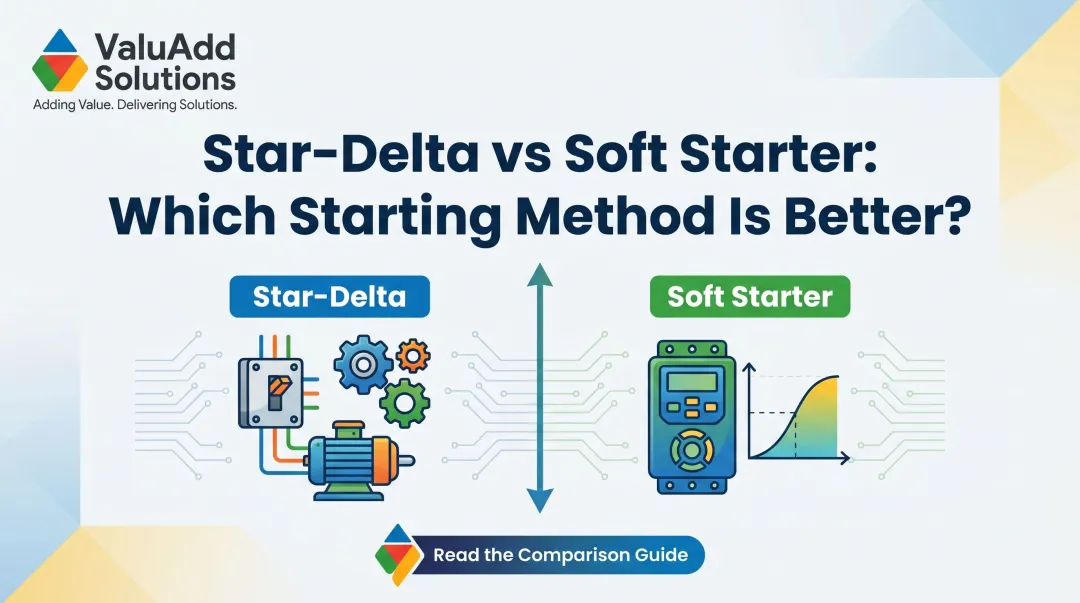
Both soft starters and variable frequency drives (VFDs) protect motors during startup, reduce inrush current, and extend equipment life, but they serve fundamentally different operational roles. Choosing the wrong technology leads to oversized costs, underperforming systems, or missed energy savings. This article breaks down when each technology makes sense, what trade-offs matter for your application, and how to avoid the most common selection mistakes.
Key Takeaways
- Soft starters gradually ramp voltage at startup to cut inrush current to 3–5× FLA (vs. 6–8× with DOL), then bypass once the motor reaches full speed
- VFDs control voltage and frequency continuously throughout operation—delivering variable speed, torque control, and 20–50% energy savings on variable-torque loads
- Soft starters cost less upfront and work best for fixed-speed applications like pumps, fans, and conveyors needing only smooth startup
- For HVAC and pumping applications, VFD energy savings typically recover the upfront cost within 12–36 months
- The right choice depends on whether your application needs speed control during operation—not just at startup
Soft Starter vs. VFD: At a Glance
| Aspect | Soft Starter | Variable Frequency Drive (VFD) |
|---|---|---|
| Primary Function | Ramps voltage during startup; bypasses at full speed | Controls voltage and frequency continuously throughout operation |
| Speed Control | No speed variation during operation | Adjustable speed from 0–100% at any time |
| Energy Efficiency | Minimal savings (only during brief startup phase) | 20–50% savings on variable-torque loads via affinity laws |
| Inrush Current | Reduces to 3–5× FLA (vs. 6–8× DOL) | Reduces to 1.5–2× FLA with controlled ramp |
| Initial Cost | $500–$3,000 for typical industrial sizes | $1,500–$10,000+ for comparable power ratings |
| Installation Complexity | Simple wiring, compact footprint | Needs ventilation, harmonic mitigation, and programming |
| Application Fit | Fixed-speed loads: pumps, HVAC fans, conveyors | Variable-torque loads: process pumps, mixers, variable-flow HVAC |
| Stopping Capability | Basic controlled deceleration | Programmable ramp-down, dynamic braking, coast-to-stop |
Both devices limit inrush current. VFDs add more complex internal hardware — requiring additional space, cooling, and setup — while soft starters remain compact and straightforward, a practical fit for retrofit applications with tight panel space.
What Is a Soft Starter?
A soft starter is a solid-state device that uses silicon-controlled rectifier (SCR) or thyristor technology to gradually increase voltage to the motor during startup. By controlling the firing angle of the SCRs, the soft starter limits inrush current and reduces mechanical torque spikes that damage couplings and gearboxes.
Once the motor reaches full operating speed, the soft starter is bypassed via a contactor, and the motor runs directly on line voltage. Protection applies only during the acceleration and deceleration phases; the soft starter plays no role in speed control during normal operation. That's precisely what makes it the right tool for fixed-speed applications that simply need a controlled ramp-up.
How Soft Starters Extend Motor Life
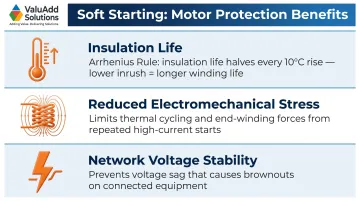
By controlling the rate of voltage rise, soft starters reduce the initial current surge from 6–8× FLA (typical with DOL starting) to approximately 3× FLA unloaded or 5× FLA under load. This directly impacts motor longevity in several ways:
- High inrush currents generate significant heat that degrades motor insulation. The Arrhenius Rule states that insulation life drops by 50% for every 10°C rise in operating temperature—lower inrush means longer winding life.
- Starting current produces severe electromechanical forces on end windings, and repeated thermal cycling compounds that stress over time. Soft starting significantly reduces both effects.
- Reducing peak inrush also prevents voltage sag across the electrical network, protecting other connected equipment from brownout conditions.
Types of Soft Starters
| Type | Voltage Range | Best For |
|---|---|---|
| Standard Three-Phase | Low voltage | General industrial applications requiring balanced phase control |
| Two-Phase | Low voltage | Cost-sensitive applications with forgiving load profiles |
| Medium Voltage | 2.3kV–13.8kV | High-power facilities such as oil and gas or municipal water treatment |
Use Cases of a Soft Starter
Soft starters fit best in fixed-speed applications where the motor needs controlled ramp-up but operates at constant speed thereafter:
- Centrifugal pumps in municipal water treatment: Prevents water hammer (pressure transients) during startup and shutdown, eliminating burst pipes and equipment damage
- HVAC fans and blowers: Reduces belt stress and bearing wear during daily start-stop cycles
- Belt-driven conveyors: Prevents material spillage and belt slippage during acceleration
- Compressors in oil and gas facilities: Protects motor windings and reduces stress on mechanical seals
For applications where speed variation is never needed, a VFD means spending 2–3× more on hardware and installation for capabilities that will never be used. Soft starters deliver the same motor protection at a fraction of the total cost.
What Is a Variable Frequency Drive (VFD)?
A VFD converts incoming AC power to DC (rectifier stage), filters and smooths it (DC bus), then inverts it back to AC at an adjustable frequency and voltage (inverter stage). Three hardware stages, one result: continuously adjustable motor speed.
That speed control is rooted in physics. An induction motor's speed is directly proportional to supply frequency (N = 120 × F / P, where F is frequency and P is pole pairs). Change the output frequency, and you change motor speed—at any point during operation, not just at startup.
Continuous Speed Control and Energy Savings
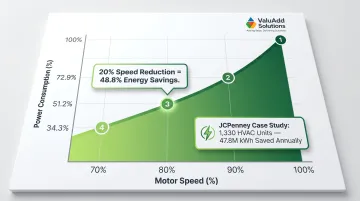
VFDs enable continuous speed modulation matched to real-time process demands. When flow demand drops, a VFD can reduce pump speed proportionally—and because power consumption is proportional to the cube of speed (affinity laws), even modest speed reductions yield substantial energy savings.
Example: Reducing fan speed by 20% (operating at 80% speed) drops power consumption to approximately 51.2% of full-speed power—a 48.8% reduction.
JCPenney retrofitted 1,330 rooftop HVAC units with VFDs and achieved 47.8 million kWh savings annually—a 22% reduction with payback under one year.
That energy advantage extends beyond pumps and fans. VFDs also provide operational capabilities that soft starters cannot match:
- Process-matched torque control: Varies torque precisely at any speed for mixers, extruders, and conveyors—no mechanical adjustments needed
- Controlled stopping modes: Ramp-down, dynamic braking, and coast-to-stop options eliminate mechanical shock on deceleration
- Proactive fault diagnostics: Detects undervoltage, phase imbalance, stall conditions, and ground faults before failure occurs
- Industrial protocol support: Modbus RTU/TCP, Ethernet/IP, and Profibus enable direct integration with PLCs and SCADA systems
ValuAdd's VFDs use H-Bridge multi-level technology, producing a low-distortion output that reduces electrical stress on motor windings—an important consideration when running multiple drives on shared power systems.
The VFD Harmonic Trade-Off
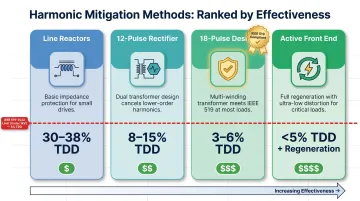
VFDs draw non-sinusoidal current, introducing harmonics that can disrupt other equipment on the same power system. IEEE 519-2022 sets the limits: 5.0% total harmonic distortion (THD) for systems under 1.0 kV, and 3.0% for systems between 1–69 kV.
Mitigation approaches:
- Line reactors (3–5%): Low cost but limited effectiveness (30–38% total demand distortion)
- 12-pulse rectifiers: Reduce harmonics to 8–15% TDD but require more space
- 18-pulse designs: Achieve 3–6% TDD, meeting IEEE 519 compliance without external filters
- Active Front Ends (AFE): Deliver <5% TDD with regeneration capability but cost 2–2.5× more than standard drives
ValuAdd's 18-pulse VFD designs with phase-shifting transformers meet IEEE 519 compliance without external filters—reducing both installation cost and panel space for municipal water treatment and facilities running sensitive equipment on shared feeders.
Use Cases of a VFD
VFDs are the right fit for variable-torque applications where load demand fluctuates:
- Variable-flow water pumps: Adjust speed based on demand, eliminating throttling valve losses
- HVAC fans and chillers: Match airflow to occupancy and temperature requirements
- Industrial mixers: Vary speed for different product batches without mechanical adjustments
- Conveyor systems with changing loads: Optimize throughput without manual speed changes
- Oil and gas extraction equipment: Adjust pump speeds based on well pressure and flow rates
For these applications, the upfront cost premium of a VFD is typically recovered through energy savings in 12–36 months. Water treatment applications see payback periods of 18–30 months, while HVAC fans often achieve payback in 12–24 months due to long run hours and variable loads.
Soft Starter vs. VFD: Which Is Right for Your Application?
The core decision comes down to one question: What does the motor need to do after it reaches full speed?
- If the answer is "run at constant speed," a soft starter is almost always sufficient
- If the answer is "vary speed based on process demand," a VFD is the correct choice
Five Key Selection Factors
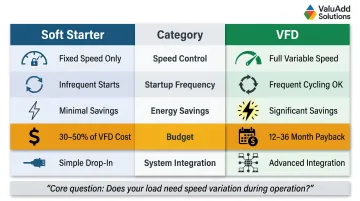
Use this table to match your application requirements to the right technology:
| Selection Factor | Soft Starter | VFD |
|---|---|---|
| Speed Control | Fixed speed — pumps, fans, conveyors with steady throughput | Variable speed — process pumps, HVAC with occupancy variation, multi-viscosity mixers |
| Startup Frequency | 1–2 daily start-stop cycles; thermal load is manageable | Dozens of cycles per day; VFDs handle thermal load more effectively |
| Energy Savings | Minimal after reaching full speed | 20–50% savings on variable-torque loads via affinity laws |
| Budget | Initial cost is 30–50% of a comparable VFD | Higher upfront; energy savings typically recover investment in 12–36 months |
| System Integration | Standalone operation; limited communication | Full PLC/SCADA integration via Modbus, Ethernet/IP, Profibus |
Medium Voltage Applications
For large motors (typically above 1,000 HP or in MV systems serving oil and gas or municipal water infrastructure), both technologies exist at medium voltage ratings. The cost gap between medium voltage soft starters and medium voltage VFDs is even more significant—Siemens cites a 10:1 cost ratio.
ValuAdd's medium voltage soft starters cover 2.3kV–15kV with modular designs and fiber-optic isolation — providing reliable motor protection where variable speed is not required, at a significantly lower cost than MV VFDs.
Clear Decision Framework
The table above covers the technical tradeoffs. For a quick go/no-go decision:
Choose a soft starter if:
- Your application runs at fixed speed
- Budget is constrained
- You need only smooth startup protection
- Installation space is limited
- System integration is not required
Choose a VFD if:
- Process demands variable speed
- Energy optimization justifies higher investment
- Advanced diagnostics are needed
- PLC/SCADA integration is required
- Application involves variable-torque loads (pumps, fans)
Edge Case: In systems where one VFD drives multiple motors sequentially, individual soft starters may still be installed on each motor for protection during individual start-stop cycles. These technologies are not always mutually exclusive.
Real-World Case Study
Municipal Water Treatment: Soft Starter Success
A municipal water treatment facility running large centrifugal pumps experienced repeated motor failures and pressure surges in distribution piping. The facility initially considered VFDs for all pump motors, but an engineering assessment determined that pump speeds did not need to vary—demand was managed through valve control.
Medium voltage soft starters were selected instead, eliminating water hammer events and motor inrush damage at roughly one-third the cost of equivalent VFDs. The facility also downgraded main fuses from 250A to 125A, saving $2,000 annually while preventing costly pipe bursts and unplanned maintenance.
Manufacturing Plant: VFD Process Flexibility
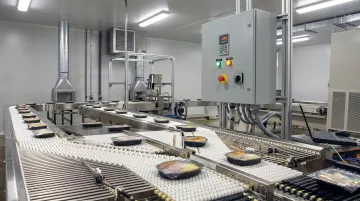
A food processing plant running conveyor and mixer systems needed to adjust line speeds based on production SKU changeovers and batch sizes. DOL starters had caused frequent belt slippage and motor overheating during speed transitions.
After switching to VFDs, the plant gained programmable speed profiles per product run—eliminating belt slippage and reducing thermal stress on motors. The energy savings potential is significant: a San Francisco refinery running variable-flow applications saved 500,000 kWh per month after replacing throttling valves with VFDs on primary feed pumps. That same project also eliminated mechanical seal and bearing failures, cutting vibration and unplanned downtime.
Key Takeaway
These two cases illustrate the core decision framework:
- Fixed speed, high inrush, cost-sensitive: Soft starters deliver the right protection without overengineering the solution
- Variable speed, process flexibility, energy recovery: VFDs justify the higher upfront cost through measurable efficiency gains
The application requirement determines the correct choice—not the device's capabilities in isolation.
Not sure which fits your application? ValuAdd's engineering team works through exactly these trade-offs—fixed-speed vs. variable-speed requirements, inrush profiles, harmonic compliance—to match the right motor control solution to your specific load conditions. Request a needs assessment to get started.
Conclusion
Soft starters and VFDs are both mature motor control technologies. The right choice comes down to one question: does your application require speed variation during operation?
Here's where each device fits:
- Soft starters suit fixed-speed, cost-sensitive applications — water treatment pumps, HVAC fans, basic industrial conveyors — where the priority is motor protection with lower capital and installation costs
- VFDs fit variable-load processes in manufacturing, oil and gas, or HVAC systems with fluctuating demand, where energy savings and precise process control justify the higher upfront investment
The stakes are real. A misapplied motor control decision leads to premature motor failure, unplanned downtime, or energy costs that compound over the equipment's lifespan.
Getting this right at the design stage — or during a retrofit evaluation — directly determines operational reliability and total cost of ownership. Match the device to your load profile, not to the most capable option on paper, and the decision becomes straightforward.
Frequently Asked Questions
Which is better: a soft starter or a VFD?
Neither is universally better. Soft starters are the better choice for fixed-speed applications needing only startup protection and smooth acceleration. VFDs are better for applications requiring variable speed, ongoing energy efficiency, or advanced process control. The correct answer depends entirely on your application requirements, not the technology in isolation.
Can a VFD replace a soft starter?
Yes, a VFD can replicate the soft-start function by ramping voltage and frequency at startup. However, using a VFD solely for that purpose means paying for capabilities — variable speed, precision torque control, communication protocols — that will never be used. For fixed-speed motors, that added cost is rarely justified.
Do you need a starter with a VFD?
In most single-motor applications, a VFD alone provides all necessary motor protection and control — no additional starter required. The exception is multi-motor systems where one VFD controls motors sequentially; in those cases, individual soft starters may be added to each motor for protection during start-stop cycles.
Which is better: a VFD or a direct on-line (DOL) starter?
A DOL starter delivers full voltage instantly, causing high inrush current (6–8× FLA) and severe mechanical shock to couplings, gearboxes, and windings — both soft starters and VFDs improve on that. VFDs add speed control and energy savings; soft starters offer a lower-cost middle ground between DOL and full VFD capability.
Do soft starters save energy?
Soft starters offer minimal energy savings — they reduce peak demand during startup but have no effect on consumption once the motor reaches full speed. For ongoing energy savings on variable-torque loads, a VFD is the right technology.
What applications are best suited for medium voltage soft starters?
Medium voltage soft starters are best suited for large motor applications (typically above 600V, often 2.3kV–13.8kV) in oil and gas, municipal water treatment, and mining — industries that need controlled startup protection for high-power motors but don't require variable speed during normal operation.