Introduction
Choosing between star-delta and soft starters is one of those decisions that looks straightforward on paper but carries real consequences on the plant floor. Both methods reduce inrush current, but they do it in fundamentally different ways — and that difference shows up in equipment life, operational flexibility, and total cost of ownership.
Star-delta starters reconfigure motor windings through mechanical contactors. Soft starters use solid-state electronics to gradually ramp voltage from zero to full line level.
The wrong choice leads to mechanical shock damage, unplanned downtime, and wasted capital — especially in water treatment, oil and gas, and continuous manufacturing. Uncontrolled motor acceleration destroys mechanical components, causing accelerated wear on couplings, gears, chains, and belts. In pumping systems, abrupt starts and stops generate pressure surges and water hammer that damage pipes and valves.
The global soft starter market reached $2.04 billion in 2023 and is projected to grow at 6.0% annually through 2030, driven largely by industries prioritizing asset longevity over initial hardware savings. This article breaks down both technologies side by side —covering operating principles, performance tradeoffs, and application fit—so you can make the right call for your application.
Key Takeaways
- Star-delta starters switch motor windings from star to delta configuration, offering a cheap, fixed-voltage solution best suited for unloaded, light-duty applications
- Soft starters use thyristors to ramp voltage gradually, eliminating mechanical shock during acceleration and supporting both loaded and unloaded starts
- Star-delta costs less upfront, but soft starters cut long-term maintenance and protect motor windings more effectively
- For facilities with frequent starts, medium-to-large motors, or sensitive mechanical equipment, soft starters offer clear operational advantages
- Use star-delta when budget is tight and the motor starts unloaded infrequently
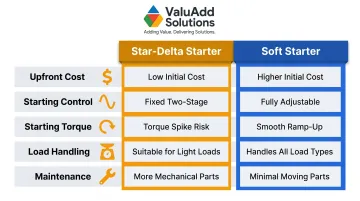
Star-Delta vs. Soft Starter: Quick Comparison
| Criteria | Star-Delta | Soft Starter |
|---|---|---|
| Upfront Cost | Lower hardware cost; three contactors add wiring labor | 5%–20% higher component cost, offset by simpler wiring and faster install |
| Starting Control | Two fixed states: star (58% voltage) then delta (full voltage); abrupt transition | Continuously variable 0%–100% via thyristor firing angle; smooth, stepless ramp-up |
| Starting Torque | Fixed at 33% of rated torque; no adjustment possible | Adjustable torque and ramp time (0.5–180 seconds); tunable to load and motor requirements |
| Load Handling | Unloaded starts only; cannot handle varying or loaded conditions | Handles loaded and unloaded starts; supports soft stop for gradual deceleration |
| Installation & Maintenance | Three contactors, timer, and additional connections; more mechanical wear points | Fewer connections, solid-state design with no moving parts; integrated diagnostics simplify upkeep |
What Is a Star-Delta Starter?
A star-delta (Y-Δ) starter connects motor windings in a star configuration at startup to limit inrush current. Voltage across each winding drops to 1/√3 (roughly 58% of line voltage), which reduces starting torque to exactly 33% of rated value — a fixed characteristic with no adjustment.
After a preset time, a timer switches the windings to delta for full-voltage operation. Most implementations use an open-transition design, which briefly cuts power during that switch. The interruption can generate transients exceeding locked rotor current, creating a mechanical jerk that accelerates bearing wear and stresses connected loads.
Core limitations tied to operational impact include:
- Fixed starting torque (33% of rated value) with no adjustment capability
- No ability to modify starting time once configured
- No soft stop capability
- Current and torque spikes during the winding transition
- Risk of stalling if the motor hasn't reached 80% speed before transition
Use Cases of Star-Delta Starters
Star-delta starters remain a valid choice in specific scenarios:
- Motors that start without load (machines with clutched gearboxes, unloaded fans, centrifugal pumps before valve opening)
- Low-frequency start/stop cycles
- Budget-constrained installations with modest motor ratings (typically under 150 kW)
- Applications with stable, predictable loads that don't require adjustable start profiles
Industries where star-delta starters are still commonly found include legacy manufacturing equipment, small agricultural or HVAC systems, and facilities where motors rarely cycle. Where those conditions don't apply — high-cycle operations, loaded starts, or torque-sensitive loads — their fixed characteristics become a liability that soft starters are specifically built to address.
What Is a Soft Starter?
A soft starter (also called a Reduced Voltage Soft Starter, or RVSS) is a solid-state motor control device that uses thyristors—also known as Silicon Controlled Rectifiers (SCRs)—connected in back-to-back pairs to regulate voltage applied to the motor.
By varying the thyristor firing angle, it gradually increases voltage from a low starting point to full line voltage, producing a smooth, stepless acceleration curve with no mechanical jerk or power interruption.
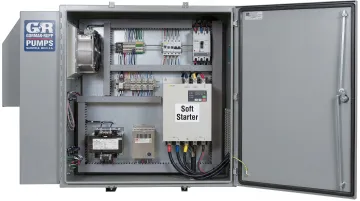
During startup, the SCRs engage and voltage ramps up at a controlled rate. Once the motor reaches rated speed, a bypass contactor engages to reduce heat and improve efficiency during normal running. ValuAdd's CSXi Series achieves 99.5% efficiency with no harmonics in bypass mode. At shutdown, the same ramp-down control decelerates the motor gradually rather than cutting power abruptly.
Core Operational Benefits
Elimination of mechanical shock reduces wear on couplings, belts, gearboxes, and motor bearings. Lower inrush current reduces electrical system stress and voltage dips on shared circuits. Adjustable torque and ramp time make the soft starter adaptable to different motor sizes and load profiles.
ValuAdd's advanced medium voltage soft starter technology supports mains voltages from 2.3 kV to 15 kV (±10%), with current ratings from 110 A to 1200 A (nominal). Maximum start current is 400% of full-load current, with a maximum start time of 30 seconds at 400% FLC.
Two-Phase vs. Three-Phase Control
Soft starters are available in both configurations:
- Two-Phase Control: Controls two phases; eliminates disturbing direct current components in advanced models; cost-effective for standard motors up to 55 kW
- Three-Phase Control: Controls all three phases; provides fully balanced current; required for inside-the-delta wiring; preferred when absolute lowest starting current is needed
Use Cases of Soft Starters
Soft starters dominate in industrial applications including:
- Centrifugal pumps (especially in water treatment where water hammer must be avoided)
- Compressors (where loaded starts are unavoidable)
- Conveyor belt systems (where smooth acceleration prevents belt slippage)
- Cranes and hoists (where precise torque control is critical)
- Large fans (where smooth acceleration prevents structural stress)
The soft starter market is growing at 6.0% annually through 2030, driven by increasing adoption in water/wastewater treatment, oil and gas, and manufacturing sectors.
Star-Delta vs. Soft Starter: Which One Should You Choose?
The decision hinges on several factors:
- Motor size and rated power (kW)
- Whether the motor starts under load or unloaded
- Start/stop frequency
- Sensitivity of connected mechanical equipment to shock
- Total cost of ownership (not just upfront cost)
- Availability of technical support
Once you've mapped those factors to your application, total cost of ownership becomes the deciding metric.
The Total Cost of Ownership Advantage
While star-delta starters have lower purchase prices, soft starters often prove more economical over time. According to Rockwell Automation, soft starter solutions are typically 5% to 20% more expensive upfront, but this premium is offset by:
- Reduced motor maintenance costs
- Extended bearing and winding life
- Fewer unplanned shutdowns
- Lower electrical system stress
- Built-in motor protection (overload, phase loss, current imbalance) that would require additional costly components in star-delta assemblies
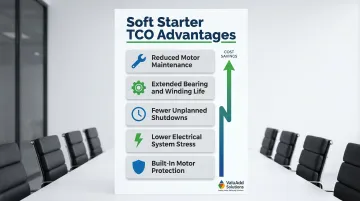
ValuAdd's RX3E soft starters include ANSI motor protection, emergency bypass contactors, and event recorders that log up to 99 events. Together, these features cut maintenance response time and reduce unplanned downtime.
Situational Recommendations
Choose star-delta if:
- Motor starts unloaded consistently
- Start/stop frequency is low (rarely cycles)
- Motor rating is modest
- Upfront budget is the dominant constraint
- No complex load variations exist
Choose a soft starter if:
- Motor starts under load
- High-cycle environment (frequent starts/stops)
- Connected to sensitive mechanical equipment (pumps, compressors, conveyors)
- Requires adjustable torque or soft stop
- Need to adapt to varying load conditions
Industry-Specific Advantages
Municipal Water Treatment: Gradual ramp-up prevents water hammer in pump systems. Facilities using soft starters have reported up to 30% reduction in mechanical wear costs, along with measurable drops in pipeline leak incidents and noise complaints.
Oil and Gas: Loaded compressor starts demand torque flexibility that star-delta cannot deliver. Its fixed 33% torque is frequently insufficient for reciprocating and screw compressors, which require adjustable current limits up to 400–600%.
Manufacturing: Frequent conveyor and mixer cycling puts energy efficiency and wear reduction at the center of uptime decisions. ValuAdd's soft starters offer adjustable voltage control deceleration and per-phase motor protection to keep equipment running between scheduled maintenance windows.
The Light Load Edge Case
Star-delta can limit starting current to a lower absolute level than a soft starter on extremely light, unloaded applications. But open transition transients typically negate that advantage—introducing electrical spikes and mechanical shock that offset any current savings. For most real-world applications, the soft starter's adjustability wins out even at light loads.
Real-World Application Scenarios
Municipal Water Supply Station — A facility replacing direct-on-line starters with soft starters featuring adaptive acceleration control had struggled with pressure surges that ruptured pipes and stressed check valves. After the switch, water hammer noise was eliminated entirely and maintenance incidents from pipeline leaks dropped sharply.
St. Petersburg Flood Pumps — The Botoport Dam in St. Petersburg installed 12 ABB PST soft starters to protect flood pumps from mechanical wear in harsh duty conditions. The facility reported mechanical wear costs reduced by up to 30%.
Manufacturing Gearbox Facility — A plant running a wye-delta starter with a mechanical brake saw recurring gearbox damage from high starting torque, plus frequent brake replacements. After switching to a soft starter with a 340% current-limit start and smart motor braking, starting torque dropped, product spillage decreased, and mechanical brake maintenance was eliminated.
Across all three cases, a pattern emerges: frequent cycling, mechanical sensitivity to shock, and the need for precise acceleration control. These are the conditions where soft starters consistently outperform star-delta switching. For facilities in water treatment, flood control, or heavy manufacturing, ValuAdd's medium voltage soft starter solutions are built around exactly these application demands.
Conclusion
The choice between star-delta and soft starters is context-dependent. Star-delta still makes sense for simple, infrequent, unloaded low-budget applications. However, soft starters are the technically superior choice for any operation where load variability, motor protection, long-term reliability, or frequent cycling is a factor.
For engineers and plant managers, the outcomes that matter most—reduced unplanned downtime, lower lifetime maintenance costs, and protection of capital equipment—consistently favor soft starters in demanding industrial environments.
Soft starter pricing has dropped considerably in recent years, and with payback periods often under two years in high-cycle applications, the cost argument for star-delta is narrowing. For most industrial operations, the switch is a practical decision, not just a technical one.
Frequently Asked Questions
Is soft starter better than star-delta?
In most industrial applications, soft starters are the better choice due to their flexibility, smooth acceleration, and ability to handle loaded starts. However, star-delta remains cost-effective for simple, unloaded, low-cycle applications where budget is the top priority and operational demands are minimal.
When should I use Wye or Delta?
The star (Wye) connection is used only during startup to reduce voltage and limit inrush current. Once the motor reaches operating speed (typically 80% of rated speed), the delta configuration restores full line voltage for normal running. This transition is fixed and cannot be adjusted mid-operation.
Can a star-delta starter be used for loaded starts?
No. Star-delta starters are designed only for unloaded starts. Attempting to start a loaded motor with star-delta results in insufficient starting torque (only 33% of rated) and risks stalling or damage during the star-to-delta transition, with potentially damaging current spikes.
What causes the mechanical jerk in a star-delta starter?
The jerk occurs during the open transition between star and delta connections. Power is briefly interrupted, causing a sudden inrush of current and torque spike when delta is reconnected. The resulting mechanical shock accelerates wear on bearings, couplings, and gearboxes.
What is the typical cost difference between a soft starter and a star-delta starter?
Soft starters historically cost 5% to 20% more than star-delta starters, depending on motor size. When total cost of ownership is factored in—maintenance, downtime, and motor longevity—soft starters often prove more economical over the equipment lifecycle due to reduced mechanical stress and built-in motor protection.
Do soft starters work with all motor sizes?
Soft starters are available for a wide range of motor sizes, from small single-phase motors to large medium-voltage industrial motors up to 25,000 HP. ValuAdd's medium voltage soft starters support motors from 2.3 kV to 15 kV, with selection based on motor kW rating and application requirements.