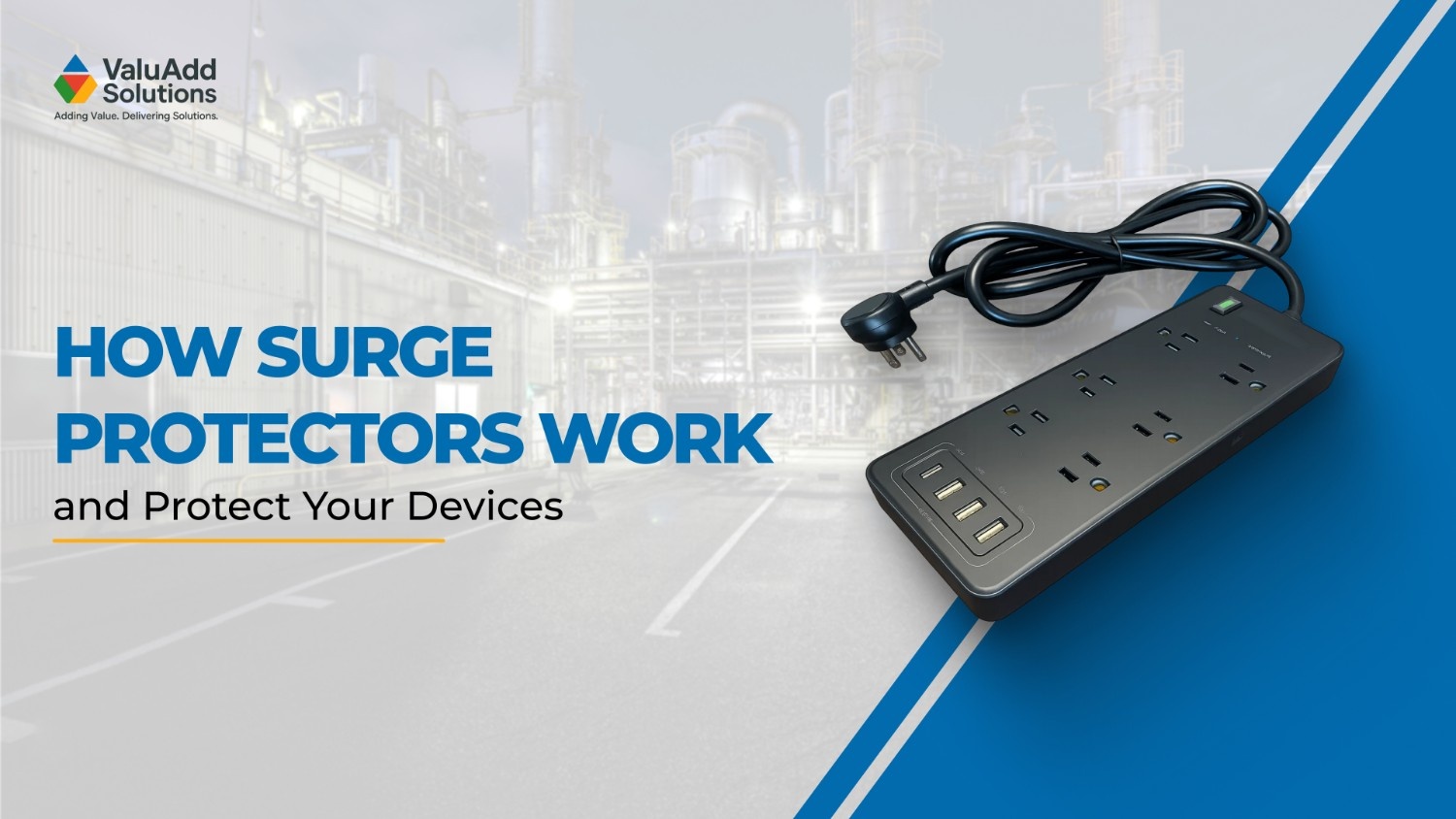
A power surge is a fast, short-lived spike in voltage that rides on top of your normal electrical supply, and it only takes a fraction of a second to stress insulation, trip electronics, or quietly shorten equipment life. These spikes come from outside your building (lightning, utility switching, grid instability) and from inside it (motors starting, compressors cycling, large loads turning on/off). In fact, industry estimates often cited by utilities put roughly 70–85% of surges as “internally generated” inside a facility due to load switching.
That’s why surge protection devices (SPDs) matter in both homes and industrial sites: they’re built to divert transient overvoltage away from sensitive circuits, helping protect everything from TVs and routers to PLCs, drives, instrumentation, and control panels.
Key Highlights
Most electrical surges originate inside the facility, making internal surge protection just as critical as shielding against lightning or utility-side disturbances.
Surge Protection Devices act as a microsecond-fast barrier, diverting dangerous transient voltage to ground before it can damage electronics or shorten equipment life.
Understanding the difference between Type 1, Type 2, and Type 3 SPDs is essential because effective protection depends on layering them across the electrical system, not relying on a single device.
Combination SPDs simplify installation by offering multi-stage protection in one unit, ideal for compact panel designs without sacrificing performance or safety.
ValuAdd strengthens surge protection by guiding facilities toward the right SPD layers, correct placement, proper grounding, and coordinated panel architecture, ensuring reliable “panel-to-load” protection that actually holds up in real-world conditions.
What Is a Surge Protection Device (SPD)?
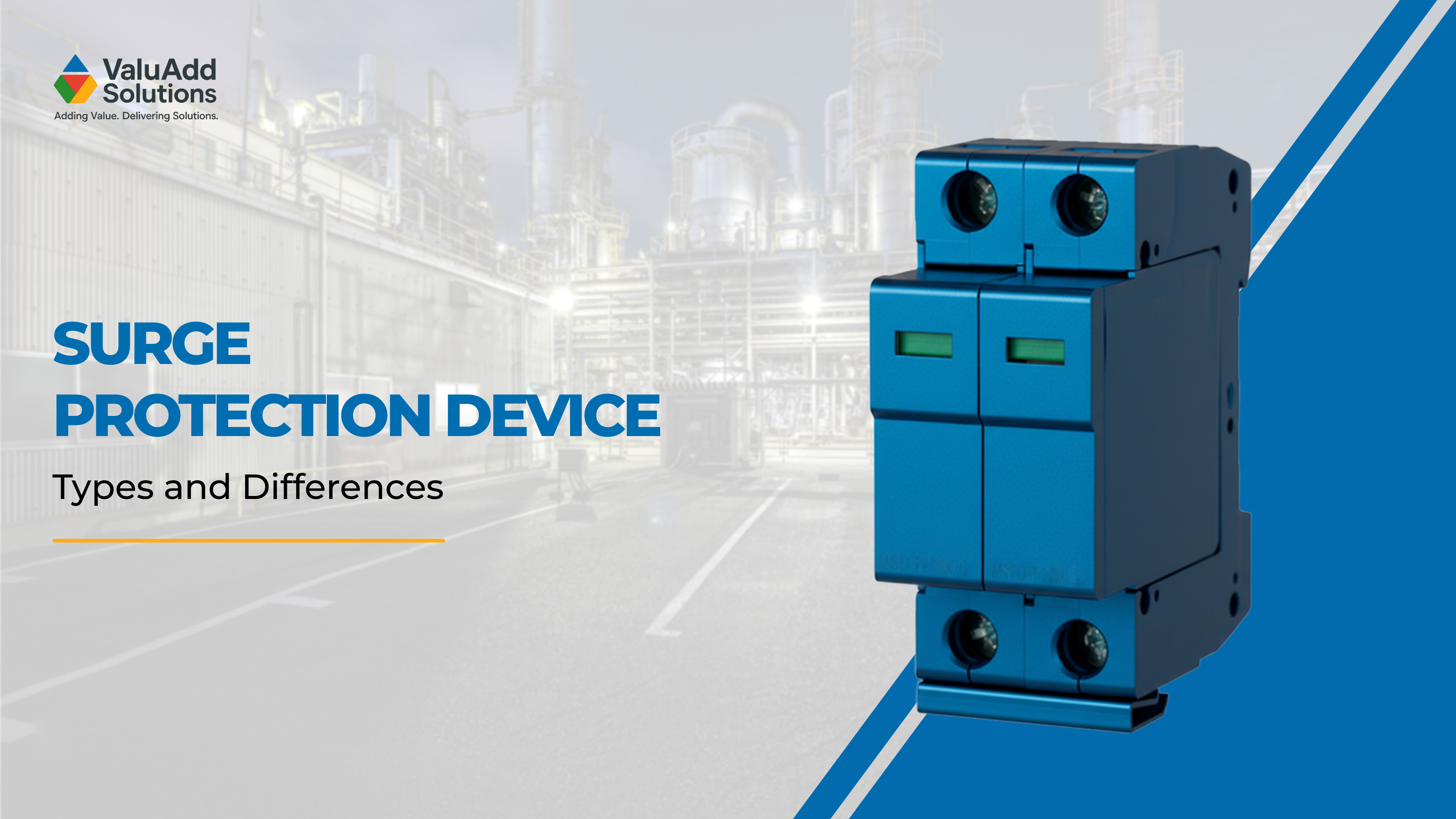
A Surge Protection Device (SPD) is a protective component installed in an electrical system to limit transient overvoltage and prevent it from reaching sensitive equipment. When a sudden voltage spike occurs, whether from lightning, utility switching, or internal load changes, the SPD reacts almost instantly, diverting excess energy away from connected circuits and safely routing it to ground.
SPDs are typically installed at key points in an electrical installation:
At the service entrance, stop external surges before they enter the building
At distribution panels to control internally generated surges
Close to critical equipment for point-of-use protection
Rather than blocking electricity, an SPD stays passive during normal operation and only activates when voltage rises above a safe threshold. This makes it a frontline defense for extending equipment life, reducing unexpected failures, and maintaining electrical reliability in both residential and industrial environments.
Different Types of SPDs Exist
Not all power surges behave the same way, and a single protection strategy can’t address every risk. Surges vary widely in magnitude, duration, and point of entry, which is why surge protection devices are classified into different types based on where they are installed and what level of energy they are designed to handle.
Some surges enter a facility from the utility side during lightning events or grid switching. Others are created inside the electrical system when large motors, HVAC units, welders, or elevators cycle on and off. The closer a surge originates to sensitive equipment, the less time and distance there is to dissipate it safely.
SPD classification accounts for three core factors:

Installation point – whether the device is installed at the service entrance, downstream at distribution panels, or directly at the equipment
Surge intensity – the expected energy level the SPD must withstand and divert without failing
System design – grounding quality, system voltage, and whether the environment is residential, commercial, or industrial
Different SPD types are not alternatives; they are layers of protection. Proper surge protection design matches the right SPD type to the right location, ensuring that high-energy transients are reduced in stages before they reach critical loads.
Type 1 Surge Protection Devices
Type 1 SPDs are designed to stop surges at the point where they first enter a facility, especially high-energy transients coming from external sources such as lightning strikes or utility-side switching events.
Installed at the service entrance, typically between the utility supply and the main distribution panel
Built to handle very high surge energy, including direct lightning-induced surges
Commonly used in industrial plants, data centers, hospitals, and buildings with external lightning protection systems, where exposure to severe overvoltage events is higher
Type 1 SPDs act as the first line of defense, reducing the most destructive surge energy before it can propagate deeper into the electrical system.
Type 2 Surge Protection Devices
Type 2 SPDs are designed to protect internal electrical distribution systems from transient overvoltages that originate within a building or pass through after being reduced by upstream protection.
Installed at distribution boards and sub-panels, downstream of the service entrance
Protect against switching surges caused by motors, HVAC systems, drives, and other large electrical loads
Most commonly used SPD type in residential, commercial, and industrial installations
Type 2 SPDs form the core layer of surge protection, limiting everyday transients that account for the majority of equipment stress and premature failures.
Type 3 Surge Protection Devices
Type 3 SPDs are designed to protect sensitive end-equipment by handling residual surges that remain after upstream protection has done its job.
Installed close to the device being protected, such as at socket outlets or within equipment enclosures
Lower discharge capacity compared to Type 1 and Type 2 SPDs, intended for fine-level protection rather than high-energy events
Used alongside Type 1 and Type 2 SPDs, not as a standalone solution
Type 3 SPDs provide the final layer of surge protection, helping shield electronics like control systems, medical equipment, IT hardware, and instrumentation from damage caused by smaller but still harmful voltage spikes.
Combination SPDs (Type 1+2 / Type 2+3)
A combination SPD is engineered with internal protection elements sized to manage different surge energies. For example, a Type 1+2 SPD can safely divert high-energy external surges at the service entrance and limit downstream switching transients. A Type 2+3 SPD reduces distribution-level surges while also providing fine protection for sensitive loads further downstream.
Where Do They Make Sense?
They’re best used where the electrical architecture is compact, but the risk profile still calls for layered protection.
Type 1+2 SPDs are commonly used at main service entrances where space is limited, but exposure to lightning or utility-side surges is high
Type 2+3 SPDs are useful in secondary panels feeding sensitive equipment, such as control rooms, labs, or IT-heavy zones
When They Reduce Installation Complexity
They cut down extra hardware and wiring while still giving you multi-stage protection behavior.
Fewer devices and interconnections compared to installing separate SPDs
Simpler coordination in compact electrical rooms
Lower installation time and reduced panel space requirements
Combination SPDs are not shortcuts; they are consolidated protection solutions. When selected correctly, they simplify system design while still maintaining layered surge protection where full separation isn’t practical.
Key Differences Between SPD Types
Each SPD type is built for a specific role in the surge protection chain, based on where surges enter, how strong they are, and how close protection needs to be to sensitive equipment.
The table below compares the main differences so it’s easier to select the right SPD for each installation point.
Comparison Factor | Type 1 SPD | Type 2 SPD | Type 3 SPD |
|---|---|---|---|
Installation location | Service entrance; between utility supply and main distribution | Distribution boards and sub-panels inside the facility | At or very close to the end of the equipment (socket outlets, device enclosures) |
Surge current capacity | Very high; designed to withstand lightning-induced and utility-side surges | Medium to high; handles most internal and residual surges | Low; intended for residual, fine-level transients |
Level of protection | Coarse protection: diverts large surge energy away from the system | Medium protection; clamps everyday switching surges | Fine protection; tight voltage limiting for sensitive electronics |
Typical applications | Industrial plants, data centers, hospitals, and buildings with lightning protection systems | Residential, commercial, and industrial electrical panels | IT equipment, control systems, medical devices, instrumentation |
Cost & maintenance considerations | Higher upfront cost; longer service life due to robust design | Moderate cost; most cost-effective protection layer overall | Lower unit cost but higher dependency on upstream SPDs for effectiveness |
Effective surge protection isn’t about choosing one SPD type, but it’s about using each type where it performs best, creating a coordinated, layered defense across the electrical system.
Common Mistakes When Selecting or Installing SPDs
Most surge protection failures don’t happen because SPDs don’t work; they happen because they’re selected or installed without considering real-world surge behavior and system design.
The table below highlights the most common mistakes, why they occur, and the risks they create.
Common Mistake | What Goes Wrong | Why It’s a Problem |
|---|---|---|
Using only one SPD type | A single SPD is expected to handle all surge scenarios | Surges vary in energy and origin; without layered protection, high-energy or residual surges can bypass or overload the SPD |
Incorrect placement | SPDs installed too far from the surge entry point or sensitive loads | Long cable lengths increase let-through voltage, reducing the SPD’s effectiveness |
Ignoring the grounding quality | SPDs connected to poor or high-impedance grounding systems | Without a low-impedance ground path, diverted surge energy cannot dissipate safely |
Underestimating surge risk | Assuming lightning or utility surges are rare or irrelevant | Frequent small surges quietly degrade equipment and shorten service life |
Mismatched SPD ratings | SPD voltage or current ratings don’t match the system | Leads to nuisance failures, ineffective protection, or premature SPD degradation |
Lack of coordination between SPDs | Upstream and downstream SPDs are not properly coordinated | Causes uneven stress, early failure of downstream SPDs, and gaps in protection |
Effective surge protection depends as much on correct selection, placement, and grounding as it does on the SPD itself. Avoiding these mistakes is often more impactful than choosing a higher-rated device.
Standards and Certifications to Look For
A surge protector that hasn’t been tested to a recognised standard is basically a “trust me” product, and that’s risky when the job is to absorb high-energy electrical events. Standards tell you two practical things: the SPD will perform the way it claims, and it will fail safely if it ever gets overwhelmed.
a. IEC standards (IEC 61643 series)
Most commonly referenced in global industrial/commercial specs and many non-US markets.
Defines SPD Types (Type 1 / 2 / 3) based on installation point and surge exposure
Uses standardised surge test waveforms so devices can be compared fairly
Helps you choose the right “layer” (service entrance vs distribution vs point-of-use) and coordinate protection across panels
b. UL standards (UL 1449)
Commonly expected in North America and frequently referenced in inspection/approval workflows.
Validates safety under fault conditions (overheating, end-of-life behaviour, short-circuit scenarios)
Provides measurable performance markings like VPR (Voltage Protection Rating), a practical indicator of how well the SPD clamps voltage during a surge
Helps reduce surprises during inspections because it’s a widely recognised certification
Compliance ensures the SPD can safely divert surge energy without overheating or catastrophic failure. It also guarantees predictable coordination with upstream and downstream protection devices, while simplifying regulatory approvals, inspections, and insurance requirements.
How ValuAdd Helps Build Panel-to-Load Surge Protection That Holds Up
Surge protection is most effective when it is engineered as a system and not treated as a single device added after failures occur. At ValuAdd, we help customers design coordinated panel-to-load surge protection strategies that account for real operating conditions, switching behavior, and power quality challenges across industrial environments.
Industrial-grade surge protection for real plant issues: ValuAdd applies surge protective devices (SPDs) designed to clamp and divert transient overvoltage before it causes PLC resets, VFD trips, sensor damage, or intermittent downtime that’s difficult to diagnose.
Layered protection from service entrance to sensitive loads: We support a staged surge protection approach, placing SPDs at the service entrance, distribution panels, and equipment level, so high-energy surges are progressively reduced before reaching critical electronics.
Motor control solutions that reduce switching transients: ValuAdd’s motor control portfolio, including VFDs and soft starters, helps manage inrush current and frequent switching events, reducing electrical stress that can propagate through panels and control circuits.
Isolation and panel architecture that supports coordination: Effective surge protection depends on clean panel design. ValuAdd provides industrial disconnects and panel components that enable proper circuit isolation, safer maintenance, and better coordination of protection zones.
Power monitoring that guides smarter protection placement: ValuAdd power monitoring systems provide visibility into power quality events and repeat disturbances, helping teams place surge protection where it delivers the most value, without guesswork.
By combining surge protection devices, motor control products, isolation hardware, and power monitoring, ValuAdd helps customers build panel-to-load surge protection strategies that hold up under real industrial operating conditions.
Final Thoughts
Surge protection works best when it’s treated like a system, not a single device. The most reliable setups layer protection across the electrical path: Type 1 (or 1+2) at the service entrance to handle incoming high-energy events, Type 2 at distribution to control everyday switching transients, and Type 3 near sensitive loads to clamp the residual spikes that still cause nuisance trips and premature electronics failure.
That “stage it where it happens” approach is the difference between basic protection and long-term reliability, especially in facilities running drives, controls, instrumentation, or critical IT.
If you want to size and place SPDs correctly for your panels and loads, contact ValuAdd through their Contact Us page and share your system voltage, grounding method, and the equipment you’re protecting.
FAQ
1) What’s the most common reason SPDs “don’t work” in the field?
Bad grounding and poor placement. If the ground path is high-impedance or the SPD is installed with long lead lengths, the surge may not divert cleanly, and the let-through voltage can still be high enough to cause trips or damage.
2) How often should an SPD be replaced?
It depends on surge exposure and duty. Many SPDs include status indicators or alarms; if the protection modules are degraded or the indicator shows failure, replace them. In high-surge environments, periodic inspection is a smart maintenance step.
3) Are SPDs only for power lines, or do I need them for data/communication lines too?
If you have equipment failures tied to Ethernet/RS-485/PLC I/O or sensor networks, data-line protection matters. Surges can enter through signal and comms wiring, so protecting only the power side can still leave a path for transients.
4) Do SPDs protect against a direct lightning strike?
SPDs help reduce damage from lightning-induced surges and transients that travel through power lines, but they’re not a guarantee against a direct strike. The most reliable setup combines proper grounding, bonding, and layered SPDs at the service entrance and downstream panels.
5) If I already have a UPS, do I still need an SPD?
Yes, UPSes mainly handle ride-through and voltage regulation, but many are not designed to absorb high-energy surge currents. An SPD upstream protects the UPS and reduces the surge energy before it reaches sensitive electronics.