Energy efficiency in motor-driven systems isn’t a “nice-to-have” initiative, and it’s where the biggest, repeatable operating-cost wins tend to hide. Across most facilities, the real electricity bill isn’t lighting or IT; it’s motion: pumps moving fluids, fans pushing air, compressors making pressure, and conveyors keeping production flowing. In the U.S., industrial electric motors use about 69% of the electricity consumed by manufacturers (and nearly a quarter of all electricity used nationally).
That’s why energy optimization has become a priority across industries: every percentage point of efficiency gained can translate into lower energy spend, cooler and more stable operations, longer equipment life, and fewer unplanned stoppages, without changing what your plant produces or how your building is used.
Key Highlights
Variable Frequency Drives increase energy efficiency by adjusting motor speed to match real-time load requirements instead of running at fixed full speed.
Small speed reductions deliver large energy savings for fans and pumps, as power consumption drops sharply with speed according to the affinity laws.
VFDs reduce both energy (kWh) and peak demand (kW) costs while also lowering maintenance needs through soft starts and smoother operation.
Mechanical methods like throttling waste energy; VFDs eliminate this by cutting speed at the source rather than burning off excess pressure or flow.
ValuAdd helps facilities unlock these benefits more consistently by pairing VFD technology with robust system design, improved reliability, and long-term operational efficiency.
What Is a Variable Frequency Drive (VFD)?
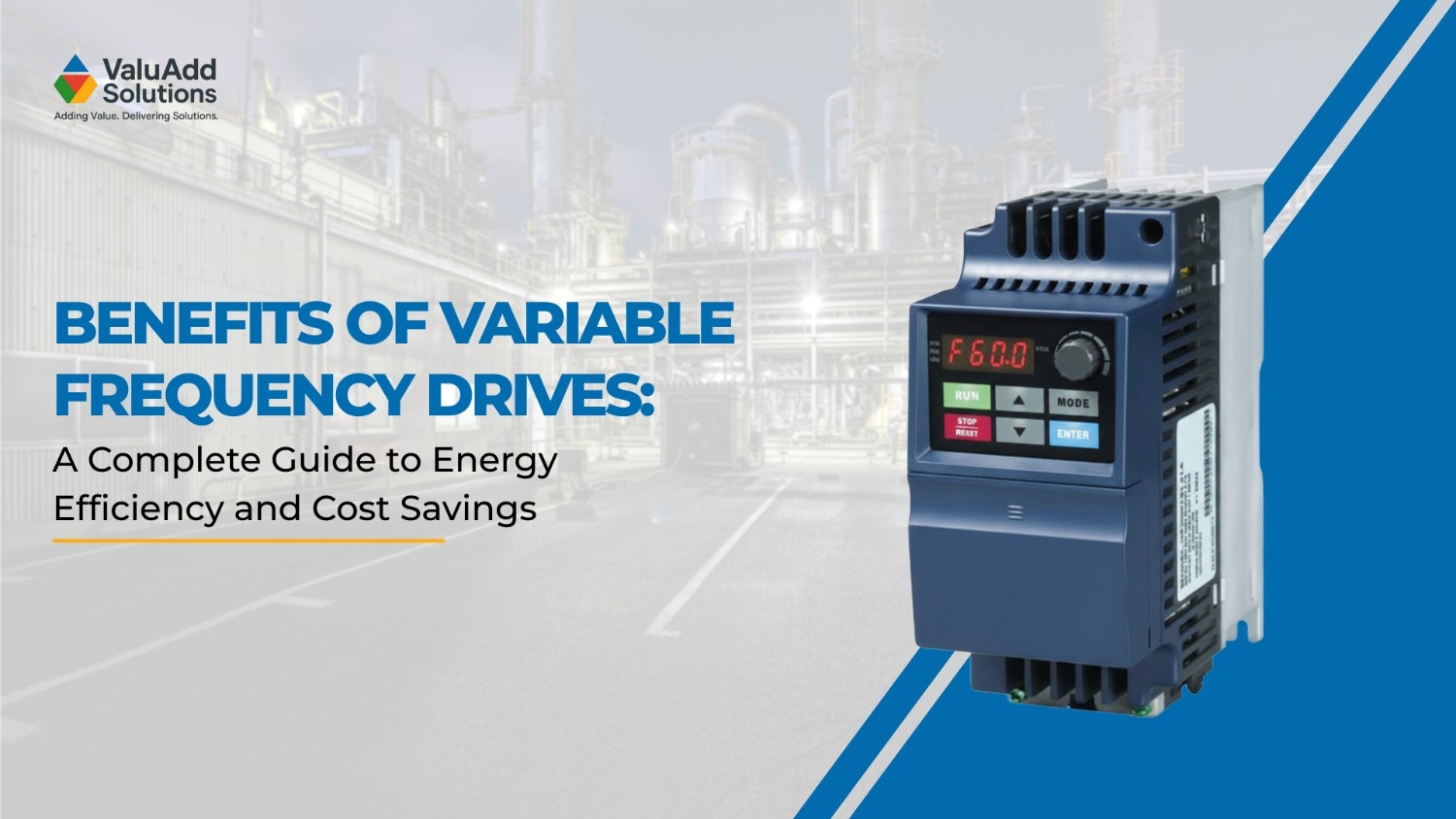
A Variable Frequency Drive (VFD) is an electronic controller that lets you run an AC motor at the exact speed your process needs, instead of being locked to the grid frequency. It does this by adjusting the frequency and voltage supplied to the motor, which directly affects speed and torque.
How does a VFD control speed and torque?
This is the core idea: frequency sets speed, and voltage supports torque, so the motor stays stable and usable across different speeds.
Speed control (via frequency):
Higher frequency → higher motor speed; lower frequency → lower motor speed.Torque control (via voltage + control logic):
The drive adjusts voltage along with frequency to maintain effective torque and prevent stalling or rough operation.
Basic working principle
A VFD works like a power “translator,” taking fixed electrical input and outputting a controlled motor supply that matches the required operating point.
Rectification (AC → DC): Converts incoming AC power to DC.
DC bus (smoothing + energy storage): Stabilizes DC using capacitors (and sometimes reactors/chokes).
Inversion (DC → variable-frequency AC): Uses high-speed switching to generate AC at the required frequency/voltage.
Key components of a VFD
These parts work together to convert power, control the motor, and protect equipment under real operating conditions.
Rectifier (diodes or active front end): Converts AC to DC
DC bus (capacitors + sometimes inductors): Smooths and stabilizes DC power
Inverter (IGBTs/MOSFETs): Creates variable-frequency AC via fast switching
Control board/processor: Executes speed/torque control, ramps, and protections
Interface & communications: Keypad/HMI and optional industrial comms
Protection systems: Overcurrent, over/undervoltage, thermal, ground fault, etc.
Fixed-speed motors vs VFD-controlled motors
Both can do the job, but they manage output very differently; fixed-speed relies on mechanical restriction, while VFD control matches motor speed to demand.
Factor | Fixed-speed motor (across-the-line) | VFD-controlled motor |
|---|---|---|
Operating speed | Mostly one speed (near rated) | Variable speed based on demand |
How output is controlled | Valves, dampers, throttling, bypass | Speed control (frequency/voltage adjustment) |
Energy efficiency at partial load | Often wastes energy due to throttling losses | Typically more efficient by reducing speed to match need |
Starting behavior | High inrush current; more abrupt starts | Soft start/stop reduces electrical and mechanical stress |
Process stability | Coarser control; more fluctuation | Smoother control; better stability |
Wear and tear | More mechanical stress during starts; throttling components wear | Reduced shock loading; can extend equipment life |
Best fit for | Constant-load applications | Variable-load applications (fans, pumps, many conveyors) |
The Relationship Between Motor Speed and Energy Consumption
Motor energy use isn’t linear. For many common motor-driven loads, especially fans and centrifugal pumps, a small speed reduction can produce a surprisingly large drop in power draw, which is why VFDs are such a big lever for savings.
a. Affinity laws
The affinity laws describe how flow, pressure/head, and power change when you change the speed of a fan or centrifugal pump (same impeller, similar operating conditions).
Flow (Q) ∝ Speed (N)
Pressure/Head (H) ∝ Speed² (N²)
Power (P) ∝ Speed³ (N³)
b. Power vs speed relationship
This “cube law” is the headline: power scales roughly with the cube of speed for centrifugal loads. That’s why modest speed trims matter.
Reduce speed by 10% (run at 90%) → power ≈ 0.9³ = 0.729 → about 27% less power
Reduce speed by 20% (run at 80%) → power ≈ 0.8³ = 0.512 → about 49% less power
Reduce speed by 30% (run at 70%) → power ≈ 0.7³ = 0.343 → about 66% less power
This is the economic logic behind “slow the motor down” instead of “run full speed and choke the flow.”
c. Why do throttling and mechanical controls waste energy
Throttling (valves, dampers, inlet guide vanes) controls output by adding resistance, not by reducing the energy being put into the system.
The motor still runs near full speed, so you’re still paying for a high power draw.
Throttling forces the system to burn off extra energy as pressure drop/heat/turbulence, instead of avoiding that energy use in the first place.
You often get more noise, vibration, and wear because the system operates further from its efficient point.
For variable-demand applications, the most efficient control is usually speed control, because it reduces the work the system is doing, rather than wasting that work after the fact.
Key Energy Efficiency Benefits of Variable Frequency Drives
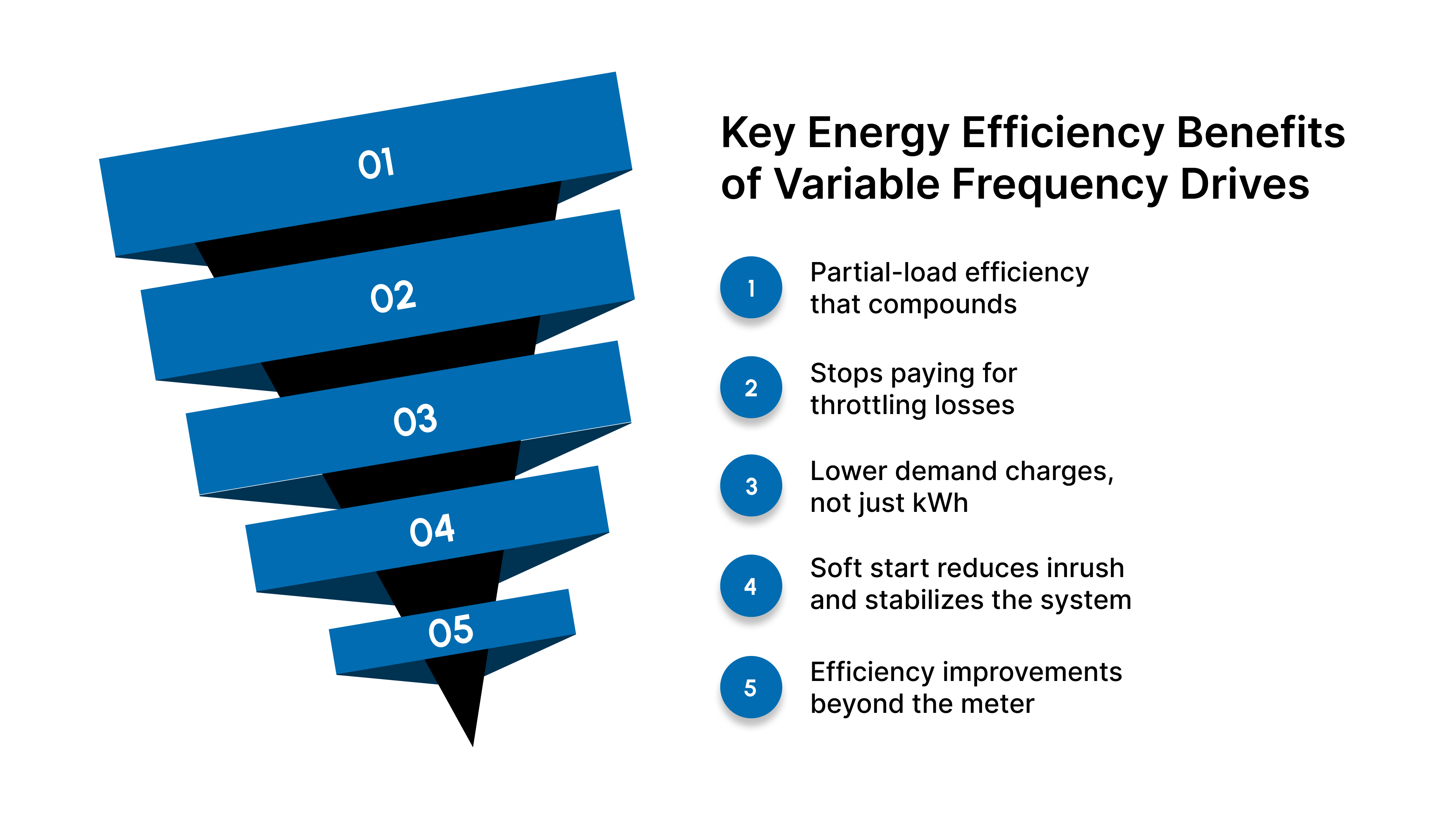
VFDs improve efficiency by controlling the cause of excess energy use, unnecessary speed, rather than letting the motor run flat-out and “fixing” output with mechanical restriction.
Partial-load efficiency that compounds (kW drops fast): On centrifugal loads (fans/pumps), even small speed cuts can slash power draw because power scales roughly with speed³. That makes VFDs most valuable anywhere demand changes across shifts, seasons, SKUs, or occupancy.
Stops paying for throttling losses: Dampers and valves “control” output by adding resistance, meaning you still buy the energy and then waste it as pressure drop, heat, and turbulence. Speed control reduces the work upstream, so the savings are structural, not incremental.
Lower demand charges, not just kWh: Across-the-line starts and operating at full speed can create high peak kW periods that inflate utility demand charges. VFD ramps and right-sized speed reduce those peaks, which often improves the bill even when runtime doesn’t change.
Soft start reduces inrush and stabilizes the system: VFDs limit starting current and smooth acceleration, reducing voltage dips, nuisance trips, and oversizing pressure on switchgear, transformers, and generators, especially important in older facilities or weak grids.
Efficiency improvements beyond the meter: By avoiding constant high pressure/flow, VFD control often reduces leakage, recirculation, and bypass (common in pumping/HVAC), while lowering mechanical stress, meaning fewer maintenance events that quietly erode energy performance over time.
Cost Savings and Return on Investment (ROI)
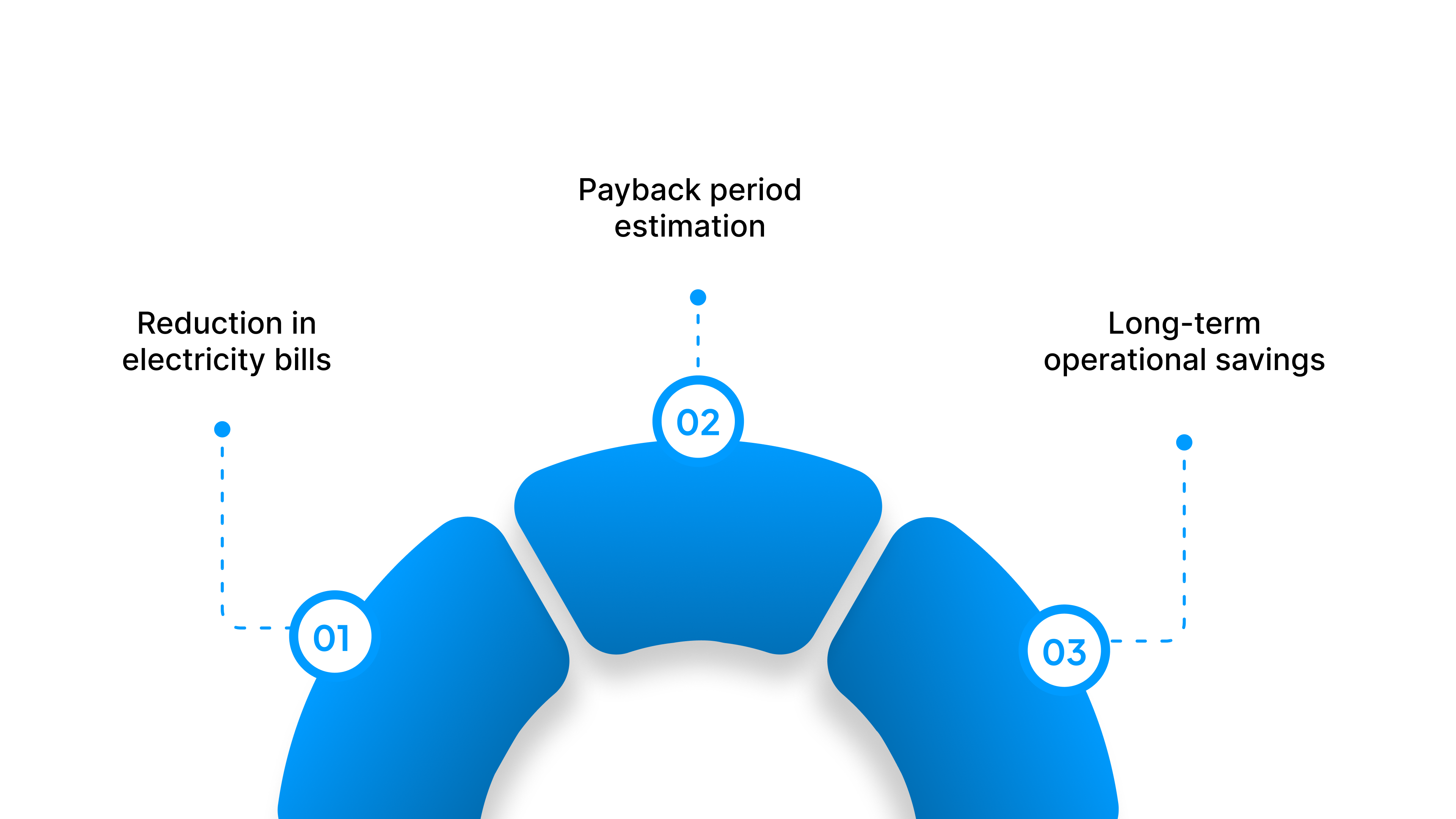
Energy efficiency only matters if it shows up on the bill and on the P&L. VFDs are one of the few upgrades where you can usually connect kWh reduction + demand reduction + maintenance reduction to a clear payback story.
1. Reduction in electricity bills
Most VFD savings come from two places, depending on your tariff:
Lower kWh (energy charges): If the motor spends meaningful time at partial load, common for fans and centrifugal pumps, speed reduction cuts kW draw dramatically versus “run full speed + throttle.”
Lower peak kW (demand charges): Soft starts and lower operating speeds reduce peak demand events that can raise monthly demand charges, especially where motors start frequently, or multiple large loads overlap.
A practical way to quantify: identify the hours spent below 100% demand, because that’s where VFDs earn their keep.
2. Payback period estimation
Use a simple, defensible model. You don’t need perfection, just realistic inputs.
Payback (months) = VFD installed cost ÷ monthly savings
Monthly savings can be estimated as:
Energy savings (₹/month) = (kW_before − kW_after) × operating hours/month × electricity rate
Add demand savings if your bill includes demand charges (peak kW):
Demand savings = (kW_peak_before − kW_peak_after) × demand rate
Quick rules that keep ROI estimates honest:
VFD ROI is strongest when load varies (HVAC, pumping, ventilation).
If the motor is truly constant-load at full output, savings may be limited (you may still justify it for control, soft start, or process stability).
Treat “paper savings” carefully: if throttling is currently used to control flow/pressure, that’s a good VFD candidate; if output is already optimized mechanically with minimal restriction, savings might be smaller.
3. Long-term operational savings
ROI isn’t just the energy line item. Over time, VFDs often reduce operating cost through:
Lower maintenance and longer asset life: Smoother starts/stops reduce mechanical shock, belt wear, coupling stress, and bearing loads.
Fewer downtime events: Better control reduces hunting/overshoot and can prevent trips caused by starting surges or unstable process conditions.
Less wasted process output: Avoiding overpressure/overflow reduces recirculation, bypassing, and leakage, quiet losses that add up every month.
Performance and Operational Benefits Beyond Energy Savings
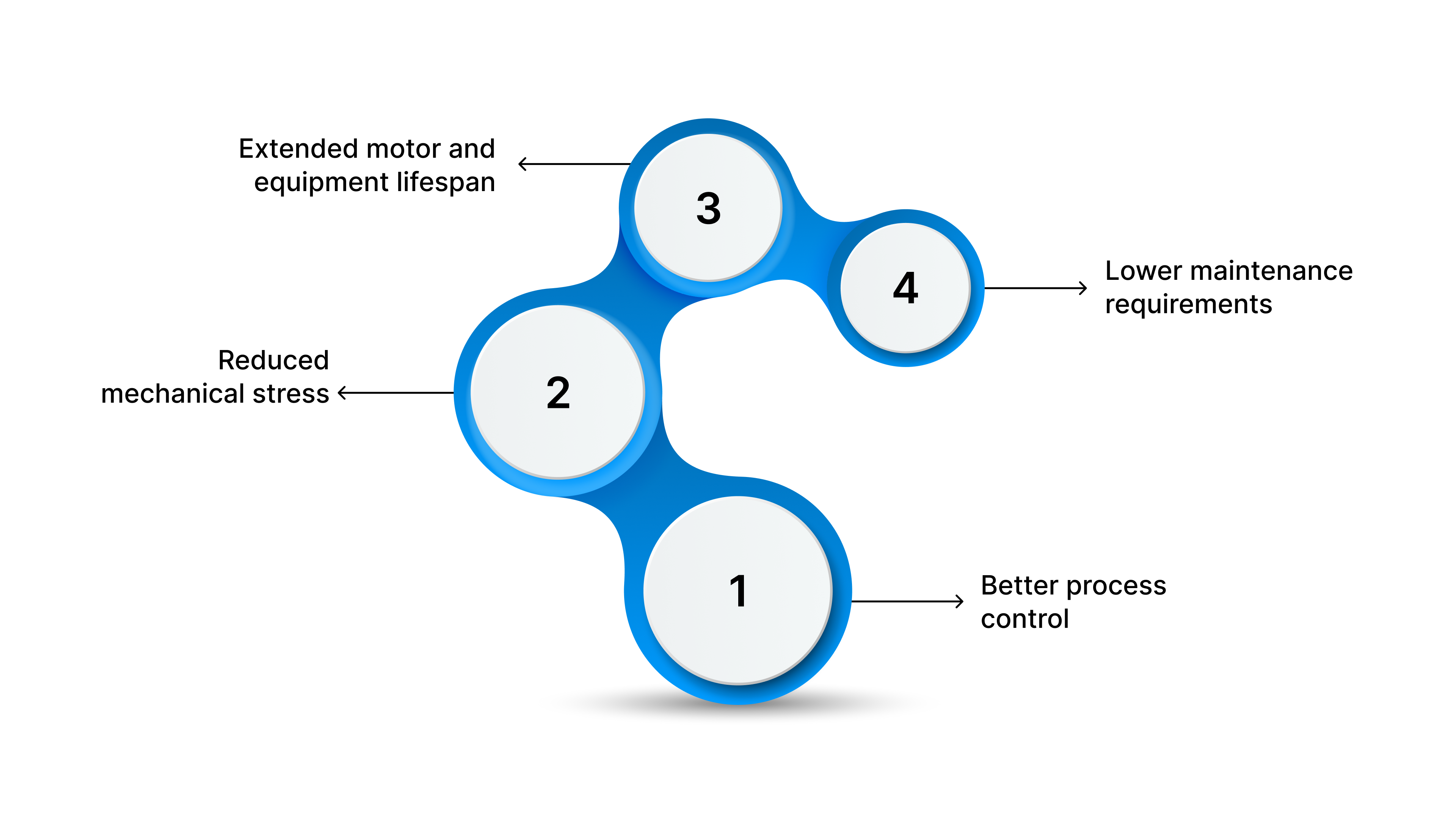
VFDs are often justified on energy savings, but many teams keep them on the spec for a different reason: they make the system easier to control, gentler to run, and cheaper to maintain across the equipment lifecycle.
1. Better process control
When speed is controllable, the process becomes controllable. VFDs let you hold tighter setpoints and respond smoothly to changing demand.
Stable flow/pressure/air volume: Maintains setpoints without oscillation common in on/off or throttled control.
Improved product and comfort consistency: Useful in HVAC, pumping loops, mixing, and material handling, where variability creates quality issues.
Easier automation: Integrates cleanly with sensors and PLC/BMS logic for closed-loop control (pressure, temperature, flow, level).
2. Reduced mechanical stress
A lot of wear starts at startup. VFDs reduce the shock loads that hit the motor and the driven equipment.
Soft starts and stops: Lower torque spikes that stress couplings, belts, gearboxes, and shafts.
Less water hammer and pressure shocks: In pumping systems, controlled ramping helps avoid sudden pressure changes.
Reduced vibration and noise: Operating at the right speed (not maximum) often lowers turbulence and mechanical resonance.
3. Extended motor and equipment lifespan
Lower stress and smoother operation typically translate into longer life for components that fail due to heat, vibration, or shock.
Reduced thermal cycling: Fewer abrupt starts can mean less heat stress on windings and insulation.
Lower peak loads: Avoids running “hard” unnecessarily, which can reduce bearing and seal wear on the driven side.
More controlled operating envelope: Helps keep equipment closer to its intended design point instead of forcing it with throttles or bypass.
4. Lower maintenance requirements
Maintenance doesn’t disappear, but it usually becomes more predictable and less frequent in the parts of the system that were being abused.
Fewer failures tied to starting: Reduced nuisance trips, contactor wear, and mechanical breakages during starts.
Less wear on control hardware: Throttling devices (valves/dampers) can see reduced duty and less erosion/cavitation risk in some scenarios.
Condition monitoring support: Many drives provide fault logs, load trends, and alarms that help maintenance teams catch issues earlier.
Common Applications Where VFD Energy Savings Are Highest
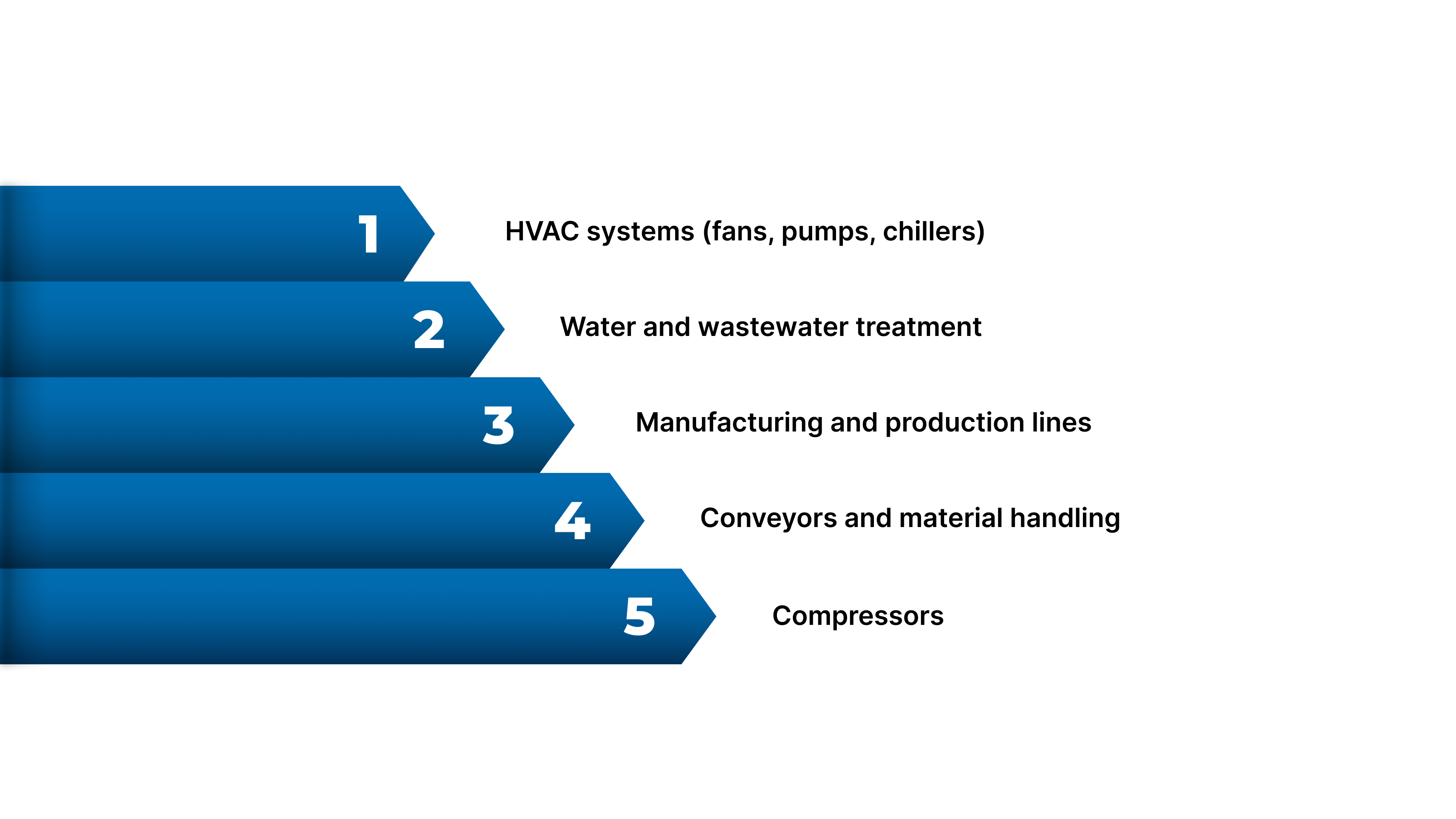
VFD energy savings are highest wherever the load doesn’t need full speed all the time. If your system frequently runs “full speed + restriction” (valves, dampers, bypass), it’s usually a strong VFD candidate.
1. HVAC systems (fans, pumps, chillers)
In buildings and plants, HVAC demand changes hourly and seasonally, making speed control one of the most reliable levers for savings.
Supply/return/exhaust fans: Match airflow to occupancy, static pressure, or CO₂ targets instead of using dampers as the primary control.
Chilled/hot water pumps: Maintain differential pressure or flow based on valve positions, reducing constant circulation at peak rates.
Cooling tower fans: Track wet-bulb and condenser water temperature needs instead of running full speed.
Chillers (where applicable): Many systems use VFDs on pumps/fans around the chiller; savings often come from the overall loop optimization, not just the chiller itself.
2. Water and wastewater treatment
These plants rarely operate at one steady condition; flows vary by time of day, season, rainfall, and process stage.
Raw water intake and transfer pumps: Speed control maintains consistent flow/pressure without excessive throttling.
Aeration blowers (when VFD-controlled): Adjust air delivery to actual dissolved oxygen demand rather than fixed output.
Lift stations and distribution pumps: Better pressure management reduces leaks, bursts, and wasted pumping energy.
Backwash/filtration cycles: Variable speed supports cycle-specific requirements without oversized constant-speed operation.
3. Manufacturing and production lines
Savings show up when equipment is oversized for peak or used across variable product runs, shifts, or batch processes.
Process pumps and fans: Common in chemicals, food, pharma, textiles, anywhere mixing, transfer, or ventilation varies.
Extrusion and winding/unwinding: Speed control improves consistency and reduces scrap during ramp-up/down.
Batch processes: Controlled acceleration/deceleration reduces shock and stabilizes output across recipes.
4. Conveyors and material handling
Conveyors aren’t always the biggest energy hog, but VFDs can remove waste created by constant high speed, frequent starts, or heavy shock loads.
Speed matching: Run conveyors at the rate the line needs instead of maximum throughput all the time.
Soft starts: Reduce gearbox/coupling stress and belt slip, especially under load.
Accumulation control: Slow down or pause sections rather than pushing product into stops.
5. Compressors
Energy savings are possible, but it’s important to be specific: VFD benefits are highest when the compressor type and control strategy support true variable output.
Air compressors (variable-speed models): Maintain stable pressure with fewer load/unload cycles and less blow-off.
Process compressors/blowers: Where flow demand varies, VFDs can reduce throttling/bypass losses.
System-level gains: Better pressure control can allow a lower setpoint, which often saves more than the drive itself.
Key Energy Efficiency Benefits of Variable Frequency Drives
VFDs improve efficiency by controlling speed at the source, so the motor only produces the output the process actually needs. That’s why they outperform “full speed + mechanical restriction” in most variable-demand systems.
1. Reduced Power Consumption at Partial Loads
This is the biggest and most reliable savings driver: instead of running the motor at 100% and throttling the process, a VFD reduces speed to match demand.
When demand drops (night shift, off-season, lower production), the drive trims speed so the motor draws fewer kW.
On fans and centrifugal pumps, partial-load savings are especially strong because power can fall sharply with speed reduction (often far more than people expect).
2. Elimination of Energy Loss from Mechanical Controls
Dampers, valves, and throttles don’t reduce the energy put into the system; they waste it after the motor has already done the work.
Throttling creates a pressure drop, turning extra energy into heat, turbulence, and noise.
A VFD avoids that waste by lowering speed, which reduces the work the motor needs to do in the first place, while often improving stability and reducing wear.
3. Improved Power Factor and Reduced Peak Demand
VFDs can improve overall electrical performance, but the real value comes from how they shape load behavior across the billing cycle.
Demand charges are driven by peak kW events; VFD control reduces “spikes” caused by running equipment harder than needed and by abrupt operating changes.
Many facilities also see better power utilization with modern drives, which can help when utilities apply penalties or when poor power quality causes operational issues (the exact impact depends on drive type and how the site is billed/monitored).
4. Lower Starting Current and Energy Spikes
Starting a motor across-the-line can create high inrush current and short-duration power stress. VFDs avoid that with controlled acceleration.
Soft start ramps reduce inrush current, helping prevent voltage dips, nuisance trips, and stress on upstream electrical gear.
Smoother starts and stops also reduce mechanical shock, which indirectly protects efficiency over time by keeping equipment in better condition.
Also Read: How Surge Protectors Work and Protect Your Devices
Key Factors to Consider Before Implementing VFDs
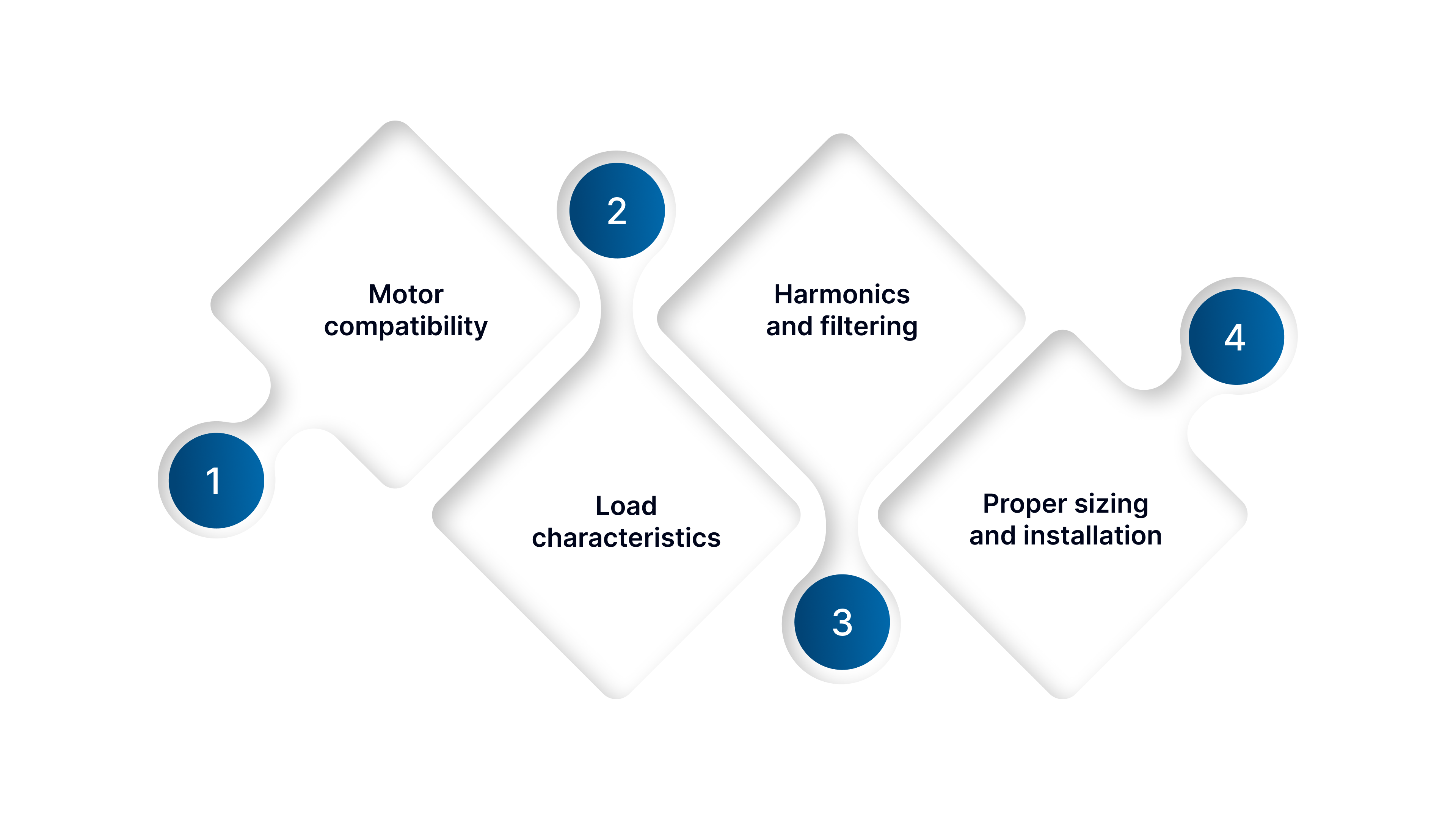
VFDs can deliver strong savings, but only when the motor, load, and electrical environment are a good fit. A quick pre-check upfront prevents the most common “it didn’t deliver” outcomes.
a. Motor compatibility
Start by confirming the motor can handle inverter duty and the operating speed range you actually need. Older motors may run hotter at low speeds, some applications need external cooling, and long cable runs can stress motor insulation if the setup isn’t designed correctly.
b. Load characteristics
VFD payback depends heavily on how the load behaves. Variable-torque loads like fans and centrifugal pumps typically deliver the highest energy savings, while constant-torque loads may benefit more from control and soft-start than pure kWh reduction.
c. Harmonics and filtering
VFDs can introduce harmonics that affect power quality, heating, and sensitive equipment, especially when many drives are installed or the electrical system is “weak.” Plan for line reactors, DC chokes, harmonic filters, proper grounding, and compliance with the relevant standards and utility requirements.
d. Proper sizing and installation
Sizing is not just motor nameplate kW/HP duty cycle, overload needs, ambient temperature, enclosure rating, altitude, and starting/torque requirements; all matter. Correct installation also includes cable selection, ventilation/clearances, protection settings, bypass strategy (if needed), and commissioning with real operating data to confirm the drive is actually reducing kW and peaks in your use case.
Delivering Measurable VFD Performance Through ValuAdd Expertise
Installing a VFD is only the first step. Real energy savings and long-term reliability depend on how well the entire system is engineered, installed, and commissioned. ValuAdd Solutions focuses on closing this gap by turning VFD investments into consistent, real-world performance.
ValuAdd delivers execution-ready solutions designed for demanding industrial environments. The focus is on stable motor control, reduced energy consumption, and longer equipment life while avoiding common issues such as nuisance trips, electrical noise, and power-quality disturbances.
Their capabilities cover complete VFD and motor control implementation, including:
Industrial-grade VFD installation and commissioning engineered for smooth operation, accurate control, and dependable efficiency under actual load conditions
Medium-voltage VFD support for high-power industrial applications designed to handle complex system architectures and heavy-duty operating demands
Soft starter integration and commissioning to enable controlled acceleration and deceleration for critical loads where mechanical stress must be minimized
Power and energy monitoring systems that provide visibility into consumption, system behavior, and operational performance
Custom control panel solutions built to meet environmental and safety requirements while supporting reliable plant-floor operation
End-to-end system commissioning, including testing, parameter optimization, documentation, and readiness validation, to ensure correct performance from day one
Every project follows a standards-led approach aligned with applicable electrical, safety, and harmonic compliance requirements. This reduces operational risk while improving long-term system stability and reliability.
Conclusion
Variable Frequency Drives deliver the best results when they’re applied to the right loads, sized correctly, and commissioned to match real operating demand. Done well, VFDs reduce energy waste at partial loads, cut peaks and starting stress, and improve process stability, so savings show up not just in kWh, but in smoother operations and lower long-term maintenance.
If you’re planning a VFD retrofit or a new installation, ValuAdd can support end-to-end VFD installation, commissioning, and monitoring setup, so your system performs the way it’s intended to. Contact ValuAdd to discuss your application and get a VFD implementation plan aligned to your motor, load profile, and site conditions.
FAQs
1) Do VFDs always save energy on any motor?
No. VFD savings are highest on variable-demand loads like fans and centrifugal pumps. On constant-load applications running near full output, the efficiency gain may be limited, though you may still benefit from softer starts and better control.
2) How much can a VFD reduce my electricity bill in real terms?
It depends on how often the motor runs below peak demand and whether you currently use throttling (valves/dampers). If the system spends a lot of time at partial load, the savings can be substantial; if it’s always near 100%, expect smaller reductions.
3) Is a VFD better than throttling with a valve or damper?
For variable flow/air systems, yes, throttling wastes energy by adding resistance while the motor still runs near full speed. A VFD reduces speed so the system simply does less work, which is typically the more efficient approach.
4) What motors and loads are the best candidates for VFDs?
Fans, cooling tower fans, HVAC pumps, chilled/hot water circulation pumps, and many process pumps are usually top candidates. Any system with changing demand across shifts, seasons, or production conditions is worth evaluating.
5) Will a VFD reduce starting current and prevent voltage dips?
In most cases, yes. VFDs ramp up speed gradually, which typically lowers inrush current compared to across-the-line starting and helps reduce nuisance trips and stress on upstream electrical equipment.