Introduction
As Battery Energy Storage Systems (BESS) expand across industrial, commercial, and residential applications, NEC disconnect requirements under Article 706.15 are frequently misapplied. The consequences show up in three predictable ways:
- Excess disconnects that add $1,500–$5,000 per switch to project budgets without providing additional compliance value
- Incorrect placement that fails inspection and triggers rework cycles, delaying project completion by weeks
- Labeling errors that leave emergency responders unable to quickly identify and operate ESS disconnects
The April 2019 incident in Surprise, Arizona, where multiple firefighters were injured responding to a thermal runaway event, illustrates what's at stake when first responders can't locate and operate disconnects under pressure.
This article covers NEC 706.15(A) through (E) in practical terms: the three compliant disconnect location paths, labeling obligations under NFPA 70E arc-flash standards, and special-case rules for residential emergency shutdown, separated modules, wall-penetrating circuits, and parallel power sources.
Whether you're a plant engineer, electrical contractor, or system integrator on utility-scale or commercial BESS projects, getting these requirements right prevents costly field changes and protects first responders.
TLDR: BESS Disconnect Requirements at a Glance
- 706.15(A): A disconnect must isolate the ESS from all wiring systems—premises circuits, other power sources, and utilization equipment
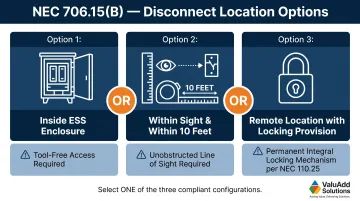
- 706.15(B): Locate the disconnect inside the ESS enclosure, within sight and 10 feet, or remotely with a permanent locking provision per 110.25
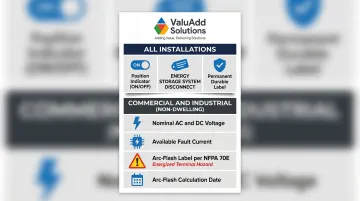
- 706.15(C): Label the disconnect "ENERGY STORAGE SYSTEM DISCONNECT" with on/off position indication
- 706.15(C) — Commercial: Also display nominal voltage, fault current, arc-flash data, and calculation date
- Residential rule: 1- and 2-family dwellings need an emergency shutdown initiation device accessible from outside the building
- Separated batteries: Physically separated battery modules require a dedicated disconnect within sight of the batteries, with full labeling
What NEC Article 706 Covers and Why It Applies to BESS
NEC Article 706 governs all energy storage systems with capacity greater than 1 kWh that operate in standalone (off-grid) or interactive (grid-tied) mode. This scope captures every battery-based BESS deployed in industrial, commercial, and residential applications—from rooftop residential units to multi-megawatt utility-scale installations.
Why ESS Disconnects Are Uniquely Critical
Unlike traditional electrical equipment that goes dead when utility power is cut, energy storage systems contain stored energy that can continue to source fault current even after the grid is isolated. This creates severe hazards for maintenance personnel and first responders who may assume the system is de-energized.
U.S. battery capacity increased 66% in 2024, adding 10.4 GW of new storage capacity and sharply expanding the number of installations that must comply with these disconnect requirements.
Those hazards drove widespread adoption of better design and installation practices. As a result, the BESS failure rate has dropped 98% from 2018 to 2024 as manufacturers and installers apply lessons learned—including proper disconnect implementation—into current designs and best practices.
Baseline Installation Rules
Article 706 establishes three foundational requirements that apply before getting to disconnects:
- Only qualified persons may install or maintain an ESS—defined as individuals with the skills, knowledge, and safety training related to the construction and operation of electrical equipment
- Listed equipment required: All ESS equipment must be listed per 706.5
- Nameplate data: Every ESS must carry a nameplate with eight required data points including rated frequency, kW or kVA rating, maximum current, and nominal AC/DC voltages
NEC 706.15(B): The Three Compliance Options for Disconnect Location
NEC 706.15(B) requires the disconnecting means to be "readily accessible" and comply with one of three location options. Article 100 defines "readily accessible" as reachable quickly without tools (other than keys), climbing over obstacles, removing barriers, or using portable ladders.
One important nuance: a key does not count as a tool. Locked-door locations accessible to authorized personnel can still qualify as readily accessible.
Option 1: Disconnect Located Within the ESS
Manufacturers may integrate the disconnect into the ESS enclosure during product listing. This is the most compact solution for wall-mounted or rooftop systems where space is constrained. The disconnect becomes part of the listed assembly.
Tool-free access to the enclosure must be maintained. If the enclosure door requires a screwdriver or hex key to open, the disconnect no longer satisfies "readily accessible" and this option fails.
Option 2: Within Sight and Within 10 Feet
The standard Article 100 definition of "within sight" allows up to 50 feet of distance. NEC 706.15(B) tightens this to just 10 feet for ESS disconnects, ensuring first responders can immediately locate and operate the disconnect during an emergency without searching the space.
Practical measurement guidance:
- Measure straight-line, unobstructed distance from the ESS enclosure to the disconnect
- Any wall, floor, or barrier that breaks line of sight disqualifies this option
- Distance exceeding 10 feet requires using Option 1 or Option 3 instead
Option 3: Remote Location with Locking Provision
When a disconnect cannot be placed within sight or within 10 feet, it may be located remotely provided the disconnect—or the enclosure giving access to it—can be locked in the open position per NEC 110.25.
110.25 lockability requirements:
NEC 110.25 requires that the locking mechanism remain in place with or without the lock installed. In practice, this means:
- The disconnect must have a permanent, integral hasp or latch
- Removable lockout/tagout clips do not qualify — they can be removed entirely
- Portable hasps fail for the same reason: no permanent locking provision remains
Remote control marking:
Where remote controls activate a disconnect not within sight of the ESS, two requirements apply:
- The disconnect must be lockable per 110.25
- The remote control location must be field-marked directly on the disconnect enclosure
NEC 706.15(C): Required Labeling and Arc-Flash Marking
NEC 706.15(C) mandates specific labeling on every BESS disconnect — requirements that directly affect first-responder safety and AHJ approval.
Baseline Labeling for All Installations
Every BESS disconnect must:
- Show whether it is in the open (off) or closed (on) position
- Display the exact marking: "ENERGY STORAGE SYSTEM DISCONNECT"
- Be permanently affixed, not handwritten, and durable enough for the installation environment (NEC 110.21(B))
Additional Commercial and Industrial Requirements
For non-dwelling installations, the disconnect must also display:
- Both nominal AC voltage and maximum DC voltage
- Available fault current derived from the ESS
- Arc-flash label prepared per NFPA 70E
- The date the arc-flash calculation was performed
NFPA 70E requires arc-flash labels to include nominal system voltage, arc-flash boundary, and at least one of the following: available incident energy and corresponding working distance, minimum arc rating of clothing, or site-specific level of PPE.
Energized-Terminal Warning Label
In BESS installations, battery strings and inverter/utility connections can independently source voltage. This means line and load terminals may stay live even when the disconnect is open. When that condition exists, the enclosure must display this exact warning:
"WARNING: ELECTRIC SHOCK HAZARD — TERMINALS ON THE LINE AND LOAD SIDES MAY BE ENERGIZED IN THE OPEN POSITION"
Source Identification Requirement
In non-residential installations, NEC 110.22 requires the disconnect marking to identify the circuit source that supplies the disconnect, unless the layout makes the source self-evident. This helps maintenance personnel and emergency responders understand the system topology quickly.
Special Cases: Residential Shutdown, Separated Batteries, and Parallel Sources
Residential (1- and 2-Family) Emergency Shutdown — 706.15(B)
One- and two-family dwellings require an emergency shutdown function capable of ceasing all export of power from the ESS to premises wiring. The initiation device must be:
- Readily accessible from outside the building
- Clearly marked to show "on" or "off" position
- Configured so switching to "off" triggers full emergency shutdown, not just opening a single circuit
This does not require running an energized circuit outside—a control signal switch that sends a shutdown command to the ESS is acceptable.
Circuits Passing Through Building Structures — 706.15(D)
ESS circuits passing through a wall, floor, or ceiling—typically in large commercial or industrial installations where batteries occupy one room and inverters or switchgear are in another—require a readily accessible disconnect within sight of the ESS on the battery side.
Scope of this rule:
- Applies: Battery and other ESS equipment occupy separate spaces
- Does not apply: Entire ESS is in one room; only the output circuit to building wiring passes through a wall
Battery Separated from ESS Electronics — 706.15(E)
A battery module that is physically separate from ESS electronics and subject to field servicing carries additional disconnect requirements:
- A readily accessible disconnect must be located within sight of the battery
- Battery circuits exceeding 240 VDC nominal must have provisions to disconnect series-connected strings into segments not exceeding 240 VDC for qualified-person maintenance
- If the disconnect is remotely controlled and controls are not within sight of the battery, the disconnect must be lockable per 110.25 and the control location must be field-marked
- The battery disconnect must carry the same arc-flash, fault-current, and battery voltage labeling required by 706.15(C)
ESS Paralleled with Other Power Sources — 706.16
An ESS operating in parallel with other power sources must meet four requirements under NEC 706.16:
- Every power source must have its own disconnecting means
- All power sources must use interactive (grid-tied) inverters
- The inverter must automatically disconnect from the utility upon utility loss per NEC 705.40
- The parallel connection must comply with NEC 705.12 supply-side or load-side connection rules
Selecting a Code-Compliant Disconnect Switch for BESS Installations
Key Selection Criteria
When specifying a BESS disconnect, verify these core attributes:
- Load break rating: Must interrupt battery circuit current at the system's nominal voltage
- Voltage and continuous current ratings: Must match or exceed ESS nameplate data
- Integral locking mechanism: Must satisfy NEC 110.25 without relying on removable clips
ValuAdd's Class E2 Load Break Disconnect Switches
ValuAdd's Class E2 Load Break compliant, UL-Listed disconnect switches are engineered for the high-energy interruption demands of industrial BESS and ESS applications. These switches meet both the load break and lockability requirements of NEC 706.15(B). Their fully rated and listed construction also supports the arc-flash labeling obligations of NEC 706.15(C), covering both code requirements in a single listed device.
Installation Guidance
If you're using an ESS manufacturer's integrated disconnect, two checks are required before adding a field disconnect:
- Confirm that deviating from the listed configuration does not conflict with the equipment's listing
- Consult both the manufacturer's installation manual and your Authority Having Jurisdiction (AHJ) before making any modifications
Frequently Asked Questions
What are the NEC requirements for disconnects?
NEC Article 706.15 requires a readily accessible disconnecting means for every ESS that isolates it from all connected wiring systems. Rules govern location (within the ESS, within sight and 10 feet, or remote with locking provisions), labeling with arc-flash data for commercial installations, and emergency shutdown functions for residential systems.
What are the emergency disconnect requirements for 2026 NEC?
The 2023 NEC—which many jurisdictions are adopting through 2025-2026—requires one- and two-family dwellings to include an emergency shutdown function with an initiation device accessible from outside the building. Verify which NEC edition your local jurisdiction has adopted, as adoption cycles vary by state and municipality.
What is the NEC 6 disconnect rule?
The "six-disconnect rule" from NEC 230.71 allows up to six main service disconnects without requiring a single main disconnect. Keep it separate from Article 706 — that rule governs service entrance equipment, not energy storage systems.
What's the difference between ESS and BESS?
ESS (Energy Storage System) is the broader NEC term covering any technology that stores energy—batteries, capacitors, flywheels, and other technologies. BESS (Battery Energy Storage System) specifically refers to battery-based storage. NEC Article 706 uses the term ESS, but its requirements apply fully to all BESS installations.
What does ESS stand for in electrical?
ESS stands for Energy Storage System, as defined in NEC Article 706. The term covers systems greater than 1 kWh that supply power to premises wiring in standalone or grid-interactive configurations.
What is ESS protection?
Under NEC Article 706, ESS protection covers the overcurrent devices, disconnect means, arc-flash safeguards, and emergency shutdown provisions required to protect personnel, property, and first responders from high-energy storage hazards.