
Proper disconnect switch sizing demands precision across multiple variables: load calculations using standardized NEC table values, strict compliance with Article 430 motor circuit rules, appropriate enclosure ratings for the installation environment, and correct horsepower ratings for motor applications. This guide walks through each step in plain technical language, connecting code requirements to real-world selection decisions that protect equipment and pass inspection the first time.
Key Takeaways
- Size to 115% of the motor's Full-Load Amperes per NEC Table 430.250 (or 430.248 for single-phase)
- Always round up to the next standard size (30A, 60A, 100A, 200A, 400A, 600A+)
- Both an ampere rating and HP rating are required—the HP rating is mandatory for NEC 430.109 compliance
- NEMA enclosure type (1, 3R, 4X, 12) should match your installation environment
- Use fusible disconnects for VFD protection and SCCR coordination
- Use non-fusible disconnects where centralized panels provide upstream protection
What Is a Disconnect Switch?
A disconnect switch is a manually operated safety device that provides a means to de-energize electrical equipment for maintenance, inspection, or emergency shutoff. Unlike a circuit breaker, it is not an automatic overcurrent protection device—its primary function is mechanical isolation of the load from the power source, creating a visible break in the circuit that allows safe work on downstream equipment.
Main Types:
- Fused safety switches — Integrate overcurrent protection (fuses) directly into the disconnect enclosure, providing both isolation and short-circuit protection in one device
- Non-fused safety switches — Provide switching and isolation only, relying on upstream circuit breakers or fuses for overcurrent protection
- Motor-rated disconnects — UL 98-listed switches designed specifically for motor circuits, built to safely interrupt the high inrush currents generated during motor starting
Common Applications Across Industrial Sectors
Disconnect switches serve critical roles across a broad range of industrial equipment, including:
- Motor branch circuits and pump stations
- HVAC systems and rooftop equipment
- Conveyors and material handling lines
- Service entrance panels in industrial facilities
Applications scale from a 30A conveyor motor isolation switch in a packaging facility to a 600A+ main service entry disconnect in a large industrial plant. In every case, the disconnect provides the visible, lockable isolation point required by OSHA 1910.147 for lockout/tagout procedures — the physical barrier between maintenance personnel and hazardous energy.
NEC Requirements for Disconnect Switches
NEC Article 430 governs motor disconnects in the United States, establishing minimum standards for ampere rating, location, visibility, and interrupting capacity. Violations result in failed electrical inspections, facility shutdowns pending correction, and potential liability if an accident occurs involving improperly rated equipment.
NEC 430.110 — Ampere Rating Rule
The disconnecting means must have an ampere rating of not less than 115% of the motor's Full-Load Current (FLC) as listed in NEC Tables 430.248 (single-phase) or 430.250 (three-phase). This rule requires using the NEC table value—not the motor nameplate current—for the calculation. Motor nameplates list actual operating current, which varies by efficiency and load factor. NEC tables provide standardized values that account for typical motor performance across all manufacturers, ensuring consistent sizing across installations.
NEC 430.102 — Location and Visibility
The disconnect must be installed within sight of both the motor controller and the motor itself (unless specific exceptions apply). The NEC defines "within sight" as visible and not more than 50 feet away. This requirement ties directly to OSHA lockout/tagout safety procedures—maintenance personnel must be able to see the disconnect from the motor location to verify it remains in the OFF position throughout the work procedure. When this rule is violated, workers cannot visually confirm isolation, creating a significant safety risk.
NEC 430.109 — Type of Disconnecting Means
NEC 430.109 requires that a motor circuit disconnect must be a listed motor-circuit switch rated in horsepower, a molded-case circuit breaker, or other approved device. A standard on/off switch without an HP rating does not satisfy this requirement. The HP rating validates that the switch can safely interrupt motor inrush current—which can reach 600-800% of full-load current during starting. Without this rating, the switch may weld closed under load or fail to interrupt the circuit safely.
NEC 230.71 — The 2-to-6 Disconnect Rule
For service entrance equipment, NEC 230.71 permits up to six disconnecting means as the service disconnect, grouped in one location, instead of requiring a single main disconnect. Recent code revisions mandate that these disconnects must consist of separate enclosures, individual panelboards, or compartmentalized switchboard sections—you can no longer group multiple disconnects in a single enclosure. This rule applies specifically to service entrance equipment; motor branch circuits under Article 430 still require a single disconnect per motor unless exceptions apply.
Short-Circuit Current Rating (SCCR) and UL 98
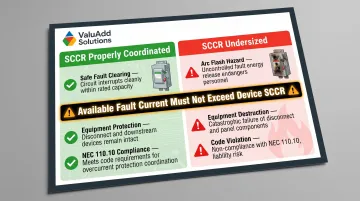
Beyond ampere rating, the disconnect must have an SCCR sufficient to withstand the available fault current at the point of installation. UL 98 is the certification standard that validates a switch's interrupting capacity and physical construction for safety. NEC 110.10 explicitly requires that equipment SCCR be selected and coordinated to permit protective devices to clear a fault without extensive damage.
That coordination requirement matters in practice: mismatched SCCR is a frequent code violation in industrial panel design, often discovered only during arc flash studies or after a fault event damages equipment. When available fault current exceeds the switch's SCCR, the device can fail catastrophically during a fault, creating an arc flash hazard that endangers personnel and destroys equipment.
How to Size a Disconnect Switch: Step-by-Step
Sizing a disconnect switch follows a code-driven sequence. Getting it right protects equipment, ensures NEC compliance, and prevents costly rework during inspection.
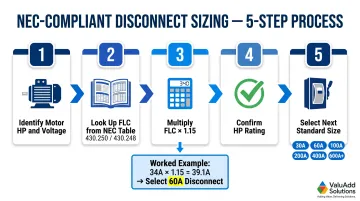
Step 1 — Determine Motor HP and Voltage
Identify the motor's horsepower and operating voltage (single-phase or three-phase). These values determine which NEC table to reference. The motor nameplate provides HP and voltage as starting points, but the Full-Load Current must come from the NEC table—not the nameplate.
Step 2 — Look Up Full-Load Current (FLC) from NEC Tables
NEC Table 430.250 (three-phase) or 430.248 (single-phase) provides the standardized FLC values used for all motor circuit calculations.
Example: A 25 HP, three-phase motor at 480V has an NEC table FLC of 34A. This value is used regardless of what the motor nameplate shows.
Step 3 — Apply the 115% Rule and Round Up
Calculate the minimum disconnect ampere rating:
Minimum Ampere Rating = FLC × 1.15
Using the 25 HP / 480V example:
- 34A × 1.15 = 39.1A
Round up to the next standard disconnect size. Standard sizes are 30A, 60A, 100A, 200A, 400A, 600A+. For 39.1A, select a 60A disconnect. Never round down — doing so violates the 115% minimum requirement.
Step 4 — Confirm HP Rating
The chosen disconnect must carry an HP rating equal to or greater than the motor's rated HP at the installation voltage. A 60A switch rated for 25 HP at 480V satisfies NEC 430.109. A switch with only an ampere rating and no HP rating cannot be used for motor circuits—it lacks the interrupting capacity to safely handle motor inrush current.
Step 5 — Select Enclosure Type for the Installation Environment
With electrical sizing confirmed, the final step is matching the enclosure to the installation environment. Choose the NEMA rating based on where the disconnect will be installed:
- NEMA 1: Clean, dry indoor locations (electrical rooms, climate-controlled spaces)
- NEMA 3R: Outdoor installations protected from rain and snow, but not hose-directed water
- NEMA 4X: Washdown areas, corrosive environments, food processing plants, wastewater treatment
- NEMA 12: Indoor manufacturing floors with dust, lint, dripping liquids, or oil mist
ValuAdd's disconnect switches are available in NEMA Type 4X and 12 enclosures, covering the most common industrial and processing plant installation requirements.
Key Factors for Selecting the Right Disconnect Switch
Once minimum ampere and HP ratings are established, several additional factors determine which specific disconnect switch best fits the application. Getting these right keeps installations code-compliant and operationally reliable for the life of the equipment.
Fusible vs. Non-Fusible
Fusible disconnects integrate fuses for overcurrent protection at the load—preferred for:
- Standalone equipment without centralized panel protection
- VFD installations requiring specific SCCR at the drive
- Applications where current-limiting fuses elevate assembly SCCR
Non-fusible disconnects are simple isolation switches relying on upstream breaker protection:
- More economical in centralized panel designs
- Used when overcurrent protection is handled at the panel
- Suitable when SCCR requirements are met by upstream devices
Motor Loads vs. Non-Motor Loads
Motor loads require the HP-rated, motor-circuit-grade disconnect described above. Non-motor loads—resistive heaters, lighting panels, general equipment—use ampere-only rated switches.
⚠ Don't misapply: Using a non-HP-rated switch on a motor circuit is both a code violation and a reliability hazard. The switch cannot safely interrupt motor inrush current and may fail under load.
Lockout/Tagout (LOTO) Capability
OSHA 1910.147 and NFPA 70E require a means to lock out energy sources during maintenance. The disconnect must support padlocking in the OFF position — treat this as a baseline requirement, not an optional feature.
Key LOTO considerations when selecting a disconnect:
- Built-in hasp provisions to accept multiple padlocks
- Support for multi-person LOTO procedures on critical equipment
- Verified compatibility with your facility's lockout program
Working Space and Installation Clearances (NEC 110.26)
NEC 110.26 establishes working space requirements around electrical equipment. For standard low-voltage industrial installations (151-600V, Condition 1), these requirements include:
- Minimum 3 feet of depth in front of the enclosure
- 30 inches of width (or the equipment width if greater)
- 6.5 feet of headroom
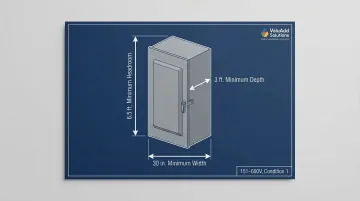
These clearances are often missed in tight panel rooms — and they cause inspection failures even when the switch itself is correctly specified. Plan your equipment layout around these minimums before installation, not after.
How ValuAdd Can Help
ValuAdd supplies industrial control and electrical components for manufacturing facilities, water treatment plants, oil and gas operations, and system integrators that need code-compliant, application-matched disconnect solutions.
Key Product Capabilities:
- Class E2 load break certified switches rated for safe interruption under full load
- NEMA Type 4X and 12 enclosures built for washdown, corrosive, and dusty environments
- UL 98 listed switches with motor-circuit HP ratings for compliant installations
Why Industrial Professionals Choose ValuAdd:
- Engineers on staff who work through disconnect sizing, SCCR coordination, and NEC compliance for complex or non-standard installations
- Ampere ratings from 30A to 1200A+ across multiple voltage classes, with enclosure options for virtually any environment
- Fast shipping on both replacement components and new installation equipment when project schedules are tight
Whether you're sizing a disconnect for a new motor circuit or verifying NEC compliance on an existing installation, ValuAdd's team can help narrow the selection and confirm the spec before you order.
Conclusion
Correctly sizing a disconnect switch requires discipline: start with the NEC table FLC, apply the 115% rule, confirm the HP rating, match the enclosure to the environment, and decide on fusible vs. non-fusible based on system protection architecture. Shortcuts at any step create compliance risk and safety hazards that may not become apparent until an inspection failure or—worse—an arc flash incident.
Industrial electrical systems are not static. Equipment gets upgraded, loads change, and the NEC itself is revised every three years. Disconnect switch specifications should be reviewed alongside any major system modification — not treated as a one-time decision.
Revisit your disconnect sizing when any of the following occur:
- Motor HP increases due to equipment upgrades
- New VFDs are added to the system
- Available fault current changes following utility upgrades
- The facility undergoes significant load reconfiguration
Each of these events can invalidate a previously compliant installation. Periodic review keeps your system safe and code-current.
Frequently Asked Questions
How do you size a disconnect switch?
Find the motor's FLC from NEC Table 430.250 (or 430.248 for single-phase), multiply by 115%, and select the next standard disconnect size above that calculated minimum—confirming both ampere and HP ratings match or exceed the motor's requirements.
What are the NEC requirements for disconnect switches?
Key requirements include NEC 430.110 (minimum 115% ampere rating), NEC 430.109 (must be HP-rated for motor circuits), and NEC 430.102 (within sight of motor and controller). SCCR must also be coordinated with available fault current per NEC 110.10.
What are the standard disconnect switch sizes?
Standard ampere ratings are 30A, 60A, 100A, 200A, 400A, and 600A+. Always select the next standard rating above the calculated minimum ampacity—never round down, as this violates the 115% minimum requirement.
Can I use a 60 amp disconnect on a 40 amp breaker?
Yes. Using a higher-rated disconnect than the upstream breaker is acceptable and often provides safety margin and room for future load growth. The critical requirement is that the overcurrent device (fuse or breaker) is sized for the actual load and conductor, not the disconnect's maximum rating.
What is the NEC rule for 2 to 6 disconnect switches?
NEC 230.71 allows up to six disconnects grouped at the service entrance to serve as the service disconnecting means without requiring a single main disconnect. Recent code revisions require these disconnects to be in separate enclosures or compartmentalized sections.
Does the NEC require an exterior disconnect?
NEC 230.70 requires a service disconnect at a readily accessible point nearest the entrance of service conductors. For many commercial and industrial installations this means an exterior or readily accessible location, though exact placement depends on building type, occupancy, and local NEC amendments.