Introduction
Picture this: It's 2 a.m. at a municipal booster pump station serving 40,000 residents. A single soft starter fails (an SCR gate drive board overheats and trips), and system pressure drops below regulatory thresholds within minutes. The standby pump won't start — it shares the same failed starter.
By dawn, sections of the distribution network have lost pressure entirely, triggering mandatory boil-water notices and EPA violations that will cost the utility hundreds of thousands in fines and emergency response.
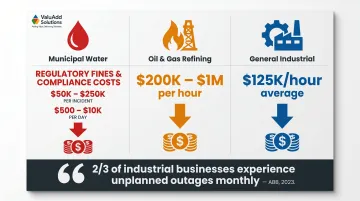
This scenario isn't hypothetical. Unplanned downtime costs the typical industrial facility approximately $125,000 per hour, while oil and gas operations can lose $200,000 to over $1 million per hour. For municipal water systems, a pump station failure directly causes sanitary sewer overflows (SSOs) and environmental penalties.
Dual redundant soft starters eliminate this single point of failure by ensuring a backup motor starting path is always available. This article covers redundant architecture types, the features that separate reliable systems from marginal ones, and how to select and commission them for maximum uptime.
Key Takeaways
- Dual redundant soft starters maintain two independent starting paths so a fault in one unit never halts the motor
- Avoid regulatory violations and catastrophic downtime by building redundancy into water treatment, oil and gas, and chemical processing applications
- Hot-standby, primary-plus-backup ATS, and dual SCR string topologies each offer different transfer speeds and complexity
- Reliable systems require automatic fault detection, IEEE 519 compliance, NEMA 4X enclosures, and medium voltage support up to 15 kV
What Are Dual Redundant Soft Starters?
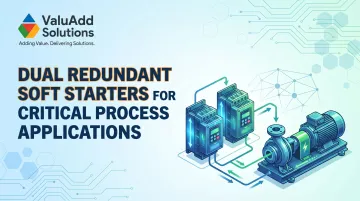
A dual redundant soft starter is a system configuration in which two soft starter units—or a soft starter paired with a bypass/transfer mechanism—are arranged so that if the active unit fails, motor starting and running control passes to the standby unit without manual intervention.
This differs from a standard soft starter with a bypass contactor. A bypass contactor reduces heat dissipation after motor run-up by bridging out the SCRs during steady-state operation, but it does not provide a backup starting path.
If the primary soft starter's control board fails, gate drive circuitry malfunctions, or SCRs open-circuit, the motor cannot start—even with a bypass contactor in place.
True redundant configurations maintain full soft-start capability from both units. That distinction drives three critical outcomes:
- The motor remains startable and controllable even during device faults
- Thermal trips or control board failures in the primary unit do not halt the process
- Single points of failure in the motor starting circuit are eliminated
For a configuration to qualify as truly redundant, each unit must independently handle full soft-start duty. ValuAdd's MVDH Series Two-High MV Soft Starter meets this requirement with two independent 350% rated solid-state starters and emergency backup full voltage capability built into a single enclosure.
Why Critical Process Applications Demand Redundancy
Defining Critical Process Applications
A critical process application is any operation where an unplanned motor stop causes:
- Safety risks to personnel or the public
- Environmental violations or regulatory non-compliance
- Production losses exceeding a defined financial threshold
- Contractual penalties or service-level agreement (SLA) breaches
Examples include booster pump stations, cooling water systems, gas compression trains, wastewater lift stations, and refinery transfer pumps.
Failure Modes That Make Single Soft Starters a Liability
Soft starters fail primarily due to excessive voltage, current, or heat impacting the Silicon Controlled Rectifiers (SCRs). Common fault modes include:
- SCR open-circuit faults – One phase loses conduction, causing severe voltage imbalance
- Gate drive board failures – Loss of gate pulse integrity prevents SCR triggering
- Over-temperature shutdowns – High-ambient conditions or frequent start/stop cycling trip thermal protection
- Communication loss – Networked control architectures lose connectivity to the starter, halting operation
According to a 2023 global survey by ABB, over two-thirds of industrial businesses experience unplanned outages at least once a month, costing the typical facility close to $125,000 per hour. In oil and gas refining, hourly costs can reach $200,000 to over $1 million.
Regulatory and Contractual Drivers
Many municipal water and oil and gas operators are contractually or required by regulation to demonstrate N+1 or N redundancy in motor starting equipment. Two key regulatory standards drive this requirement:
- EPA SSO enforcement – The U.S. EPA links sanitary sewer overflows directly to inadequate pump maintenance and missing backup systems; a single station failure can trigger an overflow within hours, exposing utilities to federal enforcement actions and state fines
- U.S. Army Corps of Engineers – Pump stations must maintain at least 2/3 of required capacity if one pump fails, requiring at least two equal-sized pumps with corresponding redundant electrical controls
Beyond Equipment Failure: Process Upsets
Voltage sags and sudden load spikes can trip a single soft starter even when the hardware itself is healthy. Without a standby unit, recovery requires manual reset and restart cycles — each one extending downtime and compounding compliance exposure. A dual-redundant architecture eliminates that gap entirely.
How Dual Redundant Soft Starter Architectures Work
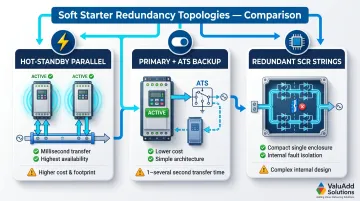
Engineers implement redundancy using three primary topologies:
1. Hot-Standby Parallel Architecture
Both units are powered and monitoring the motor circuit simultaneously. Upon fault detection in the primary, the standby takes over within milliseconds through automatic transfer logic. This is the fastest-transfer, highest-availability configuration — ideal for applications where even a brief power interruption cannot be tolerated.
2. Primary-Plus-Backup with Automatic Transfer Switch (ATS)
The primary soft starter runs normally. A fault triggers an ATS to route power through the backup soft starter. Transfer time is longer than hot-standby (typically one to several seconds), but the configuration is simpler and lower cost. An ATS automatically switches electrical loads from a primary power source or controller to a secondary one, making it suitable for applications that can tolerate brief interruptions.
3. Soft Starter with Intelligent Bypass and Redundant SCR Strings
A single enclosure contains two independent SCR firing paths. A fault on one SCR string is isolated by internal diagnostics, and the second string assumes control. This topology suits medium voltage applications and reduces panel footprint compared to dual discrete units.
Fault Detection Logic
Redundant systems rely on continuous self-diagnostics to detect fault conditions before they result in a motor trip. Modern controllers monitor:
- SCR junction temperature
- Gate pulse integrity
- Current feedback and phase imbalance
When a fault is detected, the system triggers the transfer to the backup path and logs the event for maintenance review.
Protection Coordination
Fault detection alone isn't enough — the protection layer must be engineered just as carefully. Overcurrent protection, ground fault relays, and motor protection relays must be coordinated so they do not inadvertently isolate both the primary and backup paths simultaneously. For example:
- A motor ground fault should trip both paths (motor fault)
- An SCR short-circuit should isolate only the affected starter (starter fault)
Careful relay coordination ensures that only the faulted component is removed from service.
Control System Integration
A PLC or DCS ties the redundant architecture together by handling:
- Receiving status signals from both soft starter units
- Managing transfer logic and sequencing
- Logging fault events for maintenance records
- Preventing repeated auto-restart cycling that could damage the motor
SCADA visibility allows operators to monitor transfer events in real time and schedule maintenance before redundancy is compromised.
Key Features That Define a Reliable Redundant Soft Starter System
Automatic Fault Detection and Bumpless Transfer
Transfer must be fast—ideally sub-cycle or within one to two cycles—in applications where process momentum cannot tolerate even a brief power interruption. "Bumpless" means current and torque continuity during switchover, preventing mechanical shock or process upset.
Medium Voltage Capability and IEEE 519 Harmonic Compliance
Many critical process motors—large pumps, compressors, fans—operate at medium voltage (2.3 kV to 13.8 kV). Soft starters in these applications must meet IEEE 519-2022 harmonic limits to avoid interference with sensitive process instrumentation and the utility interconnect.
IEEE 519-2022 key requirements:
- Evaluates harmonic distortion at the Point of Common Coupling (PCC)
- Daily 99th percentile very short time (3 s) harmonic currents shall be less than 2.0 times the steady-state table values
- Weekly 99th percentile short time (10 min) harmonic currents shall be less than 1.5 times the steady-state values
Because soft starters are typically bypassed at full speed, harmonic generation occurs only during the brief starting phase, making short-duration compliance critical.
For applications requiring both voltage range and verified compliance, ValuAdd's MVE-P Series (2.3 kV to 15 kV) and CBMVRX Series (up to 25,000 HP at 13.8 kV) are IEEE 519 compliant and UL Listed, covering the full span of medium voltage motor sizes found in water treatment and oil and gas facilities.
Enclosure and Environmental Ratings
NEMA Type 4X or 4X/12 enclosures are required for redundant soft starter panels in outdoor, wash-down, or corrosive environments common to water treatment and oil and gas.
| NEMA Type | Protection | Typical Use |
|---|---|---|
| Type 12 | Falling dirt, circulating dust, dripping water (indoor only) | Indoor manufacturing, machining |
| Type 4 | Rain, snow, splashing water, hose-directed water | General outdoor pump stations |
| Type 4X | Hose-directed water plus corrosion resistance | Wastewater wash-down, coastal salt spray, chemical plants |
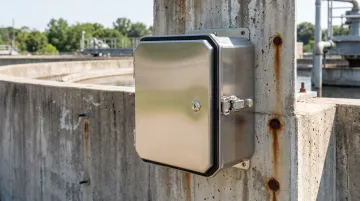
For water/wastewater and oil & gas applications exposed to chlorides or wash-down procedures, Type 4X with 316 stainless steel outperforms 304 stainless steel, as the molybdenum content in 316 SS significantly increases resistance to pitting and cracking.
Diagnostics, Event Logging, and Remote Monitoring
Built-in communication interfaces—Modbus RTU, Modbus TCP, and others—allow the redundant system to report fault codes, transfer events, and load history to a plant DCS or SCADA system. This supports:
- Predictive maintenance (trending thermal loads, start counts)
- Audit requirements in regulated industries
- Rapid troubleshooting and reduced mean time to repair (MTTR)
- Direct integration with SCADA systems and PLCs via Modbus register mapping (supported by ValuAdd's RX2E and MVRXE series)
Industry Applications Where Dual Redundancy Is Non-Negotiable
These three industries treat motor downtime as an operational emergency — not an inconvenience. Redundant soft starter configurations appear in their design standards for good reason.
Municipal Water and Wastewater
Booster pump stations, lift stations, and high-service pump motors cannot go offline. A single pump trip can depressurize a distribution system or cause an overflow event. Redundant soft starters are specified alongside standby pump units to ensure continuous service and regulatory compliance.
For example, Greenville Water in South Carolina successfully modernized its raw water pump station by replacing aging equipment with an Eaton Ampgard RVSS, ensuring uninterrupted supply to over 500,000 residents.
Oil, Gas, and Petrochemical Processing
Gas compressor trains, crude oil transfer pumps, and cooling water systems in refineries require redundancy to prevent catastrophic production losses. OSHA's Process Safety Management (PSM) standard (29 CFR 1910.119) mandates strict mechanical integrity programs, requiring documented redundancy in motor control for critical rotating equipment.
Manufacturing and Industrial Processing
A failed motor start on a large chiller, cooling tower fan, or material handling conveyor can cascade into a full production line stoppage within minutes. Food, pharmaceutical, and chemical manufacturers now routinely include redundant soft starters in critical utility motor panels — directly addressing the batch loss and contamination risks that regulators and quality auditors flag during facility reviews.
Implementation and Commissioning Considerations
Getting dual redundant soft starters right depends on three things: how the panel is built, how the system is validated at startup, and how both units are maintained over time. Skipping any one of these undermines the redundancy you're designing for.
Panel Design and Wiring Discipline
Dual redundant soft starter systems require careful panel layout to ensure both units have:
- Independent power feeds
- Separate fusing
- Physical separation so a single wiring fault or bus fault does not disable both paths simultaneously
Custom-engineered control panel design from a provider like ValuAdd ensures these separation requirements are met and that protection coordination is correctly implemented.
Once the panel is built and wired correctly, the next step is proving the redundancy actually works under realistic fault conditions before the system enters service.
Testing and Validation
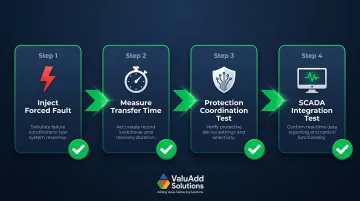
Commissioning tests required to validate redundancy include:
- Inject a forced fault on the primary unit to verify automatic transfer to the backup
- Measure transfer time to confirm it meets the application's process tolerance
- Verify protection coordination so motor faults and starter faults isolate correctly without tripping both paths
- Functionally test SCADA integration to confirm status signals, alarms, and event logs map correctly
A transfer that fails during commissioning is far less costly than one that fails during a live process upset. Document every test result — undocumented commissioning is indistinguishable from no commissioning.
Maintenance Strategy
Redundant systems require a maintenance program where:
- Both units are periodically rotated as "primary" to ensure equal wear
- SCR health checks are performed on both units (thermal imaging, gate pulse verification)
- Verify firmware/parameter alignment between units periodically to prevent configuration drift that causes the backup to behave differently than the primary at transfer
Frequently Asked Questions
Can a VFD act as a soft start?
Yes, a VFD can perform soft starting by ramping voltage and frequency, but it is a more complex and costly solution than a dedicated soft starter. For critical process redundancy applications, soft starters are often preferred for their simpler bypass capability, lower heat dissipation, and easier integration into sealed NEMA 4X enclosures.
What are the three types of motor starters?
The three types are direct-on-line (across-the-line) starters, reduced-voltage starters (including soft starters and autotransformer starters), and variable frequency drives. Soft starters fall within the reduced-voltage category.
What is a non-combination motor starter?
A non-combination motor starter does not include a built-in disconnect or short-circuit protective device—the protection is supplied separately upstream. In redundant soft starter panels, this distinction matters because the disconnect and protection coordination must account for both the primary and backup starter paths, ensuring faults are isolated correctly.
Will a soft start hurt your AC unit?
In industrial applications, properly sized and configured soft starters benefit motors and mechanical systems by reducing inrush current and mechanical shock. Problems arise only from incorrect sizing, improper ramp settings, or using a soft starter in an application with very high static load torque requirements—all of which can cause excessive heating during prolonged acceleration.
To discuss ValuAdd's MVDH Series Two-High MV Soft Starter, the MVRXE Dual Redundant system, or application-specific panel engineering, reach out to our technical team directly.