Introduction
Panel builders face a critical specification decision on nearly every motor control project: whether to integrate a bare open chassis soft starter into a custom enclosure or specify a factory-built enclosed unit. Getting this wrong carries real consequences:
- Wasted engineering hours and costly mid-project pivots
- Failed UL 508A inspections at commissioning
- Thermal management failures in the field
- Equipment damage when an unprotected unit meets harsh conditions
Both formats use the same thyristor-based power sections that gradually ramp voltage to reduce inrush current and mechanical shock. The difference is packaging, certification path, and deployment context — which makes the format decision as consequential as the amp rating itself.
This guide covers the practical tradeoffs panel builders weigh on every job: labor time, enclosure protection, UL listing complexity, and total installed cost. Understanding how environment, project scope, and certification path drive the decision helps panel shops deliver solutions that pass inspection and survive the field.
TLDR:
- Open chassis soft starters are bare modules for custom panel integration—offering lower unit cost and maximum design flexibility
- Enclosed units are factory-packaged assemblies with defined NEMA/IP ratings—enabling faster deployment and pre-certified environmental protection
- Open chassis suits OEM machine builders and large multi-motor panels; enclosed suits standalone harsh-environment installations
- Enclosed units cost more upfront but often lower total installed cost by cutting panel design labor and simplifying UL 508A listing
- Environment, installation speed, and UL certification path are the three decisive factors when choosing between formats
Open Chassis vs Enclosed Soft Starter: Quick Comparison
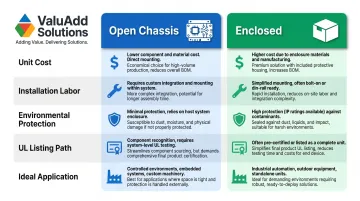
| Dimension | Open Chassis | Enclosed |
|---|---|---|
| Unit Cost | Lower unit price; enclosure and engineering add to total BOM | Higher unit price; thermal management and housing included |
| Installation Labor | Custom panel design, thermal calcs, and field assembly required | Mount and wire only; line and load connections to complete |
| Environmental Protection | No environmental rating; panel builder engineers NEMA/IP compliance | Factory-rated NEMA 12, 4, or 4X; pre-tested ingress protection |
| UL Listing Path | UL Recognized component; panel shop holds UL 508A listing responsibility | UL Listed as complete assembly; simplifies 508A BOM documentation |
| Ideal Application | OEM cabinets, MCCs, multi-motor panels sharing enclosure space | Standalone field installs, outdoor/corrosive sites, fast-turnaround projects |
Key Insight: Best value depends entirely on application context — neither format is universally cheaper once total project cost (unit price + engineering labor + certification + field time) is tallied.
What is an Open Chassis Soft Starter?
An open chassis soft starter is a soft-starter module—consisting of a thyristor-based power section plus control board—supplied without an enclosure. It's intended to be DIN-rail or panel-mounted inside a builder-supplied cabinet or motor control center (MCC) compartment, typically alongside PLCs, VFDs, relays, and other control components.
The core operational benefit is identical to any soft starter: by gradually ramping voltage to a three-phase motor at startup, it limits inrush current (often reducing it by 50–70%) and eliminates mechanical shock on couplings, belts, and gearboxes. The difference is form factor—an integrable module rather than a standalone box.
Open chassis units give panel builders complete control over the build:
- Enclosure material (carbon steel, stainless steel, fiberglass)
- NEMA/IP rating (Type 1, 12, 4, 4X, custom)
- Cabinet depth, width, and internal layout
- Grouping multiple starters, drives, and controllers in a single door
- Custom thermal management (forced ventilation, heat sinks, spacing)
One implication worth understanding: an open chassis soft starter carries component-level UL Recognized marking, not a full product listing. Under UL 508A Supplement SA, these components are intended for factory installation where their limitations of use are known and investigated. The completed panel assembly must be listed separately under UL 508A, putting the listing responsibility—including SCCR calculations, thermal analysis, and spacing documentation—on the panel shop.
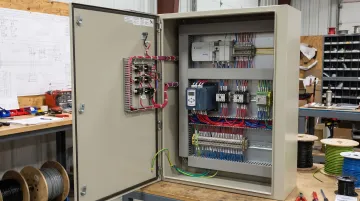
Panel builders can specify factory-installed or field-added options when ordering open chassis units:
- Bypass contactors to eliminate heat dissipation after motor reaches full speed
- Communication cards (Modbus, Profibus, EtherNet/IP) for network integration
- Motor thermistor inputs for thermal protection
- External control terminals for PLC integration
ValuAdd's EMX4 Series protected chassis soft starters support optional communication cards and feature pluggable terminals for fast installation, with ratings up to 1200A at control voltages of 120 VAC or 230 VAC.
Use Cases for Open Chassis Soft Starters
OEM Machine Builders incorporate the soft starter directly into machine-mounted control cabinets. A single enclosure across multiple machines cuts footprint and cost—and simplifies the UL 508A listing process since everything goes through one shop review.
Motor Control Centers (MCCs) present a different challenge: when dozens of starters control pumps, fans, and conveyors from a single enclosure, boxing each unit individually is impractical. Open chassis units allow high-density layouts with optimized thermal management and clear maintenance access.
High-volume panel shops running standardized builds benefit most from the lower per-unit hardware cost, particularly when UL 508A procedures are already established and assembly workflows are dialed in.
What is an Enclosed Soft Starter?
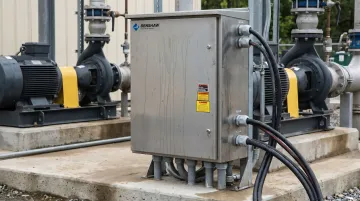
An enclosed soft starter is a complete, factory-assembled unit: the soft starter module is mounted, wired, and tested inside a rated enclosure (NEMA 1, NEMA 12, NEMA 4, or NEMA 4X) before it ships, arriving on site ready for line and load connections only.
Key Operational Advantage:
Since the factory handles thermal management (venting or sealed heat-sink design), internal wiring, and enclosure rating, the field installation scope shrinks to:
- Mounting the enclosure
- Running conduit and making entries
- Connecting two cables (line and load)
- Commissioning and parameter setting
According to industry analysis, enclosed softstarters reduce installation time and panel size by integrating numerous built-in features, significantly cutting commissioning time compared to field-assembled equivalents.
Enclosure Rating Options:
ValuAdd's enclosed soft starters carry UL Listed and NEMA Type 4X/12 compliance, with options including:
- NEMA 12: Dust and drip-resistant for industrial indoor use; protects against falling dirt, circulating dust, lint, and light splashing water
- NEMA 4: Outdoor and washdown applications; protects against rain, sleet, snow, splashing water, and hose-directed water
- NEMA 4X: Corrosion-resistant stainless or fiberglass enclosures critical for water treatment, food processing, and chemical environments where both moisture and corrosive agents are present
Combination vs. Non-Combination Configurations:
- Combination-type: Includes factory-integrated disconnect (fusible or circuit breaker) and overload protection, giving panel builders a single-SKU solution that satisfies NEC motor branch circuit protection requirements. ValuAdd's RX2E and RX4E Series, for example, feature built-in circuit breakers, comprehensive ANSI motor protection, and full voltage emergency bypass contactors.
- Non-combination: Requires the panel builder to add upstream protective devices but offers more flexibility in protection coordination.
UL Listing Advantage:
Enclosed units are UL Listed as complete assemblies, which substantially reduces the panel shop's UL 508A documentation burden. The enclosed unit appears as a single listed component on the panel BOM — no sub-assembly engineering, documentation, or testing required.
Use Cases for Enclosed Soft Starters
Standalone Motor Installations:
Enclosed units are ideal for pump, fan, compressor, or conveyor installations where the soft starter mounts directly at the motor or in a satellite control station—with no larger panel to absorb it into. This is common in water/wastewater lift stations, HVAC rooftop units, and distributed conveyor systems.
Harsh Environments:
Enclosed soft starters are the right call wherever the enclosure's NEMA rating is the only barrier between electronics and the environment. Typical deployments include:
- Water/wastewater lift stations (outdoor, wet)
- Oil and gas wellheads (outdoor, corrosive)
- Food processing wash-down areas (NEMA 4X stainless)
- Chemical plants (corrosive atmospheres)
- Coastal facilities (salt spray)
Research on water treatment applications shows soft starters are commonly deployed in deep well pumps, lift stations, grinders, and clarifiers—environments that frequently demand NEMA 4 or 4X protection.
Fast-Turnaround Projects:
When schedules are tight, factory-enclosed units recover their cost premium quickly. Skipping panel design, thermal analysis, and UL 508A documentation can shave weeks off delivery — a real advantage when engineering hours are the constraint.
Open Chassis vs Enclosed: Which Should Panel Builders Choose?
The decision hinges on three primary drivers: Environment, Project Scope, and Total Cost. Panel builders should evaluate their project against each before specifying format.
Environment Decision Rule
Choose Open Chassis if:
- The soft starter will live inside a climate-controlled electrical room or MCC
- Temperature, humidity, and particulate are controlled
- No direct exposure to moisture, corrosive agents, or outdoor ambient conditions
Choose Enclosed if:
- The unit will be exposed to dust, moisture, washdown, or outdoor conditions
- NEC Section 110.28 requires NEMA Type 4, 4X, 6, or 6P for equipment subjected to rain, snow, windblown dust, or hosedown
- The installation site includes corrosive agents (chemical plants, coastal environments, wastewater treatment)
Critical Warning: Attempting to field-adapt an open chassis unit for harsh environments introduces liability, voids warranties, and often results in premature failure. NEMA 4X enclosures are specifically required when protection from corrosive agents is necessary.
Environment is the threshold question. Once that's settled, project scope determines which format delivers better economics.
Project Scope Decision Rule
Choose Open Chassis if:
- Building large custom panels with multiple motor starters sharing one enclosure
- Total BOM cost and panel depth are critical constraints
- The shop produces high volumes of standardized panels with established UL 508A procedures
- Design flexibility (custom layout, specialized thermal management) is required
Choose Enclosed if:
- Single-motor field installations where individual enclosures are necessary anyway
- Fast-turnaround projects where engineering hours are the bottleneck
- The shop lacks established UL 508A procedures or SCCR calculation workflows
Labor-Hour Reality: Panel wiring labor (wire pulling, termination, connections) is typically the largest variable cost in custom panel building. Engineering time, drawing time, and UL 508A documentation can add 4–8 hours per panel when using UL Recognized components versus Listed assemblies.
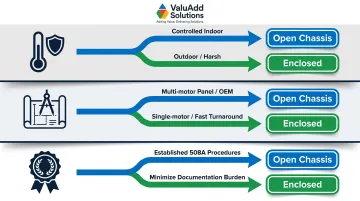
Scope drives the labor math. UL certification requirements then determine whether open chassis integration is even viable for your shop.
UL Certification Decision Rule
Choose Open Chassis if:
- Your shop maintains a comprehensive UL 508A procedure and can efficiently document component-level integration
- You're comfortable managing SCCR calculations, thermal analysis, and spacing requirements
- Your project involves dozens of motor starters where standardization delivers economies of scale
Choose Enclosed if:
- Your shop is pursuing UL 508A listing and wants to minimize documentation burden
- Using UL Listed sub-assemblies simplifies compliance compared to engineering and testing component assemblies from scratch
- You want to reduce the risk of failed inspections due to SCCR or thermal management issues
Real-World Scenario
Consider a water treatment facility upgrading multiple pump stations. The central MCC room houses a dozen pumps in a climate-controlled building—open chassis units integrated into a multi-motor panel reduce total cost and optimize space. Three satellite lift stations sit outdoors in wet, corrosive environments—enclosed NEMA 4X units provide the required protection without custom engineering.
Mixed-format projects like this are common. ValuAdd's technical team can walk through each installation point with you during pre-sales to confirm the right format before the BOM is finalized.
Quick-Reference Checklist
Choose Open Chassis if:
- Indoor, climate-controlled environment
- Multi-motor panel or MCC application
- High-volume production with established UL 508A procedures
- Custom layout or thermal management required
- Lower per-unit hardware cost is priority
Choose Enclosed if:
- Outdoor, wet, dusty, or corrosive environment
- Standalone motor installation
- Fast project turnaround required
- Simplified UL 508A listing path desired
- Reduced engineering labor is priority
Conclusion
The open chassis versus enclosed decision is not about one format being superior—it's about matching the product format to the installation context, certification path, and total project economics. Panel builders who evaluate environment, scope, and UL requirements upfront avoid costly mid-project changes, failed inspections, and field failures.
Both formats produce the same motor control results: reduced inrush current (typically 50–70%), extended equipment life by eliminating mechanical shock, and minimized unplanned downtime. The format choice determines how efficiently the panel builder delivers those outcomes to the end customer.
The key tradeoffs to weigh before specifying:
- Unit cost vs. labor savings — open chassis costs less upfront; enclosed reduces panel assembly time
- Design flexibility vs. certification speed — open chassis suits custom builds; enclosed clears UL listing faster
- Scope size — open chassis pays off on multi-unit panels; enclosed is faster to deploy on single-motor jobs
- Environment — wash-down, dusty, or corrosive installations often require the protection an enclosed unit provides by default
Knowing where a project lands on each of these factors is what separates a fast, clean installation from one that generates rework calls.
Frequently Asked Questions
What are the different types of soft starters?
The main categories are open chassis (module only for panel integration), enclosed (factory-packaged with NEMA-rated enclosure), and combination type (enclosed with integrated disconnect and overload protection). Voltage class—standard low voltage versus medium voltage—is a further differentiator, with ValuAdd offering both categories.
Is a soft starter better than a VFD drive?
Soft starters control motor starting and stopping but not running speed, making them cost-effective for fixed-speed applications like pumps, fans, and conveyors. VFDs can cost two to three times more than soft starters and are better suited when variable speed operation is needed, but introduce harmonics and added complexity.
What is the lifespan of a soft starter?
Well-maintained soft starters typically last 15–20+ years, with SCR/thyristor components rated for millions of operations. Lifespan depends on ambient temperature, duty cycle, correct sizing, and bypass contactor use—which reduces thermal stress by taking the soft starter out of circuit during run.
Can an open chassis soft starter be used in an outdoor installation?
An open chassis unit can be used outdoors only if the panel builder provides an enclosure with the appropriate NEMA/IP rating (NEMA 4/4X minimum) and ensures proper thermal management. The open chassis module itself has no environmental protection and will fail rapidly if exposed to moisture, dust, or corrosive agents.
What NEMA rating should I specify for an enclosed soft starter in a wash-down environment?
Specify NEMA 4 for general wash-down and outdoor exposure, NEMA 4X for corrosive environments requiring stainless or fiberglass enclosures. Food processing, chemical plants, and water treatment applications typically require NEMA 4X to withstand both hose-directed water and corrosive agents.
Do enclosed soft starters include overload and short-circuit protection?
Combination-type enclosed soft starters include a factory-integrated disconnect, fusing or circuit breaker, and overload protection. Non-combination types require the panel builder to add upstream protective devices. Confirm the configuration before ordering to ensure code compliance.