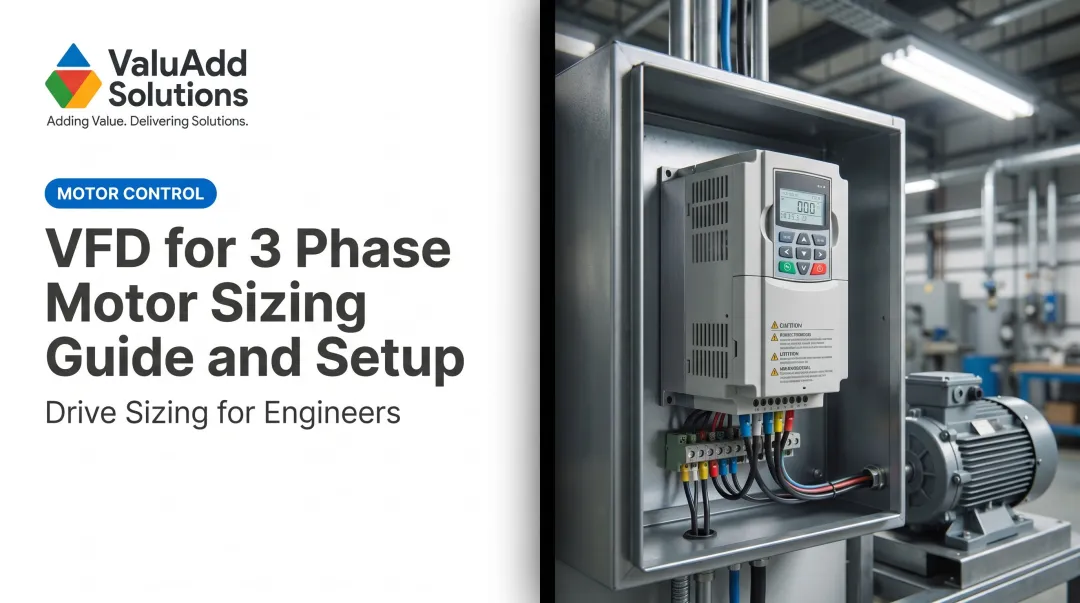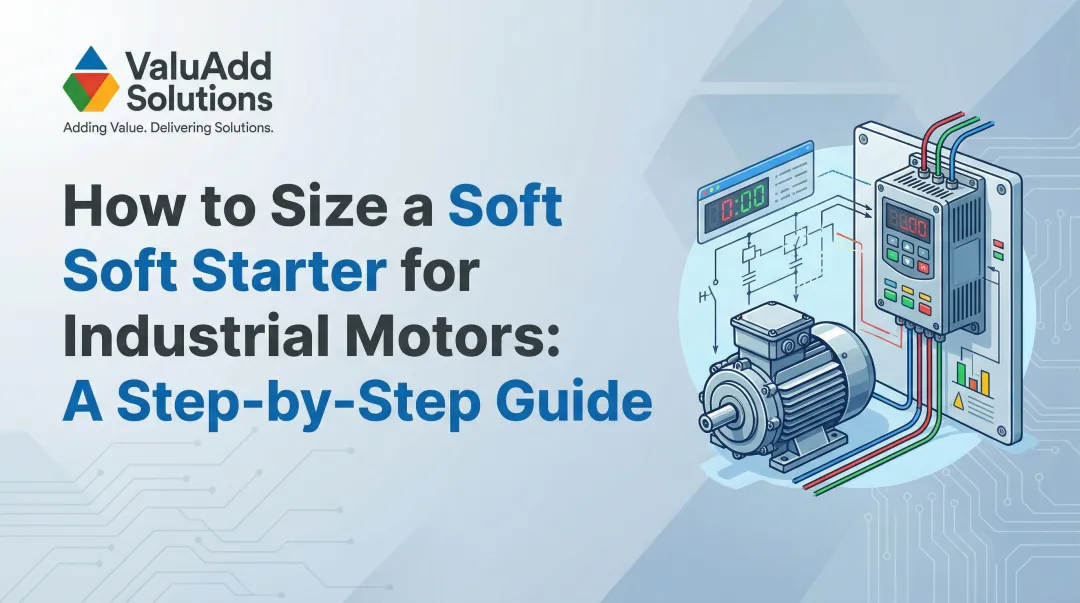
The challenge: a 50 HP motor at 460V draws 65A, while the same motor at 230V draws 130A. The soft starter must handle the actual current, not just the nameplate power. Add frequent starts, high ambient temperatures, or altitude above 3,300 feet, and your baseline selection quickly becomes inadequate.
This guide covers:
- The exact step-by-step sizing process using motor nameplate data and application load profiles
- A reference sizing chart mapping HP, voltage, and FLA to recommended soft starter current ratings
- Four key variables that force upsizing decisions
- When to step up to the next current rating
- The most common sizing mistakes that cause field failures
Key Takeaways
- Soft starter sizing is based on the motor's Full Load Amps (FLA) from the nameplate, not horsepower alone
- Application class (Class 10, 20, or 30) determines thermal stress during starting; Class 20 and 30 applications require a larger, higher-rated starter
- Ambient temperature above 40°C and altitude above 1,000 m require derating the starter's current capacity
- Inside-delta connections reduce the current seen by the starter to 58% of line current, allowing a smaller unit
- Always cross-reference both motor power rating and maximum allowable current when consulting sizing charts
How to Size a Soft Starter: Step-by-Step
Sizing a soft starter correctly comes down to three inputs: motor nameplate data, application load profile, and environmental conditions. Miss any one of them and you risk thermal trips, premature thyristor failure, or an undersized unit that can't handle your duty cycle.
Step 1: Gather Motor Nameplate Data
Record these critical parameters from the motor nameplate:
- Full Load Amps (FLA): The single most important input—soft starters are rated in amps, not horsepower
- Voltage rating: Determines which soft starter voltage class you need
- Horsepower or kW: Used as a secondary reference point
- Service factor: Indicates if the motor can handle continuous overload
- Number of phases: Confirms three-phase configuration
- Motor connection type: Inline (Wye) vs. inside-delta
Why FLA drives the selection: A 200 HP motor at 460V draws 240A, while a 200 HP motor at 230V draws 480A. Same horsepower, double the current. The soft starter must be rated for the actual amperage, not the nameplate HP.
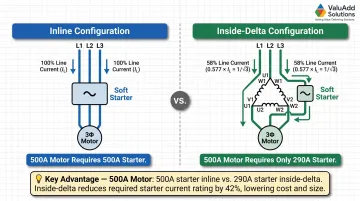
Inside-delta wiring changes the math: Inside-delta configurations wire the soft starter in series with each motor winding, exposing it to approximately 58% of the motor's line current per phase. A 500A motor in inside-delta configuration requires only a 290A soft starter. Get this wrong and you either over-spend on an oversized unit or risk thyristor overload and premature failure.
Locked rotor code affects thermal load: Motors with higher NEMA locked rotor codes (H through V) draw heavier starting currents, increasing thermal loading on the thyristors. A motor with Code T (18-20 kVA/HP) places far more stress on the starter than Code F (5-5.6 kVA/HP) — a difference that affects both class selection and derating calculations.
Step 2: Define the Application Load Profile
Three characteristics determine how hard your application will push the soft starter:
Load type:
- Constant torque loads — fans with inlet restrictions, centrifuges, high-inertia flywheels — demand full torque at startup and sustained current draw throughout the ramp
- Variable torque loads — centrifugal pumps, unrestricted fans, compressors — need less starting torque and generate lower thermal stress on the starter
Duty cycle:
- Estimate starts per hour
- Determine if the motor runs continuously or intermittently
- More frequent starts generate cumulative heat in the thyristors, reducing effective capacity between cycles
Application class:
| Class | Typical Applications | Starting Time (DOL) | Trip Time at 600% FLA |
|---|---|---|---|
| Class 10 | Centrifugal pumps, compressors, short conveyors, elevators | < 5 seconds | 10 seconds |
| Class 20 | Long conveyors, grinders, moderate-load fans | 5-10 seconds | 20 seconds |
| Class 30 | Crushers, mills, mixers, high-inertia fans, shredders | > 10 seconds | 30 seconds |
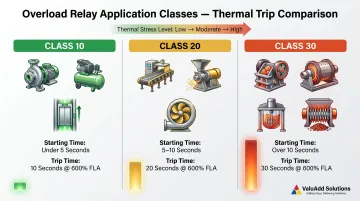
Starts per hour thresholds: Applications requiring more than 10 starts per hour typically need Class 20 or 30 ratings to handle cumulative thermal buildup. High starting current and long starting time require longer cooling periods between starts to maintain the rated number of cycles.
Step 3: Account for Environmental and Installation Conditions
Altitude derating:
At higher altitudes, thinner air reduces cooling effectiveness. Standard soft starters are rated at 1,000 meters (3,300 feet) above sea level. Above this threshold, derate the current capacity:
- ABB formula: Current capacity = 100% - [(altitude in meters - 1000) / 150]
- Rockwell formula: Derate by 1% per 100 m above 1,000 m
Example: At 2,000 meters altitude, ABB recommends reducing capacity to 93.3% of rated current. A motor with 100A FLA would require a soft starter rated for at least 107A to compensate.
Ambient temperature derating:
Soft starters are typically rated at 40°C (104°F) ambient temperature. Higher temperatures reduce heat dissipation capacity:
- ABB guideline: Reduce rated current by 0.8% per °C above 40°C, up to 60°C maximum
- Schneider guideline: Derate by 2.2% per °C above 40°C
Example: At 50°C ambient, ABB requires 8% derating. A 100A motor would need a 109A-rated soft starter.
Other environmental factors:
- High humidity or corrosive atmospheres requiring sealed enclosures
- Enclosed panel installations restricting airflow
- Installations without forced ventilation
Step 4: Select the Soft Starter Model
Apply derating factors:
Calculate the required current rating by adjusting upward for environmental conditions:
Required Current Rating = Motor FLA / (Altitude Factor × Temperature Factor)
Example calculation:
- Motor FLA: 100A
- Altitude: 1,500 m (96.7% capacity)
- Ambient: 50°C (92% capacity)
- Required rating: 100A / (0.967 × 0.92) = 112.3A minimum
Cross-reference the sizing chart:
Use both motor power rating and required current when selecting from manufacturer charts. A 75 kW motor at 380V requires a different current rating than 75 kW at 690V.
For Class 20 and Class 30 applications, step up one or more size from the chart's recommendation for the same FLA.
Medium voltage applications:
For motors 200 HP and above, or voltage classes above 690V, verify the selected model is rated for medium voltage (2.3 kV to 15 kV). Standard low-voltage units simply aren't built for these ranges. ValuAdd's medium voltage soft starter solutions cover motors up to 25,000 HP at 13,800V, with integrated circuit breaker solutions and Class E2 compliance for the most demanding industrial applications.
Soft Starter Sizing Chart: A Reference Guide
This chart maps motor horsepower and voltage to recommended soft starter current ratings. This is a starting point only—adjust for application class, duty cycle, and environmental conditions before making your final selection.
Three-Phase Motor Sizing Reference (NEC Table 430.250):
| Motor HP | Motor kW | 230V FLA | 460V FLA | 575V FLA | Min Soft Starter Rating — 230V / 460V / 575V (Class 10) |
|---|---|---|---|---|---|
| 5 | 3.7 | 15.2A | 7.6A | 6.1A | 8A / 16A / 7A |
| 10 | 7.5 | 28A | 14A | 11A | 32A / 16A / 12A |
| 15 | 11 | 42A | 21A | 17A | 45A / 25A / 18A |
| 20 | 15 | 54A | 27A | 22A | 60A / 32A / 25A |
| 25 | 18.5 | 68A | 34A | 27A | 75A / 38A / 30A |
| 30 | 22 | 80A | 40A | 32A | 90A / 45A / 36A |
| 40 | 30 | 104A | 52A | 41A | 110A / 60A / 45A |
| 50 | 37 | 130A | 65A | 52A | 140A / 75A / 60A |
| 75 | 55 | 192A | 96A | 77A | 200A / 110A / 90A |
| 100 | 75 | 248A | 124A | 99A | 260A / 140A / 110A |
| 125 | 90 | 312A | 156A | 125A | 320A / 170A / 140A |
| 150 | 110 | 360A | 180A | 144A | 380A / 195A / 160A |
| 200 | 150 | 480A | 240A | 192A | 500A / 260A / 210A |
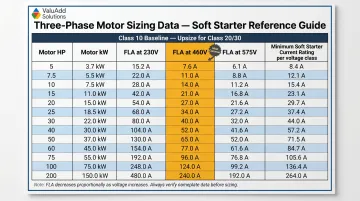
When a soft starter is sized by motor power (HP or kW), the current rating shifts with voltage. When sized by current (amps), the power rating shifts with voltage instead.
Example:
- A 160A soft starter at 380V handles approximately 75 kW
- The same 160A soft starter at 690V handles approximately 132 kW
Class 20 and Class 30 applications require stepping up one or two current ratings from the chart values. For example, a motor with a 100A FLA in Class 30 service needs a 140–160A soft starter — the extra headroom handles extended starting time and the higher thermal load it places on the device.
Key Parameters That Affect Soft Starter Sizing Results
Four variables most commonly cause soft starters to be undersized or fail prematurely: full load amps, application class, ambient/altitude conditions, and motor connection type. Understanding each one before finalizing selection prevents costly replacements and nuisance trips.
Full Load Amps (FLA) vs. Motor HP
HP alone does not define the electrical load. Two motors with the same HP but different efficiencies, power factors, or voltage ratings have notably different FLA values. A 50 HP premium efficiency motor at 460V may draw 62A, while a standard efficiency model draws 65A.
Selecting by HP without verifying FLA against voltage and efficiency class can leave a unit 5–10% undersized. Over months of operation, that mismatch forces the thyristors to run near their thermal limit continuously — shortening device life from 15 years to 3–5 years.
Application Class and Starts per Hour
The application class reflects the thermal energy the soft starter's thyristors must absorb during each start. Class 10 trips in 10 seconds at 600% of rated current, Class 20 in 20 seconds, and Class 30 in 30 seconds. Too many starts per hour without sufficient cooling intervals causes cumulative thermal buildup that trips overload protection even when the motor is correctly sized.
A soft starter correctly sized for Class 10 will trip on thermal overload if the application is actually Class 20. Industry benchmarks by class:
- Class 10: Up to 10 starts per hour with standard cooling
- Class 20: 5–10 starts per hour with moderate load
- Class 30: 1–5 starts per hour with heavy load or extended ramp times
Ambient Temperature and Altitude
Altitude reduces air density; high ambient heat shrinks the thermal gradient needed for cooling. Together, these factors can require a starter rated 20–30% above the calculated FLA.
For example: a 100A motor at sea level and 40°C requires a 100A starter. The same motor at 2,000 m altitude and 50°C ambient requires a 125A starter after applying both derating factors.
Motor Connection Type (Inline vs. Inside-Delta)
Getting this calculation wrong results in either oversizing (wasting $3,000–$8,000) or undersizing (causing overload trips within weeks of commissioning). The difference comes down to connection type.
In an inline configuration, the soft starter handles the full line current. In an inside-delta connection, it is wired in series with each winding and carries only 58% (1/√3) of the total line current. A 500A motor requires a 500A soft starter inline — but only a 290A unit inside-delta.
When Should You Upsize a Soft Starter?
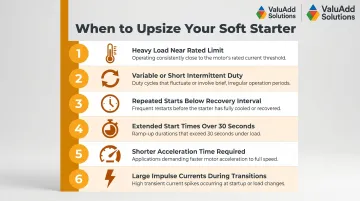
Treat the baseline FLA-matched selection as a starting point. Six real-world operating conditions require stepping up to the next current rating—conservative sizing is consistently the safer approach.
Upsize when:
- Motor frequently operates under heavy load near its rated limit — Continuous operation at 90-100% FLA reduces thermal margin during starts
- Motor operates in continuously variable or short intermittent duty cycles — Prevents adequate cooling between operational phases
- Repeated starts with cycle times shorter than manufacturer's recovery interval — Most manufacturers specify minimum off-time between starts (typically 30-60 seconds for Class 10)
- Load is too heavy or grid capacity is limited, causing extended start times — If ramp time exceeds 30 seconds consistently, step up at least one size
- Load requires shorter acceleration time than standard — Faster ramps mean higher sustained starting current
- Load has large impulse currents during transitions — Compressors cycling on/off, crushers encountering material jams
These six conditions cover single-motor scenarios. Multi-motor installations introduce additional risk.
Critical process applications: For multiple motors sharing one power supply—or for processes where starter failure causes significant downtime, such as water treatment and oil and gas facilities—size the soft starter as if the motor may start under full load. This follows the same conservative principle as across-the-line sizing.
In these high-stakes environments, ValuAdd's application engineers can help select medium voltage soft starter configurations with the protection features your process requires. The goal is matching the starter's capability to the worst-case demand, not the average.
Common Soft Starter Sizing Mistakes to Avoid
Most soft starter sizing errors aren't random — they follow predictable patterns. Here are the four mistakes that show up most often in the field.
Sizing by HP alone without checking FLA
This is the most common error. The same 50 HP motor draws 65A at 460V, 130A at 230V, and 52A at 575V. Voltage changes the current draw significantly, so the soft starter must be rated for actual FLA — not the nameplate power rating.
Ignoring application class and duty cycle
Selecting a Class 10 soft starter for a Class 20 or Class 30 application leads to thermal overload trips that get misdiagnosed as product defects. The starter isn't failing — it's protecting itself from an undersized application. Underestimating starts per hour by even 30% can push the device past its thermal recovery limit.
Skipping environmental derating
Operating a soft starter near its thermal ceiling — common in outdoor installations or hot control panels — cuts thyristor life from 100,000+ start cycles down to 20,000–30,000 cycles. Apply altitude and temperature derating factors before finalizing the current rating, not after the first premature failure.
Assuming inline and inside-delta installations use the same sizing
The current the soft starter sees differs between wiring configurations. Applying inline sizing math to a delta-connected installation leads to either oversizing (wasted cost of $2,000–$5,000) or undersizing (overload risk and early failure). Always confirm the connection type before finalizing selection.
Frequently Asked Questions
How do you size a soft starter?
Start by reading the motor's FLA from the nameplate, then select a soft starter rated at or above that value. Adjust upward for:
- Application class (10, 20, or 30)
- Duty cycle and starts per hour
- Ambient temperature above 40°C
- Altitude above 1,000 m
- Motor connection type (inline vs. inside-delta)
What size soft starter is needed for a 200 HP motor?
At 460V, a 200 HP motor has an FLA of approximately 240A per NEC Table 430.250. A standard Class 10 application requires a soft starter rated at or above 240A. Class 20 or 30 duty, frequent starts, or elevated ambient temperatures push that requirement up to 280–320A.
How many amps is a size 2 starter good for?
NEMA Size 2 contactors are rated for up to 45A at 460V. However, this refers to traditional magnetic starters. Soft starters are rated differently—by continuous current (in amps) and application class per IEC 60947-4-2, not NEMA size designations.
What happens if a soft starter is undersized?
An undersized soft starter experiences excessive thermal stress during starting, leading to thermal overload trips, reduced thyristor life, nuisance faults, and premature failure. This is especially common when starts per hour, ambient temperature, or load class are not accounted for during selection.
Should I size a soft starter by HP or by amps?
Always size by amps (FLA). While HP is a convenient reference point, the same HP rating at different voltages yields different currents. A 100 HP motor at 460V draws 124A, while the same motor at 230V draws 248A. FLA from the motor nameplate is the primary sizing input.
How does ambient temperature affect soft starter sizing?
Higher ambient temperatures reduce the soft starter's ability to dissipate heat, effectively lowering its usable current capacity. Installations in environments above 40°C require derating the soft starter or selecting a unit with a higher base current rating—typically 0.8-2.2% per degree above the standard rating.