Key Takeaways
- An electric drive controls motor speed, torque, and direction to match exact process demands — avoiding the inefficiency of fixed-speed operation
- The three main types are DC drives, eddy-current drives, and AC/VFDs — each suited to different efficiency and application requirements
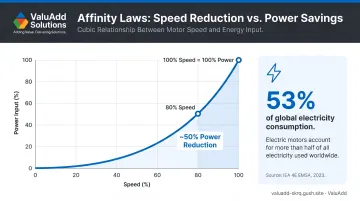
- DOE data shows a 20% pump speed reduction cuts input power by ~50% — why VFDs dominate new installations
- Across-the-line motor starts draw up to 6x full-load current; VFD-controlled starts limit inrush to ~1.5x
- Drive selection hinges on load profile, duty cycle, and total cost of ownership — not just upfront price
What Is an Electric Drive?
An electric drive is a system that controls the speed, torque, and direction of an electric motor to match the exact demands of an industrial process. The term can refer to the complete motor-plus-controller system, or — in many industrial contexts — to the controller alone.
Three categories define how a drive controls speed:
- Fixed-speed: Motor runs at one set RPM regardless of load demand
- Adjustable-speed: Operator selects from several preset speeds
- Variable-speed: Continuous, stepless control across the full operating range
The critical difference between a drive and simply switching a motor on and off is modulation. A drive continuously modulates voltage, current, and frequency to match the actual process load. A motor running full-tilt against a throttling valve wastes every watt of the gap between what it delivers and what the process actually needs.
Electric drives are deployed in industrial settings for two reasons: precise process control — matching motor output to what the application actually requires — and energy conservation, eliminating the waste inherent in throttling or damping a fixed-speed motor.
You'll see these systems called motor drives, variable-speed drives (VSDs), or adjustable-speed drives (ASDs) depending on who's talking. The DOE defines an adjustable speed drive as a device that controls the rotational speed of motor-driven equipment, with VFDs being the most common type. Knowing which label a vendor or spec sheet uses helps when comparing products — but the underlying control principles carry across all of them.
Key Components of an Electric Drive System
Every electric drive system — regardless of type — shares three functional building blocks:
| Component | Function |
|---|---|
| Electric motor | Converts electrical energy into mechanical motion |
| Power conversion/control unit | Adjusts the electrical supply delivered to the motor |
| Feedback/sensing devices | Encoders, tachometers, or sensors that monitor speed and enable closed-loop correction |
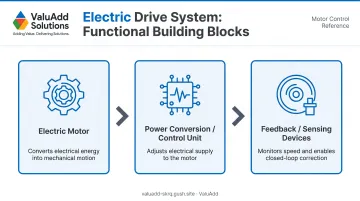
The controller sits at the center of the system. It accepts a process demand signal — a flow rate setpoint, operator input, or PLC command — and translates it into precise electrical output parameters: voltage, frequency, or current delivered to the motor. When a sensor detects deviation from the setpoint, the controller corrects in real time.
Beyond signal processing, modern drives include built-in protection functions: overcurrent, overvoltage, and thermal protection. These safeguards are what distinguish a full drive system from a basic speed controller. ValuAdd's H2 Series drives, for example, include overload protection, kinetic energy buffering, and regen avoidance — features that protect both the drive and connected equipment from damage.
The Three Main Types of Electric Drives
DC Drives
DC drives control motor speed by adjusting armature voltage or field current. Since motor speed is directly proportional to armature voltage, the relationship is clean and predictable — increase voltage, increase speed.
Strengths:
- Precise, wide-range speed control
- High starting torque capability
- Well-understood, mature technology
Limitations:
- DC motors require regular brush and commutator maintenance
- Less favored for new installations where minimizing maintenance is a priority
- Retrofit scenarios and specific constant-torque applications remain their strongest use case
Eddy-Current Drives
An eddy-current drive pairs a fixed-speed AC induction motor with an electromagnetic clutch. Varying the DC current through the clutch's field coil adjusts how much torque transmits to the output shaft, regulating output speed without altering the motor's own speed.
The fundamental limitation is efficiency. Slip energy (the difference between input motor speed and output shaft speed) dissipates as heat rather than being recovered — an unavoidable efficiency loss at every operating point below full speed.
Despite this, eddy-current drives remain in service for high-inertia, frequently started-and-stopped loads like stamping presses and heavy conveyors, where their mechanical simplicity and tolerance for shock loads offset the efficiency penalty.
AC Drives / Variable-Frequency Drives (VFDs)
AC drives — most commonly implemented as VFDs — control motor speed by adjusting the frequency and proportional voltage of the power supplied to the motor. Higher frequency, faster rotation. Lower frequency, slower rotation.
Standard V/Hz control maintains a constant voltage-to-frequency ratio, preserving motor flux and torque capability across the operating range. It works well for variable-torque loads like fans and pumps.
Sensorless vector and direct torque control are available for applications requiring precise torque response at low speeds or during rapid load changes. ValuAdd's H2 Series supports both V/Hz and sensorless vector control, making it applicable across standard HVAC and pumping work as well as more demanding industrial processes.
VFDs are the dominant choice for new industrial installations, and the market reflects that. Grand View Research projects the global VFD market to reach USD $31.4 billion by 2033, growing at a 6.4% CAGR from 2026 to 2033.
Standard VFDs introduce harmonic distortion onto the facility power distribution network — a practical concern for facilities with sensitive equipment or utility interconnection requirements. ValuAdd's medium voltage VFDs address this through H-Bridge multi-level technology, producing a nearly perfect sine wave output and achieving IEEE 519 compliance — with less than 8% total harmonic distortion for voltage (THDv) and less than 5% total demand distortion for current (TDDi).
Key Advantages of Using Electric Drives
Energy Savings
Fan and pump power follows the affinity laws — power varies approximately with the cube of speed. A 20% reduction in speed or flow cuts input power requirements by roughly 50%, according to DOE pump guidance. That's not a rounding error; it's a structural advantage over fixed-speed systems that burn full power against a throttle valve.
Electric motor systems account for 53% of global electricity consumption, per IEA 4E EMSA's 2023 data. Even modest efficiency gains at the motor level translate to substantial energy and cost reductions at scale.
Smooth, Controlled Acceleration and Deceleration
Across-the-line motor starts draw up to 6x full-load current. VFD-controlled starts limit locked-rotor current to approximately 1.5x full-load current. That difference matters for:
- Transformer and switchgear stress
- Voltage sag events affecting other equipment on the same bus
- Mechanical shock to couplings, gearboxes, and driven machinery
- Thermal stress on motor windings
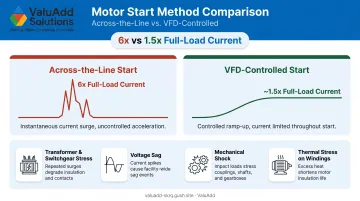
Controlled starting also eliminates inrush current spikes that cause voltage sags across the facility. IEEE 519-compliant drives go further, limiting harmonic distortion at the point of common coupling — a hard requirement for facilities running sensitive instrumentation, CNC equipment, or co-located with utility metering obligations.
Extended Equipment Life
Reduced electrical and mechanical stress translates directly to longer service intervals. Lower operating temperatures, less vibration, and the elimination of water hammer in pump systems all contribute. In manufacturing and water treatment applications, VFD installation has consistently moved maintenance from reactive to scheduled — a shift that shows up in reduced parts spend and fewer emergency service calls.
Precise Process Control
A water treatment pump maintaining constant pressure despite varying demand throughout the day is a straightforward example. Fixed-speed alternatives handle this with throttling valves — which work, but waste energy and introduce wear. Variable-speed control does it by matching motor output to actual demand, with tighter pressure regulation and no wasted power.
Common Industrial Applications of Electric Drives
Pumps and fans are where the energy case is clearest. Centrifugal pumps and fans in water treatment, HVAC, and process industries run at partial load most of their operating hours. Applying the affinity laws through VFD speed control typically delivers far greater savings than valve or damper throttling — and with better pressure/flow precision.
Manufacturing and conveyor systems rely on electric drives for synchronized multi-axis motion control, speed matching between production stages, and controlled web tension in packaging and material handling. Key use cases span:
- Automotive assembly lines requiring precise speed synchronization
- Food processing conveyors with controlled tension and gentle starts
- Discrete manufacturing cells coordinating multi-axis motion
In oil, gas, and heavy process industries, electric drives run compressors, mixers, extruders, and hoists. Soft starting reduces mechanical stress on equipment that's costly to repair and difficult to access. Adjustable speed improves process consistency in applications where throughput must flex with changing conditions.
How to Choose the Right Electric Drive
Technical Parameters to Evaluate First
- Motor type and power rating — match drive capacity to motor nameplate specifications
- Required speed range and control precision — open-loop V/Hz for standard variable-torque loads; closed-loop vector control for high-performance or low-speed torque requirements
- Load characteristics — variable torque (fans, pumps) vs. constant torque (conveyors, compressors)
- Environmental conditions — NEMA Type 4X for wet, corrosive, or washdown environments; NEMA Type 12 for indoor dust, oil, and coolant settings
Compliance and Certification Requirements
Facilities with sensitive equipment or utility interconnection rules should specify IEEE 519-compliant drives. Check for:
- UL and CE listings — ValuAdd's H2 Series carries UL Listed, cUL Listed, and CE compliance; medium voltage drives carry UL listing and IEEE 519 compliance
- NEMA enclosure rating — matched to actual environmental conditions, not defaulted to the cheapest option
- IEC 61800-5-1 / UL 61800-5-1 — the relevant safety standard for adjustable speed electrical power drive systems
Total Cost of Ownership vs. Purchase Price
Purchase price is rarely the right decision metric. The better starting point is matching drive type to application requirements:
- AC VFDs — best for new installations where energy efficiency, speed control, and long-term flexibility matter
- DC drives — suited for retrofit scenarios where existing DC motor infrastructure makes replacement cost-prohibitive
- Soft starters — appropriate when controlled starting and stopping is needed but continuous speed regulation is not
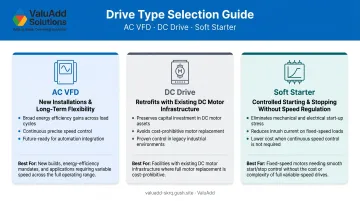
ValuAdd's engineering team carries both VFDs and soft starters and works through this selection process with system integrators and facility engineers, from specification through commissioning — so the recommendation is driven by the application, not inventory constraints.
Frequently Asked Questions
What is an electric drive?
An electric drive combines a motor with a controller that modulates voltage, current, or frequency in real time to match process demands — instead of running the motor at full capacity and throttling the excess. The result is precise, on-demand control of speed, torque, and direction.
What are the three types of electric drives?
The three main categories are DC drives (armature voltage or field current control), eddy-current drives (electromagnetic clutch-based slip control), and AC drives/VFDs (frequency and voltage adjustment). Each suits different efficiency, maintenance, and application requirements.
How do electric drives work?
The controller accepts a process demand signal, converts it into adjusted electrical output, and delivers that to the motor. Feedback sensors continuously monitor actual speed or torque and correct any deviation from the setpoint, maintaining precise control under varying load conditions.
What is the difference between a VFD and an electric drive?
A VFD is a specific type of electric drive — the most common form of AC drive. "Electric drive" is the broader term that encompasses DC drives, eddy-current drives, and all AC drives including VFDs. Every VFD is an electric drive, but not every electric drive is a VFD.
What are the advantages of electric drives over mechanical drives?
Electric drives outperform mechanical alternatives on several fronts:
- Higher efficiency — no slip energy lost as heat
- Greater precision in speed and torque control
- Lower maintenance requirements and built-in motor protection
- Easy integration with PLCs and SCADA systems
Mechanical alternatives either waste energy through throttling or sacrifice control precision.
Where are electric drives used in industry?
Common applications include pumps and fans in water treatment and HVAC, conveyors and production machinery in manufacturing, compressors and mixers in oil and gas, and hoists in material handling. Any application where controlling motor speed improves efficiency or process quality is a candidate.