A single switch mistake can shut down an entire line and cost a plant millions. A 2023 ABB survey reports unplanned downtime in the Indian industry can reach ₹7 million per hour (ABB, 2023). At the same time, workplace electrical incidents continue to cause serious injuries and fatalities each year (ESFI, 2023).
Disconnect switches play a critical role in industrial electrical systems by providing a safe, visible way to isolate equipment during maintenance and prevent faults from spreading. The right selection ensures safety, maximizes uptime, and supports electrical code compliance. The wrong choice can mean hazards, lost production, and failed inspections.
You will find disconnect switches everywhere: OEM machinery panels, industrial plants, municipal pumping and treatment systems, and commercial facilities such as HVAC or building equipment.
This article highlights the purpose of disconnect switches, why proper selection matters, and how they are applied across key environments.
Key Highlights
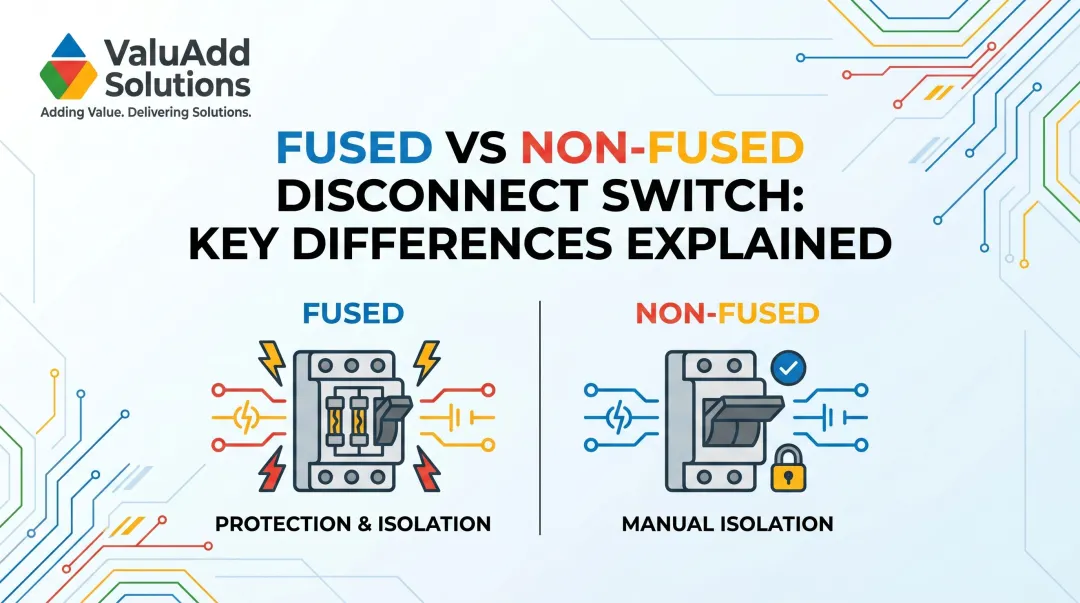
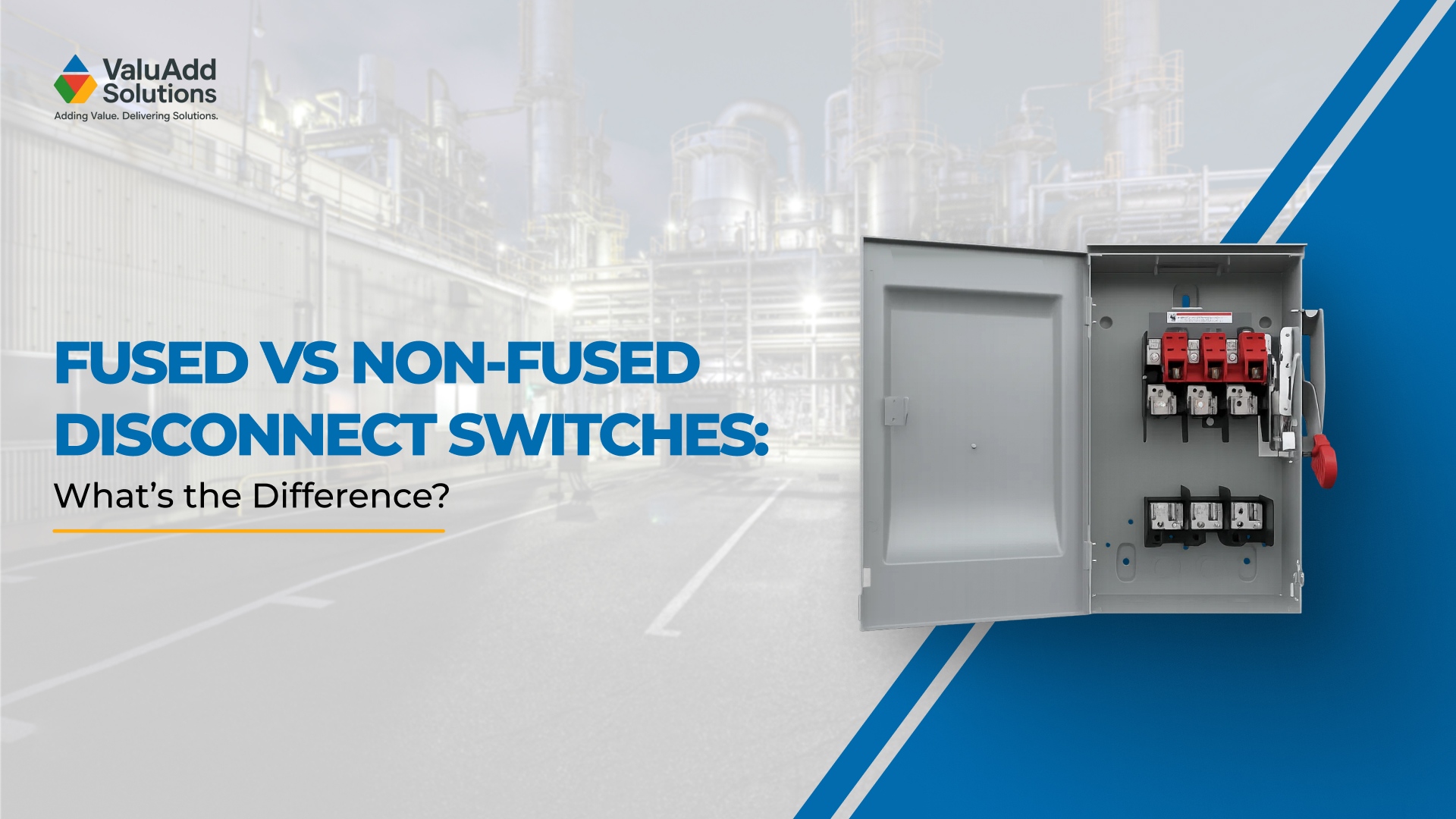
• Fused vs Non-Fused disconnects differ mainly in protection level: fused types offer built-in short-circuit + overload protection, while non-fused provide isolation only and rely on upstream protection.
• The right disconnect directly impacts safety, uptime, and NEC/NFPA compliance, especially in high-fault, motor, and VFD-heavy environments.
• Fused disconnects excel in high SCCR, arc-flash reduction, and protection of sensitive equipment like VFDs, compressors, and municipal systems.
• Non-fused disconnects are ideal for cost-efficient local isolation where breakers or feeders already provide fault protection, commonly used in HVAC, OEM panels, conveyors, and pump systems.
• ValuAdd provides trusted brands like Socomec, Boltswitch, and NOARK, helping engineers choose reliable disconnect solutions tailored to industrial, commercial, and municipal needs.
What Is a Disconnect Switch?
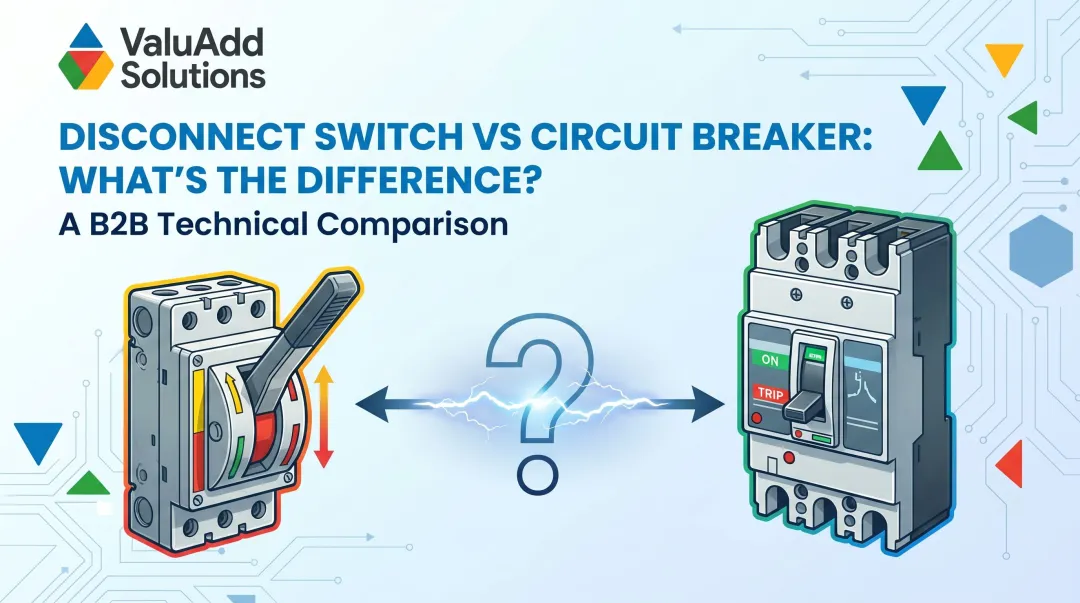
A disconnect switch is a manually operated device used to physically isolate electrical equipment from its power source. It provides a visible open break that confirms power is fully removed, ensuring safe access for service, repair, or inspection.
Role in LOTO, Maintenance Isolation, and Emergency Shutdown
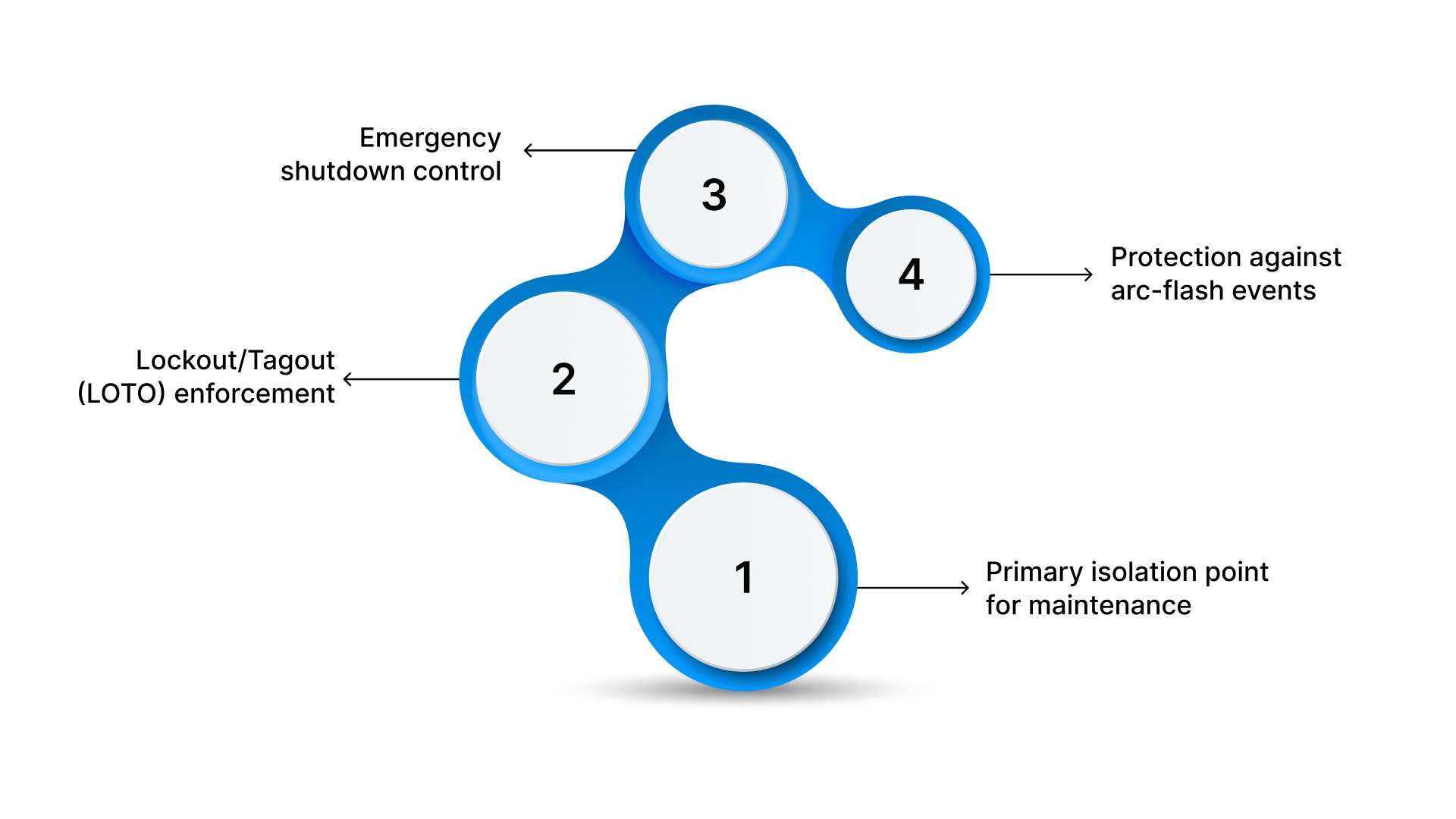
Disconnect switches are a core element of safe maintenance practices and emergency power control. They help prevent accidental energization and allow fast response to hazardous conditions.
Key roles include:
Primary isolation point for maintenance to ensure equipment is safely de-energized
Lockout/Tagout (LOTO) enforcement, allowing locks and tags to prevent unauthorized operation
Emergency shutdown control located near equipment for immediate power cut-off
Protection against arc-flash events by isolating energy before work begins.
NEC Requirements and Safety Standards
Compliance with electrical codes ensures safe operation and proper installation. The NEC and related standards define where disconnects must be located and how they should perform.
Important requirements include:
NEC Article 430: Disconnect must be in sight of motor-driven equipment and properly rated for HP, voltage, and short-circuit capacity
NEC Article 422: Requires disconnecting means for appliances to be accessible and serviceable
NFPA 70E: Mandates safe work practices, including verification of absence of voltage before any maintenance
OSHA LOTO 1910.147: Requires an isolation device that can be locked to ensure worker safety
What Is a Fused Disconnect Switch?
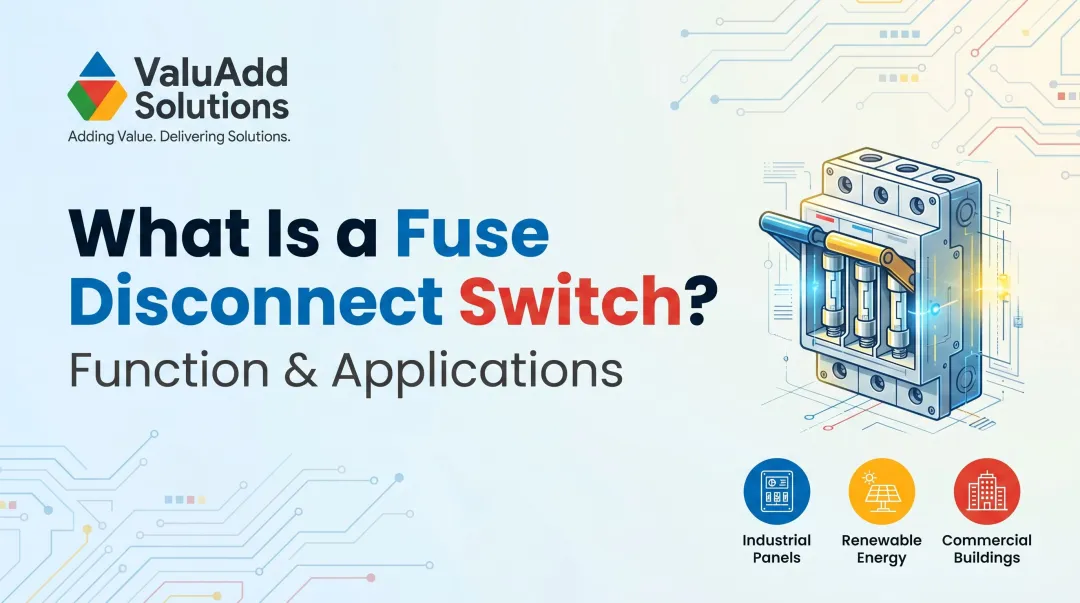
A fused disconnect switch is a device that isolates electrical equipment while also incorporating overcurrent protection through replaceable fuses. When a fault or overload occurs, the fuse element melts and interrupts the circuit instantly, preventing damage to equipment and reducing the risk of fire or arc-flash escalation. The switch portion provides the visible means of disconnect, while the fuse provides the protective interruption.
How Integrated Fuses Provide Short-Circuit and Overload Protection
Fuses inside the disconnect are specifically selected for the system’s current and fault levels. They perform two critical protection functions:
Short-circuit protection by rapidly clearing high-fault currents before they propagate into downstream devices
Overload protection by opening the circuit when the current exceeds safe operating limits over time
This prevents catastrophic equipment damage and minimizes downtime after a fault occurs.
Typical Configurations
Fused disconnects come in different configurations to match electrical system architectures and protection needs.
These options allow designers to optimize coordination, selective tripping, and physical installation.
Common types include:
Single-phase or three-phase models for a range of voltage and load types
Line-side or load-side fusing, depending on protection strategy and SCCR requirements
Knife-blade or rotary mechanisms for clear, visible isolation and ease of operation
NEMA-rated enclosures (1, 3R, 4X, 12) for indoor, outdoor, washdown, or corrosive locations
Key Benefits
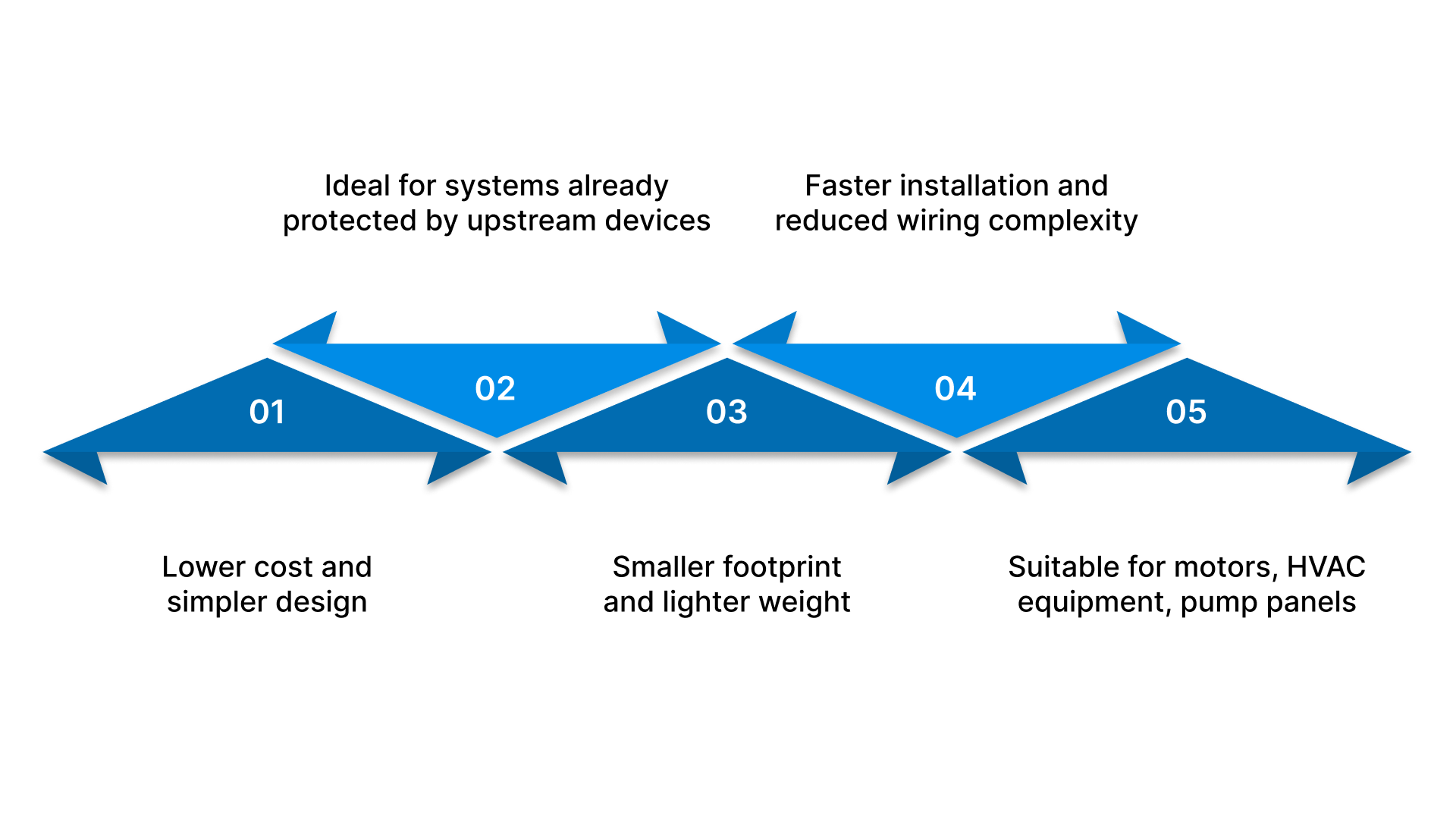
Non-fused disconnects offer meaningful advantages where fault protection is handled by upstream breakers or fuses. They help reduce system cost, simplify installation, and optimize space without compromising safety or performance.
Enhanced benefits include:
Lower cost and simpler design since no fuses or fuse hardware are required, reducing both upfront equipment cost and long-term maintenance expense
Ideal for systems already protected by upstream devices such as MCC sections, panelboard breakers, or feeder fuses, avoiding unnecessary duplication of protection
Smaller footprint and lighter weight, making them well-suited for compact OEM control panels, rooftop HVAC units, and MCC buckets
Faster installation and reduced wiring complexity, supporting quicker field deployment and easier panel assembly
Suitable for motors, HVAC equipment, pump panels, conveyors, and machinery where existing circuit protection provides required safety and compliance
What Is a Non-Fused Disconnect Switch?
A non-fused disconnect switch is a manual device used to isolate electrical equipment from its power source. It provides a visible open break to confirm that equipment is fully de-energized for maintenance or emergency shutdown.
It does not include fuses or internal overcurrent protective elements, making it strictly an isolation device.
Works as an Isolation Device Only
Non-fused disconnects are designed primarily to stop power flow and allow safe access, not to interrupt fault currents.
They are commonly used where operators need a local means of disconnecting power without altering the system’s protection scheme.
Provides visible isolation to meet safety and LOTO requirements.
Used for routine maintenance, servicing, or inspection access.
Ensures safe shutdown without affecting system coordination.
Supports emergency stop functionality near the equipment.
Depends on Upstream Circuit Breakers or Fuses
Because non-fused disconnects do not clear faults, they must be installed where short-circuit and overload protection is already provided.
This coordination ensures that faults are handled safely without relying on the local switch.
Requires properly rated upstream breakers or fused devices for system protection.
Interrupting rating must match or exceed the available fault current at its location.
Protection strategy remains controlled at the distribution or MCC level.
Helps maintain selective coordination in complex industrial systems.
Key Benefits
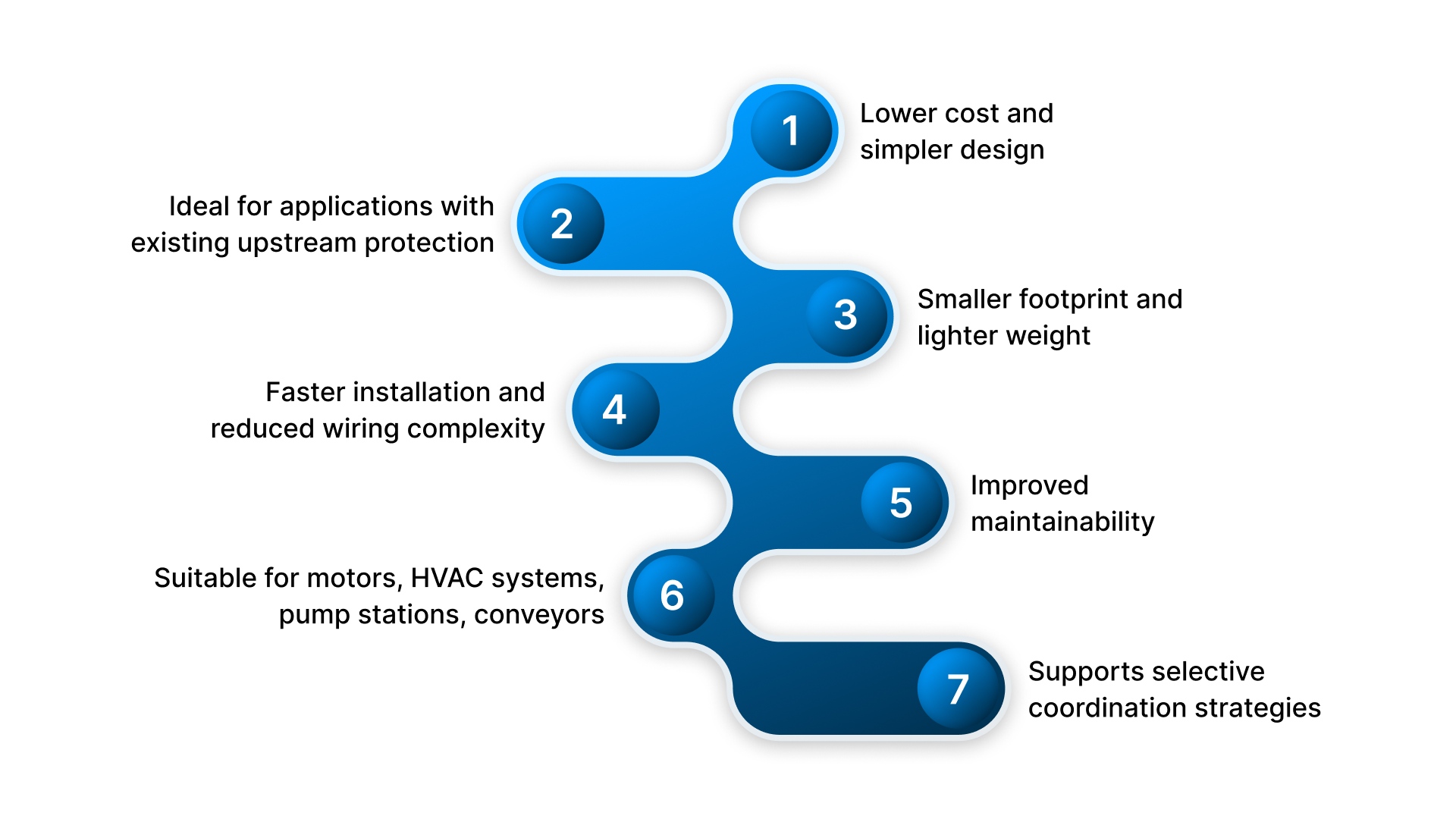
Non-fused disconnect switches provide economical and practical advantages, especially in systems where upstream protective devices already handle short-circuit and overload requirements. They help simplify equipment design while maintaining compliance and safety.
Lower cost and simpler design since no internal fuses or fuse holders are required, reducing both component and lifecycle replacement expenses
Ideal for applications with existing upstream protection, such as MCC buckets or dedicated circuit breakers, avoiding redundant protection devices
Smaller footprint and lighter weight, making them easier to install inside compact enclosures, OEM panels, rooftops, and MCC sections
Faster installation and reduced wiring complexity, minimizing labor time and field modification effort
Improved maintainability, as there are no fuses to replace, inspect, or manage as spare parts
Well-suited for motors, HVAC systems, pump stations, conveyors, and machine controls where the breaker or MCC provides the required fault protection
Supports selective coordination strategies by allowing fault clearing to remain controlled at the breaker level instead of at the equipment
Fused vs Non-Fused Disconnect Switches: Comparison Table
Below is a practical side-by-side comparison highlighting where fused and non-fused disconnect switches differ. This helps determine the right choice based on safety, cost, space, and compliance needs.
Category | Fused Disconnect Switch | Non-Fused Disconnect Switch |
|---|---|---|
Safety Protection Level | Provides isolation plus built-in short-circuit and overload protection; reduces arc-flash energy | Provides isolation only; depends on upstream devices for fault protection |
Cost Considerations | Higher cost due to fuse hardware and replacement requirements | Lower cost; no fuse replacement or stocking required |
Space & Footprint | Larger physical size because of the fuse holders | Smaller footprint, ideal for compact panels or MCCs |
Maintenance & Replacement | Requires periodic fuse checks and replacement after faults | Minimal maintenance; nothing to replace |
Compliance & SCCR Implications | Helps achieve higher SCCR ratings and simplifies NEC/UL coordination | SCCR depends entirely on upstream protection and proper coordination |
Common NEC Use Cases | High-fault environments, motors, VFDs, soft starters, and industrial control panels | HVAC units, pumps, conveyors, and machinery where upstream protection already exists |
Choosing the Right Type
Selecting between a fused and non-fused disconnect depends on application needs, available fault protection, and compliance requirements. The correct choice directly affects safety, uptime, and approval from inspectors or engineering consultants.
When to Specify Fused vs Non-Fused
Fused disconnects are preferred where fault current levels are high or where equipment requires dedicated protection. Non-fused models are appropriate where upstream devices already provide protection and the disconnect serves as a local isolation point.
1. Motor Loads and VFD Installations
Motors, VFDs, soft starters, and servo systems can experience high inrush and fault currents. Fused disconnects are commonly specified because they:
Limit let-through energy and reduce thermal/mechanical stress
Protect sensitive electronics inside VFDs and drives
Support selective coordination in multi-motor installations
2. High SCCR Requirements or Arc-Flash Reduction Needs
Industrial control panels often need to meet a required Short-Circuit Current Rating (SCCR), and fused disconnects make this easier by increasing the panel’s rating.
They also help reduce arc-flash incident energy, improving worker safety and maintenance practices.
3. Equipment-Specific Protection Requirements
Certain equipment types, such as HVAC compressors, pumps, refrigeration racks, and municipal treatment systems, may require fuse protection to comply with OEM instructions or engineering standards.
Fused disconnects help prevent equipment damage and warranty issues.
4. Utility and Municipal Systems Requiring Fused Disconnects
Water/wastewater treatment plants, pumping stations, and utility infrastructure typically specify fused disconnects to handle:
High available fault currents
Long feeder runs with voltage drop considerations
Critical uptime requirements
5. Systems Already Protected by Upstream Breakers
Non-fused disconnects are ideal where:
Circuit breakers or fused feeders already protect downstream equipment
The disconnect’s purpose is primarily local isolation and LOTO
Space and cost savings are product priorities
Questions Buyers Should Ask
Engineers, panel builders, facility maintenance teams, and OEMs can use these questions to guide the decision.
Where is fault protection currently provided? (Upstream, local, or shared)
What SCCR level must the panel or system meet? (UL 508A, NEC inspectors, consultant specs)
What are the load characteristics? (Motor, resistive, VFD, compressor, heater, pump)
Are there local code or consultant-driven requirements? (NEC Articles, municipal standards, industry-specific rules)
What are the available fault current levels at the installation site? (Utility short-circuit data)
Common Applications and Industry Examples
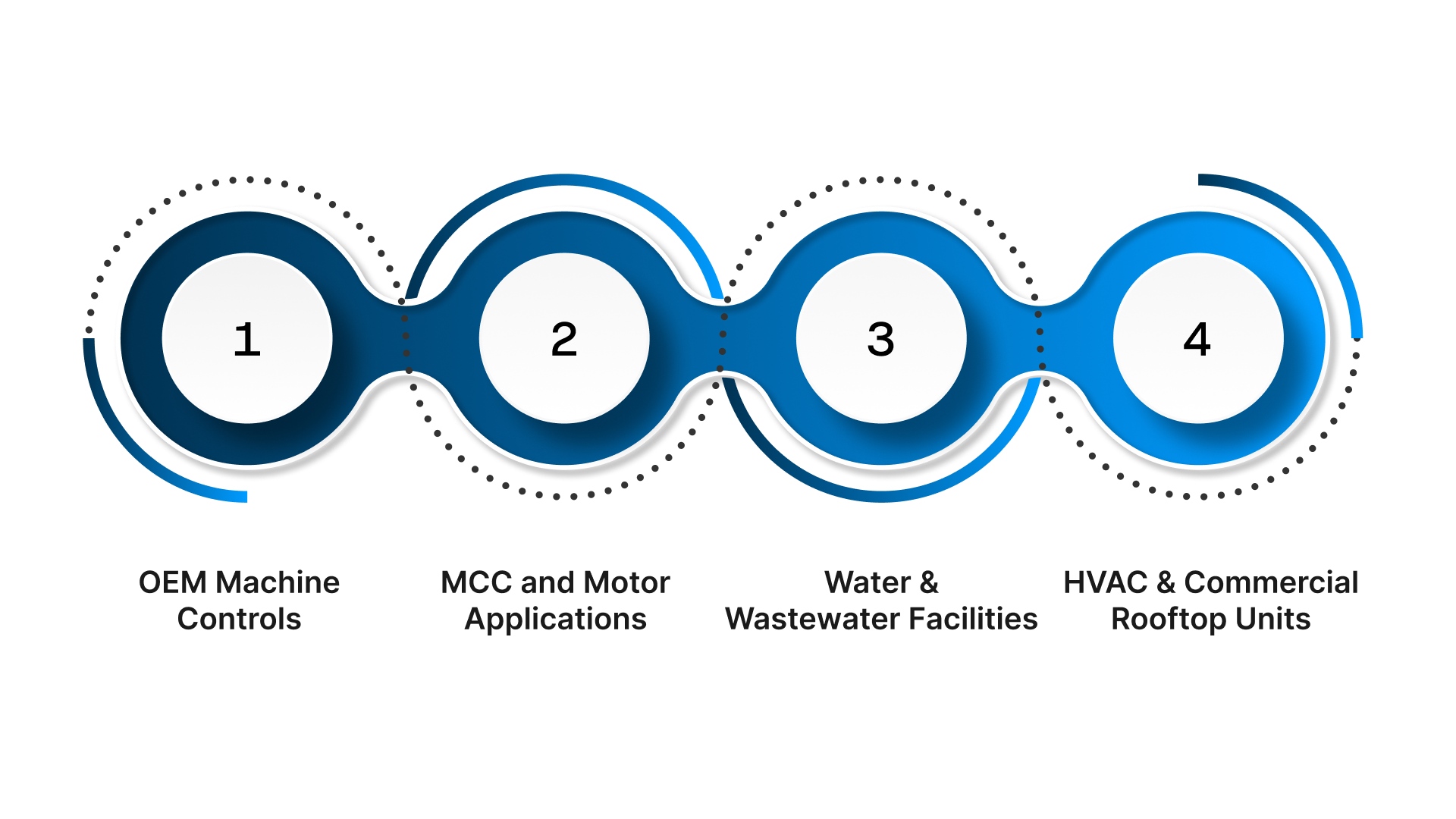
Disconnect switches are essential across industrial, municipal, and commercial facilities where safe isolation, reliability, and equipment protection are critical. Below are common application areas along with real-world style usage examples.
OEM Machine Controls
Used in packaged equipment and factory machinery where local isolation and compliance are required.
Examples: Packaging machines, conveyor skids, dosing systems, robotic cells
Sub-points:
Local isolation for maintenance and LOTO
Supports compact control panel designs for OEM manufacturing
Reduces field-wiring issues during installation and commissioning
MCC and Motor Applications (VFD / Soft Starter)
Common in motor control centers and distributed control equipment handling high-load machines.
Examples: Pump motors, industrial fans, crushers, air compressors
Sub-points:
Protects VFDs and soft starters from fault energy and overload
Allows selective coordination in multi-motor production lines
Local disconnect for troubleshooting and isolation without shutting down the MCC
Water & Wastewater Facilities
Municipal infrastructure relies on reliable switching for critical pumping and process systems.
Examples: Lift stations, booster stations, clarifiers, aeration blowers
Sub-points:
Handles high fault currents typical in utility-fed sites
Supports redundancy and continuous process operation
Often specified as fused disconnects per consultant requirements
HVAC & Commercial Rooftop Units
Required for servicing and safety access for large commercial climate systems.
Examples: Rooftop RTUs, chillers, refrigeration racks, air-handling units
Sub-points:
Non-fused for general HVAC circuits with upstream protection
Fused for compressor protection based on the manufacturer's spec
Meets NEC requirement for disconnect within sight
Leading Disconnect Solutions You Can Source Through ValuAdd
Choosing the right disconnect device also means choosing the right manufacturer. ValuAdd partners with industry-proven brands that deliver reliable switching, protection, and power control solutions for OEM, industrial, municipal, and commercial applications.
Below are key manufacturer offerings and how they support real-world system needs.
Socomec – Advanced Switching, Load-Break, and Transfer Solutions
Socomec is known globally for high-performance load-break switches and fused disconnect solutions designed for demanding electrical systems.
Wide range of load-break and manual transfer switches supporting isolation and continuity requirements
Fused and non-fused disconnects for motors, VFDs, and industrial panels
Strong safety features with visible isolation and arc-resistant construction
Ideal for OEMs and industrial facilities requiring reliable shutdown and switching control
Best fit for: motor isolation panels, UPS bypass systems, generator transfer switching, and utility equipment
Boltswitch – Heavy-Duty Fusible Bolted Pressure Contact Switches
Boltswitch specializes in rugged, industrial-grade fusible disconnects built to withstand high-stress environments and heavy fault currents.
Bolted pressure contact designs ensure low-resistance performance and long equipment life
High interrupting capability for high-fault industrial and utility systems
Suitable for large motors, mining, metal processing, and harsh facilities
Supports mission-critical environments requiring maximum reliability
Best fit for: steel mills, chemical plants, refineries, and other heavy-industrial sites
NOARK Electric – MCCBs and Compact Disconnect Solutions
NOARK provides low-voltage molded-case circuit breakers and disconnect switches for distribution protection and panel integration.
Compact footprint for OEM machine controls and industrial power panels
Cost-efficient designs without sacrificing quality or UL/CE compliance
Ideal complement to fused or non-fused disconnect architectures
Best fit for: panel builders, control systems, commercial distribution panels, and MCC equipment
Disconnect switches integrate directly with other critical electrical components to improve performance, safety, and system reliability that support power quality products and complement panels, MCCs, drives, and protection relays. Also strengthens arc-flash mitigation, boosts SCCR ratings, and improves panel layout and serviceability.
Conclusion
Disconnect switches are essential to electrical safety and reliable equipment operation. The choice between fused and non-fused designs directly affects fault protection, system SCCR, arc-flash performance, installation cost, and overall uptime. Fused disconnects deliver integrated protection for high-fault or sensitive applications, while non-fused options provide efficient isolation where upstream protection already exists.
Selecting the right type requires understanding the application, load characteristics, available fault current, and code or specification requirements. Local technical support helps ensure safe system design, proper coordination, and compliance.
ValuAdd provides engineering assistance and real-world application expertise to help choose the best disconnect solution. Contact us to start your project with confidence.
Frequently Asked Questions (FAQs)
1. When is a non-fused disconnect appropriate?
Choose non-fused when upstream breakers or fused feeders already supply required protection, and the switch is used primarily for local isolation and LOTO.
2. Do disconnect switches need to be located within sight of the equipment?
Yes, NEC typically requires disconnects within sight and readily accessible, especially for motors and HVAC equipment.
3. Are disconnect switches required for all motors?
Most motor installations require a disconnecting means for service and safety access as specified under NEC Article 430.
4. Are fused disconnects better for VFD applications?
Yes, because they help limit let-through fault energy and protect drive electronics during fault events.
5. How do fused disconnects help with SCCR compliance?
Fuses can raise the panel’s Short-Circuit Current Rating by providing high interrupting capacity and better energy limitation.