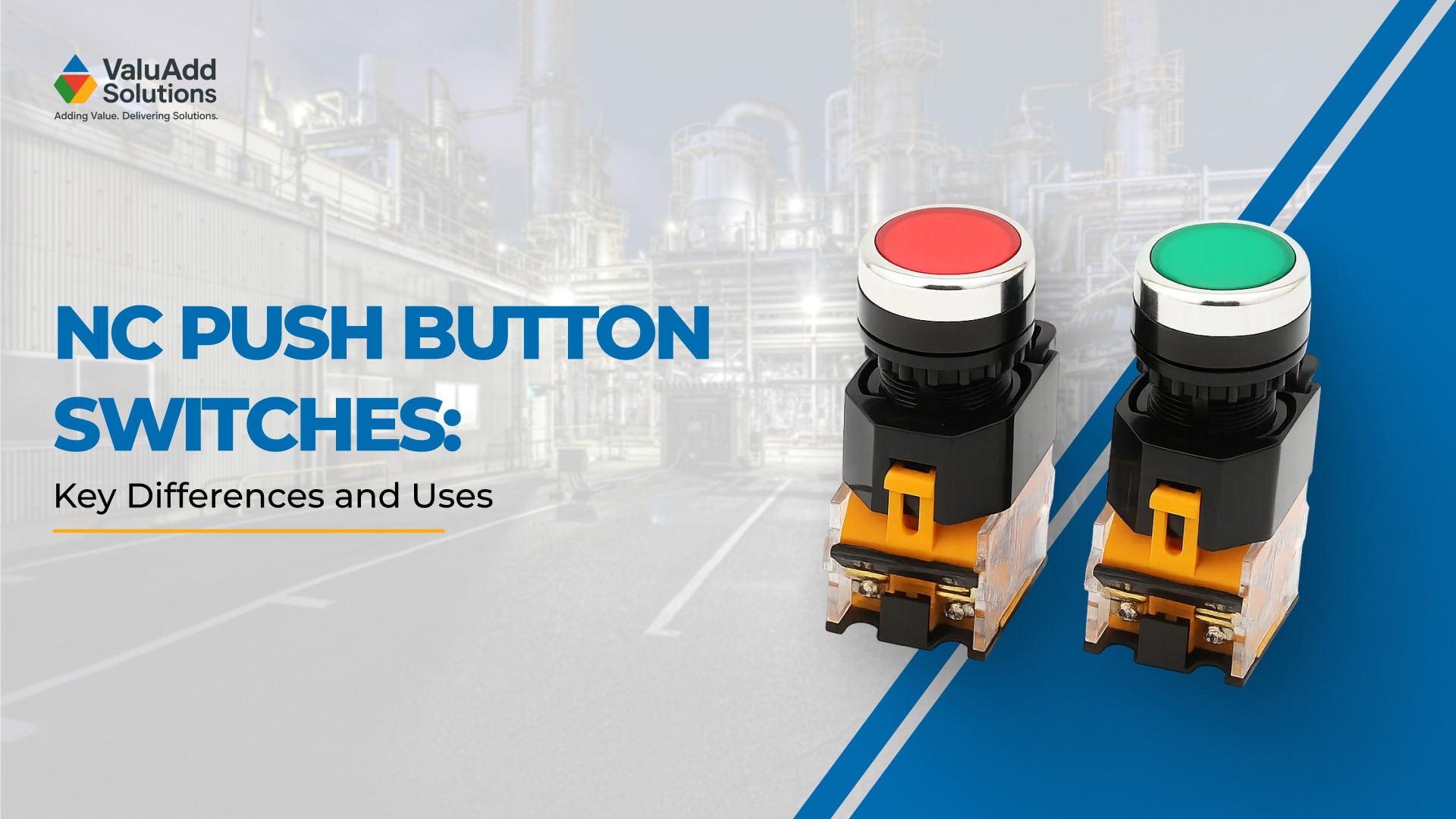
Ever pressed a big red STOP button on a machine, or seen someone hit it during an emergency? That simple act plays a critical role in protecting people and machines in factories, commercial buildings, and public-utility systems.
Most control panels and safety systems rely on push buttons, the basic switches that either make or break electrical circuits. In industrial control and automation work, knowing the difference between “NC” (Normally Closed) and “NO” (Normally Open) push buttons is essential. This knowledge can be the difference between a machine stopping safely when it should, or continuing to run under unsafe conditions.
This guide is designed to help maintenance trainees, junior engineers, and apprentices build a clear, foundational understanding of NC push buttons: what they are, how they work, when to use them, and why they matter for safety and equipment protection.
Key Highlights
NC push buttons are fail-safe switches that keep circuits closed by default and open when pressed to stop equipment instantly.
They are the industry standard for STOP and E-STOP functions, meeting OSHA, ISO 13850, and UL 508A safety requirements.
NC vs. NO defines control logic: NC for stop/safety circuits and NO for start/activation functions.
NC switches protect workers and equipment, reducing unexpected startups, injuries, and mechanical damage.
ValuAdd supports correct NC push button selection and application through engineering help, training, demos, and product guidance.
What is an NC (Normally Closed) Push Button Switch?
An NC (Normally Closed) push button switch is a type of control device in which the electrical circuit is complete (closed) when the button is in its normal, unpressed state. This means current flows continuously through the circuit without interruption. The switch only breaks (opens) the circuit when the button is pressed, stopping the flow of electricity and triggering the desired control action.
How It Works
Normal condition (not pressed):
The internal contacts are touching, forming a closed loop. Electrical current flows freely to the load or control device.Actuated condition (pressed):
Pressing the button forces the contacts apart, creating an open circuit. The current flow is immediately interrupted, causing the connected equipment to stop or deactivate.
Example of Electrical Behavior
A practical example is an emergency stop (E-STOP) button in industrial machinery. When the system is running, the NC contact allows current to flow and keeps the machine enabled. Pressing the E-STOP opens the circuit instantly, stopping the motor or cutting power for safety. Another example is a STOP button in a motor control station, where pressing the NC button breaks the circuit controlling the relay coil, causing the motor to shut off.
The Importance of NC Push Buttons in Industrial Systems
Choosing or wiring the wrong type of push button can cause unsafe machine behavior, failures to stop equipment, and risk to personnel.
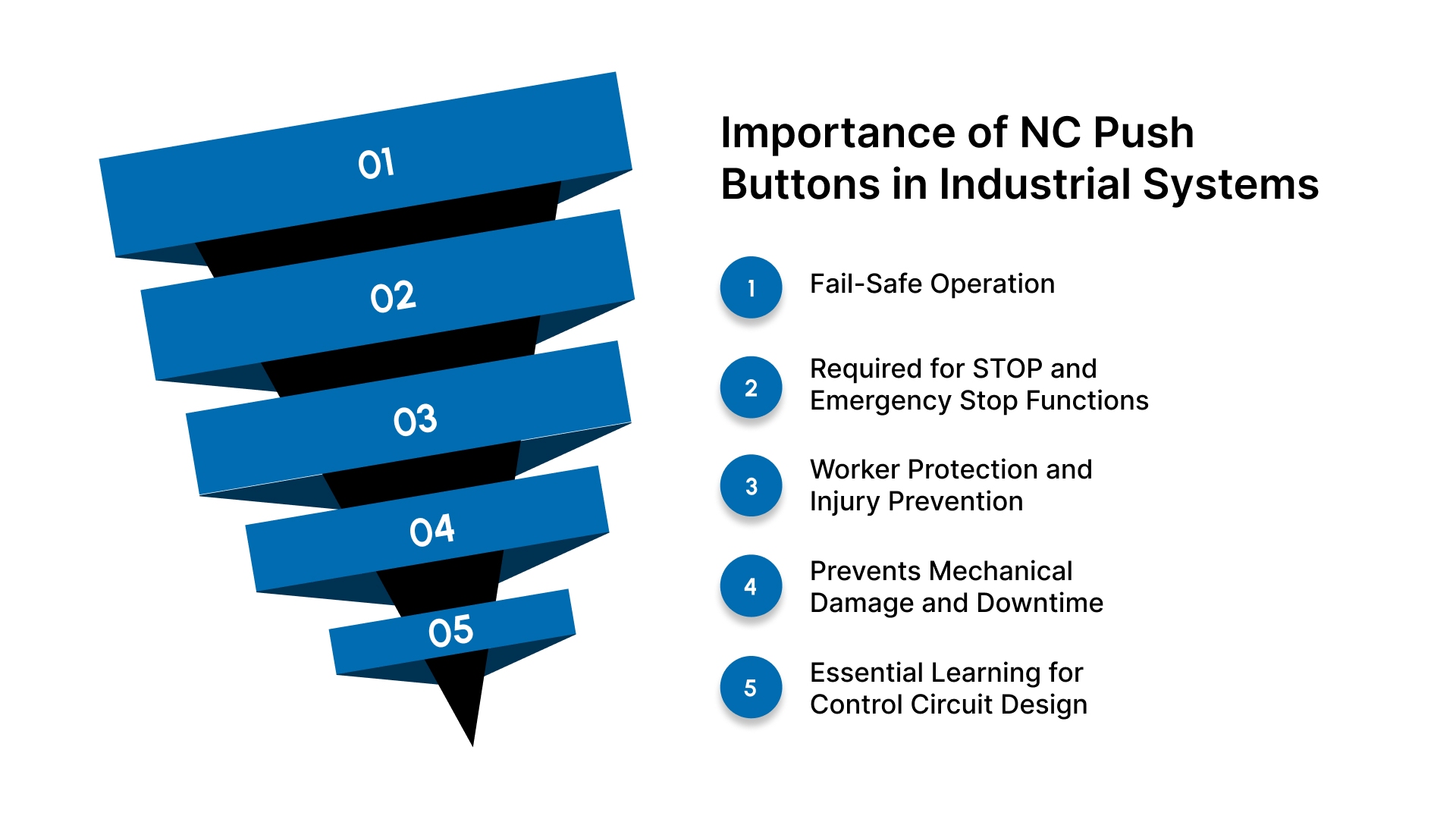
Fail-Safe Operation: NC circuits default to OFF if the circuit is broken, meaning if a wire comes loose, a terminal fails, or a device is damaged, the machine shuts down automatically instead of continuing to run unsafely.
Required for STOP and Emergency Stop Functions: Safety standards such as OSHA machine guarding guidelines, ISO 13850 (Emergency Stops), and UL 508A control panel design practices expect stop circuits to use NC contacts because they provide a predictable, reliable shutdown.
Worker Protection and Injury Prevention: Reliable stop functions prevent unexpected startup, a major cause of industrial injuries reported by OSHA and NIOSH.
Prevents Mechanical Damage and Downtime: Rapid stopping protects motors, pumps, hydraulics, conveyors, and mechanical components from costly failures.
Essential Learning for Control Circuit Design: A Correct understanding of NC logic builds the foundation for troubleshooting, reading schematics, ladder logic, and designing safe systems.
Key Differences Between NC and NO Push Button Switches
Understanding their operational differences helps distributors, contractors, and OEM integrators specify the right component for each control application.
Operating Principle
Feature | NC (Normally Closed) | NO (Normally Open) |
Default State | The circuit is closed and conducting | The circuit is open with no current flow |
Action When Pressed | Opens the circuit and stops current | Closes the circuit and energizes the load |
Typical Function | Stop / Shutdown / Safety | Start / Run / Activation |
Electrical Symbol | — | / |
Functional Intent in Control Systems
In real-world control panels and automated systems:
NC push buttons are used where a system must automatically stop or enter a safe state if power is lost, wiring breaks, or the button is pressed.
NO push buttons are used when an operation should occur only when intentional activation is required.
For distributors and system designers, this differentiation is key when selecting components for process control, building automation, and machinery safety.
Safety and Compliance Considerations
Parameter | NC Switch | NO Switch |
Fail-safe operation | Yes, circuit breaks on fault | No, the device simply remains inactive |
Emergency stop suitability | Industry standard for E-STOPs | Not used for E-STOP |
Regulatory alignment | Meets ISO safety & lockout standards | Not intended for safety control |
Risk mitigation | High | Moderate to low |
NC push buttons are mandated in many controlled environments, such as treatment plants, motor control centers (MCCs), conveyor systems, packaging equipment, HVAC automation, and municipal pumping stations, where safety interlock reliability is prioritized.
Application Examples in the Field
NC Push Button Typical Uses | NO Push Button Typical Uses |
Emergency Stop circuits on machinery | Start buttons for motors, lighting, and compressors |
Stop controls in motor starter panels | Push-to-run controls and momentary activation |
Safety gate interlocks & limit switches | Operator control stations & automation panels |
Alarm & monitoring fail-safe circuits | Access control activation or equipment enable |
These applications reflect common installations handled by contractors, panel builders, and OEM control specialists supplying industrial manufacturing, municipal utilities, commercial facilities, and automation distributors.
Choosing Between NC and NO Switches
Selecting the correct push button switch type is a critical decision for industrial, commercial, municipal, and OEM control systems.
Application Requirement: Start vs. Stop Function
The primary selection criteria involve the intended action of the control point:
Use NC switches for STOP, shutdown, or emergency functions where breaking the circuit stops a motor, process, or power feed.
Use NO switches for START or activation functions where pressing the button enables motors, relays, power systems, or automated sequences.
This distinction ensures proper control logic and supports equipment protection standards across MCC panels, automated lines, pump systems, or building control panels.
Safety Importance
In high-risk or regulated environments, safety requirements typically dictate the use of NC switches:
NC is a fail-safe, any wiring failure or power loss automatically stops the equipment.
Required in emergency stop systems, interlock gates, and maintenance lockouts per safety codes such as ISO 13850 & NFPA guidelines.
NO switches are acceptable only for non-safety actions, such as operational start commands or momentary manual controls.
Type of Load (Motor, Relay, or Control Circuit)
The type of device being controlled influences switch selection and circuit design:
Motors, drives, and heavy equipment: NC is used for shutoff functions and to protect drive systems and motor starters.
Relays and PLC control circuits: NO is commonly used to trigger coils, start sequences, and energize control logic.
Automation sequencing: NC ensures equipment stops immediately when interlocks or limits are reached.
Understanding the load characteristics helps contractors and panel builders design reliable operation without control logic conflicts.
Practical Uses of NC Push Button Switches
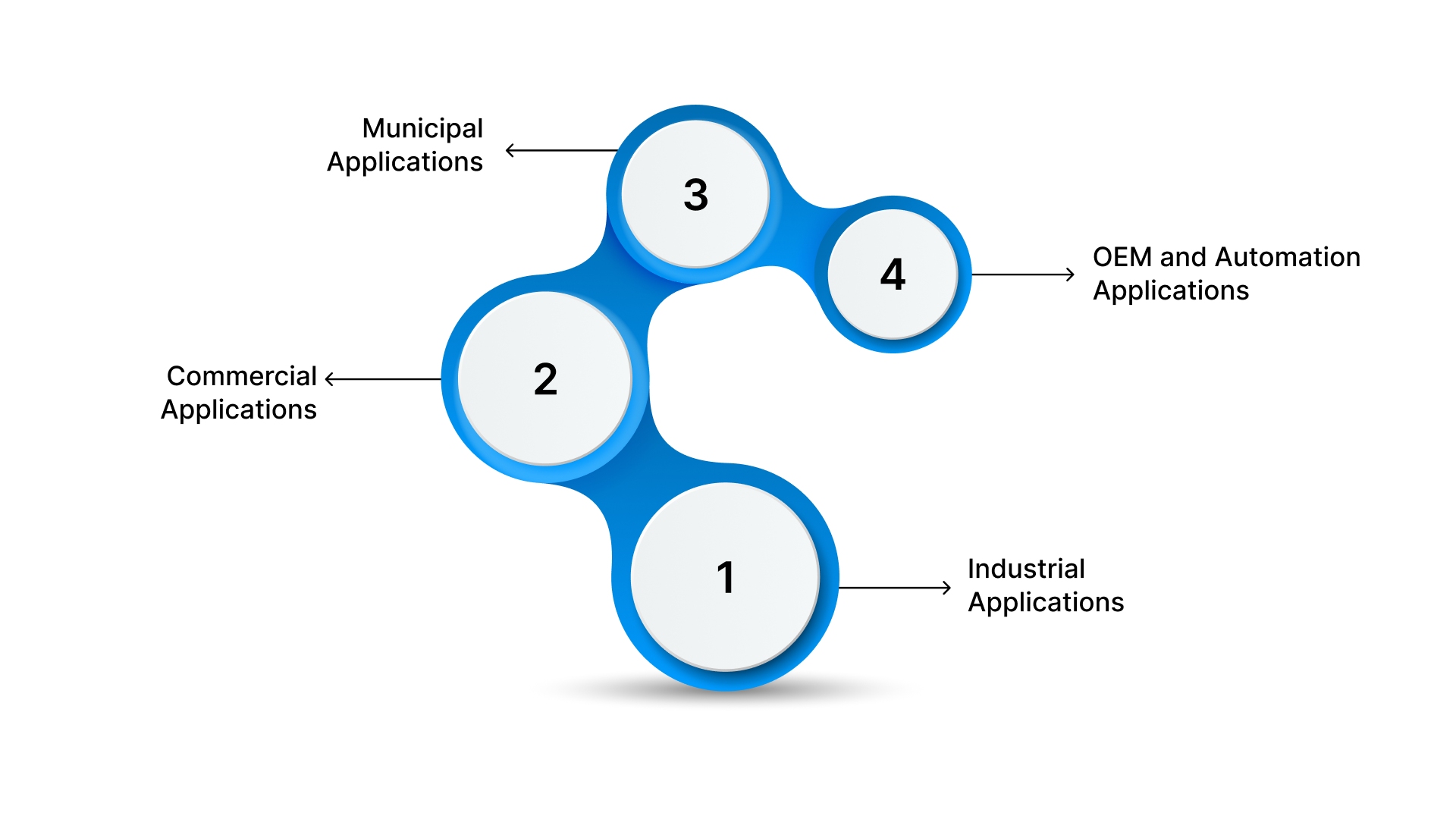
In industrial, commercial, municipal, and OEM equipment environments, NC push button switches play a critical role in ensuring safe operation, process reliability, and compliance with safety standards. Their fail-safe behavior makes them a core component specified by distributors, contractors, panel builders, and system integrators across diverse applications.
Industrial Applications
In manufacturing plants, material-handling operations, and automated production lines, NC push buttons are essential for equipment protection and operator safety. Their instant circuit-breaking action is crucial where machines must stop immediately to prevent hazards or equipment damage.
Common Industrial Use Cases
Emergency Stop (E-STOP) buttons on conveyor systems, packaging machines, and robotic lines
Stop controls in motor starter panels and VFD system interfaces
Safety interlock circuits for machine guards, light curtains, and access doors
Overload protection and thermal trip reset circuits for automated machinery
Commercial Applications
Commercial facilities such as HVAC plants, building automation systems, escalators, and commercial generators utilize NC push buttons to ensure reliable shutoff and emergency response capability. Contractors rely on NC switches to maintain safety and code compliance in people-occupied buildings.
Common Commercial Use Cases
Alarm and fire suppression safety shutoff circuits
Emergency stop buttons for elevators, escalators, and moving walkways
HVAC control panels and commercial chiller shutdown controls
Backup generator safety stop and lock-out panels
Municipal Applications
Municipal water treatment systems, pump stations, and utility distribution equipment depend on NC switches within safety-critical control circuits. Their fail-safe nature helps avoid catastrophic downtime or public-safety risks.
Common Municipal Use Cases
Pump station stop circuits and wet-well overload shutdown controls
Emergency stop and maintenance lock-out on blowers, mixers, and aeration equipment
SCADA and remote monitoring shutdown inputs for utilities and infrastructure plants
Safety gate and access door interlocks in utility service areas
OEM and Automation Applications
OEM machinery builders, UL-508A panel shops, and automation integrators specify NC switches to ensure equipment meets functional safety requirements and reduce liability exposure.
Common OEM and Panel-Builder Use Cases
PLC and relay-based safety circuits for stop/disable commands
Limit and position switch feedback on actuators, linear guides, and elevators
Industrial robots, CNC, press brakes, and packaging system safety circuits
Control stations and HMI panels for machine shutdown control
Get local stocking support, hands-on training, demos, and engineering guidance from ValuADD to choose the right components and streamline your control panel builds.
Choosing the Right NC Push Button
Selecting the correct NC push button for an industrial control system is about more than just picking a color or shape. The right choice ensures safety, reliability, compatibility, and long-term performance in the environment where it’s installed. Below are key factors to consider when specifying or replacing an NC push button.
Color Codes
Color helps clearly communicate the button’s function for operators and maintenance personnel. Standard industrial conventions include:
Color | Typical Meaning / Use |
Red | STOP / Emergency stop / Shutdown |
Yellow | Special function / abnormal condition reset |
Black | General stop or control function |
Blue or Green (when used) | Optional control depending on facility standard |
Actuator Types
The actuator is the part you physically press. Different shapes improve usability in different environments.
Type | Best Use Case |
Mushroom head | Easy to hit quickly for emergency or rapid stop |
Flush | Low profile, prevents accidental activation |
Raised/extended | Easier to locate with gloves or in low visibility |
Key release | Controlled access, prevents unauthorized resetting |
Maintained vs. momentary | Maintained stays engaged; momentary returns automatically |
Voltage & Current Ratings
Push buttons must be rated appropriately for the voltage and current they will carry.
Match the button’s rating to the control circuit voltage (e.g., 24VDC, 120VAC, etc.)
Consider current draw of coils, relays, contactors, or PLC inputs
Oversize for safety rather than undersize, especially in industrial loads
Environmental Protection
Where and how the button is installed determines durability needs.
Rating Type | Protection Level |
NEMA 1 / 12 | Indoor, dusty, dry environments |
NEMA 4 / 4X | Splash-proof, corrosion-resistant, washdown |
IP65 / IP67 | Sealed for moisture, harsh weather, outdoor panels |
Mounting Size: 22mm vs. 30mm
Most industrial push buttons come in two standard sizes:
22mm – common in modern compact panels
30mm – older equipment, heavy-duty applications
Ensure compatibility with panel cutouts and accessories when upgrading or replacing.
Accessories & Options
NC push buttons can be configured to match functional needs. Common add-ons include:
Legend plates (labels for clarity: STOP, E-STOP, RESET, etc.)
Contact block configurations, adding multiple NC/NO contacts as needed
Illumination — LED indication for power status or fault condition
Guard bezels to prevent accidental activation
Accessories improve usability, safety, and troubleshooting efficiency.
3 Common Mistakes When Using NC Switches
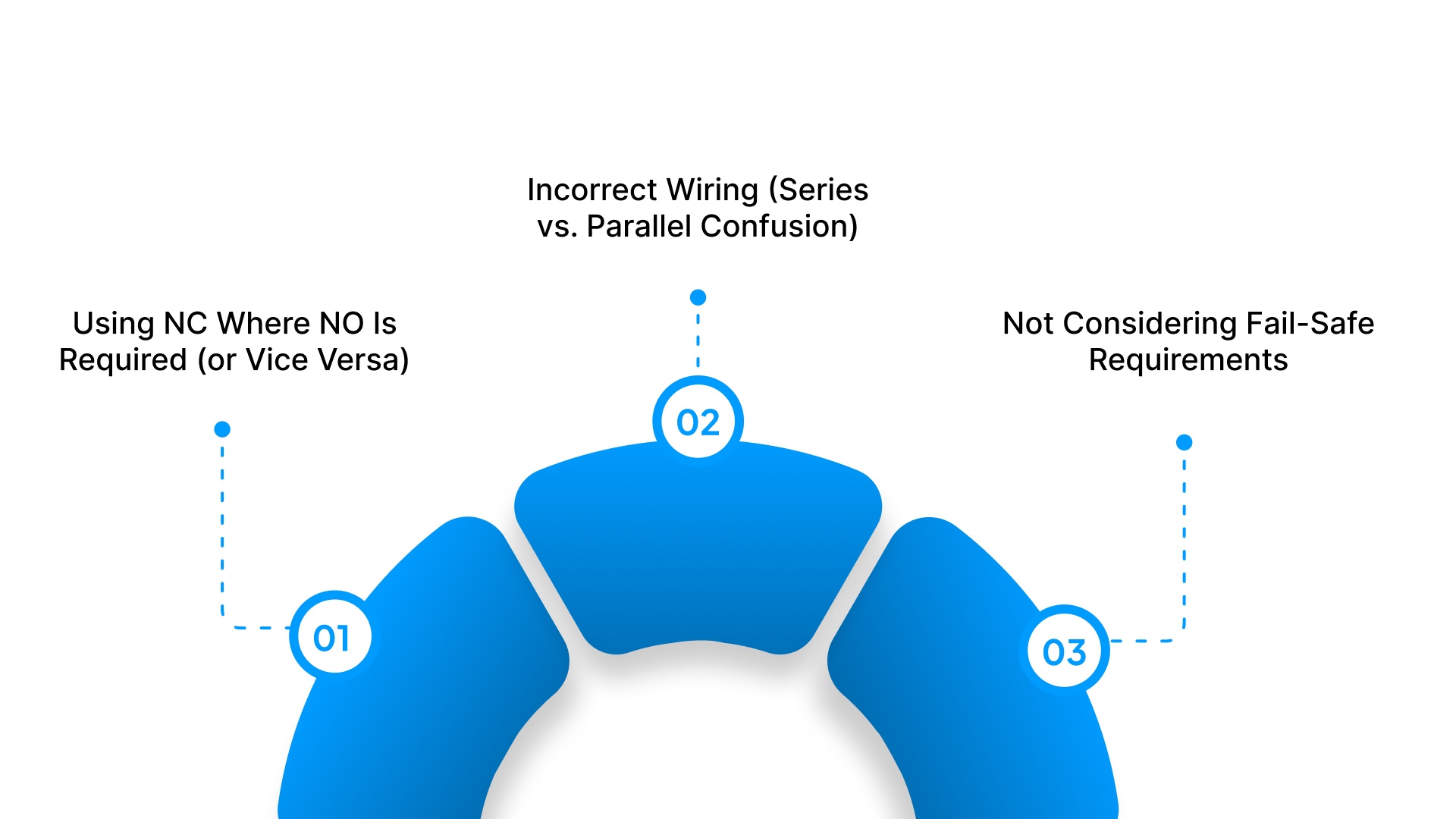
Even experienced installers and control panel designers can encounter issues when selecting or wiring NC push button switches. Understanding common errors helps contractors, distributors, and OEM engineers avoid failures that can lead to equipment downtime, safety hazards, and troubleshooting costs.
1. Using NC Where NO Is Required (or Vice Versa)
One of the most frequent mistakes is choosing the wrong switch type for the application.
Using NC instead of NO in a start or activation circuit results in equipment energizing unintentionally or failing to start correctly.
Using NO instead of NC in a safety-stop function prevents proper shutdown and eliminates fail-safe protection, potentially violating safety standards.
Correct selection begins with clearly defining the function, STOP vs. START, or safety vs. operation, and confirming circuit logic requirements.
2 Incorrect Wiring (Series vs. Parallel Confusion)
Another common issue occurs when wiring NC switches incorrectly in multi-device control circuits.
Stop and safety NC switches should be wired in series to allow any one device to open the circuit and stop the system.
Start or enable switches, and NO circuits are wired in paralle,l so multiple points can activate the system.
Incorrect wiring leads to unexpected equipment behavior, difficulty diagnosing faults, and inconsistent shutdown performance.
3 Not Considering Fail-Safe Requirements
Fail-safe operation is a core reason NC switches are used in industrial and municipal systems. A frequent mistake is overlooking this during system design.
NC switches ensure that a broken wire, loose terminal, or power loss opens the circuit and safely stops the system.
When NO is incorrectly used in safety-critical controls, the system may remain energized even if cables are damaged.
Compliance-driven applications (e.g., E-STOPs, interlock gates, pump overload shutdowns, MCC panels) depend on NC components to meet regulatory and insurance requirements.
How ValuAdd Helps You Choose the Right NC Push Buttons
Learning the difference between NC and NO push buttons is the first step, but putting that knowledge into practice on real equipment is where most new technicians struggle.
ValuAdd, provides the real-world support needed to move from theory to application, helping OEMs, industrial facilities, panel builders, and distributors implement the right components and build reliable control systems that protect people and equipment.
• Expert guidance selecting the right NC push buttons, contact blocks, and operator devices based on application needs such as Stop circuits, E-Stops, safety loops, and interlocks.
• Application engineering support to help maintenance teams and designers apply NC push buttons correctly in motor control, automation, municipal infrastructure, and commercial systems.
• Training and hands-on learning resources for maintenance trainees, apprentices, junior engineers, and distributor sales teams learning industrial control basics, from wiring NC vs. NO to reading schematics.
• Product standardization assistance for OEMs and panel shops to simplify BOMs, improve availability, and maintain consistency across repeat builds.
• A synergistic product ecosystem, combining BACO push buttons with complementary solutions like enclosures, relays, disconnects, UPS, power-quality, and motor control devices, enabling full control system design, not piece-by-piece sourcing.
• Support for safety, compliance, and fail-safe design, aligned with OSHA, UL 508A, NEC, and ISO safety expectations used in industrial, municipal, and commercial environments.
• Local field support across North Carolina, South Carolina, and Virginia, including on-site application reviews, distributor collaboration, demos, and training sessions.
From OEM machine builders to municipal pump stations, the right NC push button, correctly applied, can prevent injury, protect machinery, reduce downtime, and simplify service for years.
Conclusion
Understanding NC push buttons, how they work, how they differ from NO contacts, and how they are used in real control circuits is a foundational skill for anyone entering the world of industrial electrical systems. These components may seem simple, but they play a critical role in machine safety, reliability, and fail-safe operation across industrial, commercial, and municipal environments.
However, knowing the theory is only part of the journey. Selecting the right push button, applying it correctly, and integrating it into a complete control system requires real-world experience, practical guidance, and the right product support. That’s where ValuAdd makes the difference, helping new technicians, engineers, panel builders, and distributors turn knowledge into safe, reliable system performance. Contact us for training, product recommendations, or application support.
Frequently Asked Questions (FAQs)
1. Why are NC push buttons used for stop functions?
NC buttons provide fail-safe protection because if wiring becomes loose, damaged, or disconnected, the circuit opens automatically and shuts the equipment down. This prevents unexpected operation and enhances safety.
2. Where are NC push buttons commonly used?
NC push buttons are widely used in motor stop circuits, E-Stop safety systems, machine interlocks, pump stations, HVAC equipment, and automation panels. They appear anywhere stopping equipment quickly is critical.
3. What happens if an NC stop button wire breaks or fails?
The circuit automatically opens, causing the machine to power down rather than run uncontrollably. This is what makes NC push buttons essential to safety-critical design.
4. What color is typically used for NC stop push buttons?
Red is the standard color for stop and emergency stop push buttons, and yellow is often used for safety reset or abnormal condition acknowledgment. Colors ensure clear operator communication.
5. What actuator styles are available for stop push buttons?
Common styles include mushroom-head for quick striking, flush or raised buttons for regular operations, and key or twist release for secured emergency stop recovery. The style depends on accessibility and safety needs.