Introduction
Matching a soft starter to motor horsepower and voltage looks straightforward — until an SCR fails six months into operation and the pump station goes offline. In industrial manufacturing, water treatment, oil and gas, and processing environments, that kind of sizing error means unplanned downtime, motor winding damage, and real safety exposure.
This guide walks plant engineers, electrical engineers, and system integrators through correct soft starter sizing from the ground up. Getting it right requires more than a nameplate glance. You'll need to evaluate:
- Motor Full Load Current (FLA) — the true sizing baseline
- Application duty class and start frequency
- Operating environment and enclosure requirements
- Connection method (inline vs. inside-delta)
Each factor affects which unit survives the application long-term.
Key Takeaways
- Size soft starters based on motor Full Load Current (FLA) from the nameplate, not horsepower tables
- Duty class drives current demand: Class 30 loads draw 600–700% FLA; Class 10 loads draw 300–400% FLA
- Derate for starts per hour, ambient temperature above 40°C, and altitude above 1,000 meters
- Inside delta connection reduces required starter current to 58% of line current, allowing a smaller unit
- AC53a (non-bypassed) and AC53b (bypassed) ratings define thermal duty cycle — match the correct rating to your application before sizing
What Is Soft Starter Sizing and Why It Matters
Soft starter sizing is the engineering process of selecting a unit whose current rating, thermal capacity, and duty-cycle tolerance match the specific demands of the motor and application—not simply its voltage class or horsepower label.
Correct sizing delivers measurable operational benefits:
- Prevents SCR overheating by ensuring the device can dissipate heat generated during high-current starts (approximately 4.5 watts per ampere)
- Eliminates nuisance trips by matching the thermal model to actual start time
- Protects motor windings from sustained overcurrent exposure
- Extends service life of both the starter and connected equipment
That's why sizing differs from general selection. Selection identifies the right product family and feature set: bypass type, communication protocols, protection functions. Sizing determines the specific current rating required for safe, reliable operation under real-world conditions, accounting for environmental factors and duty cycles that generic selection tools ignore.
Step-by-Step: How to Size a Soft Starter for Industrial Motors
The five-step sizing process builds sequentially—each step depends on the previous. Skipping any step is a common source of field failures. The process moves from gathering baseline motor data, through understanding application demands and environmental conditions, to final configuration selection.
Step 1: Gather Motor Nameplate Data
The motor's Full Load Current (FLA or FLC) is the primary sizing input and must come directly from the motor nameplate. Also record voltage, power (HP or kW), service factor, and enclosure type. Nameplate FLA accounts for the specific motor's efficiency, power factor, and design characteristics—data that generic HP tables cannot capture.
If nameplate data is unavailable, use the table below as a temporary reference only. NEC Article 430.6 explicitly requires using nameplate current ratings for motor overload protection, not table values.
Full-Load Current for Three-Phase AC Motors (NEC Table 430.250)
| Horsepower (HP) | 230 Volts (A) | 460 Volts (A) | 575 Volts (A) |
|---|---|---|---|
| 5 | 15.2 | 7.6 | 6.1 |
| 10 | 28 | 14 | 11 |
| 20 | 54 | 27 | 22 |
| 30 | 80 | 40 | 32 |
| 50 | 130 | 65 | 52 |
| 75 | 192 | 96 | 77 |
| 100 | 248 | 124 | 99 |
| 150 | 360 | 180 | 144 |
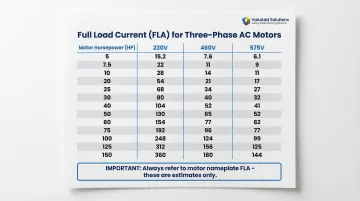
Critical caveat: NEC table values are conservative estimates intended for conductor and fuse sizing. Using these values for soft starter settings can lead to improper protection or unnecessary upsizing. Motors built for low speeds (below 1,200 RPM) or high torques draw higher currents than standard Design B motors, making nameplate data mandatory.
Step 2: Determine Application Class and Start Duty
Applications are classified by starting severity. Class 10 covers lightly loaded equipment—fans, unloaded conveyors, centrifugal pumps—where motors reach full speed within 10 seconds. Class 20 covers medium loads like compressors, loaded mixers, and grinders, allowing up to 20 seconds. Class 30 covers the most demanding starts—shredders, crushers, high-inertia conveyors—requiring up to 30 seconds.
Typical Starting Current by Application
| Application | Start Current Multiple | Recommended Class |
|---|---|---|
| Centrifugal Pump | 3.0 - 3.5 × FLA | Class 10 |
| Fan (Low Inertia) | 3.0 - 4.0 × FLA | Class 10 |
| Loaded Conveyor | 4.0 - 5.0 × FLA | Class 20 or 30 |
| Crusher / Mill | 4.0 - 5.0 × FLA | Class 30 |
| Mixer / Stirrer | 4.0 - 4.5 × FLA | Class 20 |
IEC 60947-4-2 defines AC53a and AC53b utilization codes that encode start current multiple, start duration, duty cycle, and starts per hour into a single rating string:
- AC53a (non-bypassed): SCRs carry current during start, run, and stop phases. Example:
100 A : AC53a : 6-6 : 60-1means 100 A rated current, 600 A (6×) start current for 6 seconds, 60% on-load duty cycle, 1 start per hour. - AC53b (bypassed): SCRs carry current only during start and stop; bypassed during run. Example:
100 A : AC53b : 3-52 : 1440means 100 A rated current, 300 A (3×) start current for 52 seconds, minimum 1440 seconds OFF-time between starts.
Step 3: Account for Operating Conditions and Apply Derating Factors
Starts per hour add cumulative heat to SCRs. A standard duty rating might allow 10 starts per hour; heavy duty might limit this to 5. Exceeding these limits without upsizing causes thermal tripping. Use the manufacturer's derating table to find the corrected current rating based on actual start frequency.
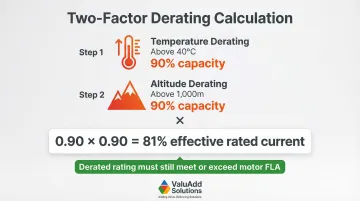
Ambient temperature above 40°C and altitude above 1,000 meters both reduce thermal capacity. Temperature derating typically ranges from 0.6% to 2% per °C depending on the model. Altitude derating follows approximately 1% per 100 meters above 1,000 meters.
These factors compound multiplicatively. If temperature derate results in 90% capacity and altitude derate results in 90% capacity, total available capacity is 0.90 × 0.90 = 81% of rated current. The derated current rating must still meet or exceed motor FLA.
Step 4: Select the Motor Connection Method
Two connection options exist:
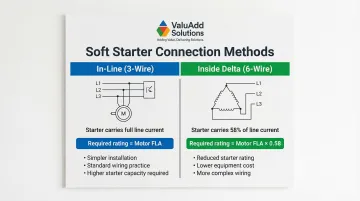
In-line (3-wire): Line current flows through the starter. The starter must be rated for full motor FLA.
Inside delta (6-wire): Starter carries only winding current, which is approximately 58% (1/√3) of line current. This allows a smaller-rated starter to control a larger motor.
Inside delta formula: Required soft starter current rating = motor FLA × 0.58
Inside delta requires access to all six motor winding terminals and typically requires an additional main contactor. Cost trade-offs must be evaluated—cabling complexity increases, but starter cost decreases. DC braking functions are typically unavailable in inside delta configurations, and some manufacturers restrict this connection on 690 V line supplies.
Step 5: Match Starter Current Rating to Derated Requirement and Confirm Bypass Configuration
Choose a soft starter with a current rating equal to or greater than the motor FLA after all derating adjustments (temperature, altitude, starts per hour, connection method) have been applied. Never size to the lower end of a rating band.
Internally bypassed soft starters run cooler during the run phase because SCRs carry no current. This increases the effective current rating between starts. AC53b ratings reflect this intermittent duty, allowing higher currents or more frequent starts for the same physical hardware compared to AC53a (continuous operation).
ValuAdd's medium voltage soft starter range covers demanding applications where standard low-voltage units fall short. The MVE-P Series handles 2.3 kV to 15 kV at 110A to 1200A; the MVDH Series adds dual redundant 350% rated protection with fiber-optic isolation and built-in motor monitoring for applications where a single starter failure carries significant process risk.
Key Factors That Affect Soft Starter Sizing
Full Load Current (FLA) is the non-negotiable anchor. Nameplate FLA accounts for motor efficiency, power factor, and load characteristics in a way that HP-based estimates cannot. Even a 5-10% error in FLA can place the starter outside its rated thermal envelope under sustained load, leading to overheating and premature failure.
Application Class / Start Duty sets the current multiplier during starting. A Class 30 crusher application may draw 600-700% of FLA during starting, while a Class 10 centrifugal pump may need only 300-400%. This difference directly impacts the thermal energy the soft starter must dissipate without tripping.
Environmental Derating is easy to underestimate. A site at 2,000 meters altitude and 50°C ambient temperature may reduce the effective starter rating by 20-30% below its nameplate value. Derating curves require applying both factors to the base current rating — temperature first, then altitude.
Bypassed vs. Non-Bypassed Configuration is a sizing variable, not just a design preference. A non-bypassed starter accumulates heat during the full run cycle (SCRs dissipate approximately 4.5 watts per ampere continuously), requiring a conservatively higher rating. A bypassed starter carries current only during start and stop, allowing a tighter, more economical size selection for applications with infrequent starts.
Common Soft Starter Sizing Mistakes to Avoid
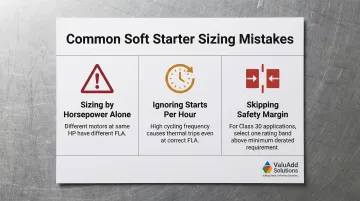
Three mistakes account for most soft starter failures in the field:
- Sizing by horsepower alone: Different motors at the same HP can have different FLA depending on efficiency class, voltage, and design. Siemens explicitly requires sizing based on nameplate FLA, not HP — ignoring this leads to nuisance trips, SCR overheating, and shortened starter life.
- Ignoring starts per hour: In water treatment, HVAC, and conveyor applications where motors cycle frequently, a starter sized correctly for FLA can still overheat if cycling frequency isn't reflected in the AC53 utilization code. Schneider Electric identifies exceeding rated starts per hour as a primary cause of thermal trips.
- Skipping the safety margin: Selecting a starter at exactly the derated current threshold leaves no buffer for load variability, motor aging, or temperature swings. For Class 30 or heavy-duty applications, select one rating band above the minimum derated requirement.
When a Soft Starter Is Not the Right Solution
Soft starters are not suited to applications requiring continuous speed control, precise torque profiling across a wide speed range, or regenerative braking. In these cases, a variable frequency drive (VFD) is more appropriate. VFDs provide continuous variable speed control and energy recovery capabilities that soft starters cannot deliver.
Several other scenarios also point away from soft starters:
- No mechanical or electrical stress at start: If the load starts easily, causes no voltage sag, and needs no soft stop or motor protection, a direct-on-line or star-delta starter is typically more cost-effective
- Slip-ring motors with extreme torque demands: These often require control strategies a soft starter cannot provide
- True low-speed control (below ~15–20 Hz): Soft starters have no output frequency control; a VFD is the correct tool here
ValuAdd's portfolio spans soft starters, contactors, and VFDs, so engineers can select the right technology for each application rather than fitting the load to whatever's on hand.
Frequently Asked Questions
Can a motor starter be too big?
Yes. An oversized soft starter can cause control instability because its minimum controllable output may exceed what a small motor requires. Internal current sensing often lacks the resolution to manage small motor currents accurately, resulting in erratic starting or nuisance trips.
How many amps is a size 0 starter good for?
NEMA Size 0 contactors/starters are rated for 18 amperes continuous at AC3 duty (motor starting), corresponding to roughly 5 HP at 460V. The exact ampere rating depends on manufacturer and voltage; verify against NEMA ICS 2 standard.
What is the difference between AC53a and AC53b soft starter ratings?
AC53a covers non-bypassed soft starters (SCRs carry current throughout the run phase); AC53b covers bypassed starters where SCRs only conduct during start and stop. Both codes encode start current, duration, duty cycle, and starts per hour. A bypassed unit typically achieves a higher effective current rating for the same physical size.
What information do I need from the motor nameplate to size a soft starter?
You need Full Load Current (FLA/FLC), supply voltage, frequency, HP or kW rating, and service factor. FLA is the most critical value — always read it from the nameplate rather than estimating from HP tables, since it reflects the motor's actual efficiency and power factor.
How does ambient temperature affect soft starter sizing?
Most soft starters are rated at 40°C ambient. Above this threshold, the starter's current rating must be derated per the manufacturer's curve—typically 0.6% to 2% per °C depending on model. Failure to derate can cause SCR overheating and premature failure, particularly in enclosed panels or outdoor enclosures in hot climates.
What happens if a soft starter is undersized?
An undersized soft starter will exceed its thermal limits under load, causing overtemperature trips, SCR damage, and shortened service life. If the starter trips mid-start, the motor and connected load may also be exposed to uncontrolled voltage transients.