Introduction
Industrial control panels are the command center of virtually every automated facility — from a water treatment plant managing pump flows across a city to a packaging line cycling through hundreds of products per minute. Without them, every motor start, process adjustment, and safety interlock would require a technician standing at the machine.
Most engineers and facility managers already know they need a control panel. The harder questions involve which type fits the application, which components are non-negotiable, and how to match both to the environment and compliance requirements they're working within.
This article breaks down the four primary panel types, the core components inside them, how they're applied across key industries, and the selection criteria that determine whether a panel performs reliably for decades — or creates recurring maintenance problems that compound over time.
Key Takeaways
- Industrial control panels are rated enclosures housing electrical components that monitor, protect, and automate industrial machinery and processes.
- The four primary types — MCC, PLC, relay-based, and SCADA/DCS — serve different levels of process complexity and scale.
- Core components include circuit breakers, PLCs, VFDs, HMIs, relays, and terminal blocks.
- Choosing the right panel comes down to process complexity, environmental conditions, scalability needs, and compliance standards like UL 508A, IEEE 519, and NEC.
What Is an Industrial Control Panel?
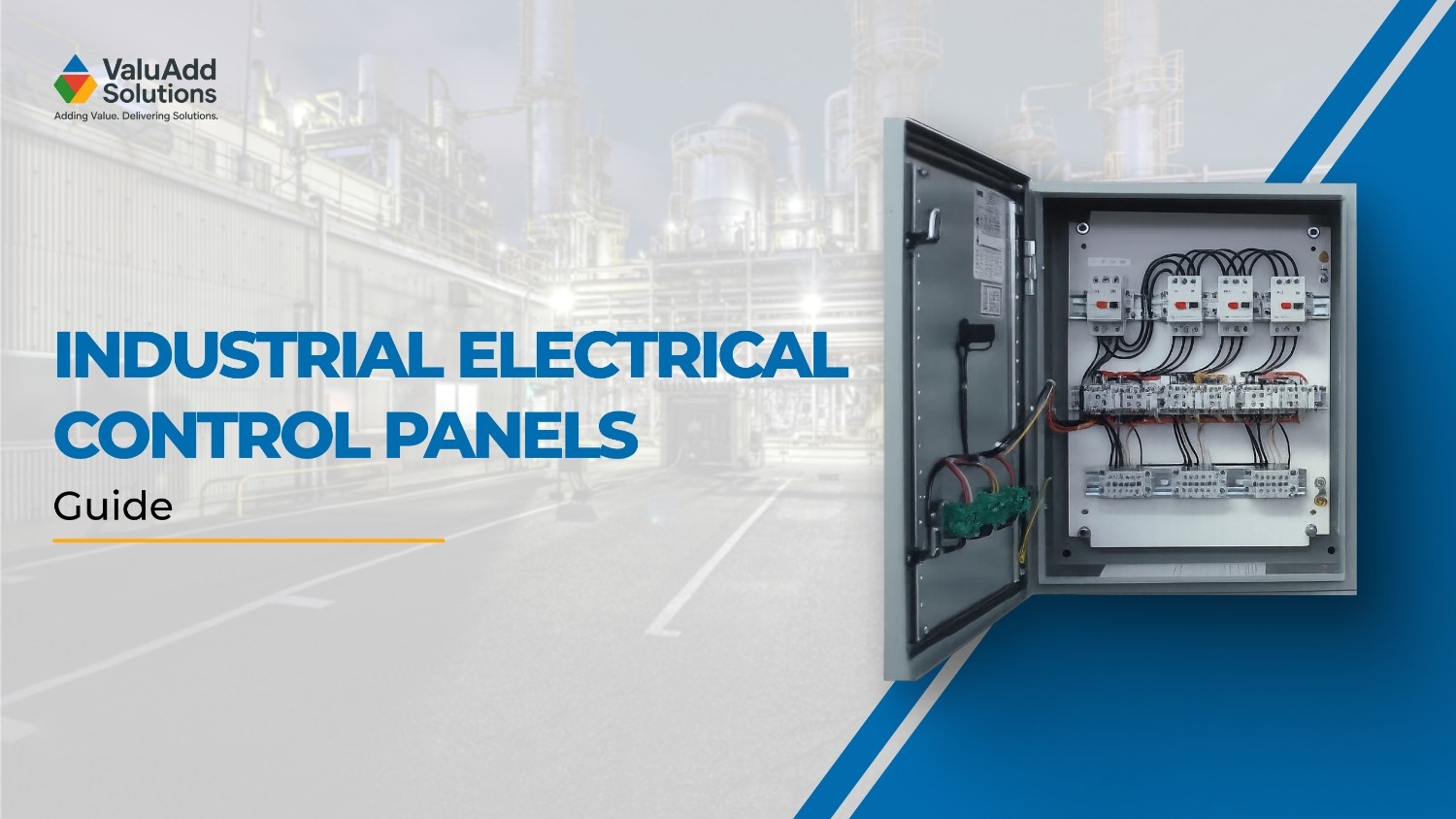
Per NEC Article 409.2, an industrial control panel is an assembly of two or more power circuit components, control circuit components, or both — housed in a rated enclosure and designed to monitor, control, and protect industrial machinery and automated processes.
Every panel has two structural layers:
- The enclosure — rated to UL 50, NEMA, and/or IP standards for environmental protection against dust, moisture, corrosion, and impact
- The internal backplate — where components like circuit breakers, PLCs, and relays mount on DIN rails, organized by wire ducts
What makes panels useful is what they replace: manual intervention. A control panel centralizes control of conveyors, pumps, motors, and valves into a programmable, automated system. UL 508A is the primary US standard governing how these assemblies are built and listed — and it's the certification most engineers should require by default.
Types of Industrial Control Panels
No single panel type fits every application. The decision depends on motor density, automation complexity, data needs, and the specific equipment being controlled.
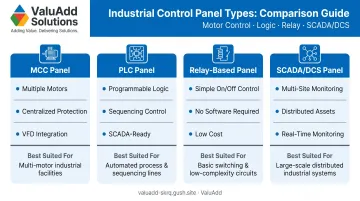
Motor Control Center (MCC) Panels
An MCC consolidates multiple motor control units into a single enclosure: starters, breakers, VFDs, and overload relays all managed from one central point.
Best suited for: Manufacturing plants, pumping stations, water treatment facilities, and oil and gas operations where multiple motors run simultaneously.
Key differentiator: MCCs commonly integrate Variable Frequency Drives to enable precise motor speed control. According to the EPA, properly applied VFDs in public water systems can reduce energy consumption by 10% to 50%. Payback periods typically run 1 to 8 years, making VFD-integrated MCCs a practical choice for pump-heavy applications.
Trade-offs:
- Reduces wiring complexity and centralizes protection
- Simplifies maintenance across many motors
- Requires significant upfront space and investment
- Overkill for facilities running only one or two motors
The low-voltage MCC market reflects demand for this centralization — Grand View Research values it at $4.28B in 2023, projected to reach $5.97B by 2030.
PLC Control Panels
A PLC (Programmable Logic Controller) panel uses a programmable industrial computer as its brain, executing logic to monitor sensor inputs and trigger outputs (motor starts, valve operations, alarm signals) based on pre-written programs.
Best suited for: Assembly lines, conveyor systems, packaging machines, food and beverage production : any process requiring precise sequencing and repeatable automation.
Key differentiator: PLCs replace hardwired relay logic with software. The IEC 61131-3:2025 standard governs PLC programming languages, meaning logic can be ported across vendors , which is a significant advantage for facilities that need long-term flexibility.
Trade-offs:
- Highly flexible, reprogrammable without rewiring
- Supports data logging, remote diagnostics, HMI and SCADA integration
- Requires programming expertise and carries higher initial cost than relay panels
Relay-Based Control Panels
Relay-based panels use electromechanical relays, contactors, timers, and fuses wired into hardwired control circuits. These panels require no software. All switching is handled through physical wiring.
Best suited for: Straightforward on/off control tasks such as basic pump control, HVAC units, lighting systems and harsh environments (mining, construction) where ruggedness and easy troubleshooting matter more than flexibility.
Key differentiator: Control Engineering notes that PLC panels become more economical once a design reaches roughly 3 to 4 or more relays. Below that threshold, relay panels often make more practical sense.
Trade-offs:
- Low cost, no software required, easy to troubleshoot
- Any logic change requires physical rewiring
- Not practical for multi-step or complex automation
SCADA/DCS Panels
SCADA (Supervisory Control and Data Acquisition) and DCS (Distributed Control System) panels operate at a different scale entirely, overseeing entire systems across wide geographic areas or multi-unit facilities.
Best suited for: Pipelines, power grids, water distribution networks, and chemical plants where real-time remote monitoring, alarm management, and process optimization span multiple sites.
Key differentiator: Where PLC panels control a specific machine or process unit, SCADA/DCS panels coordinate distributed assets and visualize aggregated data for centralized decision-making.
Critical consideration — Cybersecurity: NIST SP 800-82 Rev. 3 (2023) covers OT security guidance specifically for ICS categories including SCADA and DCS. Treat it as a core specification requirement, not an afterthought.
Key Components Inside an Industrial Control Panel
Regardless of panel type, all industrial control panels share a core set of components. Understanding each one's role is essential for proper selection, maintenance, and troubleshooting.
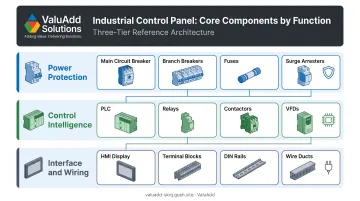
Power Protection Components
These components form the first line of defense against electrical faults:
- Main circuit breaker — primary disconnect for the entire panel, sized to the total connected load
- Branch circuit breakers — protect individual circuits downstream
- Fuses — fast-acting overcurrent protection for sensitive devices
- Surge arresters — protect against lightning strikes and utility voltage transients
Correct sizing is required for NEC Article 409 compliance and UL 508A listing. Undersized protection creates a safety risk; oversized protection fails to trip when it should.
Control Intelligence: PLCs and Relays
The PLC monitors digital and analog inputs from field devices — sensors, switches, transmitters — and executes output commands based on programmed logic. It's the decision-making layer.
Relays and contactors serve as the switching muscle. They handle high-power loads based on PLC commands or manual signals. Relay selection matters: standard relays suit general switching, while safety-rated relays are required in processes where a control failure could cause injury or equipment damage.
Variable Frequency Drives (VFDs)
VFDs regulate AC motor speed and torque by adjusting the frequency and voltage of the power supply, enabling smooth acceleration, reduced mechanical stress, and energy savings on variable-torque loads like pumps and fans.
In water treatment, oil and gas, and manufacturing applications, IEEE 519-2022 harmonic compliance is often required to protect the electrical system from distortion caused by non-linear VFD loads. ValuAdd's Benshaw H2 519/519P Series Clean Power Drives address this directly, using an 18-pulse design with a phase-shifting transformer to achieve less than 8% THDv and less than 5% TDDi — meeting IEEE 519-2014 Table 1 and Table 2 thresholds.
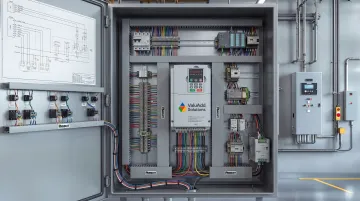
Higher-power applications demand more. Benshaw's medium voltage drives (MVH2 Series up to 1,500 HP at 4,160V; M2L Series up to 12,000 HP at 7.2kV) use H-Bridge multi-level technology for near-sinusoidal output and low harmonic content, a meaningful advantage on large motor installations where distortion can affect upstream equipment.
Human-Machine Interface (HMI)
HMIs are the operator-facing component — display screens providing real-time process data, system status, and alarm notifications. Operators interact with the process without touching internal panel components.
For harsh environments, enclosure ratings matter as much as display performance. ValuAdd's Cimon CM-eXT2-15W-RH-DF offers a 15.6-inch display with 1,200 cd/m² luminance, IP68 front protection, NEMA Type 4X and 12 compliance, and an operating range of -20°C to +70°C — suitable for outdoor installations and environments with washdown exposure where standard HMIs would fail within months.
Wiring Infrastructure: Terminal Blocks, DIN Rails, and Wire Ducts
These elements define the panel's long-term maintainability:
- Terminal blocks provide labeled connection points for field wiring, making troubleshooting and future modifications straightforward
- DIN rails keep components organized on a standardized mounting structure, making individual replacements fast
- Wire ducts route and protect internal cabling, preventing damage and simplifying future additions
A well-organized wiring infrastructure separates a panel that takes 20 minutes to troubleshoot from one that takes half a day.
Industrial Control Panel Applications by Sector
The underlying components are consistent across industries — but configuration, ratings, and compliance requirements vary substantially.
Manufacturing and Processing Plants
PLC and MCC panels drive conveyor systems, packaging lines, and motor-driven equipment. PLCs handle sequencing logic; MCCs manage motor power distribution.
Key configuration requirements:
- Food and beverage lines require NEMA 4X enclosures and IP69K-rated devices for washdown
- High-cycle applications benefit from solid-state relay outputs over mechanical contacts
- Safety-rated PLCs (IEC 62061 / ISO 13849) apply where machine guarding interlocks are present
Municipal Water Treatment and Pumping Stations
MCC panels with integrated VFDs control pump speeds for efficient flow management. The EPA documents energy savings of 10%–50% when VFDs replace across-the-line starters in pump applications — a quantifiable justification for the added cost.
Specifiers for these projects should note:
- IEEE 519 compliance is often specified to limit harmonic distortion fed back to the utility grid
- Wet and outdoor pump station environments typically require NEMA 4X or 4X stainless enclosures
- Redundant control power supplies are common in critical water infrastructure
Oil and Gas
Remote wellhead and pipeline control uses both relay-based panels (simple, fixed-function sites) and explosion-rated PLC panels where programmable logic is needed. The compliance requirements here are non-negotiable.
- OSHA 1910.307 mandates equipment approved for the specific hazardous location classification
- UL 508A panels are not a substitute for UL 698A listed equipment in Class I, Division 1 or 2 areas
- Purged and pressurized enclosures (Type X, Y, or Z) are an option where Ex d alternatives are impractical
Power Generation, Chemical Processing, and Multi-Site Utilities
SCADA/DCS panels provide the supervisory layer needed to coordinate distributed assets across large facilities or multiple sites. These panels integrate field I/O, communications gateways, and HMI displays into a single coordinated architecture.
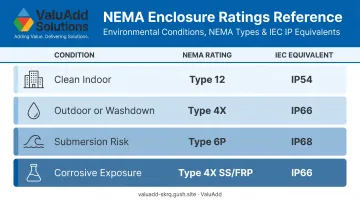
Enclosure Ratings: A Cross-Sector Reference
Regardless of sector, enclosure selection must match site conditions:
| Condition | NEMA Rating | IEC Equivalent |
|---|---|---|
| Clean indoor environment | Type 12 | IP54 |
| Outdoor or washdown | Type 4X | IP66 |
| Submersion risk | Type 6P | IP68 |
| Corrosive chemical exposure | Type 4X (SS or FRP) | IP66 |
How to Choose the Right Industrial Control Panel
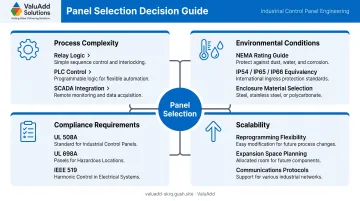
Specifying the wrong panel type creates expensive problems — a relay-based panel dropped into a multi-step automated process requires rewiring rather than reprogramming, and an under-rated enclosure in a washdown environment voids certifications and risks equipment failure. Four factors should drive every panel selection decision:
1. Process complexity and automation needs
- Simple on/off control → relay-based panel
- Multi-step sequencing, data logging, remote diagnostics → PLC panel
- Enterprise-wide or multi-site monitoring → SCADA/DCS
2. Environmental conditions and enclosure ratings
- Indoor, dust-protected: NEMA Type 12
- Outdoor or washdown exposure: NEMA Type 4
- Corrosive, chemical, or coastal environments: NEMA Type 4X
- Always verify both NEMA and IP ratings where both are specified — NEMA includes corrosion and icing tests that IP ratings don't cover
3. Compliance and certification requirements
- US installations: UL 508A required for listed panels
- Hazardous locations: UL 698A — not interchangeable with standard UL 508A
- Motor-heavy applications with VFDs: IEEE 519-2022 harmonic compliance
- Hazardous area classification: NEC Article 500 or Article 505 (Zone method)
4. Scalability and future flexibility
- PLC panels can be reprogrammed as processes change; relay panels require rewiring
- Ensure the enclosure has physical space for future component additions
- Plan communication protocols early — integrating SCADA, MES, or cloud monitoring upfront is far easier than retrofitting it later
ValuAdd's product range is spec'd to address these requirements directly — Benshaw soft starters, Cimon HMIs, Baco 22mm/30mm controls with IP69K ratings, and IEEE 519-2022-compliant VFDs, all available in NEMA Type 4X and Type 12 configurations for the environments and sectors covered above.
Frequently Asked Questions
What is an industrial control panel?
An industrial control panel is a rated enclosure containing electrical components — circuit breakers, PLCs, relays, VFDs, and HMIs — that collectively monitor, protect, and control industrial machinery and automated processes. Per NEC Article 409.2, it requires at least two power or control circuit components.
What is the difference between a PLC panel and an MCC panel?
A PLC panel uses programmable logic to sequence and automate processes — handling inputs, outputs, and decision logic. An MCC panel is specifically designed to control and protect multiple electric motors from a centralized assembly. The two are often used together: the PLC provides the logic, the MCC handles motor power distribution.
What are the three types of UL industrial control panel labels?
The three are: UL 508A (the primary standard for shop-built industrial control panels, the most commonly required US certification), UL 698A (for panels in hazardous classified locations), and UL 50 (covering enclosures for electrical equipment in non-hazardous locations).
What are the main components of an industrial control panel?
Core components span three functional categories:
- Power protection: main circuit breaker, branch breakers, fuses, surge arresters
- Control logic: PLCs, relays, contactors, VFDs
- Interface and wiring: HMI displays, power supply, terminal blocks, DIN rails, wire ducts
What NEMA rating do I need for my industrial control panel?
NEMA Type 12 suits clean indoor environments with dust and drip protection. NEMA Type 4 adds outdoor and hose-directed water protection. NEMA Type 4X provides the same as Type 4 with corrosion resistance for washdown, chemical, or coastal environments. Always rate to the harshest condition the panel will face.
What industries use industrial control panels the most?
Manufacturing, municipal water treatment, oil and gas, power generation, food and beverage, chemical processing, and material handling are the primary users.