Introduction
Industrial facilities face a deceptively simple challenge: how do you safely isolate power for maintenance without triggering code violations or failed inspections? The answer lies in understanding that not all disconnect switches are created equal. In U.S. electrical systems, UL 98 and UL 508 represent two distinct safety standards for non-fused disconnect switches. Choosing the wrong one can derail project timelines, void panel listings, and create unsafe working conditions.
Many system integrators and plant engineers struggle with this distinction. A UL 98 listed switch installed inside a control panel may fail UL 508A inspection requirements. Conversely, a UL 508 rated switch used as an NEC-required motor disconnect may lack the necessary horsepower rating or short-circuit current withstand capability.
According to NFPA 79 Section 5.1.10, a UL 508 manual motor controller cannot serve as a machinery's primary supply disconnect. This is a common specification error that forces expensive panel redesigns.
What follows breaks down each standard's performance requirements, application context, and the selection criteria that determine which one belongs in your system.
Key Takeaways
- Non-fused disconnect switches isolate circuits without built-in overcurrent protection—they depend on upstream circuit breakers or fuses
- UL 98 applies to field-installed disconnects in general electrical distribution per NEC requirements
- UL 508 applies to disconnect switches mounted inside UL 508A listed industrial control panels and machinery
- Installation context drives selection: UL 98 for standalone/field use; UL 508 for panel-mounted components
- Both require separate overcurrent protection; neither replaces a fused disconnect on its own
What Is a Non-Fused Disconnect Switch?
A non-fused disconnect switch is a manually operated device that opens and closes electrical circuits without containing an internal fuse element. Its primary role is isolation—it physically separates equipment from the power source for safe maintenance, emergency shutdowns, and lockout/tagout (LOTO) procedures mandated by OSHA 29 CFR 1910.147. Unlike circuit breakers or fused disconnects, these switches do not provide overcurrent protection; that function is handled by upstream devices such as molded case circuit breakers (MCCBs) or separate fuse holders.
Core Components
Every non-fused disconnect includes:
- Enclosure — typically NEMA-rated for environmental protection
- Contact assembly — electrical contacts (poles) that physically interrupt current flow
- Operating mechanism — rotary handle or toggle switch
- Visible position indicator — shows ON/OFF status for safety verification
Why Non-Fused Instead of Fused?
Fused disconnects combine isolation and overcurrent protection in one device. Non-fused switches only isolate. This separation is intentional—it allows system designers to:
- Use upstream circuit breakers for protection (avoiding redundant fusing)
- Independently size and select overcurrent devices
- Reduce costs when protection already exists
- Meet specific NEC or NFPA requirements for motor branch circuits
Standard Electrical Ratings
| Rating Type | Typical Range | Common Values |
|---|---|---|
| Ampere Rating | 16A to 2000A | 30A, 60A, 100A, 200A, 400A, 600A, 800A, 1200A |
| Voltage Rating | Up to 600V AC (UL 508) or 1000V AC (UL 98) | 240V, 480V, 600V AC |
| Horsepower Rating | Varies by UL standard | Specific HP ratings required for NEC motor disconnects |
For reference, the SIRCO M series covers 16A–100A at 600V AC (UL 508/UL 98 listed), while the SIRCO UL 98 C addresses heavier industrial loads from 400A–1000A at 800V AC—both common in water treatment, oil and gas, and manufacturing applications.
LOTO Compliance: Why Visible Isolation Matters
OSHA 1910.147 requires that energy-isolating devices be capable of being locked out—meaning a padlock can secure the switch in the OFF position during maintenance. Non-fused disconnects fulfill this requirement with:
- Padlockable handles (some accept up to three locks)
- Visible open-contact indication that confirms the circuit is de-energized
- Door interlocks that prevent panel access when energized
The SIRCO M series supports up to three simultaneous padlock positions and includes door interlocking in the ON position—directly satisfying OSHA 1910.147's requirement for a lockable, energy-isolating device.
UL 98: The Standard for General-Duty Non-Fused Disconnect Switches
UL 98 ("Enclosed and Dead-Front Switches") governs disconnect switches used in general electrical installations—service entrance equipment, feeder circuits, branch circuits, and field-wired applications per the National Electrical Code (NEC). These are standalone devices mounted outside control panels, designed to withstand the full range of field installation stresses.
Performance Testing Under UL 98
The standard evaluates:
- Switching capacity — ability to make and break rated load current
- Endurance — some switches are tested for up to 20,000 mechanical operations and 6,000 electrical cycles
- Dielectric withstand — insulation integrity at rated voltage
- Short-circuit withstand — ability to remain intact under fault conditions
- Temperature rise — thermal performance under continuous load
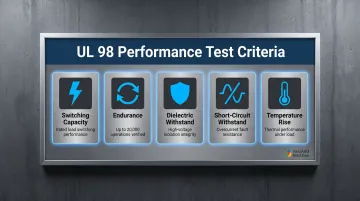
UL 98 switches are tested as stand-alone field devices, not as panel components.
Key Electrical Ratings
Three ratings determine whether a UL 98 switch fits a given installation: horsepower, ampacity, and short-circuit current.
Horsepower (HP) ratings: Required for motor branch circuit disconnects per NEC Article 430.102. The switch must carry an HP rating equal to or greater than the motor's rated HP at the supply voltage.
Ampere ratings: UL 98 switches range from 30A to 2000A, covering small machinery circuits through large industrial feeders. The SCCR must meet or exceed the available fault current at the installation point.
Physical Configurations
UL 98 switches are available in standard NEMA enclosure types:
| NEMA Type | Environment | Protection Against |
|---|---|---|
| Type 1 | Indoor | Falling dirt, contact with live parts |
| Type 3R | Outdoor/Indoor | Rain, sleet, snow |
| Type 4/4X | Outdoor/Indoor | Windblown dust, splashing water, corrosion (4X) |
| Type 12 | Indoor | Circulating dust, lint, dripping liquids |
For installations requiring outdoor or harsh-environment ratings, ValuAdd's SIRCO UL 98 C pairs glass fiber-reinforced polyester construction with the appropriate NEMA enclosure to match the conditions in the table above.
Typical Applications
- Motor disconnects mounted on walls or equipment frames adjacent to motors
- HVAC unit disconnects for rooftop or outdoor equipment
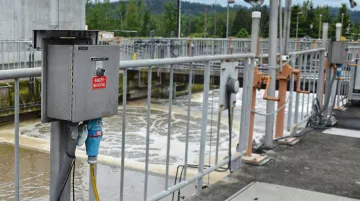
- Pump station disconnects in water treatment facilities
- Service entrance applications requiring field-installed, permanently wired disconnect means
Each of these use cases calls for a field-mounted device — which is precisely where UL 98 ends and the panel-rated UL 508 standard begins.
UL 508: Non-Fused Disconnects for Industrial Control Panels
UL 508 ("Industrial Control Equipment") governs components installed inside or mounted on industrial control panels and machinery electrical systems. A UL 508 rated disconnect is evaluated as a panel component—part of a larger assembly, not a standalone field device.
Performance Requirements
UL 508 evaluates similar electrical characteristics (making/breaking capacity, endurance, dielectric withstand, temperature rise) but in the context of panel integration. Key differences include:
- Reduced clearance requirements: 3/8 inch (9.5 mm) through air at 600V, compared to 1 inch (25 mm) for UL 98
- Compact design: Optimized for DIN rail or back-panel mounting
- SCCR coordination: Must be evaluated as part of the panel's overall short-circuit rating per UL 508A Supplement SB
UL 508A Panel Listing Connection
When a panel shop builds a UL 508A listed control panel, every component—including disconnect switches—must be rated and listed for that use. Using a UL 508 listed disconnect maintains the panel's UL listing and satisfies inspection requirements from the authority having jurisdiction (AHJ).
To determine the assembly's SCCR, panel builders evaluate each component's individual rating and apply current-limiting device rules per UL 508A Supplement SB. This calculation must account for the disconnect switch specifically.
Typical Configurations
- Rotary-style door-mounted handles with interlock mechanisms
- DIN rail or back-panel mounting for compact integration
- Door interlocks that prevent opening the panel when the disconnect is ON
ValuAdd's SIRCO M series covers these configurations with UL 508 listed rotary switches supporting front, right-side, or left-side operation and door interlock capability.
Understanding how these panel-level disconnects fit into broader code requirements matters just as much as the hardware itself.
Code Context: NFPA 79 Machinery Requirements
NFPA 79 Section 5.1.10 requires a disconnecting means for industrial machinery supply circuits. However, the main supply disconnect must be a listed motor circuit switch rated in horsepower, a listed molded case switch, or a similar UL 98 listed device.
A UL 508 manual motor controller marked "suitable as motor disconnect" qualifies only as an additional disconnect on the load side of the last short-circuit protective device. It cannot serve as the primary machine supply disconnect.
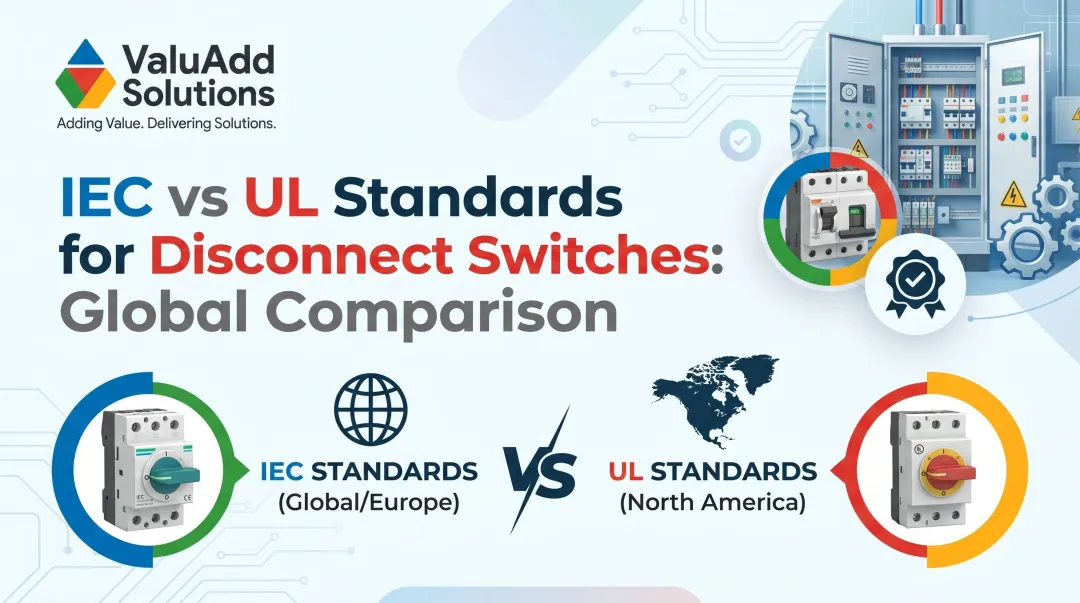
UL 98 vs. UL 508: Key Differences Explained
The fundamental distinction is installation context—where and how the switch is used.
| Feature | UL 98 Non-Fused Disconnect | UL 508 Non-Fused Disconnect |
|---|---|---|
| Application | Field-installed, standalone | Panel component, machinery |
| Intended Use | Service entrance, feeders, branch circuits | Motor control, panel internal disconnect |
| Clearance (Through Air) | 1 inch (25 mm) at 600V | 3/8 inch (9.5 mm) at 600V |
| Clearance (Over Surface) | 2 inches (50 mm) at 600V | 1/2 inch (12.7 mm) at 600V |
| HP Rating Required? | Yes, for NEC motor disconnects | Optional; often marked "suitable as motor disconnect" |
| NFPA 79 Main Disconnect | Permitted (if HP rated) | Not Permitted for primary supply |
| Typical Ampere Range | 30A to 2000A | 16A to 125A |
| Applicable Code | NEC Article 430 | NFPA 79, UL 508A |
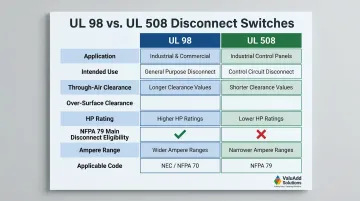
These distinctions aren't just technical footnotes—using the wrong standard in the wrong context creates real inspection and compliance failures.
Practical Implications of Using the Wrong Standard
UL 98 switch inside a UL 508A panel:
- Fails to satisfy panel listing requirements under UL 508A
- Larger clearance requirements consume valuable panel space
- Triggers UL inspection failure and forces costly redesign
UL 508 switch as NEC-required motor disconnect:
- Lacks the required HP rating for NEC motor disconnect service
- Insufficient SCCR for upstream fault levels
- Does not meet NEC Article 430 requirements
- Creates code violation and inspection failure
When specifying a disconnect, confirm the installation location first — field-installed branch circuit work calls for UL 98, while anything inside a listed control panel requires UL 508. Getting that call right keeps inspections clean and avoids rework.
Common Industrial Applications for Non-Fused Disconnect Switches
Field/General Electrical Applications (UL 98 Context)
Motor disconnects for pumps and compressors:
- Water treatment plants require NEC 430.102 compliance with disconnect switches located "within sight" (visible and not more than 50 feet from the motor)
- Oil and gas facilities use NEMA 4X rated switches for corrosion resistance in harsh outdoor environments
HVAC equipment disconnects:
- Rooftop units and outdoor condensers require NEMA 3R or 4X enclosures
- Must carry HP rating matching the equipment's motor
Machine tool branch circuit disconnects:
- Mounted adjacent to equipment per NEC Article 430
- Typically 30A–200A ratings for individual machines
ValuAdd serves these verticals with UL 98 listed disconnect switches engineered for municipal water treatment, oil and gas, and manufacturing — applications where LOTO compliance and verified isolation ratings directly affect site safety audits and insurance requirements.
Control Panel Applications (UL 508 Context)
Machine tool control panels:
- System integrators building UL 508A panels use UL 508 listed disconnects
- Compact DIN-rail mounting saves panel space
- Door interlocks enhance operator safety
Motor control centers (MCCs) and automation enclosures:
- VFD panels with an internal disconnect switch for each drive
- Main panel disconnects for processing equipment and packaging machinery
ValuAdd's SIRCO M series supports these applications with UL 508 listed rotary switches in frame sizes M1, M2, M2 CD, and M3 (16A–100A, 600V AC).
Enclosure/Environment Considerations
Harsh or washdown environments:
- Food processing plants require NEMA 4X (watertight, corrosion resistant)
- Chemical plants need stainless steel construction
- Outdoor installations demand NEMA 3R minimum
Standard indoor industrial:
- NEMA 12 provides dust and drip protection
- Suitable for manufacturing and assembly facilities
Specifying the wrong enclosure rating is one of the most common causes of premature disconnect failure in the field. A NEMA 12 switch installed in a washdown area, for example, will corrode and fail — voiding UL listing and potentially triggering an OSHA citation. Match the NEMA type to the actual environment before finalizing a panel design.
How to Select the Right Non-Fused Disconnect Switch
Step 1: Determine Installation Context
Is the switch going inside a control panel or field-installed?
- Inside a UL 508A panel → UL 508 listed switch required
- Field-installed, standalone → UL 98 listed switch required
Getting this right first keeps the rest of your selection process on solid footing.
Step 2: Verify Ampere Rating
Calculate the maximum continuous current at 125% for motor loads per NEC:
- Motor FLC × 1.25 = minimum conductor ampacity
- Disconnect switch ampere rating must be ≥ 115% of FLC per NEC Article 430
Example: A 50A motor requires conductors rated for 62.5A (50 × 1.25) and a disconnect rated for at least 57.5A (50 × 1.15)—so select a 60A switch.
Step 3: Confirm Short-Circuit Current Rating (SCCR)
The switch's SCCR must meet or exceed the available fault current at the installation point:
- Consult utility data or perform fault current calculations
- For UL 508A panels, calculate assembly SCCR per UL 508A Supplement SB
- Never install a switch with insufficient SCCR—it creates a safety hazard
Step 4: Verify Horsepower Rating (Motor Applications)
For UL 98 switches used as NEC-required motor branch circuit disconnects:
- The switch must carry an HP rating ≥ the motor's rated HP at supply voltage
- Example: A 10 HP motor at 480V requires a disconnect rated for at least 10 HP at 480V
- Using an under-rated switch violates NEC requirements
Step 5: Match Environmental Protection
Select NEMA enclosure rating based on installation environment:
| Environment | NEMA Rating | Typical Use |
|---|---|---|
| Indoor, controlled | Type 1 | Office/commercial buildings |
| Outdoor, weather-exposed | Type 3R | Rooftop HVAC, outdoor equipment |
| Washdown, corrosive | Type 4X | Food processing, chemical plants |
| Indoor industrial, dust | Type 12 | Manufacturing, assembly plants |
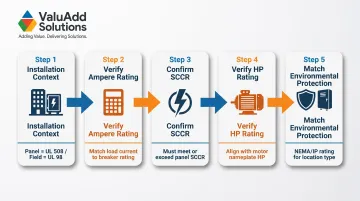
ValuAdd carries NEMA 4X and NEMA 12 rated disconnect switches, and the technical team can help system integrators confirm the right enclosure rating for their specific installation conditions.
Frequently Asked Questions
What is a non-fused disconnect switch?
A non-fused disconnect switch is a manual isolation device that opens and closes an electrical circuit without a built-in fuse. It relies on upstream overcurrent protection—such as circuit breakers or external fuses—for overload and short-circuit protection, serving strictly as an isolation point for safe maintenance.
Do I need a fusible or non-fusible disconnect?
If a circuit breaker or fuse panel already protects the circuit upstream, a non-fused disconnect is sufficient for isolation. If no upstream protection exists—such as in a dedicated feeder—a fused disconnect is required to handle both isolation and overcurrent protection.
What is the difference between UL 508 and UL 98?
UL 98 covers disconnect switches for general-purpose, field-installed electrical applications—standalone motor or service disconnects per the NEC. UL 508 covers disconnect switches used as components inside industrial control panels and machinery electrical systems per NFPA 79. Installation context drives the distinction.
Can a UL 98 disconnect switch be used inside a control panel?
Generally, no. A UL 98 listed switch is not the correct listing for use inside a UL 508A listed control panel. Panel builders should use UL 508 listed disconnects as control panel components to maintain the panel's UL listing and satisfy the authority having jurisdiction (AHJ) during inspection.
What is a non-fused transfer switch?
A non-fused transfer switch is a different device from a disconnect switch—it transfers an electrical load between two power sources (e.g., utility and generator) without incorporating fuses. A non-fused disconnect switch simply isolates a circuit from a single power source.
What ampere and voltage ratings are typical for non-fused disconnect switches?
Amperage ratings typically span 30A to 800A, with 60A, 100A, 200A, and 400A as the most common sizes. Voltage ratings cover 240V, 480V, and 600V AC, with select UL 98 switches reaching 1000V AC. The correct rating must satisfy NEC requirements for the specific load and circuit.
Need help selecting the right non-fused disconnect switch for your application? ValuAdd's technical team specializes in industrial control components for water treatment, oil and gas, and manufacturing. Contact us for expert guidance on UL 98 and UL 508 listed disconnect switches, NEMA-rated enclosures, and LOTO-compliant isolation solutions sized and specified for your specific industrial application.