Introduction
When a single failed push button halts a production line, the average cost can reach $532,000 per hour in unplanned downtime. Despite their small size, industrial push buttons, pilot lights, and selector switches represent mission-critical components in any control system—devices that directly determine whether operators can safely start, stop, monitor, and control industrial processes.
This guide covers types, construction differences, control station configurations, and the technical specifications engineers need to select the right components across manufacturing, water treatment, oil and gas, and food processing applications.
TLDR:
- Push buttons, pilot lights, and selector switches form the complete operator-machine interface loop in industrial control systems
- Industrial-grade devices offer 10 million+ cycle life, IP65/66/68 environmental protection, and UL/CE certifications vs. consumer-grade alternatives
- LED pilot lights last 50,000-100,000 hours compared to a few thousand for incandescent bulbs
- IEC devices use 22mm mounting; NEMA devices use 30mm mounting—procurement teams must know their panel standard
- ValuAdd's control devices carry UL Listed, CE, and IP65/66/68 ratings for industrial environments including oil and gas, water treatment, and manufacturing
Understanding Pilot Devices: The Human-Machine Interface
Pilot devices handle two-directional communication between operators and machines. Command devices (push buttons and selector switches) send operator instructions to control circuits, triggering contactors, relays, or PLC inputs. Status devices (pilot lights and stack lights) relay machine conditions back, confirming actions or alerting to faults.
Choosing the right devices starts with understanding which standard governs your installation.
IEC vs. NEMA Standards: A Critical Procurement Distinction
The pilot device market divides along two standard systems:
- IEC (International Electrotechnical Commission): IEC 60947-5-1 governs control circuit devices globally. IEC devices use metric dimensions—typically 22mm or 22.5mm panel cutouts—and modular construction for tighter panel layouts
- NEMA (National Electrical Manufacturers Association): NEMA ICS 5-2017 applies primarily in North America. NEMA devices use 30.5mm mounting holes and more robust housings with greater metallic content
Many manufacturers now dual-rate devices to both standards, but panel builders must verify compatibility before ordering. The 22mm standard saves significant panel real estate, making it increasingly popular even in traditional NEMA markets.
How These Devices Work Together
In a typical pump control panel for a water treatment facility:
- A green pilot light confirms the pump is powered and ready
- The operator presses a momentary start push button to energize the motor contactor
- A three-position selector switch in Hand-Off-Auto position determines whether the pump runs continuously (Hand), stops (Off), or responds to a level sensor (Auto)
- A red pilot light illuminates if the thermal overload trips, requiring operator intervention
- A mushroom-head emergency stop button provides immediate shutdown capability
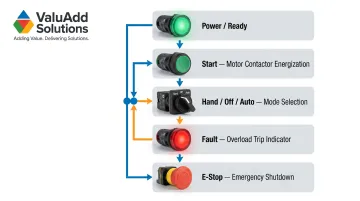
Each device performs a distinct function, but they form an interdependent control loop where operators issue commands and receive continuous status feedback.
Industrial Push Buttons: Types, Functions and Variants
Contact Types and Basic Operation
Push buttons use two fundamental contact configurations:
- Normally Open (NO) / Push-to-Make: Contacts remain open (no current flow) at rest. Pressing the button closes the contacts, completing the circuit; typical for motor start buttons
- Normally Closed (NC) / Push-to-Break: Contacts remain closed (allowing current flow) at rest. Pressing the button opens the contacts, interrupting the circuit; common in safety interlocks and stop circuits
Most industrial push buttons support both NO and NC contact blocks simultaneously, allowing a single button to control multiple circuits based on wiring configuration.
Actuator Styles Matched to Applications
Different industrial environments require different actuation methods:
- Flush-mount: Recessed into the panel surface to prevent accidental activation, ideal for densely packed panels or high-vibration environments
- Extended/dome: Projects above the panel surface for easier operation with gloved hands or in low-visibility conditions
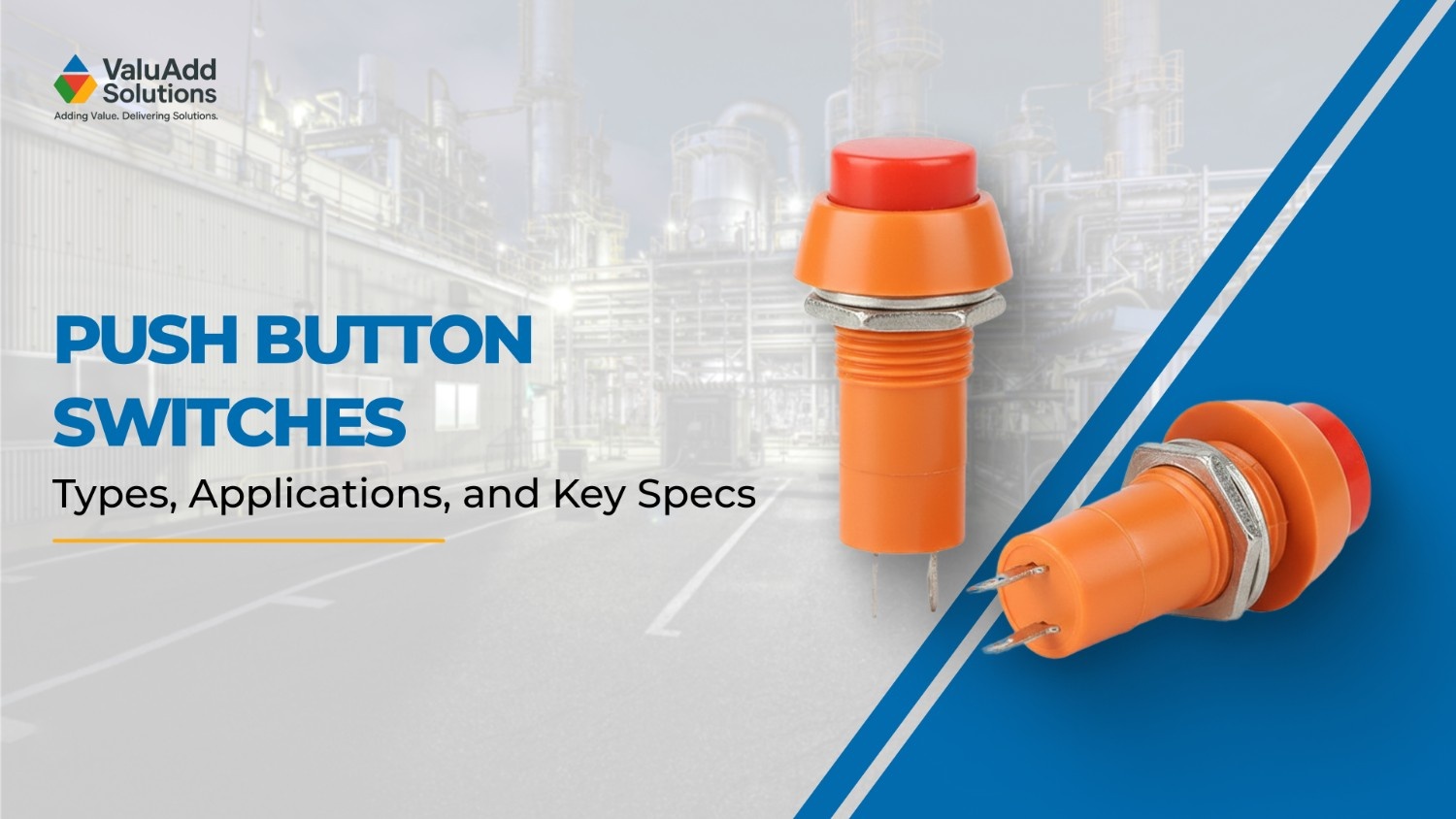
- Mushroom head: Large red actuator (32mm, 40mm, or 70mm diameter) used exclusively for emergency stop (E-stop) functions requiring fast, unmistakable actuation
When specifying actuator style, consider panel density, operator PPE requirements, and whether the application demands accidental-activation protection.
Momentary vs. Latching Action
Momentary push buttons spring back to rest position when released. They are the standard choice for start/stop commands, where the button initiates an action and a contactor or relay maintains the circuit.
Latching (maintained) push buttons stay in position until deliberately reset. These suit applications requiring visual confirmation that a mode is active, such as manual override switches or test mode indicators.
Illuminated Push Buttons: Command and Status Combined
Illuminated push buttons combine command and status indication in a single device. When pressed, the button glows using LED backlighting to confirm the commanded action is active, reducing panel real estate while providing immediate operator feedback. LED-backlit versions offer 50,000–100,000 hour service life compared to incandescent alternatives.
Key-Operated Push Buttons
Key-operated variants restrict access to critical machine functions by requiring a physical key to actuate. Common in multi-operator environments or machinery with high-risk operations, these buttons prevent unauthorized personnel from initiating potentially dangerous sequences.
Pilot Lights: Real-Time Visual Status Indicators
Pilot lights provide continuous visual confirmation of machine or process status, enabling operators to monitor multiple systems simultaneously without consulting displays or control logic.
Industry-Standard Color Coding
IEC 60073 and NFPA 79 define strict color-coding principles to reduce operator error, especially in high-stress or emergency situations:
- Green: Running, safe, normal operating condition (e.g., motor running, system ready)
- Red: Stopped, fault, danger, emergency condition requiring immediate attention (e.g., E-stop activated, overload trip)
- Yellow/Amber: Caution, abnormal condition, impending critical change (e.g., high temperature warning, automatic operation about to start)
- Blue: Mandatory action required, acknowledgment needed (e.g., manual mode selected, operator input required)
- White: Power present, general information, no specific safety meaning (e.g., control power available)
Consistent color use across all control panels within a facility reduces the risk of misinterpretation during routine operation and emergencies.
LED vs. Incandescent Technology
LED pilot lights have largely replaced incandescent units across industrial control panels — and the performance gap in the table below explains why:
| Characteristic | LED Pilot Lights | Incandescent Pilot Lights |
|---|---|---|
| Service Life | 50,000-100,000 hours | Few hundred to few thousand hours |
| Current Draw (24V DC) | ~13 mA | 70-80 mA |
| Heat Output | Minimal | Significant |
| Vibration Resistance | Excellent | Poor (filament breakage) |
| Energy Consumption | 85-90% lower | Baseline |
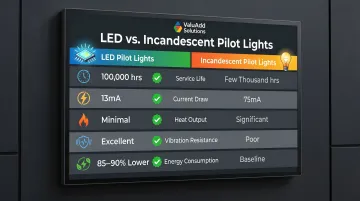
In a 24/7 operation, an LED pilot light lasting 100,000 hours provides over 11 years of continuous service, compared to frequent bulb replacements for incandescent units. Lower heat output also reduces panel cooling requirements and improves reliability of adjacent components.
Push-to-Test Functionality
The push-to-test feature lets operators verify a pilot light is functional without interrupting the machine process. Pressing the lens momentarily connects the lamp circuit directly to supply voltage, confirming the bulb or LED illuminates.
This prevents "dark lamp" conditions from masking actual fault states. A non-illuminated red pilot light should mean no fault exists — not that the bulb has burned out.
Mounting Sizes, Voltages, and Environmental Ratings
Standard panel cutout diameters include 13mm, 16mm, 22mm, and 30mm. Voltage compatibility typically spans 24VDC, 120VAC, and 240VAC. IP ratings determine suitability for specific environments:
- IP65: Dust-tight, protected against water jets — suitable for general industrial use
- IP66: Dust-tight, protected against powerful water jets — suitable for washdown areas
- IP68: Dust-tight, protected against continuous immersion — suitable for outdoor or submerged installations
ValuAdd's pilot lights carry IP65, IP66, and IP68 ratings with UL Listed and CE certifications, making them suitable for water treatment, oil and gas, and food processing environments where washdown exposure is routine.
Selector Switches: Precise Multi-Position Control
Selector switches use a rotated actuator that manually moves between 2, 3, or 4 fixed positions, each opening and closing different contact combinations to execute distinct commands.
Actuator Action Types
- Maintained: Stays in the selected position until manually rotated—the most common type for mode selection
- Spring-return: Snaps back to neutral position when released—used when momentary selection is needed
- Key-operated: Requires a physical key to rotate—restricts unauthorized changes to operating modes
Common Industrial Applications
Hand-Off-Auto (HOA) selector switches are standard in motor and pump control installations. Per NFPA 79 requirements, mode selection alone shall not initiate machine operation—a separate action (pressing a start button) is required:
- Hand mode: Drive or motor runs continuously while in this position (local manual control)
- Off mode: Drive is stopped; no operation possible
- Auto mode: Drive responds to remote signals from PLCs, sensors, or SCADA systems
Other common configurations include:
- Forward-Off-Reverse: Controls conveyor direction, letting operators manually select material flow
- Speed-range selectors: Switch between preset motor speeds without PLC reprogramming
Selector switches are preferred over multiple push buttons when a single device must enforce mutually exclusive commands. Only one mode can be active at a time, and the physical position provides immediate visual confirmation of the selected state.
Key-Operated Selector Switches for Controlled Access
Key-operated selector switches appear wherever unauthorized mode changes present safety or quality risks:
- Switching a machine between production and maintenance mode (which may disable safety interlocks)
- Selecting between automatic operation and manual test sequences
- Enabling service modes that allow bypassing normal operational limits
Different key withdrawal codes enforce procedural requirements — for example, a key removable only in the left position prevents operators from walking away while equipment remains in a hazardous state. Options include removal in left position only, center only, or all positions.
Industrial-Grade vs. Standard Switches: Key Differences
Construction and Cycle Life
Industrial push buttons and selector switches are rated for up to 10 million mechanical operations, compared to consumer-grade switches rated for tens of thousands of cycles. This durability stems from:
- Metal or high-grade thermoplastic housings designed for repeated mechanical cycling
- Hardened silver-alloy contacts for reliable switching under inductive motor loads
- Gold-plated contacts for low-voltage PLC signaling circuits (below 20V/0.1A) where oxidation would prevent reliable switching
- Robust screw terminals rated for vibration-prone industrial environments
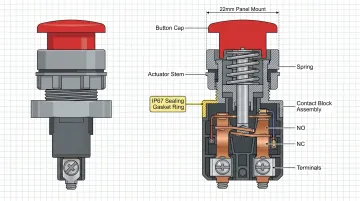
Standard consumer switches use lighter materials, lower contact ratings, and riveted terminals that fail prematurely under industrial mechanical stress and electrical loads.
Environmental Protection Ratings
Industrial-grade devices carry IP65, IP66, or IP68 ratings (and NEMA 4X equivalents), meaning:
- IP65: Complete protection against dust ingress; protected against water jets from any direction
- IP66: Complete protection against dust ingress; protected against powerful water jets (100 liters/min at 100 kPa)
- IP68: Complete protection against dust ingress; protected against continuous immersion under specified pressure
- NEMA Type 4X: Meets IP66 equivalent plus corrosion resistance testing—critical for food processing, chemical plants, and marine environments
Standard switches carry no environmental protection and fail rapidly when exposed to dust, moisture, or wash-down conditions.
For example, ValuAdd's 22mm and 30mm control devices feature IP65, IP66, and IP69k ratings, with IP69k specifically tested against high-pressure, high-temperature washdown (80°C water at 80-100 bar)—essential for food processing facilities requiring sanitary design.
Electrical Ratings and Certifications
Industrial devices are rated for 600V operation, can interrupt inductive motor loads generating high inrush currents, and carry NEMA A600 ratings (600V AC, 10A continuous, 7200VA make capacity). They must meet:
- UL Listed: Required for most North American installations per NEC Article 409
- CE Marked: Required for equipment sold in Europe under Low Voltage Directive 2014/35/EU
- IEC 60947-5-1: International standard for control circuit devices
Standard switches are designed for low-voltage resistive loads only (typically 120V, 3A maximum) and lack the contact interrupt capacity and arc suppression needed in motor control circuits.
Choosing the Right Device: Ratings, Standards and Specifications
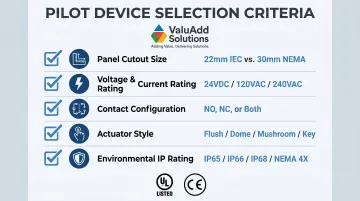
Key Selection Criteria
Engineers should evaluate these specifications when selecting pilot devices:
- Panel cutout size: 22mm is the most common industrial standard globally; 30mm remains standard in legacy NEMA installations
- Supply voltage and current rating: Match device voltage to control circuit voltage (24VDC, 120VAC, or 240VAC); verify contact ratings exceed maximum load current
- Contact configuration: Specify NO, NC, or both based on control logic requirements
- Actuator style: Match to operator environment (gloves = extended/dome; safety = mushroom; access control = key-operated)
- Environmental rating: Match to installation location (general industrial = IP65; washdown = IP66/IP68; corrosive = NEMA 4X)
Critical Certifications to Verify
Before purchasing, confirm devices carry appropriate certifications:
- UL Listed: Required for UL 508A industrial control panels in North America
- CE Marked: Required for equipment sold in European markets
- NEMA Type 4X compliance: Ensures corrosion resistance plus water/dust protection
- IP66/IP68: Required for submersion or high-pressure washdown environments
ValuAdd's push buttons, pilot lights, and selector switches carry UL Listed and CE certifications with IP65, IP66, and IP68 ratings — verified for manufacturing, water treatment, and oil and gas applications.
Matching Device Protection to Enclosure Protection
A common specification error: pairing a NEMA Type 4X enclosure with an IP65-only push button creates a weak point in environmental protection. NFPA 79 Annex F and UL 508A clarify that IP and NEMA ratings are not directly interchangeable: NEMA ratings include additional environmental tests (corrosion, ice formation) not covered by IEC 60529.
Best practice: If the panel requires NEMA 4X, specify devices rated NEMA 4X — not just IP66 equivalent.
Technical Support for Complex Specifications
Spec-matching gets more involved when builds require mixed NO/NC contact configurations, custom sequencing, or integration with specific PLC systems. In those cases, working with a supplier who offers engineering support during the specification phase can prevent costly field modifications later.
ValuAdd's engineering team provides specification assistance for control panel builds — validating contact configurations and environmental ratings before the order ships.
Frequently Asked Questions
What is the difference between industrial grade switches and normal switches?
Industrial-grade switches feature heavy-duty silver-alloy or gold-plated contacts, sealed housings rated IP65/66/68 or NEMA 4X, voltage ratings up to 600V, and mechanical cycle life exceeding 10 million operations. Standard switches are designed for low-voltage residential or light commercial use with no environmental protection, limited to a few thousand cycles.
What are the most common control switches used on industrial equipment?
Push buttons (start/stop/emergency stop), selector switches (Hand-Off-Auto, Forward-Reverse), and limit switches represent the most frequently used control devices. Push buttons and selector switches form the primary operator interface on control panels and machine stations across virtually all industrial equipment types.
What are three types of pilot switches?
The three main categories are push buttons (momentary or latching devices that initiate commands), selector switches (rotary multi-position devices for mode selection), and pilot lights (visual status indicators). "Pilot switch" broadly refers to any of these operator-interface devices used in industrial control circuits.
How does a push to test pilot light work?
Pressing the lens of a push-to-test pilot light temporarily bypasses the normal control circuit and connects the lamp directly to supply voltage. This allows operators to confirm the bulb or LED functions without disrupting the machine process or triggering any control action.
What are examples of industrial control systems?
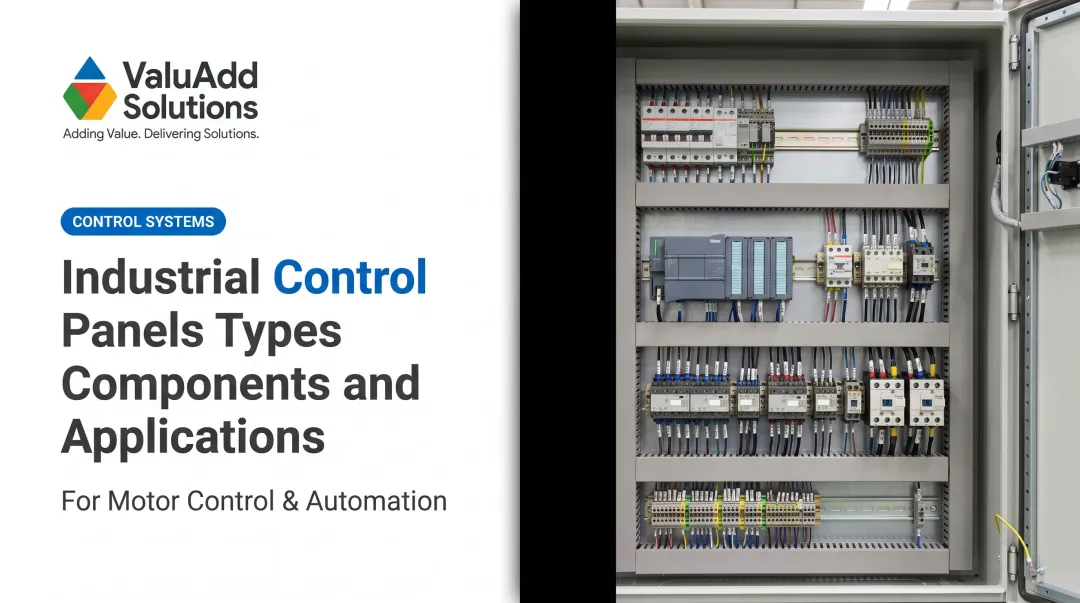
Motor control centers (MCCs), pump control stations, conveyor control panels, PLC-based automation systems, and SCADA systems all rely on push buttons, pilot lights, and selector switches as front-line operator interface components. These devices are the standard means by which operators start, stop, monitor, and reconfigure automated processes.