Introduction
At 2:00 a.m., a technician arrives at a water treatment facility for emergency maintenance on a critical 200HP pump motor. The motor controller sits twenty feet away, but the nearest breaker panel is 150 feet across the building—through two locked doors. Without a properly rated disconnect switch within reach, the technician faces an impossible choice: violate OSHA Lockout/Tagout (LOTO) requirements by working on energized equipment, or shut down the entire facility to access that distant breaker.
A disconnect switch is a manual isolation device that physically separates an electrical circuit from its power source, creating a verifiable air gap that protects personnel during maintenance, inspection, or emergency scenarios. Unlike circuit breakers that automatically trip during faults, disconnect switches exist for one reason: reliable, lockable isolation that personnel can verify before touching equipment.
This guide covers what engineers and system integrators need to specify, select, and install disconnect switches correctly—from NEC code requirements to enclosure ratings to real-world motor branch circuit applications.
TLDR:
- Physically isolate circuits for safe maintenance—unlike breakers, they don't trip automatically
- NEC 430.102(B) requires disconnects within sight (≤50 feet) of motors; NEC 230.85 mandates exterior emergency disconnects for dwellings
- Load-break (Class E2) switches safely interrupt operating current; off-load types must only open when current is zero
- Fusible types combine isolation with overcurrent protection; non-fusible require upstream breakers or fuses
- Selection factors include current rating, voltage, HP rating, SCCR, enclosure type, and mounting style
What Is a Disconnect Switch and How Does It Work?
A disconnect switch—also called an isolator, safety switch, or disconnector—is a manual switching device that physically separates a circuit from its power source. When the operator moves the handle or lever to the open (OFF) position, internal blade contacts separate mechanically, creating a visible gap in the electrical path. This verifiable break confirms the circuit is de-energized, a key safety confirmation during maintenance. Closing the handle (ON position) reconnects the contacts, restoring power to downstream equipment.
The primary purpose is personnel safety, not circuit protection. Unlike breakers that automatically open during faults, disconnect switches require manual operation. Most designs include provisions for padlocks on the handle in the open position, enabling compliance with OSHA's LOTO standard (29 CFR 1910.147), which mandates that energy isolating devices be "capable of being locked out" to prevent accidental re-energization during service work.
Off-Load vs. Load-Break: A Critical Distinction
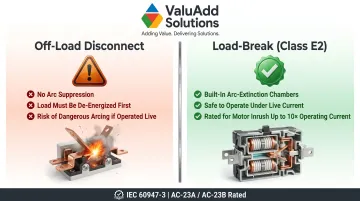
| Type | Arc Suppression | Operation Requirement |
|---|---|---|
| Off-load (no-load) | None | Load must be de-energized before switching |
| Load-break rated | Arc-extinction chambers | Can safely make and break under operating current |
Off-load disconnects must only be operated after the connected load has been de-energized by another means—such as shutting down a motor or opening an upstream breaker first. Switching under live current causes dangerous arcing that can destroy the switch or injure the operator.
Load-break rated switches (such as Class E2 compliant types) incorporate arc-extinction chambers and contact designs that handle energy released when interrupting inductive loads. IEC 60947-3 defines AC-23A/B utilization categories for motor and highly inductive loads, requiring devices to withstand duty cycles including locked-rotor currents 6–10 times rated current.
Standard Disconnect Switches Don't Protect Circuits
A non-fusible disconnect switch provides isolation only—it contains no sensing mechanism to detect overcurrent or fault conditions. Overcurrent protection must be supplied separately: either by fuses integrated into a fusible disconnect housing, or by an upstream circuit breaker or panel fuses. In practice, this means selecting a disconnect switch and its overcurrent protection source as a coordinated pair—not as interchangeable alternatives.
Types of Disconnect Switches
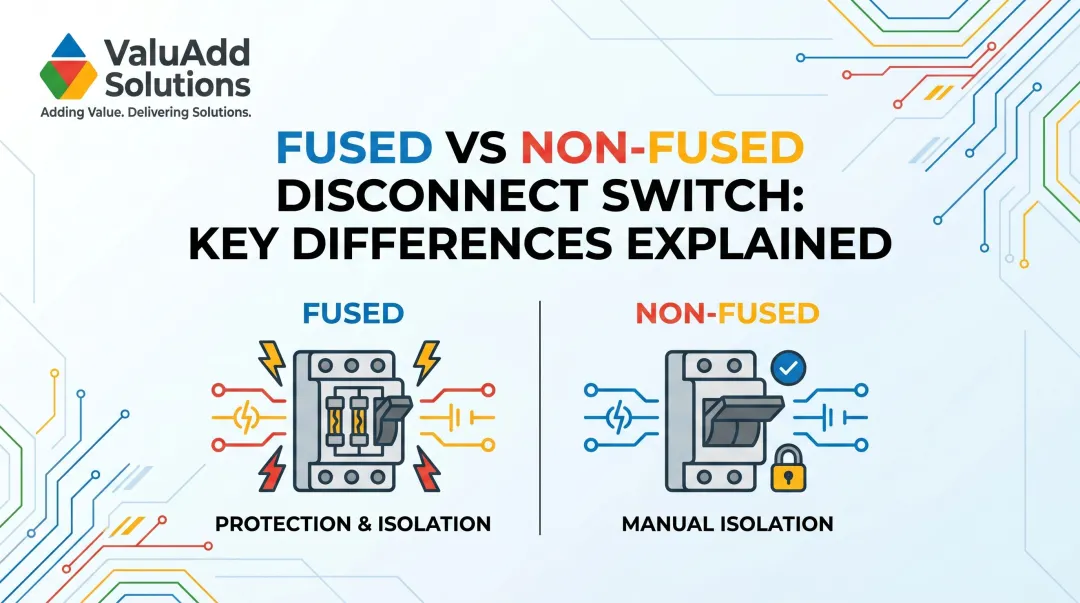
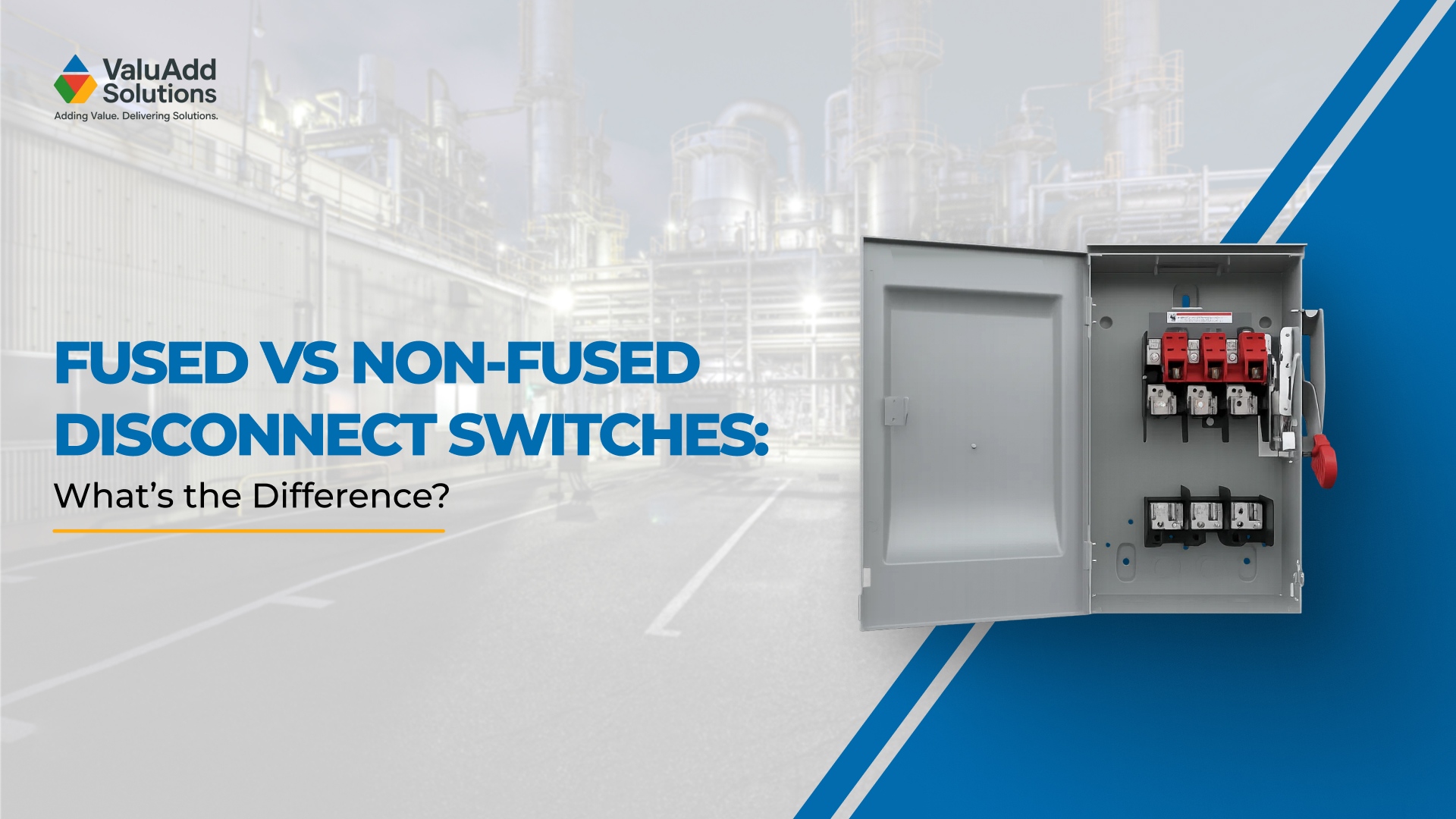
Fusible vs. Non-Fusible Disconnect Switches
Fusible disconnect switches integrate fuse holders within the same enclosure, combining manual isolation with overcurrent protection in one compact unit. When fault current exceeds the fuse rating, the fuse element melts and interrupts the circuit until replaced.
This makes fusible disconnects the go-to choice in motor branch circuits—particularly where high inrush currents require time-delay fuses to prevent nuisance trips during startup.
Non-fusible disconnect switches contain no fuses and rely entirely on upstream protective devices—breakers or panel fuses—for overcurrent protection. They're simpler, typically less expensive, and well-suited when adequate upstream protection already exists and the only need is a local, lockable isolation point for maintenance.
ValuAdd's SIRCO UL 98 C non-fusible switches, for example, feature a double-breaking-per-pole design and glass fiber reinforced polyester construction, delivering reliable isolation up to 800 VAC and 1000A.
Load-Break and High-Performance Types
Beyond the fusible/non-fusible distinction, the load-break rating determines whether a switch can be safely operated under live conditions.
Load-break (Class E2) disconnect switches are rated to safely make and break circuits under normal operating current, with built-in arc-extinction capabilities. Class E2 compliance is the standard for switches operated under load in motor, pump, HVAC, and process applications—this differs from basic isolators that must only be operated off-load.
Other classifications engineers encounter include:
- Electrical disconnect switches: General-purpose devices for motors, HVAC, and industrial machinery governed by IEC 60947-3 or NEMA KS-1 standards
- Battery disconnect switches: Specialized devices for vehicles and stored equipment (outside the scope of most industrial AC applications)
- Rotary/cam-style disconnects: Compact switches integrated into industrial control panel doors for machine tools, robotics, and process equipment
ValuAdd's SIRCO M series covers rotary and toggle types in 3-pole configurations from 16A to 100A, certified to UL 508, UL 98, and IEC 60947-3. That combination makes them a practical fit for motor-rated disconnect and control panel integration.
NEC Code Requirements for Disconnect Switches
Motor and Machinery: The Within-Sight Rule
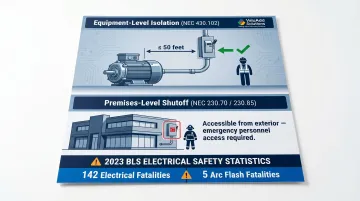
NEC Article 430.102(B) mandates that a disconnect must be located "in sight from" the motor and driven machinery it controls. Per NEC Article 100, "in sight from" means visible and not more than 50 feet distant. This rule exists so technicians can verify—without leaving the work area—that the motor is truly de-energized before performing maintenance.
An exception allows a remote disconnect if the motor controller disconnecting means is lockable per NEC 110.25. However, in industrial practice, a dedicated disconnect switch at the equipment provides clearer visual confirmation and easier padlock provisions, making it the preferred solution for LOTO compliance.
Emergency Disconnects for Dwellings
NEC Article 230.85 (added in the 2020 NEC) requires an accessible, exterior emergency disconnect for all new one- and two-family dwellings, enabling first responders to shut off power without entering the building. The 2023 NEC expanded this requirement to also apply when service equipment is replaced, significantly impacting electrical contractors performing residential service upgrades.
Equipment-Specific NEC Disconnect Rules
Beyond motors, the NEC dictates disconnect placement for nearly every type of powered equipment:
- HVAC (Article 440): Disconnect must be within sight of the condensing unit and meet working space requirements of NEC 110.26(A)
- Appliances (Article 422): Motor-operated appliances over 1/8 HP require a disconnect within sight or lockable in the open position
- Transformers (Article 450): Remote disconnecting means must be lockable
Two Core NEC Principles
Across all these applications, two foundational rules tie the entire framework together:
- Equipment-level isolation (NEC 430.102): Every motor and industrial machine needs a disconnect within sight of the equipment, so technicians can confirm isolation at the point of work — not from a remote panel down the hall.
- Premises-level shutoff (NEC 230.70 / 230.85): Every building must have a service disconnecting means capable of cutting all power to the premises, accessible to both occupants and first responders.
These rules carry real consequences. In 2023, the Bureau of Labor Statistics recorded 142 occupational fatalities due to electrical exposure and 5 from electric arc exposure — the numbers that put the life-safety rationale behind every one of these code requirements into sharp relief.
How to Select the Right Disconnect Switch
Match Critical Performance Specifications
Current rating must meet or exceed the circuit's full-load amperage. For motors, NEC 430.6 requires using Full-Load Current (FLC) values from Tables 430.247-430.250, not the nameplate current. Undersized ratings are a common—and dangerous—installation error.
Three additional ratings complete the specification picture:
- Voltage rating: Must match the system—AC or DC, single-phase or three-phase
- Horsepower rating: Applies to motor loads; must equal or exceed the motor's HP at the applied voltage
- Short-Circuit Current Rating (SCCR): Defines how much fault current the switch (or its fuses) can safely interrupt. NEC 110.10 and 409.22 require that available fault current never exceed the marked SCCR.
Enclosure and Mounting Considerations
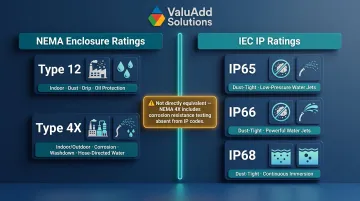
NEMA enclosure types define environmental protection:
- NEMA Type 12: Indoor use; protects against dust, dirt, lint, dripping water, and light oil/coolant splashing—suitable for general manufacturing
- NEMA Type 4X: Indoor or outdoor; protects against windblown dust, rain, hose-directed water, and provides enhanced corrosion resistance—required in washdown, marine, and chemical environments
IP ratings (IEC 60529 standard) provide international equivalents:
- IP65: Dust-tight, protected against water jets
- IP66: Dust-tight, protected against powerful water jets
- IP68: Dust-tight, protected against continuous immersion
NEMA and IP ratings are not directly equivalent—NEMA 4X includes specific corrosion testing not present in IP codes. ValuAdd offers disconnect switches with NEMA 12 and Type 4X enclosures, as well as IP65, IP66, and IP68 rated options.
Mounting styles include panel mount, base mount, DIN rail, and wall/box mount. Selecting the correct enclosure for the environment is as critical as matching electrical ratings—a Type 12 enclosure will fail quickly in a corrosive washdown application that requires Type 4X.
Fusible vs. Non-Fusible Decision
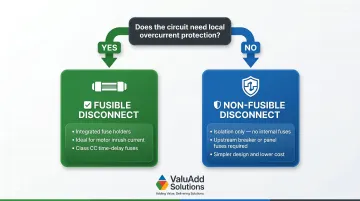
Once enclosure and electrical ratings are confirmed, the final call is whether local overcurrent protection belongs at the disconnect itself.
- Fusible: Choose when you need a protective device sized specifically for the load—for example, a motor with high inrush current requiring Class CC time-delay fuses
- Non-fusible: Choose when upstream protection (a breaker or panel fuses) already exists and you only need a reliable isolation point
Both UL 98 (enclosed switches for branch/feeder/service applications) and IEC 60947-3 govern which disconnects are approved for specific uses.
Disconnect Switch vs. Circuit Breaker: Key Differences
Functional Distinction
A circuit breaker is an automatic overcurrent protection device that trips open on its own when it detects a fault. A disconnect switch is a manual isolating device with no automatic trip capability (unless it is a fusible type, where the fuse provides that protection). Breakers protect circuits; disconnect switches protect people.
When Can a Breaker Serve as a Disconnect?
NEC 430.109(A) permits a lockable circuit breaker within sight of equipment to serve as the disconnecting means. In industrial practice, however, a dedicated disconnect switch is the preferred choice for maintenance crews. It provides clearer visual indication of the open state, more straightforward padlock provisions, and a handle built for frequent LOTO use.
Why Use Both Devices Together
These two devices serve distinct, complementary roles:
- Circuit breaker — handles continuous fault protection 24/7, automatically interrupting dangerous overcurrents
- Disconnect switch — provides local, lockable isolation at the equipment for service work
In practice, the breaker protects the circuit around the clock, while the disconnect protects the technician during the 30 minutes needed to change a bearing or inspect wiring.
Industrial Applications of Disconnect Switches
Motor Branch Circuits
Every motor-driven pump, compressor, conveyor, fan, and HVAC unit in manufacturing, water treatment, and oil and gas facilities requires a disconnect within sight of the motor per NEC 430.102(B). Fusible safety switches in these circuits are coordinated with thermal overload relays and upstream feeders, each serving a distinct role:
- Fuses interrupt short circuits before damage occurs
- Thermal overload relays protect against sustained overload current
- The disconnect provides a safe isolation point for maintenance
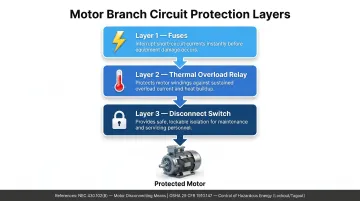
Facilities rely on correctly specified disconnects to minimize unplanned downtime and meet OSHA LOTO requirements (29 CFR 1910.147), which ranks among OSHA's top 10 most frequently cited standards. ValuAdd's SIRCO UL 98 C series supports motor applications up to 1000A at 800V AC with visible position indicators and double-breaking contacts for enhanced safety.
Service Entrance, Control Panels, and Renewable Energy
Additional industrial applications include:
- Main service entrance switches feeding distribution panels per NEC 230.70
- Panel-door rotary disconnect handles for machine tools, robotics, and process equipment — ValuAdd's COMO CS and SIRCO M series are common choices here
- PV solar array disconnects (NEC 690) and generator transfer switches (NEC 700/701/702)
Harsh Environments Require Specialized Enclosures
Food processing and chemical plants require NEMA 4X or IP66/IP68 rated enclosures to withstand washdowns, humidity, and corrosive atmospheres. Mining and oil and gas operations may require explosion-proof or hazardous-location rated units complying with NEC Articles 500/501 or international ATEX/IECEx standards. Installing an under-rated enclosure in these environments risks both equipment failure and code violations during inspection.
Frequently Asked Questions
How does a disconnect switch work?
A disconnect switch physically separates a circuit from its power source by opening internal blade or rotary contacts when the handle is moved to the OFF position, creating a visible air gap that confirms the circuit is dead. Closing the handle reconnects the contacts and restores power to the equipment.
What is the correct procedure to throw a disconnect switch?
Shut down the connected load first, then move the handle to OFF, verify zero voltage with a meter, and apply a padlock and tag per OSHA LOTO requirements. Never open an off-load rated disconnect under live current—it causes dangerous arcing.
What is the difference between a disconnect and a switch?
A general-purpose switch controls equipment during normal operation. A disconnect switch is a safety isolation device that fully de-energizes a circuit for maintenance, with lockout/tagout provisions and visible open contacts confirming the circuit is safe to work on.
What are the two NEC rules for disconnecting means?
(1) NEC 430.102(B) requires a disconnect within sight of every motor and industrial machine—visible and within 50 feet—to enable safe maintenance. (2) NEC 230.85 / 230.70 requires a service disconnecting means capable of shutting off all power to the premises, with recent editions mandating accessible exterior emergency disconnects for dwellings.
What is the difference between a fusible and non-fusible disconnect switch?
A fusible disconnect contains integrated fuse holders that provide overcurrent protection—when a fault occurs, the fuse blows and must be replaced before power is restored. A non-fusible disconnect contains no fuses and provides isolation only, relying on an upstream circuit breaker or panel fuses for overcurrent protection.
Can a circuit breaker serve as a disconnect switch?
Yes—the NEC permits a lockable circuit breaker within sight of equipment to serve as the disconnecting means. In industrial settings, a dedicated disconnect switch is the better choice: it provides clearer visual indication of the open state, easier padlock provisions, and a handle built for frequent LOTO operations.