Introduction
Remote solar farms and energy storage systems frequently occupy hostile, unattended locations—desert expanses, industrial rooftops, offshore platforms—where dispatching technicians for manual disconnect operation is slow, costly, and dangerous during fault conditions. When a short-circuit event or battery thermal runaway begins, every minute counts; relying on a truck roll to physically actuate a switch can mean the difference between a contained incident and catastrophic equipment damage.
A motorized DC disconnect switch is an electromechanically actuated device designed to safely interrupt high-voltage DC circuits on command from a remote control signal. Unlike manual disconnects or AC-rated switches, which rely on physical presence and natural current zero-crossing, motorized DC disconnects enable instant, SCADA-triggered isolation where DC current never crosses zero and on-site intervention is impractical.
Research shows unplanned solar plant repairs cost owners up to $3,000 per MW annually, with individual truck rolls ranging from $200 to over $1,000 per dispatch — costs that remote actuation eliminates entirely.
This article explains why remote solar and ESS installations demand motorized DC disconnect capability, how these switches work (including specialized arc suppression and SCADA integration), what features matter most when specifying one, and which certifications ensure code compliance and long-term reliability.
TLDR:
- Motorized DC disconnects enable instant remote isolation in unattended solar/ESS sites, eliminating costly truck rolls
- DC-rated contacts use magnetic blowout and arc runners to safely interrupt currents that never cross zero
- Class E2 load break rating ensures switches can make and break full load current under live conditions
- Look for UL 98B listing, IP66+ enclosure protection, and SCADA protocol support (Modbus RTU/TCP)
- NEC Articles 690 and 706 permit remote-actuated disconnects if lockable and clearly marked
Why Remote Solar and ESS Installations Demand Motorized Disconnect Switches
Physical Inaccessibility Drives Remote Actuation Requirements
When a fault, maintenance window, or emergency shutdown is required at a remote site, dispatching a technician can take hours. During that time, equipment damage and safety hazards escalate. Motorized disconnects allow instant remote actuation via SCADA systems, eliminating the delay between fault detection and isolation.
The financial impact is measurable: unplanned solar plant repairs cost owners up to $3,000 per MW annually, with individual truck rolls ranging from $200 to over $1,000 when factoring in labor, vehicle costs, and dispatch overhead. For a 100 MW utility-scale facility experiencing multiple unplanned events per year, remote switching capability delivers substantial O&M savings over system lifetime.
DC Circuit Hazards Make Remote Operation a Safety Imperative
Direct current circuits in solar and ESS applications present unique hazards. Unlike AC, DC current does not cross zero, making arc suppression significantly harder. When an AC switch opens under load, the current naturally extinguishes twice per cycle; DC arcs can sustain indefinitely unless forced to extinguish through specialized mechanisms.
Manual switching under load in a live DC environment is dangerous. Key exposure risks for an operator at a 1500 VDC combiner box during a fault include:
- Arc flash from uncontrolled energy release
- Sustained plasma arcs that don't self-extinguish
- Voltage levels that remain lethal even after grid disconnection
Remote, motor-actuated switching removes personnel from the hazard zone entirely.
ESS Bidirectional Current Flow Requires Dedicated DC Isolation
Battery systems push current bidirectionally and maintain voltage even when the grid is absent. Isolation cannot rely on simply cutting the AC feed—a dedicated, field-operable DC disconnect is essential. ESS installations frequently involve:
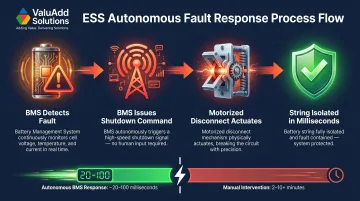
- Battery management systems (BMS) issuing autonomous shutdown commands
- Thermal runaway scenarios requiring immediate string isolation
- Maintenance windows where individual racks must be de-energized without affecting parallel banks
Motorized DC disconnects respond instantly to BMS dry-contact triggers or communication protocol commands, cutting isolation time from minutes to milliseconds in autonomous fault scenarios.
Regulatory Pressure from NEC and NFPA Standards
NEC Article 690 (for solar PV) and NFPA 855 (for ESS) increasingly require accessible, rapid-disconnect capability. NEC 690.15(D)(4) permits remote controls to activate the disconnecting means, provided the disconnect is lockable per NEC 110.25 and the control location is clearly marked on the device. For unmanned facilities, motorized switches satisfy this requirement while maintaining code compliance.
ESS installations face parallel requirements under NEC 706.15(B), which mandates that disconnecting means be:
- Readily accessible and within sight or within 10 feet of the ESS
- Lockable in accordance with NEC 110.25
- Clearly marked at the control location when remote actuation is used
Motorized disconnects address all three provisions simultaneously, making them the practical default for code-compliant unmanned ESS deployments.
How Motorized DC Disconnect Switches Work
Motorized Actuator Mechanism and Control Signal Input
A motorized actuator—typically a DC motor with gearbox and position feedback—drives contact separation and closure on command from a control signal. Most industrial-grade units accept:
- Dry contact inputs (normally open or normally closed)
- Low-voltage control signals (12/24/48 VDC)
- Communication protocol interfaces (Modbus RTU, Modbus TCP/IP)
The actuator translates these signals into mechanical motion, driving the main contacts through their full travel in typically 2–5 seconds. This remote actuation eliminates the need for on-site personnel during switching operations.
DC-Rated Contact Design and Arc Suppression
DC-rated contacts differ fundamentally from AC-rated designs. Because DC current lacks a natural zero-crossing, arc extinction requires forced mechanisms:
- Arc runners: Electromagnetic forces drive the arc away from the contacts and into the arc chute
- Magnetic blowout coils: Ferrous coils around the current path create an electromagnetic field that pushes the arc into the arc chute
- Splitter plates (arc chutes): Steel plates in an insulated housing break the single arc into multiple smaller arcs, cooling the plasma and absorbing heat until the arc extinguishes
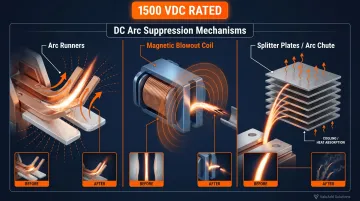
At 1500 VDC—the established baseline for utility-scale PV systems—these mechanisms are critical to safely interrupt load currents without sustained arcing that erodes contacts or breaches the enclosure.
Position Feedback and SCADA Status Reporting
Limit switches or encoders confirm open/closed state and report back to SCADA or remote monitoring platforms. Operators can verify isolation without a site visit — and for Lockout/Tagout (LOTO) procedures, that remote confirmation is a compliance requirement, not just a convenience.
Typical status signals include:
- Contact position (Open, Closed, Intermediate)
- Fault/trip indication
- Motor stall or failure alarm
- Control power status
Class E2 Load Break Rating Explained
Class E2 load break rating means the switch can make and break full load current repeatedly under rated conditions. This differs from a simple isolator, which is designed only for no-load switching. In solar and ESS applications, disconnection often occurs under live load rather than no-load conditions: fault clearing, combiner box isolation, or battery string de-energization are all live-load events.
For example, the SIRCO MOT DC ESS from ValuAdd is designed with Class E2 load break compliance, enabling repeated load-break operations at up to 1500 VDC and 2000 A. That matters in practice: a disconnect managing daily maintenance cycles or frequent fault-clearing events can accumulate hundreds of operations over a 20-year project life.
SCADA and Communication Protocol Integration
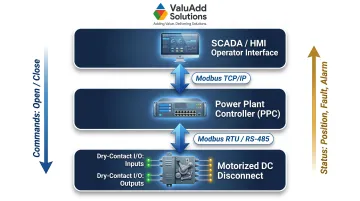
Motorized DC disconnects connect to supervisory control systems via:
- Modbus RTU (serial RS-485): Reliable over long cable runs, common for edge devices in remote solar farms
- Modbus TCP/IP (Ethernet): Used for integration with higher-level plant controllers
- Hardwired I/O: Dry-contact inputs/outputs for simple on/off control and status feedback
In a typical utility-scale PV or ESS plant, the Power Plant Controller (PPC) aggregates data from field devices and issues switching commands based on fault detection, time-scheduled maintenance, or operator manual override. The disconnect's Modbus interface maps to specific coils (commands) and discrete inputs (status).
This mapping allows the PPC to respond automatically to grid disturbances or BMS alarms — without waiting for a technician to reach the site.
Key Features to Look For When Selecting a Motorized DC Disconnect Switch
Voltage and Current Rating Matched to Application
Match rated voltage (1000 VDC vs. 1500 VDC) and continuous current capacity to your string/combiner or battery bank design. For example:
- String-level disconnects: Typically 10–30 A at 1000 VDC
- Combiner-level disconnects: 100–600 A at 1500 VDC
- Battery bank disconnects: 1000–2000 A at 1000–1500 VDC
Consider derating for high-temperature environments. ValuAdd's INOSYS LBS UL 98B disconnect switches operate from -40°C to +50°C without derating, and up to +55°C with no performance penalty—critical for desert or rooftop installations.
Enclosure Protection Rating (IP/NEMA)
Once electrical ratings are confirmed, enclosure protection is the next critical selection factor. Outdoor and remote installations face dust, rain, and corrosion that can degrade unprotected hardware within months:
| Rating | Protection Level | Recommended Application |
|---|---|---|
| IP65 | Dust-tight; protected against low-pressure water jets | Sheltered rooftop or indoor battery rooms |
| IP66 | Dust-tight; protected against powerful water jets | Ground-mount solar exposed to rain and dust |
| IP68 | Dust-tight; continuous immersion | Ground-mount systems subject to flooding |
| NEMA 4X | All NEMA 4 protections plus validated corrosion resistance (200-hour salt spray test) | Coastal or industrial environments with corrosive atmospheres |
For floating PV installations, where saltwater accelerates galvanic corrosion, NEMA 4X is essential.
Control Voltage Flexibility and Fail-Safe Behavior
Look for switches that accept a range of control voltages (12/24/48 VDC) common in solar system auxiliary power. Specify whether the default fail position (open or closed) on loss of control power matches your site's safety requirements:
- Fail-open: Prioritizes isolation and personnel safety (common for ESS)
- Fail-closed: Maintains power continuity (less common for safety-critical DC applications)
Motorized Actuator Reliability and Cycle Life
Specify:
- Minimum 2,000–12,500 rated mechanical operations
- Ambient temperature range of -40°C to +70°C for harsh climates
- MTBF data: Request this from the manufacturer — it's a key indicator of long-term reliability in remote deployments
Certifications and Compliance Markings
Look for these critical nameplate markings:
- UL Listed per UL 98B (Enclosed and Dead-Front Switch Disconnectors for Photovoltaic Systems)
- CE marking for international projects
- Halogen-free materials for fire-safety-sensitive ESS environments
- Class E2 load break rating, confirming load-interrupting capability
Certifications and Compliance Standards That Matter
UL 98B: The Primary US Listing for PV DC Disconnects
UL 98B (4th edition, December 2024) covers open, enclosed, and dead-front switches rated up to 2000 VDC for ambient conditions between -20°C and +50°C. It validates interrupting and withstand performance under DC-PV2 utilization categories—the most demanding rating for utility-scale solar, where parallel strings generate significant overcurrent and reverse-current stress.
ValuAdd's SIRCO MOT DC ESS carries UL 98B listing, confirming safe interruption of 1500 VDC circuits under DC-PV2 conditions—including the arc suppression performance required for high-voltage string configurations.
NEC Article 690 and 706 Requirements
- NEC 690.15: Requires a disconnecting means for PV systems; permits remote controls if lockable and marked
- NEC 706.15: Requires ESS disconnecting means within sight or within 10 feet of the ESS; same remote-control provisions apply
- NEC 690.12: Mandates rapid shutdown for rooftop PV systems, reducing controlled conductors to 30 volts or less within 30 seconds outside the array boundary
Motorized switches help meet these requirements in unmanned or remotely operated facilities by enabling rapid, code-compliant de-energization. For projects outside the US—or those requiring dual compliance—international standards introduce their own set of requirements.
International and Environmental Compliance
- CE marking: Required for European and many international projects
- IEC 60947-3: International standard for low-voltage switchgear, covering DC-PV1 and DC-PV2 utilization categories
- Halogen-free materials: IEC 60754 / EN 50267 compliance with fire-safety standards for ESS indoor installations
Common Remote Solar and ESS Applications
Utility-Scale Solar Farms and Floating Solar
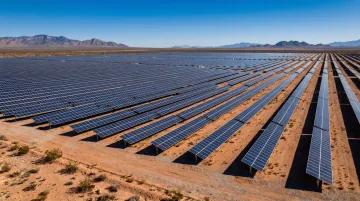
Large arrays in remote or water-based locations benefit from string-level and combiner-level motorized disconnects that enable rapid de-energization of faulted sections without personnel on site. As of August 2024, California (21.0 GW), Texas (18.8 GW), and Florida (9.7 GW) accounted for nearly half of U.S. utility-scale solar capacity. The vast distances between these remote sites and O&M dispatch centers make remote SCADA switching financially essential.
Floating PV faces additional challenges: electrical connections are highly susceptible to moisture, and saltwater accelerates galvanic corrosion. Motorized disconnects rated NEMA 4X with robust DC-PV2 isolation capabilities mitigate these risks.
Off-Grid and Microgrid ESS Installations
Battery storage systems supporting remote industrial operations—mining camps, oil and gas wellheads, telecom towers—require disconnects that respond to battery management system (BMS) commands autonomously, isolating battery racks and managing bidirectional power flows without disrupting operations.
A copper mine in Chile, for instance, deployed 45 MW solar and 120 MWh BESS to replace diesel generation entirely. That kind of continuous heavy-industry load leaves no margin for manual intervention during fault conditions.
Commercial Rooftop Solar with Fire Department Rapid Shutdown
NEC 690.12 requires rapid shutdown systems that reduce controlled conductors to 30 volts or less within 30 seconds. Motorized disconnects at the array level support firefighter safety by enabling instant de-energization from ground-level control points. This capability is especially valuable for large commercial rooftops where manual access to string combiners is hazardous during emergency response.
Frequently Asked Questions
What is a PV AC disconnect?
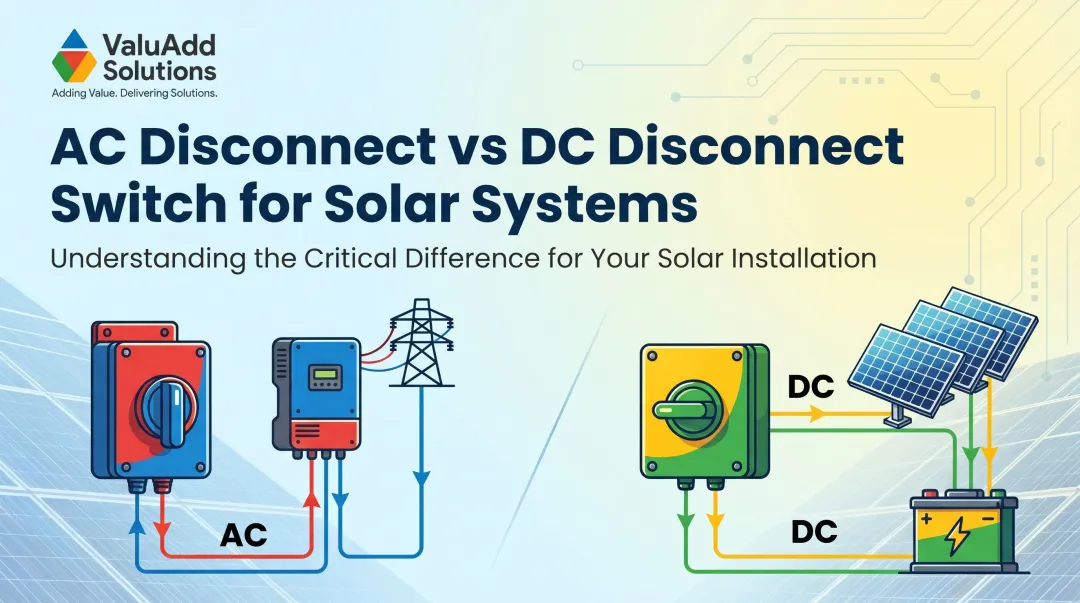
A PV AC disconnect is a switch installed on the AC output side of a solar inverter, used to isolate the inverter from the AC grid or load. It differs from a DC disconnect, which is placed on the DC side between the PV array and the inverter.
What is the difference between a motorized and a manual DC disconnect switch?
A manual disconnect requires physical on-site operation, while a motorized disconnect uses an electric actuator triggered remotely via control signal or communication protocol. Motorized disconnects are critical for unmanned or hard-to-access solar/ESS sites where dispatching personnel is costly and slow.
Why can't a standard AC-rated switch be used for DC solar applications?
DC current does not cross zero (unlike AC), so arcs do not self-extinguish. DC-rated switches must include arc-quenching mechanisms—magnetic blowout, elongated arc path—specifically designed for DC voltages up to 1000 V or 1500 V.
What communication protocols do motorized DC disconnect switches support?
Most industrial-grade motorized disconnects support hardwired dry-contact or low-voltage control inputs. Many also offer Modbus RTU or Modbus TCP/IP interfaces for integration into SCADA or energy management systems.
What IP rating is required for outdoor solar disconnect switches?
Use IP65 minimum for roof-mounted or sheltered outdoor locations, IP66 or higher for ground-mount systems exposed to rain and dust, and IP68 for installations at risk of temporary submersion or flooding.
What is Class E2 load break rating and why does it matter?
Class E2 is an endurance rating confirming the switch can make and break load current under rated conditions for thousands of switching cycles. In solar/ESS applications, disconnection routinely happens under live load—so a switch without this rating will degrade or fail prematurely.