Introduction
When specifying electrical components for solar and energy storage projects, performance, safety, and code compliance all hinge on getting the right parts—not just panels and inverters. According to an NREL techno-economic analysis, PV module connector failures and degradation alone can increase annualized O&M costs by $71,933 for a utility-scale plant, resulting in an NPV loss of $1.49 million over the project's life.
A complete solar or energy storage installation depends on dozens of electrical components working together, from disconnect switches and combiner boxes to battery management systems and surge protection devices.
This article covers primary generation components, balance of system (BOS) electrical hardware, energy storage components, compliance standards, and selection criteria for industrial and commercial contexts.
Key Takeaways
- BOS electrical components—disconnects, combiners, overcurrent protection, surge protection—are as critical to solar performance and safety as the panels themselves
- Energy storage systems add BMS, charge controllers, and BESS-specific protection devices, each with distinct electrical requirements
- UL listing, NEMA enclosure ratings, and IEEE 519 compliance are mandatory checkpoints for commercial and industrial installations
- Commercial and industrial systems require higher-rated, environmentally hardened components well beyond residential specs
- With the U.S. installing nearly 50 GWdc of solar capacity in 2024, proper component selection directly impacts project timelines and lifecycle costs
Primary Power Generation Electrical Components
Photovoltaic (PV) modules serve as DC power sources, and their output characteristics—voltage, current, and string configurations—directly dictate the sizing and rating requirements of downstream electrical components. NEC 690.7 establishes maximum voltage limits: PV system DC circuits on or in buildings are limited to 1,000 Vdc, while ground-mount systems may use listed DC PV equipment rated up to 1,500 Vdc. Maximum system voltage must be calculated using the sum of series-connected modules' open-circuit voltage (Voc), corrected for the lowest expected ambient temperature at the site.
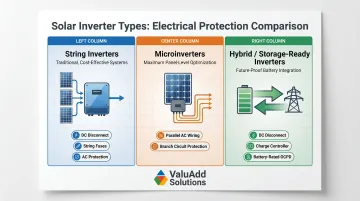
String configuration and voltage limits determine which inverter architecture fits the system — and each type creates distinct electrical interface requirements:
- String inverters aggregate multiple series-connected panels and require robust DC disconnect switches, string fuses, and AC-side protection at a centralized location
- Microinverters attach to individual modules, distributing DC/AC conversion across the array and requiring parallel AC wiring with branch circuit protection
- Hybrid/storage-ready inverters include bi-directional power conversion for battery integration, necessitating additional DC disconnect switches, charge controllers, and battery-rated overcurrent protection devices
Wiring, Conductors, and Connectors
MC4 connectors, PV wire ratings, and conductor sizing between panels and the combiner box or inverter follow PV-specific standards distinct from standard building wire. NEC Article 690 requires USE-2 or RHW-2 conductors rated for outdoor exposure, high temperatures, and UV resistance. Parallel vs. series string configurations affect ampacity requirements and the selection of fusing and disconnect hardware.
NEC 690.8 and 690.9 require circuit conductors and overcurrent protection devices (OCPDs) to be sized at 125% of the maximum circuit current, which is itself already 125% of short-circuit current (Isc)—resulting in a 156% multiplier for proper sizing.
NEC 690.33 requires that mating connectors be of identical type and brand, or explicitly listed and identified for intermateability. Mismatched connectors are a primary cause of DC arc faults and fires.
Junction Boxes and Combiner Boxes
Two box types serve distinct roles in the array:
- Combiner boxes aggregate multiple PV strings into a single output circuit, housing string fuses or breakers before the inverter. Voltage and current ratings must account for temperature-corrected Voc and the sum of all string currents.
- PV array junction boxes (mounted on individual panels) contain bypass diodes that protect against partial shading and reverse current damage, preventing hotspots and sustaining output when cells are shaded.
Balance of System (BOS) Electrical Components
BOS components encompass all electrical hardware beyond panels and inverters that ensures safe power flow, circuit protection, and grid interconnection. BOS is frequently underspecified and is a leading cause of system failures and code violations in commercial and industrial projects—particularly when residential-grade components are incorrectly applied to higher-voltage, higher-current installations.
DC and AC Disconnect Switches
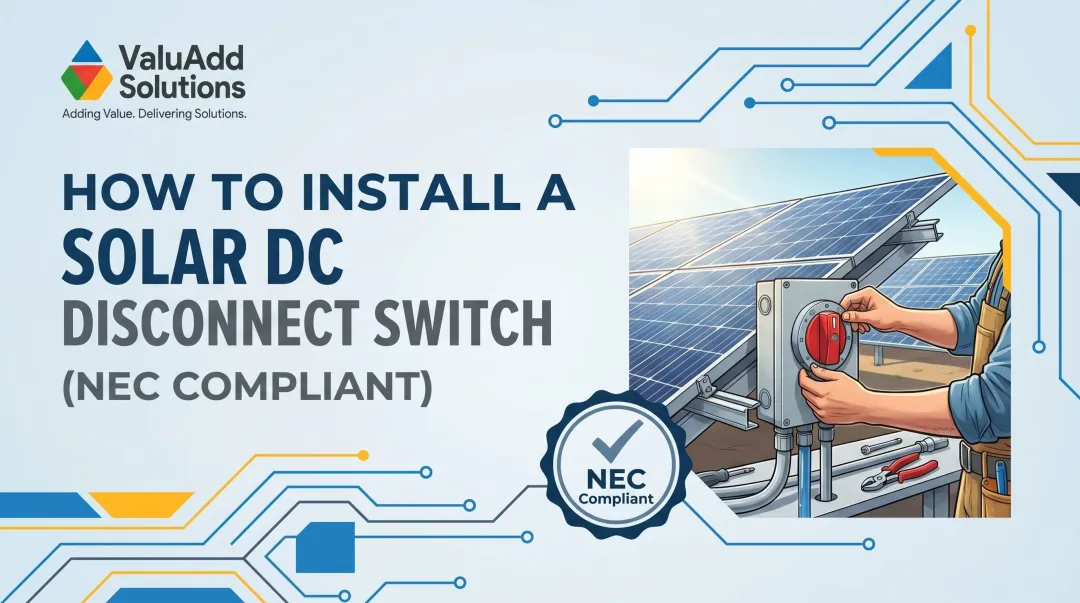
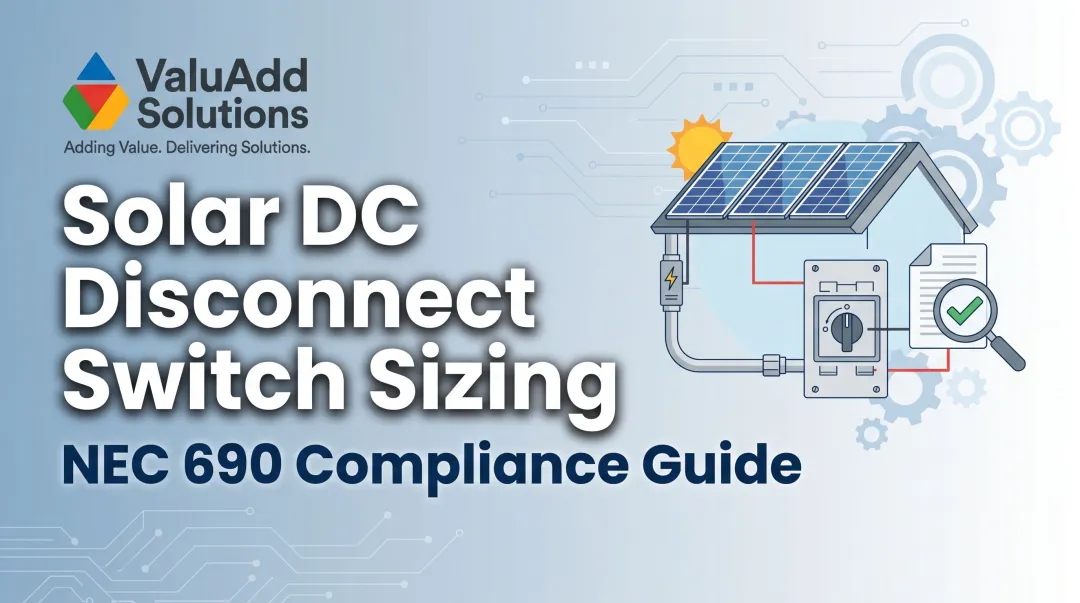
DC disconnects (required between the PV array and inverter) and AC disconnects (required between inverter and utility interconnection point) must carry load-break ratings appropriate for their application. DC disconnect switches used in PV applications up to 2,000 Vdc are evaluated under UL 98B, which specifically addresses the unique demands of isolating solar arrays.
NEC 690.12 requires rapid shutdown functions for PV systems on buildings to protect emergency responders. Within 30 seconds of initiation, controlled conductors outside the 1-foot array boundary must drop to 30 volts or less, and conductors inside the boundary must drop to 80 volts or less.
Outdoor-rated enclosures must meet NEMA Type 4X standards, covering windblown dust, rain, hose-directed water, corrosion, and a 200-hour salt spray test. IEC IP ratings such as IP66 are not interchangeable with NEMA Enclosure Type ratings—IP ratings do not account for corrosion or icing resistance, making direct substitution a compliance risk.
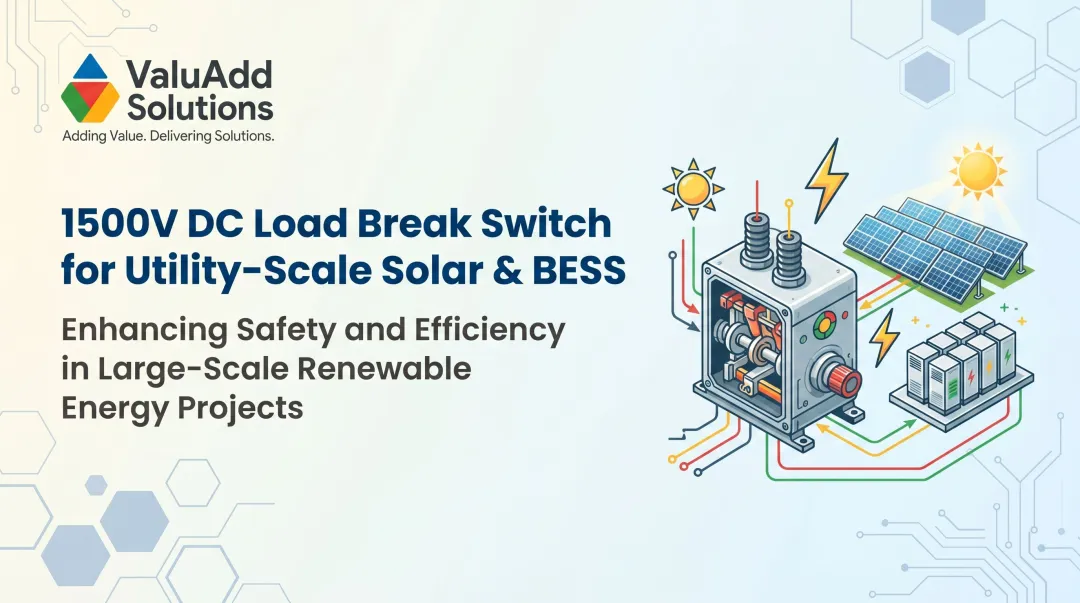
For installations where these requirements converge, ValuAdd's SIRCO MOT DC ESS and INOSYS LBS UL 98B disconnect switches address both compliance and durability demands—offering UL 98B certification, ratings up to 1,500 Vdc and 2,000A, and tested performance in salt spray and high-humidity environments.
Overcurrent Protection Devices
Fuses and circuit breakers in PV source circuits, PV output circuits, and inverter output circuits must be sized appropriately. PV-rated fuses differ from standard fuses in their DC interrupting capacity requirements and are governed by UL 2579 and IEC 60269-6, subjecting them to extreme temperature and current cycling tests not required for standard AC fuses.
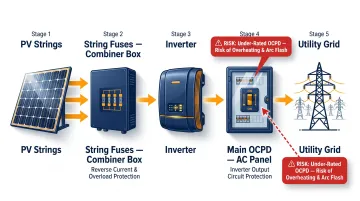
Key distinctions in OCPD placement and risk:
- PV string fuses in combiner boxes protect individual strings from reverse current and overloads
- Main OCPD at the AC panel interconnection point protects the inverter output circuit
- Under-rated OCPDs in high-DC-voltage applications can fail to interrupt fault currents, resulting in arc flash, fire, or equipment damage
Surge Protection Devices (SPDs)
SPDs protect inverters and sensitive electronics from transient voltage spikes caused by lightning or grid switching events. UL 1449 (5th Edition) covers SPDs for PV applications up to 1,500 Vdc. Type 1 SPDs are permanently connected between the service transformer and the line side of service equipment; Type 2 SPDs are installed on the load side or at the inverter level.
SPDs limit transient voltages but are not substitutes for a proper lightning protection system. Lightning protection requires separate grounding and bonding infrastructure beyond what any SPD provides.
Ground Fault Protection and Arc Fault Circuit Interrupters (AFCIs)
NEC 690 requires both ground fault protection and AFCI protection for PV systems. NEC 690.11 mandates listed DC arc-fault circuit interrupters (AFCI) for PV systems operating at 80 Vdc or greater to detect and interrupt series arcs. NEC 690.41(B) requires DC PV systems to have a ground-fault protection device to detect unintended contact with grounded equipment.
Commercial and industrial systems often require dedicated, higher-capacity ground fault protection devices (GFPD) compared to residential applications, due to larger array sizes and higher fault current levels.
Energy Storage Electrical Components
Energy storage systems (ESS) introduce a distinct layer of electrical complexity, including high-capacity DC circuits, bi-directional power flow, and increased protection requirements compared to generation-only systems. Safe BESS deployment requires a stacked certification approach: UL 1973 for batteries, UL 9540 for the system, and UL 9540A for fire propagation testing. These certification layers directly shape component selection at every level of the system.
Battery Types and Their Electrical Characteristics
From an electrical specification standpoint, battery chemistries differ significantly:
- Lithium Iron Phosphate (LFP): ~3.2V per cell, 0.25C to 1C charge/discharge rates, 2,000 to 6,000+ cycles, dominant chemistry for stationary storage due to thermal stability
- Nickel Manganese Cobalt (NMC): ~3.6V per cell, 0.5C to 2C rates, 1,000 to 3,000 cycles, higher energy density but lower thermal stability
- Vanadium Redox Flow: 800 to 1,240 Vdc system voltage, continuous discharge capability, unlimited cycles for 25 years (0-100% depth of discharge)
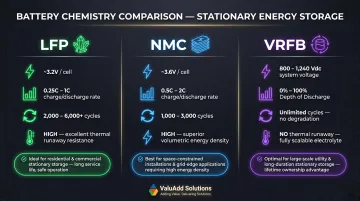
These voltage ranges, C-rates, and cycle characteristics directly affect component sizing—including wiring ampacity, fuse ratings, BMS specifications, and inverter compatibility.
Battery Management Systems (BMS)
The BMS is the critical electrical control component that monitors cell voltage, state of charge (SOC), temperature, and state of health (SOH). According to IEEE 2686-2024, BMS functions include cell balancing and triggering protective disconnects during overcharge, over-discharge, or thermal fault conditions. Without proper BMS-to-inverter communication, a system cannot respond to fault conditions in real time—making protocol compatibility a non-negotiable requirement in commercial BESS design.
Charge Controllers
Two primary charge controller types serve different applications:
- PWM (Pulse Width Modulation): Simpler, lower-cost, but operates the array at battery voltage, sacrificing efficiency
- MPPT (Maximum Power Point Tracking): Operates the array at maximum power voltage, increasing energy harvest by 5% to 30% compared to PWM—particularly in cold climates where array voltage is significantly higher than battery voltage
MPPT controllers are standard for commercial and industrial applications, given their higher efficiency and compatibility with larger array voltages. They must be rated for the array's open-circuit voltage and maximum charge current.
Battery Disconnect Switches and BESS Protection Devices
Battery banks require dedicated DC disconnect switches rated for the battery bank voltage and fault current, separate from PV disconnects. Manual service disconnects and automatic protection relays within a BESS cabinet work together to enable safe maintenance and fault isolation.
ValuAdd's portfolio includes UL Listed components rated for commercial and industrial BESS applications:
- SIRCO MOT DC ESS: Up to 1,500 Vdc and 2,000A
- INOSYS LBS UL 98B: 750 Vdc per pole, up to 1,500 Vdc with two poles in series
- FP ESS Fuses: Up to 1,500 Vdc with 250 kA short-circuit capacity
Certifications and Compliance Standards
Electrical components for solar and energy storage installations must carry recognized certifications to meet NEC requirements, pass AHJ (Authority Having Jurisdiction) inspections, and maintain equipment warranties. NEC 90.7 and 110.2 mandate that electrical equipment must be approved and examined for safety, typically achieved through listing and labeling by recognized testing laboratories. Using non-listed components in permitted commercial installations can result in inspection failures, warranty voids, and liability exposure.
NEMA enclosure type ratings and IEC IP ratings define protection levels for electrical components in exposed installation environments:
| NEMA Type | IEC IP Equivalent (Approximate) | Key Differences |
|---|---|---|
| Type 3 / 3R | IP 54 | NEMA includes icing and rust resistance; IP does not |
| Type 4 / 4X | IP 66 | NEMA 4X requires 200-hour salt spray test for corrosion |
| Type 12 | IP 54 | Indoor use only; protects against dust and dripping liquids |
These ratings are not interchangeable—the environment should drive the specification. Rooftop, ground-mount, and utility-scale arrays require NEMA 4X or IP66/IP68-rated enclosures for long-term reliability.
IEEE 519-2022 establishes steady-state limits for voltage and current harmonic distortion at the Point of Common Coupling (PCC), which is the interface between the utility source and facility loads.
Inverter output and power conditioning components that comply with IEEE 519 are especially critical in industrial and commercial facilities. Harmonic distortion on shared distribution systems can degrade sensitive equipment downstream — including VFDs, precision motors, and power quality-sensitive manufacturing processes.
Selecting Electrical Components for Industrial and Commercial Solar Installations
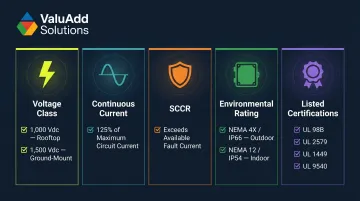
Key selection criteria differentiate industrial/commercial solar electrical components from residential-grade equivalents:
- Voltage class: 1,000 Vdc minimum for rooftop, 1,500 Vdc for ground-mount
- Continuous current rating: Must handle 125% of maximum circuit current continuously
- Short-circuit interrupting capacity (SCCR): Must exceed maximum available fault current at installation location
- Environmental protection rating: NEMA 4X/IP66 for outdoor, NEMA 12/IP54 for indoor industrial
- Listed certifications: UL 98B for DC disconnects, UL 2579 for PV fuses, UL 1449 for SPDs, UL 9540 for BESS
Undersized or residential-spec components create liability, downtime, and costly re-work in commercial projects. Specifying the right supplier from the outset matters as much as specifying the right component.
ValuAdd supports system integrators and facility managers with:
- UL Listed, NEMA 4X/12, IEEE 519, and IP-rated certified components
- Component selection assistance and application engineering
- Panel and enclosure design services
- Territory-based technical support for on-site troubleshooting and installation guidance
Fast procurement is just as critical as component selection. Solar module supply chains have largely stabilized, but the electrical T&D sector faces severe bottlenecks: generation step-up transformers (GSUs) are experiencing average lead times of 143 weeks. Facility managers should evaluate lead times and stocking levels alongside certifications when specifying suppliers for time-sensitive installations.
Frequently Asked Questions
What are the electrical components of solar panels?
Solar panels themselves contain solar cells (PV cells), busbars, fingers, a junction box with bypass diodes, and MC4 connectors. These are distinct from system-level electrical components like inverters, disconnects, combiners, and BOS hardware that enable safe grid interconnection and power distribution.
What is a BOS component?
BOS (Balance of System) components are all electrical and mechanical hardware in a solar installation beyond the PV panels themselves. This includes inverters, disconnect switches, combiner boxes, overcurrent protection, wiring, racking, surge protection devices, and monitoring systems.
What electrical components are required for an energy storage system?
Battery storage systems require a charge controller (typically MPPT), a battery management system (BMS), battery-rated DC disconnect switches, and appropriately sized overcurrent protection for the battery bank's voltage and current. BESS installations also require UL 9540-certified system integration and UL 9540A fire propagation testing documentation.
What certifications should electrical components for solar installations have?
UL listing is required by NEC and most AHJs, with UL 98B specifically covering DC disconnect switches in PV applications. NEMA enclosure ratings (4X for outdoor/corrosive environments, 12 for indoor industrial) ensure environmental protection. IEEE 519 compliance applies to inverters and power conditioning equipment to prevent harmonic distortion on commercial and industrial circuits.
What is the difference between grid-tied and off-grid electrical components?
Grid-tied systems require utility interconnection equipment — net meters, anti-islanding inverters, and a utility disconnect. Off-grid systems require charge controllers, larger battery banks, and generator integration hardware, along with more robust overcurrent and disconnect protection due to islanded operation and the absence of utility fault current contribution.
Why do industrial solar installations require different electrical components than residential systems?
Industrial installations operate at higher voltages (1,500 Vdc vs. residential 600 Vdc), larger capacities, and in harsher environments — requiring higher-rated disconnect switches, NEMA 4X/IP68 enclosures, and IEEE 519-compliant inverters that exceed residential product ratings. They also face significantly higher fault current levels, so all equipment must carry appropriate short-circuit interrupting capacity ratings.