Introduction
Misapplying NEC 690.15 is one of the most common reasons solar installations fail inspection — and it's a costly mistake to catch in the field. While most contractors cite 690.13 during plan review, the equipment-level disconnect requirements in 690.15 are where errors actually happen: wrong placement, inaccessible hardware, and mislabeled gear for inverters, charge controllers, DC-to-DC converters, and DC combiners.
The 2023 NEC restructured this section significantly, relocating location requirements from 690.15(A) to 690.15(D) and tightening the "in sight from" and "readily accessible" language. This guide breaks down what changed, what it means for roof-mounted inverters, battery-plus-PV systems, and rooftop combiner installations, and how to stay compliant from permit to final inspection.
Key Takeaways
- NEC 690.15 requires a means to disconnect individual equipment from all ungrounded conductors of all power sources—not just the PV array
- Disconnects must be "in sight from" (≤50 ft, visible) AND "readily accessible", or lockable per NEC 110.25
- Roof-mounted utility-interactive inverters require both a DC disconnect and an AC disconnect within sight of the inverter
- Rooftop DC combiner boxes on dwellings must include a load-break disconnect inside or within 6 ft
- 690.15 is not a substitute for 690.13—both provisions apply simultaneously
What Is NEC 690.15—and How Is It Different from NEC 690.13?
NEC 690.15 mandates a dedicated means to disconnect equipment such as inverters, charge controllers, and DC-to-DC converters from all ungrounded conductors of all sources that feed them. This is not limited to the PV source—if a battery also energizes the inverter, the disconnect must isolate both. Understanding how 690.15 differs from 690.13 is where most contractors run into compliance gaps.
Scope Difference
NEC 690.13 isolates the entire PV system from building conductors, serving as the system-level shutoff. NEC 690.15 isolates individual components within the system so they can be safely serviced or replaced without de-energizing everything.
Practical Implication
A compliant 690.13 disconnect does not satisfy 690.15. An inverter in a multi-source system (PV plus battery) requires either a disconnect that can isolate it from both sources simultaneously, or grouped disconnects that are clearly labeled by source.
The 2023 NEC also tightened the location rule: disconnects must be both "in sight from" the equipment and "readily accessible," or lockable per 110.25.
Key Definitions
- Readily Accessible — Reachable quickly without tools (other than keys), without climbing over obstacles or using portable ladders
- In Sight From — Visible and no more than 50 feet from the equipment
A disconnect inside a locked electrical room is "readily accessible" to qualified personnel but is not "in sight" from a rooftop inverter—therefore, 690.15 requires a local solution at the inverter.
What NEC 690.15 Requires: The Three Core Provisions
Provision A: Utility-Interactive Inverters in Not Readily Accessible Locations
When utility-interactive inverters are mounted on roofs or other areas that are not readily accessible, the code requires:
- DC PV disconnecting means mounted within sight of, or integral to, each inverter
- AC disconnecting means mounted within sight of, or integral to, each inverter
- AC output conductors and an additional AC disconnect must comply with 690.13(A) for system-level placement
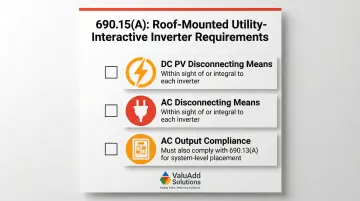
"Within sight" means visible and not more than 50 feet from the equipment — relevant for any roof-mounted microinverter or string inverter that's inaccessible from grade level. AHJs commonly require physical signage at grade directing to those disconnects.
Provision B: Equipment Permitted on the PV Side
The following equipment is permitted to remain on the PV side of the 690.15 disconnecting means — no additional upstream disconnect is required for these devices:
- PV source circuit isolating switches
- Overcurrent devices
- DC-to-DC converters
- Blocking diodes
This is a commonly misread permission, not a requirement.
Provision C: DC Combiner Disconnects on Rooftop Dwellings
DC combiners mounted on roofs of dwellings or other buildings must have a load-break disconnecting means located either:
- Inside the combiner, or
- Within 1.8 m (6 ft) of it
The disconnect may be remotely controlled but must be capable of manual local operation when control power is unavailable.
Load-break devices are rated to interrupt current under load without arcing or damage — a hard requirement, not a best practice. Using a non-load-break switch creates arc flash risk and will trigger non-compliance at inspection.
Where NEC 690.15 Applies: Equipment and Installation Scenarios
Equipment Categories Triggering 690.15 Obligations
- Utility-interactive inverters
- Stand-alone inverters
- Charge controllers
- DC-to-DC converters
- AC modules
- Fuses
Each piece of equipment above needs a disconnecting means that isolates it from all sources of voltage — not just the PV array.
Multi-Source Scenario
A grid-tied PV system with battery storage where the inverter is energized by both the PV array and the battery presents the most common field challenge:
- Each source path must be disconnectable
- The disconnects must be grouped in one location
- Each disconnect must be labeled by source to allow emergency responders or maintenance personnel to understand what they are isolating
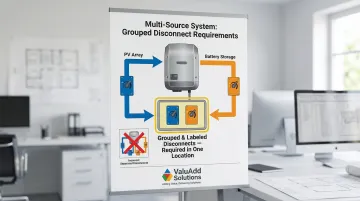
Failure to group disconnects — such as installing the battery disconnect at the battery bank and the inverter AC disconnect at the panel — violates the grouping requirement and creates a hazard during emergency response.
Single-Source Systems: Within-Sight Disconnect Rules
Multi-source systems present the most complex grouping challenges, but single-source installations carry their own compliance requirements worth distinguishing.
For rooftop string inverters or microinverters, the within-sight DC and AC disconnect requirements under 690.15(A) drive the primary compliance decisions on-site. Key field considerations include:
- Disconnects must be visible and accessible from the inverter location
- Many AHJs require physical signage at grade level directing personnel to those disconnects
- Microinverter arrays may require individual disconnecting means at each module position
AC Modules
For AC modules (which integrate inverter and module), 690.6(C) permits a single disconnect for the combined AC output. However, each module in a multi-module system also requires individual connector-type disconnecting means.
Technical Specifications for a Compliant DC Disconnect Under NEC 690.15
Load-Break vs. Non-Load-Break Ratings
Load-break disconnect: Rated to interrupt current under load without arcing or damage.
Non-load-break switch: May only be opened safely with the circuit de-energized.
Under 690.15(C), load-break is mandatory for rooftop combiners. Non-load-break devices must be permanently marked "Do Not Open Under Load" per 690.16.
Voltage and Current Rating Requirements
The disconnect must be rated for:
- Maximum DC system voltage calculated per 690.7 using temperature correction for the lowest expected ambient temperature
- Maximum circuit current the disconnect will carry
Standard AC-rated switches are not suitable for DC PV circuits due to arc behavior. DC arcs do not have a natural "zero-crossing" to help extinguish the arc. At voltages ≥600V, an AC switch may fail to interrupt a DC arc — leading to catastrophic equipment failure or fire.
Devices must be listed for DC use at the applicable voltage.
Interrupting (AIC) Rating
The disconnect must carry an interrupting rating sufficient for both the maximum circuit voltage and available fault current. These two requirements work together — a device correctly rated for voltage can still fail if its AIC rating falls short of available fault current.
In PV systems, source-side terminals remain energized even when the disconnect is open. When that condition applies, NEC requires the following warning label to be posted:
"WARNING: ELECTRIC SHOCK HAZARD. DO NOT TOUCH TERMINALS. TERMINALS ON BOTH THE LINE AND LOAD SIDES MAY BE ENERGIZED IN THE OPEN POSITION."
UL Listing and Environmental Ratings
For contractors sourcing DC disconnects for 690.15 compliance:
- UL 98B listing for PV/DC applications is mandatory
- IP or NEMA Type ratings are required for exterior and rooftop combiner locations — NEMA 4X provides protection against windblown dust, rain, splashing water, and corrosion
ValuAdd supplies DC disconnect switches rated to Class E2 load break standards, available in NEMA Type 4X and IP-rated configurations to meet these installation requirements.
Common Mistakes Contractors Make with NEC 690.15
These three mistakes account for the majority of 690.15 failures caught at inspection — and the third one carries real safety consequences in the field.
Using 690.13 to Satisfy 690.15
The most common conflation error is using the 690.13 system disconnect to satisfy 690.15 equipment disconnection. They are separate, cumulative obligations:
- 690.13 system disconnect isolates the PV source from the building wiring
- 690.15 equipment disconnect de-energizes each component individually for service
Grouped-and-Identified Failure
In multi-source systems, contractors sometimes install separate disconnects in different locations without grouping them. For example:
- Battery disconnect at the battery bank
- Inverter AC disconnect at the panel
This violates the grouping requirement and creates hazard during emergency response when personnel cannot find all sources in one place.
Wrong Switch Type Error
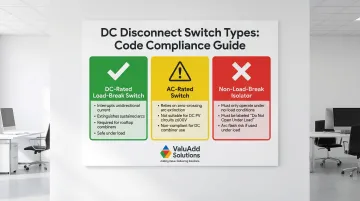
Using an AC-rated switch or a non-load-break isolator on a rooftop DC combiner is a fire and injury risk. The arc interruption difference matters: a DC circuit at 600V or above will sustain an arc that an AC-rated switch cannot safely break.
Key distinctions when selecting DC disconnect switches:
- DC-rated switches are designed to interrupt unidirectional current and extinguish sustained arcs
- AC-rated switches rely on the natural current zero-crossing to break the arc — a condition that does not exist in DC circuits
- Non-load-break isolators must only be operated under no-load conditions; using them under load creates immediate arc flash exposure
Frequently Asked Questions
What is the difference between NEC 690.13 and NEC 690.15?
NEC 690.13 addresses the system-level disconnect isolating all ungrounded DC PV conductors from building wiring, while 690.15 addresses equipment-level disconnects for individual components from all sources that feed them. Both requirements apply simultaneously.
Does a rooftop inverter need both a DC and AC disconnect under NEC 690.15?
Yes, per 690.15(A), utility-interactive inverters in not-readily-accessible locations require both a DC PV disconnecting means and an AC disconnecting means, each mounted within sight of or integral to the inverter.
What does "load-break" mean and when is it required under NEC 690.15?
A load-break disconnect can safely interrupt current while the circuit is energized. Under 690.15(C), it is specifically required for DC combiner disconnects on rooftops of dwellings. Non-load-break switches must be labeled "Do Not Open Under Load."
Does NEC 690.15 apply to battery storage systems connected to PV?
Yes, charge controllers and inverters connected to batteries fall under 690.15. When both a battery and PV array energize the same inverter, the disconnect must isolate the inverter from both sources simultaneously. Multiple disconnects must be grouped and labeled to identify each source.
Can one disconnect satisfy NEC 690.15 for multiple inverters?
Per 690.15, one disconnect may serve the combined AC output of multiple inverters in an interactive system. That said, each inverter in a not-readily-accessible location still requires its own within-sight DC and AC disconnects per 690.15(A).
What happens if the DC disconnect under NEC 690.15 has terminals energized in the open position?
NEC 690.17(E) requires a warning sign on or adjacent to the disconnect stating that terminals on both line and load sides may be energized in the open position. The sign must comply with 110.21(B), which means it must be durable, legible, and either field-marked or pre-printed — not handwritten.