Introduction
When designing electrical distribution systems—for a manufacturing plant, water treatment facility, or industrial control panel—the choice between copper and aluminum busbars is a fundamental design decision, not a procurement afterthought. It shapes your installation from the ground up.
The material you specify directly affects:
- Current-carrying capacity within a fixed footprint
- Installation labor and structural support costs
- Long-term maintenance demands and inspection frequency
- Risk of unplanned downtime from joint degradation
For a motor control center feeding a production line, that choice can mean the difference between a compact, low-maintenance switchboard and a space-intensive assembly requiring thermal inspections and joint re-torquing every 3-5 years.
This guide breaks down conductivity, cost, weight, and long-term reliability so you can match the right material to your application.
Key Takeaways
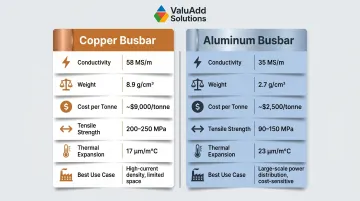
- Copper delivers 100% IACS conductivity vs. aluminum's 61%, enabling smaller cross-sections for the same ampacity
- Aluminum busbars cost roughly 74% less per ton and weigh 70% less than copper equivalents
- Matching copper's current-carrying capacity requires 1.6× the aluminum cross-section — a real constraint in tight enclosures
- Compact, high-reliability installations — switchgear, data centers, dense panel boards — favor copper for its space efficiency and low maintenance
- Aluminum wins on large-scale infrastructure runs where volume, weight savings, and upfront cost outweigh the size penalty
Copper vs. Aluminum Busbar: Quick Comparison
Here's how the two materials compare across the properties that drive most selection decisions.
| Property | Copper | Aluminum |
|---|---|---|
| Electrical Conductivity | ~100% IACS (~1.72 × 10⁻⁸ Ω·m) | ~61% IACS (1350 alloy) |
| Weight | 8.96 g/cm³ | 2.70 g/cm³ (~70% lighter) |
| Cost | $13,573/tonne (LME May 2026) | $3,580/tonne (~3.8× cheaper) |
| Tensile Strength | 200–250 N/mm² (higher, stable joints) | Lower; requires anti-oxidant treatment |
| Thermal Expansion | 17 µm/m·°C (lower movement) | 23 µm/m·°C (higher movement) |
| Best Use Case | Compact MCCs, VFD enclosures, critical infrastructure, corrosive environments | Utility substations, solar/wind farms, large commercial buildings, weight-restricted installations |
What is a Copper Busbar?
A copper busbar is a solid conductor—typically rectangular in cross-section—used to carry high currents between switchgear, panel boards, and distribution equipment. Copper became the global conductivity benchmark for a reason. The International Annealed Copper Standard (IACS) sets pure annealed copper at 20°C as 100% conductivity—the reference point against which all other conductive materials are measured.
Core Properties That Drive Performance
Electrical characteristics:
- Conductivity: 100–101% IACS (C10100 oxygen-free copper)
- Resistivity: 1.724 × 10⁻⁸ Ω·m at 20°C
- Lower resistive losses mean reduced heat generation, tighter temperature rise control under continuous load, and more current capacity per square millimeter
Mechanical properties:
- Tensile strength: 200–250 N/mm² (annealed C101)
- Thermal expansion coefficient: 17 µm/m·°C
- Joints remain mechanically stable through thermal cycling; minimal creep under sustained mechanical load; lower risk of connection loosening over decades of service
Corrosion Behavior and Maintenance Profile
Copper's natural oxide layer (cuprous oxide) remains electrically conductive, unlike aluminum's insulating oxide. This means connections don't degrade into high-resistance failure points as readily as aluminum joints do when improperly maintained — copper oxide layers maintain electrical continuity, keeping maintenance intervals longer. Copper also exhibits very low creep under sustained loads, so original torque specifications hold for decades.
Copper's Limitations
Higher material cost: As of May 2026, copper trades at $13,573 per tonne on the LME—nearly 3.8 times aluminum's price.
Greater weight: At 8.96 g/cm³, copper demands heavier structural supports and increases installation labor, particularly for large bus runs or overhead installations.
Use Cases of Copper Busbars
Copper is the standard specification in the following applications:
- High-density switchboards and MCCs — maximum ampacity per unit area where panel space is constrained
- VFD enclosures and industrial control panels — compact layouts in manufacturing, municipal water treatment, and oil and gas settings typically require copper to meet UL 508A and NEMA standards within tight footprints
- Critical infrastructure — data centers, hospitals, and production facilities where unplanned downtime carries severe financial or safety penalties
- Corrosive or high-humidity environments — oil and gas facilities, water treatment plants, and marine installations where copper's stable oxide behavior limits galvanic degradation
Copper holds a 63.4% market share in the U.S. busbar market as of 2025, driven by reliability requirements and specification standards in critical-power applications.
What is an Aluminum Busbar?
An aluminum busbar uses the metal's low density (2.70 g/cm³) and lower cost to make electrical distribution practical at large scale. Aluminum's conductivity sits at approximately 61% of copper (IACS), but its 70% weight reduction and ~74% lower material cost per ton make it the right call when scale and budget drive the decision.
Aluminum Grades and Conductivity Trade-Offs
| Alloy | Conductivity (% IACS) | Application Context |
|---|---|---|
| 1350 | 61.0–61.8% | Maximum conductivity; lower mechanical strength; used where current density is the priority |
| 6101 | 55.0–59.5% (varies by temper) | Heat-treatable alloy; higher mechanical strength; T6 temper achieves 55% IACS, T64 reaches 59.5% |
Alloy selection comes down to one trade-off: 1350 for maximum conductivity, 6101 when the installation demands greater structural integrity.
Key Limitations and Engineering Workarounds
Three engineering constraints come with aluminum that copper doesn't share:
- Cross-section sizing: Aluminum requires approximately 1.6× the cross-sectional area of copper to match equivalent resistance — meaning larger bars, more enclosure space, and potentially heavier assemblies despite aluminum's density advantage.
- Oxide layer formation: Aluminum forms a hard, electrically insulating oxide layer immediately on air exposure. The fix: wire-brush joint surfaces immediately before assembly and apply anti-oxidant compound to prevent re-oxidation.
- Thermal expansion: Aluminum's expansion coefficient (23 µm/m·°C) exceeds copper's (17 µm/m·°C), stressing joints during thermal cycling. Designers compensate with Belleville washers, expansion joints on long runs, and re-torquing schedules every 3–5 years.
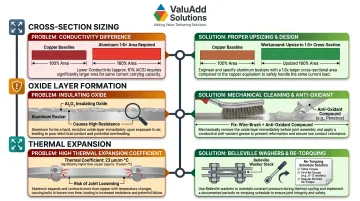
These workarounds are well-established — but they do add installation steps and long-term maintenance obligations that copper avoids.
Sustainability Advantage
Recycling aluminum saves 95.5% of the energy required for primary production, and more than 80% of U.S. aluminum production today comes from recycled sources. For organizations with sustainability procurement requirements, that recycled-content story is increasingly relevant in supplier evaluations.
Use Cases of Aluminum Busbars
Aluminum is the logical or industry-standard choice in:
- Substations, grid feeders, and transmission infrastructure where hundreds of meters of busbar make copper's cost prohibitive
- Solar farms and wind power collection systems where extended distribution runs amplify the weight and cost advantages
- High-rise commercial construction, where long bus duct runs benefit from reduced structural load and lighter installation
- Mobile substations, rail systems, and marine installations where weight limits rule out copper entirely
In a documented 100MW solar farm case study, replacing copper with aluminum busbars reduced structural weight by 30% and cut installation costs by 15–20%.
Copper vs. Aluminum Busbar: Which Should You Choose?
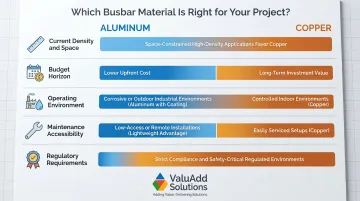
Material selection comes down to five project-specific constraints. Match your situation to these factors before committing to either option:
1. Current density and available space: Can your enclosure accommodate 1.6× larger aluminum cross-sections?
2. Budget horizon: Are you optimizing for upfront CAPEX or 30-year total cost of ownership?
3. Operating environment: High humidity, temperature cycling, and corrosive atmospheres favor copper's stable joints.
4. Maintenance accessibility: Can you commit to periodic inspections and re-torquing, or do you need install-and-forget reliability?
5. Regulatory requirements: Do your industry standards (UL 508A, NEMA, IEEE 519) or project specifications mandate copper?
Situational Recommendations
Choose copper when:
- Panel or enclosure space is constrained and maximum current density per unit area is required
- The system is classified as critical infrastructure (hospitals, data centers, production facilities with zero-downtime requirements)
- The environment is corrosive, high-humidity, or subject to significant temperature cycling
- Standards such as UL 508A or NEMA explicitly require copper, or project specifications demand it for safety certification
Choose aluminum when:
- The installation is large-scale (utility substations, solar/wind farms, large commercial distribution) where material volume makes copper's price premium prohibitive
- Weight reduction in the structure is a hard constraint (mobile substations, overhead installations, seismic zones)
- Long busbar runs with adequate space for larger cross-sections are practical
- The facility has a maintenance program capable of periodic joint inspection and re-torquing every 3–5 years
Lifecycle Cost vs. Upfront Cost
While aluminum's initial material cost runs roughly 74% lower per ton, copper typically delivers lower total cost of ownership (TCO) in critical systems due to reduced maintenance, fewer joint failures, and lower downtime risk. Expected service lives differ: copper busbars typically last 30–50+ years with minimal intervention, while aluminum systems deliver 25–40 years of service with proper maintenance protocols.
Hybrid Solutions
Bimetallic busbars offer a practical middle ground. Copper-clad aluminum busbars and friction-welded bimetallic transition connectors let designers capture aluminum's weight and cost savings along the main run while preserving copper's reliability at critical connection points. This approach is increasingly common in:
- EV battery systems
- Energy storage installations
- Large industrial distribution facilities
Real-World Application: Industry Scenarios
Scenario 1: Copper in Manufacturing/Industrial Control
A processing plant commissioning a new motor control center to serve critical production equipment faces a familiar challenge: the panel footprint is fixed by facility layout, but the system must handle 800A continuous with 42kA fault current capability while meeting UL 508A certification requirements.
Design decision: The system integrator specifies copper busbars to achieve the required ampacity within the standard 72" MCC lineup. Copper's 100% IACS conductivity allows the engineering team to use compact bar dimensions (4" × 1/2" copper vs. 5" × 3/4" aluminum equivalents), maintaining clearance distances for arc flash protection and leaving room for future circuit additions.
Outcome: The installation passes UL certification on first submission, operates at stable temperatures under full load, and requires no joint maintenance in the first five years of service—meeting the plant's zero-tolerance approach to production interruptions.
This kind of space-constrained, high-fault-current scenario is where copper's compact form factor consistently justifies its cost premium over aluminum.
Scenario 2: Aluminum in Utility/Renewable Energy
An electrical contractor specifying a 100MW solar farm's collection system faces different pressures. The distribution buses total 800 meters, and the project budget allocates $2.8M for busbar materials. Using copper at May 2026 LME pricing would consume 92% of that budget; aluminum brings the materials spend down to 68%, freeing capital for additional circuit protection and monitoring equipment.
Engineering trade-offs: The engineering team's aluminum specification includes:
- 1350-series aluminum busbars at 1.6× the copper-equivalent cross-section
- UL 486A-486B-listed Cu-Al transition connectors at all panel interfaces
- Anti-oxidant compound applied at every joint
- Structural supports redesigned for larger bar geometry, offset by a 70% weight reduction
Outcome: Material costs drop by 32%, structural support costs decline by 18%, and the installation crew reports easier handling during overhead runs. The maintenance plan includes thermal imaging surveys every three years and joint re-torquing every five years—acceptable trade-offs given the project's budget constraints.

Both scenarios reach the right answer—but only because the engineering team matched material properties to the actual constraints of each project. The MCC panel demanded copper's density; the solar farm's 800-meter run demanded aluminum's economics.
Conclusion
Copper's superiority in conductivity (100% vs. 61% IACS), tensile strength (200–250 N/mm²), and corrosion resistance makes it the rational choice for compact, high-reliability, and critical industrial systems where panel space is limited and maintenance windows are scarce.
Aluminum's weight advantage (70% lighter) and cost benefit (74% lower per ton at May 2026 pricing) make it the economically sound choice for large-scale or budget-constrained projects. That said, proper installation practices must be followed consistently: anti-oxidant treatment, Cu-Al-rated connectors, and periodic re-torquing.
For plant engineers and system integrators specifying VFD panels, MCCs, and industrial control systems, the busbar choice directly affects panel design, certification pathway, and long-term maintenance burden. ValuAdd's technical team can help you work through these trade-offs—evaluating load profiles, enclosure constraints, and certification requirements—to land on the right material for your application.
Frequently Asked Questions
Are copper bus bars better than aluminum?
Copper outperforms aluminum in conductivity, tensile strength, and corrosion resistance, making it the stronger choice for compact, high-reliability applications. Aluminum wins when weight and upfront cost are the primary constraints. The right choice depends on your application's specific requirements, not a universal ranking.
What is the best metal for a busbar?
Copper is the industry standard for high-performance applications, offering 100% IACS conductivity and predictable joint behavior. Aluminum works well in large-scale, cost- and weight-sensitive systems when proper design practices—anti-oxidant treatment and Cu-Al connectors—are followed.
Is brass or copper busbar better?
Copper is the superior conductor (100% IACS vs. brass at ~28% IACS) and provides better ampacity for the same cross-section. Brass—a copper-zinc alloy—offers higher hardness and better corrosion resistance but significantly lower conductivity. Copper busbars are standard for power distribution; brass appears primarily in terminal hardware and smaller connectors.
Can you connect copper wire to an aluminum bus?
Yes, but it requires UL 486A-486B-listed bimetallic or Cu-Al-rated connectors, anti-oxidant compound at the joint, and proper torque specifications to prevent galvanic corrosion. Direct metal-to-metal contact without rated hardware creates a safety risk and violates NEC 110.14 requirements.
Do aluminum busbars require special connectors?
Yes. Aluminum busbars require connectors explicitly rated for aluminum or Cu-Al service. Standard copper-only connectors can't handle aluminum's insulating oxide layer and higher thermal expansion, leading to joint failures over repeated thermal cycles.
Which busbar material is better for industrial motor control and VFD applications?
Copper is the standard choice for motor control centers, VFD enclosures, and industrial control panels—compact layouts, high current densities, and UL/NEMA requirements all favor it. Aluminum can work for incoming distribution sections where larger cross-sections and available space make it practical.