
Introduction
Power distribution blocks and busbars both route current to multiple circuits—but choosing the wrong one creates real problems: undersized conductors, bloated panel footprints, failed inspections, and hours of rework. They look interchangeable on a spec sheet. In practice, they serve fundamentally different applications.
The right choice affects current-carrying capacity, panel space, installation time, and code compliance: all critical factors for system integrators, manufacturing facilities, and processing plants. According to busway systems installation data, selecting the right distribution architecture can cut installation time by up to 75% and reduce panel size by more than a third.
That translates directly to lower upfront costs, less downtime, and better long-term reliability.
Key Takeaways
- Power distribution blocks (PDBs) split one large incoming conductor into multiple smaller outgoing circuits; busbars act as a shared high-current backbone across parallel connection points
- PDBs work best for control panels and moderate-load branch distribution where modular installation and UL-listed compliance matter
- Busbars excel in high-current distribution—switchgear, motor control centers, large industrial panels—where space efficiency and thermal performance are priorities
- Both can work together: busbars carry the primary power backbone while PDBs handle branch-level distribution to individual loads
- The right choice hinges on load current, output count, panel space, and applicable electrical codes
Power Distribution Block vs. Busbar: Quick Comparison
The four categories below cover the practical differences that matter most when selecting between these two distribution methods.
Current Capacity
Power Distribution Block:
- Moderate loads typically ranging from 90A to 760A for standard industrial models
- Eaton Bussmann UL 1953 Listed blocks range from 175A to 760A; UL 1059 Recognized blocks reach up to 1520A
- Mersen Compact EP series extends to 2260A for specialized applications
Busbar:
- High-current applications from 225A to 6000A
- Eaton Pow-R-Way III busway: 225A to 5000A (copper) / 4000A (aluminum)
- Schneider Electric I-Line: up to 5000A (copper) / 4000A (aluminum)
- ABB ReliaGear: up to 6000A for large motor control centers
Installation Method
Power Distribution Block:
- Pre-assembled, DIN-rail or panel-mount configurations
- Screw-clamp or mechanical terminations
- No custom fabrication required
- Plug-and-play installation reduces labor time
Busbar:
- Often custom-fabricated or modular rail systems
- Requires bolt-on connectors, tap-off blocks, or welded joints
- May require enclosure-specific engineering
- Higher upfront design effort but faster large-scale installation
Flexibility
Power Distribution Block:
- Highly modular—circuits can be added or removed without reconfiguring the entire assembly
- Ideal when load requirements change frequently
- Individual terminations simplify troubleshooting
Busbar:
- Fixed distribution path once installed
- Modifications require structural changes or adapter components
- Better suited for stable, long-term installations
Cost Profile
| Power Distribution Block | Busbar | |
|---|---|---|
| Upfront cost | Lower; economical for small-to-medium installs | Higher; design and materials investment |
| Best value range | Branch circuits with fewer than 10 outputs | Large-scale or high current density applications |
| Scale economics | Per-circuit cost rises at scale | More cost-effective per connection at scale |
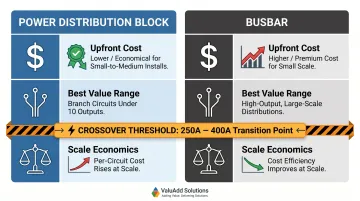
According to Legrand's Power Guide, busbars typically become the more practical choice above 250A to 400A. ValuAdd's single-pole distribution blocks — rated from 90A to 255A — sit squarely in the range where blocks deliver better value before that crossover point.
What Is a Power Distribution Block?
A power distribution block (PDB) is a wiring component designed to accept one large incoming conductor on the line side and distribute current to multiple smaller outgoing conductors on the load side. In practical terms, it acts as a current splitter inside an electrical panel or enclosure.
Construction and Compliance
Industrial PDBs feature insulated thermoplastic or thermoset housing with one or more copper alloy conductors. These blocks provide distinct line-side and load-side sections rated separately, with screw-clamp or mechanical termination points. UL-Listed PDBs—such as those in ValuAdd's product portfolio—are tested for safe use in industrial and commercial panels under NEC requirements.
Critical compliance considerations:
- UL 1953 Listed blocks provide adequate spacing for feeder circuits (1 inch through air, 2 inches over surface at 600V) and are approved for general installation
- UL 1059 Recognized blocks must be specifically evaluated by an inspector for spacing requirements in the OEM application
- NEC Article 409.110 mandates that industrial control panels be marked with a Short-Circuit Current Rating (SCCR)
- Using UL 1953 Listed PDBs with high SCCR ratings (up to 200 kA) prevents the distribution block from becoming the "weak link" that limits the entire panel's SCCR to a default 10 kA
Product Configurations
ValuAdd offers PDB configurations that include:
- Single-pole blocks (90A to 255A) for single-phase or DC distribution
- Three-pole blocks (125A to 175A) for three-phase applications
- DIN-rail and panel-mount options for flexible installation
- Compact designs optimized for space-constrained enclosures with IP20 finger-safe protection
These blocks conform to international standards including UL 1953, UL 1059, CSA-C22.2 No. 128, IEC 61439-1, and IEC 60947-7-1, making them viable for both North American and global industrial deployments.
Operational Impact
Regardless of which configuration fits your panel, the operational payoff is the same: PDBs reduce point-to-point wiring by consolidating branch connections at a single rated component. This approach improves panel organization, reduces wiring errors, and simplifies future circuit additions or replacements. Integrators report that without distribution blocks, they must splice wires together or daisy-chain terminal strips—neither safe nor practical in industrial applications. Using PDBs results in cleaner wiring, faster troubleshooting, and easier long-term maintenance, offsetting upfront component cost through reduced installation labor.
Use Cases for Power Distribution Blocks
Where PDBs Fit
Power distribution blocks are commonly installed in:
- Machine control panels with multiple motor, drive, sensor, and control loads fed from a single power source
- HVAC equipment requiring organized branch distribution
- Industrial automation enclosures in manufacturing cells
- Branch distribution points within processing facilities
- Oil and gas control panels requiring UL/NEMA-rated components
- Water treatment plant panels needing maintainable wiring for pump and valve circuits
Dominant Industry Applications
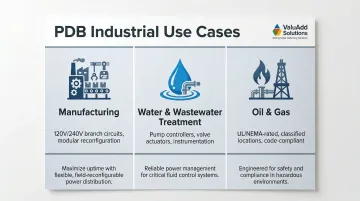
Manufacturing facilities use PDBs extensively for distributing 120V/240V branch circuits to individual machines and control devices. The modular design lets plant engineers reconfigure circuits as production lines evolve—without rewiring entire panels.
Water and wastewater treatment plants rely on PDBs to organize connections to pump controllers, valve actuators, and instrumentation. These circuits require frequent maintenance access, and clearly labeled PDB ports make it faster to isolate individual loads during service calls.
In oil and gas operations, UL/NEMA-rated PDB components are specified for control panels in classified locations where code compliance isn't optional. That same traceability—clearly identifiable circuit paths that match panel schedules and load calculations—is what makes PDBs the preferred choice any time an inspector needs to verify wiring without hunting through an unmarked terminal cluster.
What Is a Busbar?
A busbar is a solid or laminated metallic conductor—typically copper or aluminum—that serves as a shared electrical node within switchgear, distribution boards, motor control centers, or large panel assemblies, allowing multiple circuits to tap off a single low-impedance conductive path.
Core Operational Advantages
Busbars minimize resistance and voltage drop across long distribution runs, dissipate heat more efficiently than bundled cable terminations, and maintain a consistent equipotential plane for all connected loads—critical in high-current industrial environments.
Material performance:
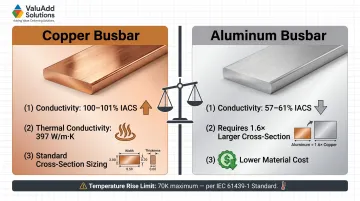
- Copper busbars provide conductivity of 100% to 101% IACS (approximately 58 MS/m) and thermal conductivity of 397 W/m·K
- Aluminum busbars offer 57% to 61% IACS conductivity, requiring a cross-sectional area approximately 1.6 times larger than copper for equivalent current capacity
- Copper's higher thermal conductivity is critical for meeting 70 K temperature rise limits verified under IEC 61439-1 testing protocols
Key Busbar Types
Single bus arrangements: Simple, common in smaller switchgear and distribution panels where a single primary source feeds multiple branch circuits.
Modular insulated busbar systems: Feature plug-in tap-offs used in modern industrial panels. Manufacturers like Siemens (SIVACON 8PS), Schneider Electric (Canalis KTA/KTC), and ABB (WavePro-A) offer factory-tested modular systems with IP54 to IP55 protection ratings and current capacities from 40A to 6600A.
Laminated busbars: Used in motor drives, battery systems, and compact high-current applications. ValuAdd's Isoflexx® laminated busbars feature cross-sections from 21.6 mm² to 1200 mm² and provide high flexibility for space-constrained installations.
Compliance and Safety
Busbar selection carries compliance implications that vary by installation type. Industrial busbars must meet UL, IEC, and NEC requirements. Bare busbars require proper enclosure and clearance distances. Insulated or enclosed busbar systems reduce arc flash risk and are preferred in facilities requiring NEMA Type 4X or Type 12 compliance.
According to NFPA 70E arc flash risk assessment requirements, passive mitigation solutions such as insulated busbars and compartment segregation reduce the probability of an arc flash occurring.
Enclosed busbar systems also reduce shock hazards from accidental contact, supporting the hierarchy of risk controls that prioritizes elimination and engineering controls over PPE.
Replacing Line-Side Wiring
Busbar systems can replace all line-side wiring and associated accessories, including power distribution blocks and wire duct, within an electrical panel. By mounting components directly to the busbar via adapters, integrators eliminate the labor required to measure, cut, strip, and terminate multiple smaller cables—sharply reducing the required enclosure size.
Use Cases for Busbars
Where Busbars Fit
Busbars are the standard solution for:
- Primary power distribution in switchgear assemblies
- Motor control centers (MCCs) feeding dozens to hundreds of motors
- Large VFD drive panels requiring high current density
- Power distribution units (PDUs) in data centers
- Substation applications distributing hundreds to thousands of amps
Dominant Industry Applications
Heavy manufacturing: In cement plants and other heavy industries, motor control centers rely on main copper busbars as current-carrying conductors to connect the incoming power source to multiple protective devices serving individual motor loads. Copper busbars handle the high fault current levels these environments generate without the voltage drop penalties that wiring-based distribution would introduce at scale.
Municipal water treatment: ABB's intelligent MCCs integrating busbar distribution are deployed in water and wastewater treatment plants, enabling robust power delivery and real-time diagnostics for large pump motor feeds and treatment process equipment.
Oil and gas: Offshore Floating Production Storage and Offloading (FPSO) vessels and E-Houses heavily utilize medium-voltage and low-voltage bus duct systems alongside switchgear and MCCs to deliver high current capacity within tightly constrained footprints, where routing individual cables to each load is neither practical nor safe.
Power Distribution Block vs. Busbar: Which Should You Use?
Decision Factors
Before choosing, engineers must answer five critical questions:
- What is the total load current?
- How many output circuits are needed?
- What is the available panel footprint?
- How often will circuits be reconfigured?
- What certifications and compliance standards apply?
Choose a PDB When
Power distribution blocks are the right solution when:
- Total load current stays below 400A per block
- Circuit count is fixed or rarely changes (fewer than 10-12 branch circuits)
- The panel is a machine control or branch distribution point where modularity matters
- Fast installation matters — DIN-rail mount blocks swap out in minutes
- UL Listed or CE Certified components are required for inspection approval
- Panel space supports conventional wire routing without heat buildup concerns
Choose a Busbar When
Busbar systems become the practical choice when:
- Total system current exceeds 250A to 400A — the threshold where busbar distribution becomes more practical than blocks and cables
- Multiple circuits tap a shared source and voltage drop must stay minimal (busbar impedance is far lower than equivalent cable runs)
- Panel space is tight — busbars eliminate wire duct, cable bends, and termination space
- The system is part of switchgear or an MCC where high current density is standard
- High-density installations with 15+ tap points justify the higher upfront cost over time
Use Both Together
The most practical industrial installations combine both technologies: a busbar handles the primary power backbone (line side) and PDBs handle branch-level distribution to individual load circuits.
Example hybrid configuration:
- 800A copper busbar runs vertically through the panel as the main distribution spine
- Tap-off adapters at four points feed 200A to local zones
- Each zone uses a three-pole PDB to split power to 6-8 individual loads
- Result: high-current efficiency of busbars + organized, modular flexibility of distribution blocks
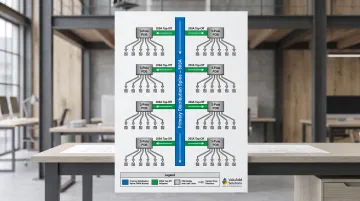
This architecture is standard in large industrial panels, motor control centers, and process control rooms where hundreds of circuits must be organized, protected, and maintained over 20+ year lifecycles.
Compliance and Safety Layer
For system integrators and plant engineers in manufacturing, water treatment, and oil and gas, choosing UL Listed PDBs or certified busbar systems affects more than performance. It determines whether installations pass inspections, satisfy NEMA enclosure ratings, and hold up under regulatory scrutiny.
ValuAdd's power distribution components carry UL Listed, CE, and FCC certifications and meet standards including UL 1953, IEC 61439-1, and NEMA Type 1/3R — covering the compliance requirements most commonly flagged during industrial inspections.
Real-World Application Example
Consider a system integrator designing a motor control panel for a processing plant: six VFD circuits must be fed from a single 400A feed in a compact NEMA Type 12 enclosure.
Initial Design
The integrator initially considered a bank of distribution blocks:
- Six individual three-pole PDBs mounted vertically
- Incoming 400A cable split at a junction point
- Individual cable runs to each PDB
- Outgoing conductors to each VFD
Challenges quickly emerged: the required wire bending radius, duct space, and termination clearances pushed the enclosure size beyond the footprint available on the plant floor. Heat management became a concern with bundled high-current cables.
Reconfigured Solution
The team evaluated a busbar backbone with PDB branch points:
- Vertical 600A copper busbar installed as the primary spine
- Six tap-off adapters directly feeding smaller distribution blocks or individual VFD connections
- Eliminated junction point and most line-side cable
- Reduced panel depth by 6 inches, height by 8 inches
Measurable Outcomes
The hybrid approach delivered results consistent with comparable installations:
- ~36% reduction in panel size—critical for fitting within the available footprint
- 66% reduction in wiring time—as demonstrated by Rockwell Automation's Volga case study
- ~32% reduction in overall weight—simplifying installation and structural requirements
- Improved thermal performance—busbar heat dissipation eliminated cable bundling hot spots
Takeaway and Next Steps
These outcomes reflect a broader point: power distribution decisions shape cost, safety, and uptime across the entire panel design. ValuAdd's technical team offers product selection support tailored to your specific panel requirements. Contact our engineering specialists to review your application and identify the right distribution architecture for your current requirements, space constraints, and compliance needs.
Conclusion
Power distribution blocks and busbars each solve a specific distribution challenge. PDBs excel in organized, moderate-load branch distribution where modularity and code compliance are essential. Busbars are the right choice when current density, thermal performance, and space efficiency take priority at scale. Matching the right component to the right context is what keeps panel designs from being over-engineered, under-rated, or difficult to maintain.
Getting this selection right pays off across the board:
- Plant engineers reduce unplanned downtime by avoiding thermal bottlenecks and overcrowded terminals
- System integrators cut installation labor and simplify panel documentation
- Facilities engineers in water treatment and oil and gas gain systems that hold up under continuous load and harsh environments
Frequently Asked Questions
Is a distribution block the same as a bus bar?
No. While both distribute power to multiple circuits, a power distribution block is a pre-assembled insulated component with one input and multiple outputs for branch circuits in a panel. A busbar is a bare or insulated metallic conductor serving as a shared current pathway in higher-current switchgear or distribution assemblies.
What is the purpose of a power distribution block?
A PDB connects a single large incoming conductor to multiple smaller outgoing conductors within an electrical panel, eliminating point-to-point wire splicing. This improves panel organization, ensures UL-listed current distribution to branch circuits, and simplifies maintenance.
When to use a distribution block?
Use distribution blocks in machine control panels, automation enclosures, or HVAC equipment that require modular, code-compliant wiring organization. They're the right fit when load currents stay below 400A and output counts remain under 10-12 circuits per block.
What is a PDB in electrical?
PDB stands for Power Distribution Block—a wiring component with a line-side input and multiple load-side outputs, rated for specific wire gauges and amperage. These UL Listed devices are commonly used in industrial and commercial electrical panels to split incoming power into multiple branch circuits safely and compliantly.
What is the difference between PDB and LDB?
A PDB (Power Distribution Block) handles power circuit distribution at higher amperage ratings, while an LDB (Lighting Distribution Block) targets lighting branch circuits at lower amperages. Choose based on circuit type—LDBs are configured for panelboard lighting applications, PDBs for general power distribution.
What is the difference between a bus bar and a terminal block?
A terminal block provides individual, isolated wire-to-wire connections for control or signal circuits—each terminal is electrically independent. A busbar shares a common conductive path across all connection points for high-current power distribution. In complex industrial panels, both are typically used together: busbars for power, terminal blocks for control wiring.