Introduction
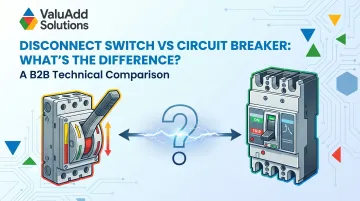
Industrial engineers and facility managers frequently encounter a critical question: can disconnect switches and circuit breakers be used interchangeably? Both devices interrupt power flow in electrical systems, but their functions are distinct. They are not interchangeable, and selecting the wrong device creates serious safety hazards and compliance violations.
The stakes are especially high in industrial facilities. Manufacturing plants, water treatment operations, and oil and gas processing sites face real consequences from incorrect selection:
- Compromised equipment protection
- Worker injuries during maintenance
- NEC violations that trigger citations
- Unplanned downtime costing thousands per hour
OSHA issued 2,547 citations for lockout/tagout violations in FY2025, with 78% going to manufacturing facilities. Energy isolation failures remain a persistent operational risk across the industry.
Key Takeaways
- A disconnect switch manually isolates circuits for safe maintenance but does not respond to faults automatically
- Circuit breakers automatically trip to interrupt overcurrent and protect wiring, and also support manual switching
- Disconnects protect people through LOTO compliance and visible isolation; breakers protect circuits and equipment
- Industrial settings require both: breakers handle fault protection, disconnects provide safe local isolation
- NEC Article 430 mandates disconnecting means within sight of motors, making both devices legally required
Disconnect Switch vs Circuit Breaker: Quick Comparison
| Feature | Disconnect Switch | Circuit Breaker |
|---|---|---|
| Primary Function | Manual isolation for maintenance | Automatic overcurrent protection |
| Operation Mode | Manual only | Automatic trip + manual switching |
| Overcurrent Protection | None (non-fusible) or fuse-based (fusible) | Built-in thermal-magnetic trip |
| Typical Industrial Use | Local equipment isolation, LOTO procedures | Panel/MCC overcurrent protection |
| Post-Fault Reset | Fuse replacement required (fusible models) | Resettable—no parts replaced |
Load vs. No-Load Operation:
Whether a device can break under load is a core industrial safety requirement. Standard disconnect switches (isolators) must be opened only after an upstream breaker has removed current. Circuit breakers interrupt circuits under full load or fault conditions: arc chutes and trip mechanisms handle thousands of amperes safely.
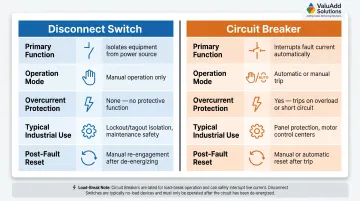
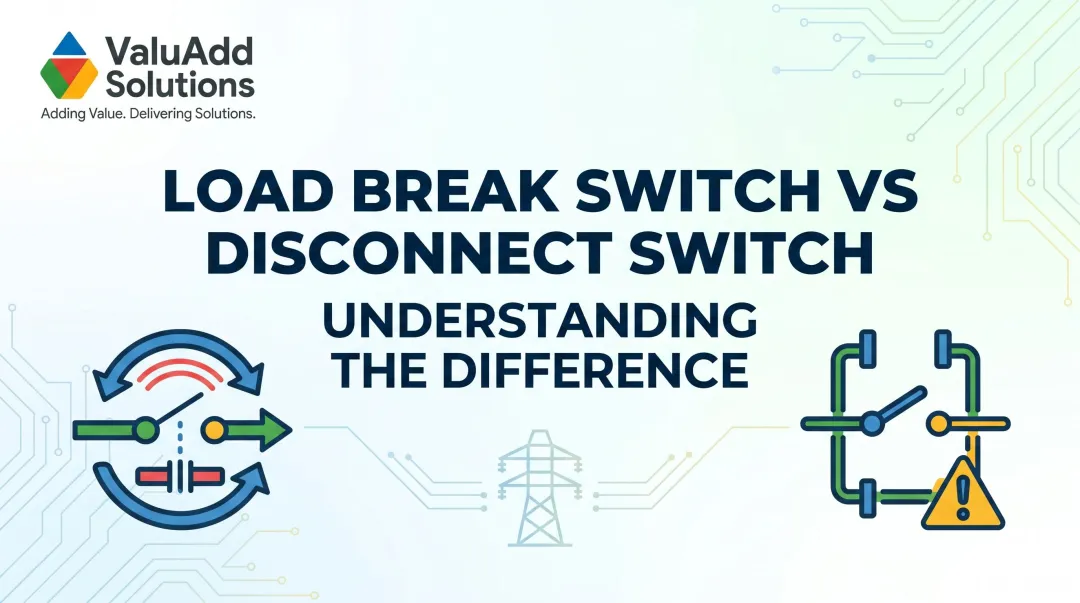
Load-break rated disconnects (Class E2) bridge this gap. They can safely interrupt normal operating current and extinguish the resulting arc, making them suitable for situations where circuits may not be fully de-energized before switching. This specification is critical in industrial environments where upstream isolation isn't always practical.
Specification choices also affect long-term budget. Understanding total cost of ownership — not just purchase price — is where the decision often shifts.
Cost Structure:
- Disconnect switches: Lower initial cost, simpler construction, but fusible models require stocking replacement fuses
- Circuit breakers: Higher upfront investment and, according to Eaton's lifecycle analysis, 67% higher total cost of ownership than fusible equipment over 20 years — driven primarily by maintenance requirements
- Economic choice depends on: Fault current levels, available maintenance staff, acceptable downtime windows, and total circuit count
What Is a Disconnect Switch?
A disconnect switch is a manually operated mechanical device that physically separates a circuit from its power source. When opened, it creates a visible air gap or blade separation—allowing technicians to confirm with their eyes that the circuit is de-energized. Unlike a circuit breaker, a disconnect provides no automatic response to electrical faults. Its sole purpose is isolation for maintenance, repair, or emergency shutdown.
Types of Disconnect Switches
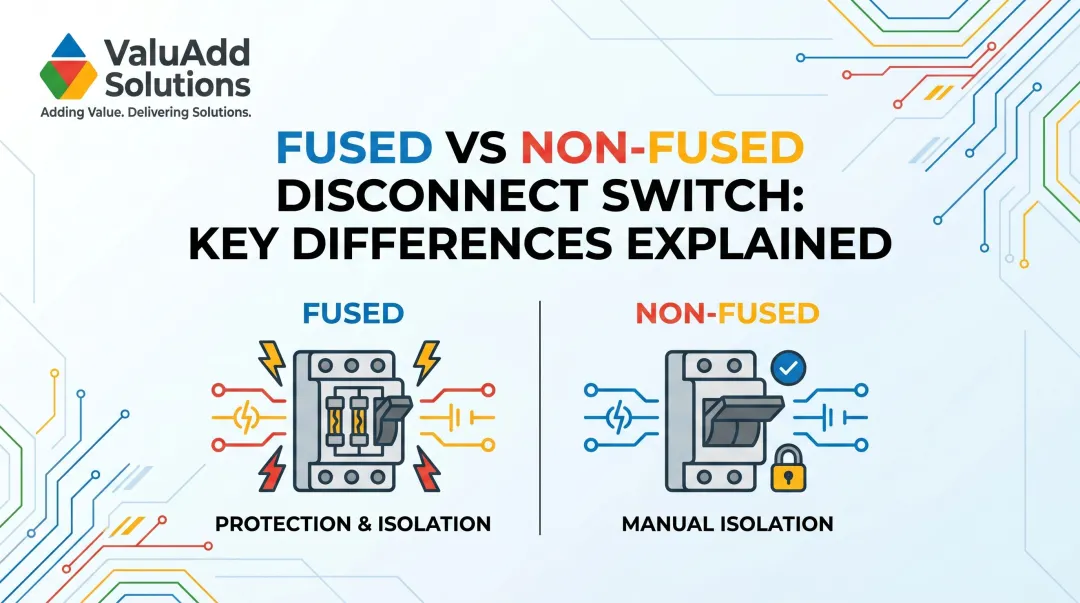
Non-fusible disconnects:
- Provide isolation only—no overcurrent protection built in
- Rely entirely on an upstream breaker or fuse to clear faults
- Used when protection already exists and only a local isolation point is needed
- Common in motor circuits where the MCCB is located at the panel
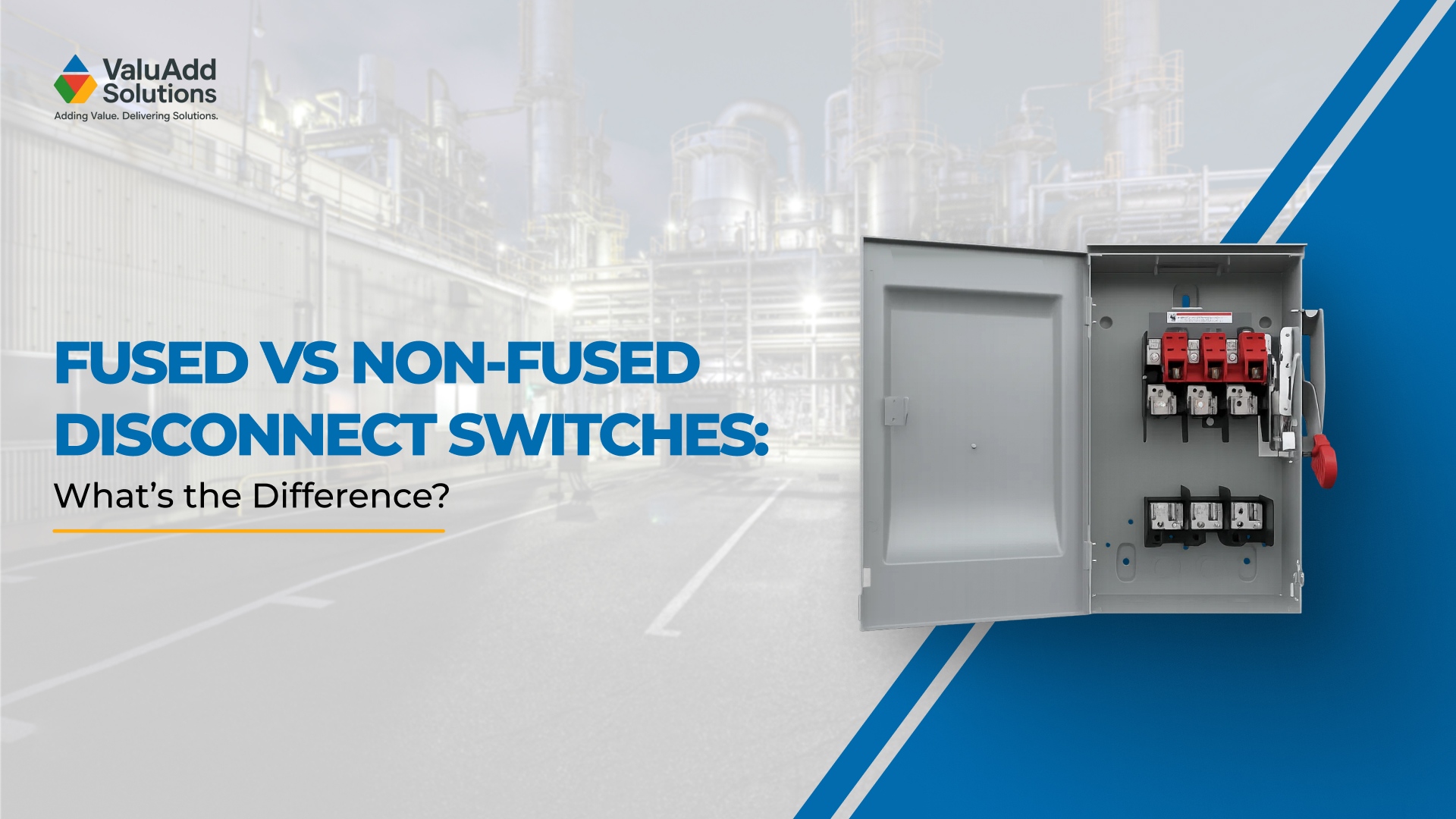
Fusible (fused) disconnects:
- Incorporate fuse elements that blow during overcurrent or short-circuit conditions
- Offer both isolation and overcurrent protection in a single enclosure
- Allow precise fuse sizing to match load characteristics
- Require fuse replacement after each fault
Load-Break Rated Disconnects
Standard isolators must be opened only under no-load conditions—attempting to break load current risks arc flash and equipment damage. Class E2 Load Break certified disconnects, by contrast, can safely interrupt normal operating current and extinguish the resulting arc.
In industrial environments, circuits aren't always fully de-energized before switching. A technician approaching a pump motor may need to open the local disconnect while residual current flows through control circuits or auxiliary equipment. Class E2 Load Break rating ensures the switch can handle this safely.
ValuAdd's disconnect switch portfolio carries Class E2 Load Break certification, giving facilities the visible isolation point they need without requiring a full system shutdown before switching.
The Lockout/Tagout Connection
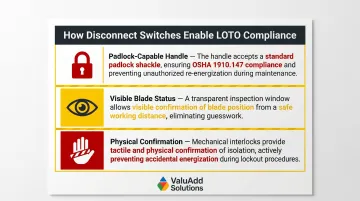
NIOSH investigations found 77% of 185 electrical fatalities involved failure to completely de-energize equipment, and 17% involved failure to lock and tag energy control devices. Disconnect switches solve both problems by design:
- Padlock-capable handle: OSHA 1910.147 requires energy isolating devices to accept padlocks, physically preventing re-energization during maintenance
- Visible blade status: Technicians can verify from a safe distance that contacts are open—no voltage testing required for initial confirmation
- Physical confirmation: Unlike a breaker in a closed panel, a disconnect's open position is immediately apparent, reducing the risk of accidental energization
Use Cases of Disconnect Switches
Motor and Equipment Applications
NEC Article 430.102 mandates a disconnecting means within sight of every motor controller and motor location. "Within sight" means visible and within 50 feet. A maintenance technician servicing a conveyor motor, VFD-driven pump, or air compressor must be able to see and operate the disconnect from the equipment location—not walk back to a distant panel.
This requirement appears throughout industrial facilities:
- Every motor on a manufacturing floor
- Pump stations at water treatment plants
- Compressor rooms in oil and gas facilities
- Conveyor systems and material handling equipment
- VFD-controlled HVAC systems
Motor applications represent just one category. Disconnects are required across a broad range of electrical systems wherever safe isolation is a code or safety priority.
Additional Required Locations
- Main service entrances — Required at service panels and sub-panels for emergency isolation of entire systems
- Rooftop HVAC equipment — NEC Article 440.14 requires disconnects within sight of air conditioning and refrigeration equipment, meeting working space requirements per NEC 110.26(A)
- Photovoltaic systems — NEC 690.13 mandates a DC disconnect between solar arrays and inverters, a critical safety requirement for firefighters and maintenance personnel
- Outdoor equipment — Pump stations, outdoor chillers, and remote processing equipment all require accessible shutoffs regardless of panel location
What Is a Circuit Breaker?
A circuit breaker is an automatic switching device that continuously monitors current flow and trips open (often within milliseconds) when it detects an overload or short circuit. It cuts power before heat damage, fire, or equipment failure occurs. Unlike a disconnect switch that requires human action, a circuit breaker responds to electrical conditions autonomously.
Core Trip Mechanisms
Thermal trip:
- A bimetal strip bends under sustained heat from overcurrent
- Protects wiring from prolonged overload conditions that would gradually damage insulation
- Inverse-time characteristic: trips faster at higher currents
- Typical response: several seconds at 150% rated current, minutes at 125%
Magnetic trip:
- An electromagnet actuates instantaneously during high-amplitude fault currents
- Protects against short circuits that could cause fires or explosions
- Response time: milliseconds at 5-10× rated current
- Essential for clearing faults before arc flash energy reaches dangerous levels
Industrial Molded Case Circuit Breakers (MCCBs) often feature adjustable trip settings. This flexibility accommodates motor inrush currents without nuisance tripping.
Motor inrush can reach 600-800% of full-load current for several seconds during startup. NEC Table 430.52 allows inverse time breakers to be sized up to 250% of motor full-load current for standard AC motors, providing that necessary margin.
Key Advantage: Resettability
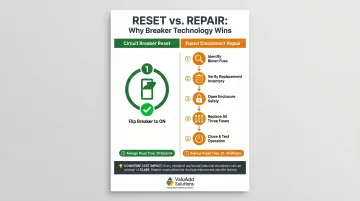
Once a fault clears, a circuit breaker flips back to ON and is ready to protect again. No parts to replace, no waiting on fuse inventory, no guessing at the correct rating before reinstalling. This reduces mean time to repair (MTTR) significantly compared to fused disconnects.
For example, a nuisance trip caused by temporary overload (a motor starting under heavy load) requires only seconds to reset a breaker. The same event with a fused disconnect requires:
- Identifying the blown fuse
- Verifying replacement fuse inventory
- Opening the enclosure
- Replacing all three fuses (best practice)
- Closing and testing
This difference matters in 24/7 manufacturing operations where every minute of downtime costs hundreds or thousands of dollars.
Industrial Circuit Breaker Types
That resettability advantage applies across all breaker types — and the right type depends on where it sits in your system.
Miniature Circuit Breakers (MCBs):
- Branch circuits in control panels
- Lighting and receptacle circuits
- Current ratings: 1-63A typically
- Lower interrupting capacity (10-25 kA)
Molded Case Circuit Breakers (MCCBs):
- Feeder circuits and sub-panels
- Motor branch circuits
- Current ratings: 15-2500A
- Higher interrupting capacity (25-200 kA at 480V)
- Common in Motor Control Centers protecting individual starters
Specialty breakers:
- Vacuum and SF₆ breakers for medium-voltage switchgear
- Used in utility substations and large industrial facilities
- Handle voltages above 1000V
For three-phase motor circuits, MCCBs provide simultaneous trip across all phases — a protection detail that matters. If one phase opens due to a fault while others stay energized, single-phase conditions can destroy a three-phase motor within seconds. Common-trip breakers prevent this scenario.
Use Cases of Circuit Breakers
Circuit breakers serve as primary overcurrent protection at every level of electrical distribution. That coverage spans from the main service entrance down to individual branch circuits:
- Main service panels (protecting entire facility feeders)
- Sub-panels (protecting branch circuit groups)
- Motor Control Centers (protecting individual motor starters)
- Control panels (protecting internal wiring and devices)
In industrial environments, that protection maps directly to the equipment running your operation. Typical applications include:
Water treatment facilities
- Large pump motor protection (50-500 HP)
- VFD feeder circuits requiring adjustable trip settings
- Chemical feed pump branch circuits
Manufacturing plants
- CNC machine tool feeders
- Robotic cell power distribution
- Conveyor motor protection
- Compressor room circuits
Oil and gas operations
- Wellhead pump controllers
- Compressor station feeders
- Processing equipment protection (automatic fault interruption prevents damage to expensive downstream equipment)
US manufacturing customers face an estimated $11 billion annual downtime cost due to short-duration power interruptions and voltage sags. Properly selected and coordinated circuit breakers minimize this exposure by clearing faults before they cascade into larger system failures.
Disconnect Switch vs Circuit Breaker: Which Should You Use?
Most industrial equipment requires both devices working together. The real question is whether a given location needs automatic fault protection (breaker), a local manual isolation point (disconnect), or both. Typically: the breaker at the panel or MCC protects the feeder, while the disconnect near the equipment satisfies NEC "within sight" and LOTO requirements.
Choose a Disconnect Switch When:
- Performing routine maintenance or troubleshooting on equipment
- The equipment location is out of sight from the panel (>50 feet or obstructed view)
- OSHA LOTO procedures must be followed for safe work
- You need a visible, padlockable isolation point that personnel can verify is open before approaching energized parts
- Local codes require a "within sight" disconnecting means (NEC Articles 430, 440, 422)
Choose a Circuit Breaker When:
- Protecting circuit wiring and equipment from overloads and short circuits
- Controlling distribution at panel, sub-panel, or MCC level
- The system needs automatic fault interruption 24/7 regardless of operator presence
- Working with three-phase motor circuits where common-trip, resettable devices reduce maintenance burden
- Available fault current is within the breaker's interrupting capacity rating
High-Current Industrial Applications
For circuits with extremely high available fault currents—large industrial machinery, utility substations, or facilities close to utility transformers—current-limiting fuses isolate faulted circuits before fault current reaches its maximum value, limiting thermal and mechanical stresses. Fused disconnects outperform MCCBs of equivalent rating in clearing speed when available fault current exceeds 100 kA.
However, for most manufacturing and processing plant circuits under 600V with available fault currents below 65 kA, an MCCB paired with a local disconnect represents the standard NEC-compliant approach. This combination provides:
- Automatic protection at the panel (breaker)
- Local isolation for maintenance (disconnect)
- LOTO compliance (disconnect)
- Cost-effective protection without exotic interrupting ratings
Real-World Industrial Scenario
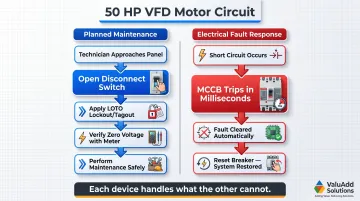
Consider a manufacturing plant with VFD-driven motors on a production line, a standard configuration in industrial facilities:
System configuration:
- 50 HP motor controlled by VFD
- Motor branch circuit protected by 150A MCCB in the Motor Control Center
- Class E2 load-break rated disconnect switch mounted within sight of the motor (30 feet away)
During planned maintenance:
- Technician approaches the motor location
- Opens the local disconnect switch
- Applies padlock and tag per LOTO procedure
- Verifies zero voltage with test equipment
- Performs maintenance safely
During an electrical fault:
- Short circuit occurs in motor winding
- MCCB in MCC trips within milliseconds
- Fault cleared automatically—no human intervention required
- After fault investigation, MCCB resets with no parts replaced
Key insight: The technician never touches the MCC breaker during routine maintenance. The disconnect provides all necessary isolation. The MCCB, in turn, provides fault protection whether anyone is present or not. Each device handles what the other cannot.
Diagnosing the right gap: Nuisance trips and unplanned shutdowns typically point to breaker sizing or coordination issues, not a missing disconnect. Maintenance workers taking risks near live equipment usually signals a missing or undersized disconnect. The symptoms differ, and so do the fixes. ValuAdd's technical team works through these diagnostics with customers to identify which device addresses the actual operational problem.
Conclusion
Disconnect switches and circuit breakers are not competing devices—they solve fundamentally different problems. Breakers provide continuous, automatic protection against electrical faults. Disconnects provide deliberate, visible, lockable isolation for safe human intervention. Industrial facilities need both, positioned correctly throughout the electrical system.
Getting that selection and placement right has measurable consequences:
- Reduces unplanned downtime caused by nuisance trips from misapplied breakers
- Ensures OSHA and NEC compliance, keeping workers safe and avoiding violations
- Extends equipment life by guaranteeing maintenance happens under verified zero-energy conditions
A properly rated breaker paired with a Class E2 load-break disconnect near critical equipment is the established standard in manufacturing, water treatment, and processing facilities. ValuAdd works with engineers and system integrators in these environments to specify the right combination for each application.
Frequently Asked Questions
Is a circuit breaker the same as a disconnect switch?
No. While both can interrupt power, a circuit breaker automatically trips on faults and provides overcurrent protection, whereas a disconnect switch is purely a manual isolation device with no internal fault sensing. A breaker can sometimes serve as a disconnecting means under NEC if accessible and lockable, but it does not replace a dedicated disconnect in most industrial motor applications.
When should a disconnect switch be installed?
Install a disconnect switch wherever local, lockable de-energization is required—next to motors, machines, or any equipment subject to servicing (NEC Article 430). It's also required when the panel or breaker is out of sight or more than 50 feet from the equipment.
Where are disconnect switches required?
NEC requires disconnects within sight of motors (Article 430), HVAC equipment (Article 440), and appliances (Article 422) when not within sight of the panel. They're also required as service entrance disconnects and at building exteriors per NEC 230.85.
What is the 125% rule in electrical?
The 125% rule (NEC 210.20 and 430.22) requires conductors and overcurrent devices to be rated at minimum 125% of the continuous load. For motor circuits specifically, the branch circuit breaker or fuse must meet this threshold to prevent nuisance tripping under normal operating conditions.
What will electricians call disconnects?
Electricians use several common terms: disconnect switch, safety switch, isolator, fusible switch (when it contains fuses), pull-out disconnect, or simply "the disconnect." In industrial and NEC contexts, the formal term is "disconnecting means." The term "safety switch" is especially common in the US for heavy-duty fusible disconnect enclosures.