
Introduction
An incorrectly sized fuse in a disconnect switch can result in nuisance tripping, thermal damage, failed inspections, or unsafe fault conditions—all of which translate directly to unplanned downtime and liability in industrial operations. In fact, unplanned downtime costs U.S. manufacturers up to $207 million weekly, with many facilities experiencing outages that average $400,000 per hour.
The real challenge in fuse disconnect switch sizing isn't selecting a device with a high enough ampere rating. It's matching the fuse rating to the actual load—accounting for continuous operation, available fault current, and load type. A fused disconnect switch is a UL 98-listed enclosed safety switch that handles both manual load-break isolation and overcurrent protection through replaceable fuses in a single device.
Getting that match right requires working through several interdependent factors. This guide walks through reading nameplate data, applying the 125% continuous load rule, accounting for SCCR and load type, and selecting the correct fuse class for the application.
Key Takeaways
Key sizing requirements:
- Switch must meet the load's MCA; fuse rating cannot exceed the MOP
- Continuous loads (3+ hours) require both fuse and switch sized to at least 125% of load current—the basis of the 80% rule
- Motor loads require an HP-rated switch per NEC Article 430 and time-delay fuses for startup inrush
- Fuse class (J, RK1, RK5, CC) determines interrupting rating and overall panel SCCR
How to Size a Fuse Disconnect Switch: Starting with Load Data
All sizing decisions flow from two sources: the equipment nameplate (for MCA, MOP, and load type) and the available fault current at the installation point. Skipping either creates downstream compliance failures.
Reading the Equipment Nameplate: MCA and MOP
Minimum Circuit Ampacity (MCA) defines the floor for both disconnect switch ampere rating and conductor sizing. The switch must be rated at or above this value. MCA already accounts for continuous load derating—it's calculated at 125% of the largest motor's full-load amperes (FLA) plus the sum of other loads.
Maximum Overcurrent Protection (MOP) caps the allowable fuse ampere rating. Exceeding MOP voids the equipment listing with no exceptions. Installing above this value violates NEC 110.3(B), which requires equipment to be used according to its listing instructions.
Worked Example: A nameplate showing MCA = 52A and MOP = 70A requires:
- Disconnect rated ≥52A
- Fuse rated ≤70A
- Solution: 60A disconnect with 60A Class J fuses satisfies both
When equipment doesn't provide MCA/MOP values, sizing calculations start from NEC Table 430.250 full-load current (FLC) values—not the motor's nameplate FLA. These two can differ, and using nameplate FLA instead of table FLC is a common source of undersized overcurrent protection.
Applying the 125% Continuous Load Rule
Under NEC 210.19(A)(1) and 210.20(A), a load running 3 or more hours qualifies as a continuous load. Two rules apply immediately:
- Fuse ampere rating must be at least 125% of the continuous load current
- Disconnect switch ampacity must meet the same 125% threshold
- Practical result: neither device should be loaded above 80% of its rating
Example Calculation:
- 40A continuous motor load requires:
- Minimum 50A fuse (40A × 1.25)
- Minimum 50A-rated disconnect switch
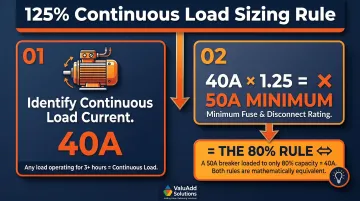
During inspection, inspectors commonly verify this calculation by checking that the installed fuse rating doesn't exceed 80% of its marked ampacity under continuous load conditions. An undersized device running above that threshold will show elevated terminal temperatures before any visible failure occurs.
Key Factors That Determine the Right Fuse Rating
Nameplate data sets the baseline. Beyond that, three variables drive the final selection: available fault current and SCCR compliance, load type, and voltage with pole configuration. Each one can disqualify an otherwise correctly sized fuse.
Available Fault Current and SCCR
The fuse and disconnect switch combination must carry an SCCR equal to or greater than the available fault current at the panel's line terminals. Available fault current is determined by upstream transformer kVA and impedance (not by load size), and must be confirmed with the end customer or the Authority Having Jurisdiction (AHJ) before finalizing selection.
Current-limiting fuse classes (Class J, RK1) reduce let-through current during a fault and can substantially increase the SCCR of the panel assembly, allowing lower-rated downstream components to remain in service. UL 508A Supplement SB provides the analytical method for verifying specific fuse-and-switch combination ratings.
Load Type and Its Impact on Fuse Sizing
Motor Loads: Per NEC 430.109, a motor disconnect must carry a horsepower (HP) rating in addition to an ampere rating. Time-delay fuses are required to withstand motor inrush current—typically 600–700% of full-load amps at startup—without nuisance blowing. A switch meeting only the ampere rating may still be undersized for the motor HP and fail listing verification.
VFD and Resistive Load Differences: VFD nameplates typically specify a maximum fuse class and ampere rating to maintain the drive's own SCCR. Exceeding that rating can void the VFD warranty and listing. Resistive loads (heaters, lighting) follow a simpler rule—125% of load current for continuous operation—with no HP rating or time-delay requirement.
Voltage Rating and Pole Configuration
The disconnect's voltage rating must meet or exceed system voltage. Critical: AC-rated switches cannot be substituted in DC circuits. DC arcs behave differently (no zero-crossing) and require devices explicitly marked for DC use. Using an AC-rated device in a DC circuit is both a code violation and a safety hazard.
Pole Selection Logic:
- 2-pole for single-phase loads
- 3-pole for three-phase motor and equipment loads
- 4-pole when the neutral must also be switched
Misapplying a 2-pole switch on a 3-phase circuit leaves one phase unprotected and creates both a safety hazard and a listing violation.
Selecting the Right Fuse Class for Your Load Type
Fuse class selection controls three interdependent outcomes: physical interchangeability (rejection features prevent wrong-class substitution), time-current behavior (fast-acting vs. time-delay), and interrupting rating (AIC). Getting this wrong creates either inadequate fault protection or nuisance trips.
Common Industrial Fuse Classes: A Quick Comparison
| Fuse Class | Voltage | Amp Range | AIC Rating | Current-Limiting | Time-Delay Available | Best-Fit Application |
|---|---|---|---|---|---|---|
| Class J | 600 Vac | 1–600A | 200–300 kA | Yes (High) | Yes | Motor branch circuits, VFDs, high-SCCR panels |
| Class RK1 | 600 Vac | 0.1–600A | 200–300 kA | Yes (High) | Yes | Mains, feeders, critical industrial loads |
| Class RK5 | 600 Vac | 0.1–600A | 200 kA | Yes (Moderate) | Yes | General motor circuits, transformers |
| Class CC | 600 Vac | 0.1–30A | 200 kA | Yes (High) | Yes | Control circuits, small motors, limited space |

Current-limiting classes (J, RK1) can "boost" panel SCCR under UL 508A by reducing let-through energy during a fault. This must be validated against published component combination data, not assumed.
Time-Delay vs. Fast-Acting: Choosing Correctly
Time-delay fuses are the right call for motor and transformer loads with high inrush current. They hold 500% of rated current for a minimum of 10 seconds, preventing nuisance trips during startup. Class RK5 or RK1 with time-delay covers most industrial motor applications.
Fast-acting current-limiting fuses belong on sensitive electronics — PLC power supplies, VFD input sections, and resistive loads with minimal inrush — where fault energy must be cleared before damage propagates downstream.
Warning: Installing a fast-acting fuse on a motor circuit is the most common mismatch in industrial panels. The fuse clears on the first startup inrush before any real fault exists.
Common Fuse Sizing Mistakes and How to Avoid Them
MOP as the Design Target
MOP is the maximum permitted fuse rating, not the design target. The correct process is to calculate the required fuse rating from the 125% continuous load rule first, then confirm it falls at or below MOP. Sizing directly to MOP without applying continuous load derating violates NEC and is a primary source of thermal overload issues flagged at inspection.
Overlooking the HP Rating
A disconnect switch that is ampere-rated for a motor circuit can still be undersized for that motor's horsepower under NEC 430.109. Both the ampere rating and HP rating must be verified whenever motor loads are involved. This error often passes visual inspection but fails third-party listing review.
Field Substitution During Fuse Replacement
Design-phase errors are preventable at the drawing board. Maintenance-phase substitutions are harder to control — and often cause more damage.
When technicians replace blown fuses, they frequently select the next available ampere rating rather than the exact engineered value. One step higher can increase let-through energy enough to damage VFD input stages or push adjacent components beyond their SCCR rating.
Prevent this with three steps at commissioning:
- Document the exact fuse class and ampere rating on the panel label
- Include spare fuses with exact part numbers in panel documentation
- Specify the approved replacement fuse in the maintenance procedures, not just the ampere value
How ValuAdd Can Help
ValuAdd supplies UL-listed, industrial-grade fused disconnect switches built for demanding environments. The product portfolio spans a broad range of amperage ratings and frame sizes, with options including:
- UL Listed, CE Certified, and Class E2 load break compliant units
- NEMA Type 4X and Type 12 rated enclosures for washdown and harsh industrial settings
- Configurations suited for manufacturing, oil and gas, water treatment, and processing plants
Technical specialists offer application guidance on fuse class selection, SCCR documentation, and component combination verification—helping plant engineers and system integrators resolve sizing questions before they reach inspection. A territory-based service model and fast shipping options keep projects moving when deadlines are tight.
Fuse disconnect sizing is systematic but not static. Re-verify SCCR compliance whenever upstream fault current data changes—such as after a utility transformer upgrade—and revisit fuse class selection at each major system revision. Building that review into standard operating procedure protects the installation well beyond initial commissioning.
Frequently Asked Questions
How do you determine the correct fuse size for a fused disconnect switch?
Start from the equipment nameplate MCA and MOP values. Apply the 125% continuous load rule for loads running 3+ hours, confirm the fuse rating does not exceed MOP, then verify the fuse-switch combination's SCCR against available fault current at the installation site.
Will a 400 amp fuse fit in a 600 amp disconnect?
Physical fit depends on fuse class and holder configuration, but a 400A fuse in a 600A disconnect is electrically permissible when it meets the load's MCA and MOP requirements. Size overcurrent protection to protect the load and conductors—not to match the switch's maximum ampere rating.
What is the NEC code for disconnect switches?
NEC Article 430 covers motor disconnects, requiring a horsepower rating and minimum ampacity of 115% of motor FLC. For all branch circuits, NEC 210.19(A)(1) and 210.20(A) set the continuous load sizing requirements (125% of continuous load current).
What is the 125% rule for sizing fuse disconnect switches?
For any load operating continuously for 3 or more hours, both the fuse ampere rating and disconnect switch ampacity must be at least 125% of the load current—meaning neither device should be loaded above 80% of its rating. Example: a 40A continuous load requires a minimum 50A fuse and 50A switch.
What fuse class should I use for motor loads?
Use time-delay fuses (Class RK5 or RK1) for motor branch circuits to handle startup inrush without nuisance blowing. Specify Class J when high SCCR panel compliance is also required—these current-limiting fuses can analytically boost panel ratings under UL 508A.
Can I use a higher amp-rated disconnect than my load requires?
Yes, using a higher-rated disconnect is common practice for future capacity margin. However, the fuse or overcurrent protection must always be sized to the actual load and conductor capacity—not to the disconnect's maximum ampere rating.