Introduction
Both fused and non-fused disconnect switches are standard safety components in industrial electrical systems, yet selecting the wrong type can lead to equipment failure, unplanned downtime, or code non-compliance. Unplanned downtime costs manufacturers up to $1.7 million per hour — which makes disconnect selection a critical business decision, not just an engineering checkbox.
The choice between these two switch types affects overcurrent protection strategy, installation cost, maintenance burden, and NEC/NFPA 70 compliance. While both physically isolate circuits for safe maintenance, they differ fundamentally in how they handle fault conditions and where they fit within a protection architecture.
This guide delivers clear definitions, a side-by-side comparison, situational recommendations, and real-world application scenarios to help you make the right call for your specific system.
Key Takeaways
- Fused disconnect switches combine circuit isolation with built-in overcurrent protection — non-fused switches provide isolation only
- Use fused types for standalone equipment, high-inrush motor circuits, or installations without upstream breakers
- Non-fused types lower cost and maintenance burden when properly sized breakers already protect the circuit upstream
- Key decision factors: upstream protection availability, load type (motor vs. resistive), downstream equipment criticality, and NEC compliance
- Both types are available in 30A to 1200A+ ratings and NEMA 1, 3R, 4, 4X, and 12 enclosures
Fused vs. Non-Fused Disconnect Switch: Quick Comparison
| Feature | Fused Disconnect | Non-Fused Disconnect |
|---|---|---|
| Overcurrent Protection | Built-in fuse-based protection | None—relies entirely on upstream devices |
| Upfront Cost | Higher initial investment | Lower purchase price |
| Maintenance | Periodic fuse replacement required | Minimal—no fuse management |
| Short-Circuit Current Rating | Up to 200 kA with Class J/R/T fuses | Defaults to 10 kA unless tested in series combination |
| Typical Applications | Standalone machinery, motor circuits, hazardous environments | Panel-fed systems, HVAC, lighting, MCCs with upstream breakers |
| NEC Compliance | Can satisfy both disconnect and branch-circuit protection (Article 430) | Requires separate upstream OCPD |
Fused disconnects integrate overload and short-circuit protection directly at the point of use — no upstream device required. They cost more upfront and require fuse replacement after fault events, but they provide standalone protection for high-value assets like motors, VFDs, pumps, and compressors. Their higher short-circuit current rating (SCCR), often 200 kA with current-limiting fuses, makes them the default choice for high-fault industrial environments.
Non-fused disconnects handle manual isolation only. They're more economical and eliminate fuse-related maintenance — a practical fit where upstream molded-case circuit breakers or fuse panels already provide properly sized overcurrent protection.
Both types are available across similar amperage ranges (30A to 1200A+) and in NEMA 1, 3R, 4, 4X, and 12 enclosures. The real selection factor is protection architecture, not form factor.
What is a Fused Disconnect Switch?
A fused disconnect switch is a safety device that merges two functions: circuit isolation (physically disconnects power for safe maintenance or emergency shutoff) and overcurrent protection (integrated fuses interrupt current if it exceeds rated levels). When a fault occurs, the fuse element melts, instantly breaking the circuit before damage propagates downstream.
Why Fused Protection Matters for Industrial Equipment
Fuse-blow protection is especially critical for expensive, hard-to-replace assets such as motors, VFDs, pumps, and compressors. A fuse can stop a failing motor from drawing excess current before the damage becomes catastrophic and costly. Industrial downtime costs up to $500,000 per hour for 76% of industry decision-makers—a fused disconnect acts as the first line of defense against failures that would otherwise cascade into unplanned shutdowns.
Fuse Types and Selection Criteria
Choosing the right fuse class is essential. Common industrial cartridge fuse classes include:
- Class J (1A–600A, 200 kA): Fast-acting or time-delay; ideal for motor branch circuits and IEC starters
- Class RK1 (0.1A–600A, 200 kA): Extremely current-limiting; replaces older Class H/K fuses; used for feeders and mains
- Class RK5 (0.1A–600A, 200 kA): Time-delay standard; most widely used for motors, transformers, and general-purpose circuits
- Class T (1A–1200A, 200 kA): Compact and fast-acting; suited for non-inductive loads, VFDs, and power conversion equipment
- Class L (601A–6000A, 200 kA): Time-delay or fast-acting; for high-capacity mains and large feeders
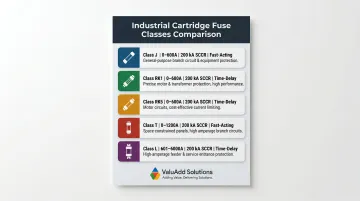
Time-delay (dual-element) fuses allow temporary inrush currents (which can reach 600% to 850% of full-load amps during motor startup) to pass without nuisance tripping, while still providing short-circuit protection. NEC 430.52(C)(1) permits time-delay Class R/J fuses to be sized up to 175% of motor full-load current, or up to 225% if starting current requires it.
Fast-acting fuses, by contrast, are reserved for resistive loads or surge-sensitive solid-state devices. Incorrect fuse selection causes either nuisance trips or inadequate protection.
NEC and Code Compliance
NEC Article 430 governs motor disconnect and overcurrent protection requirements. A fused disconnect can satisfy both the disconnecting means requirement (within sight of the motor controller, not more than 50 feet distant) and the branch-circuit short-circuit and ground-fault protection requirement in a single device—if sized per NEC 430.52. This consolidation simplifies panel layouts and reduces hardware count for system integrators designing compliant installations.
ValuAdd's Class E2 load break certified disconnect switches are tested and rated for the switching demands of industrial motor and high-load applications, making them a direct fit for NEC 430-compliant installations.
Use Cases of Fused Disconnect Switches
Fused disconnects are the appropriate choice in the following scenarios:
- Standalone machinery located away from the main panel: CNC machines, conveyor drives, packaging equipment
- High-inrush motor applications: Pumps, compressors, fans with significant startup current
- Hazardous or high-consequence environments: Oil and gas extraction and refining, chemical processing, heavy manufacturing
In these settings, a fused disconnect eliminates the need for a separate overcurrent device at the motor branch—consolidating protection into a single, maintainable unit.
What is a Non-Fused Disconnect Switch?
A non-fused disconnect switch physically isolates a circuit from its power source by breaking the electrical contacts. It provides no built-in overcurrent protection and depends entirely on upstream protective devices (circuit breakers or panel-mounted fuses) to handle fault conditions. Its sole function is safe, lockable isolation.
Operational and Economic Benefits
Non-fused disconnects offer several practical advantages:
- Costs less upfront — simpler internal design means fewer components and lower material cost
- Eliminates fuse replacement after an isolation event; just re-close the switch to restore power
- Reduces maintenance complexity by cutting the number of failure points in the circuit
These advantages matter most in applications where upstream protection is already confirmed and correctly sized.
Enclosure and Rating Options
Non-fused disconnects are available across the full range of industrial NEMA enclosure ratings:
- NEMA 1 — general indoor use
- NEMA 3R — outdoor and rain-resistant environments
- NEMA 4 — watertight and hosedown-rated
- NEMA 4X — corrosion-resistant (stainless steel or non-metallic)
- NEMA 12 — indoor dust-tight applications
That range covers everything from food processing and water treatment to outdoor industrial installations.
Critical Dependency and Common Mistake
Non-fused disconnects are only safe and appropriate when upstream overcurrent protection is correctly sized for the load. If the upstream breaker is oversized or improperly selected, the absence of a fuse creates a genuine safety gap that can result in equipment damage or fire. UL Solutions warns that where non-fused motor circuit HP-rated switches are used, they must be protected by separately installed upstream fuses or circuit breakers.
Use Cases of Non-Fused Disconnect Switches
Non-fused disconnects are appropriately applied in these scenarios:
- Equipment fed directly from a properly rated circuit breaker panel
- HVAC systems, lighting circuits, and resistive heating loads
- Motor control centers (MCCs) where each motor starter already has dedicated upstream protection
Common ValuAdd applications include:
- Municipal water treatment facilities running pump motors off established panelboard protection
- Manufacturing MCCs with distributed breaker protection assigned per motor
- Commercial and light industrial installations where standard breaker panels cover overcurrent protection
Fused vs. Non-Fused: Which One is Right for Your Application?
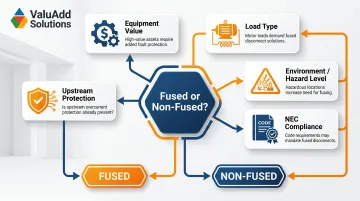
The right choice is determined by five factors:
- Presence of upstream overcurrent protection (and whether it's correctly sized)
- Equipment sensitivity and replacement cost
- Load type (resistive vs. inductive/motor with inrush)
- Environment and hazard level
- NEC compliance requirements for the specific circuit type
Choose Fused When:
- No upstream overcurrent protection device exists in the circuit
- Equipment is high-value or difficult to replace (large motors, specialized machinery)
- Load is a motor or inductive device with significant startup inrush current
- Application is in a hazardous or high-consequence environment
- NEC Article 430 requires the disconnect to serve as the branch-circuit overcurrent device
Choose Non-Fused When:
- A properly sized, coordinated circuit breaker or fuse panel is already installed upstream
- Load is resistive — lighting, heating, or other consistent-draw equipment
- Fast power restoration and maintenance simplicity are operational priorities
- Reducing upfront hardware cost without compromising safety is a business goal
Cost vs. Protection Tradeoff
Fused disconnects carry a higher upfront cost and add recurring fuse replacement expenses. However, they can prevent catastrophic equipment failures that far exceed those costs — a single avoided motor burnout or transformer failure typically justifies the investment.
According to the ARC Advisory Group, downtime costs the process industries $1 trillion annually. For a manufacturing facility or processing plant, a fused disconnect that prevents one unplanned motor failure — with replacement costs often running $5,000–$50,000 or more — pays for itself immediately.
Real-World Scenarios: Seeing the Difference in Action
Scenario 1: Standalone Conveyor Motor (Fused Disconnect)
A manufacturing plant installs a standalone conveyor motor 200 feet from the main electrical panel with no intermediate breaker. A winding fault develops — and with no upstream overcurrent protection nearby, a fused disconnect is the only thing standing between a blown fuse and a burned-out motor.
The fuse isolates the fault immediately. The conveyor is back online after a simple fuse replacement. Without that protection in place, the motor burns out completely, requiring a costly replacement and days of unplanned downtime.
Scenario 2: Municipal Water Treatment MCC (Non-Fused Disconnect)
A water treatment facility operates multiple pump motors, each fed from a centralized panelboard with properly rated molded-case circuit breakers. Non-fused disconnects at each pump station reduce hardware cost and eliminate fuse management across dozens of isolation points without creating a safety gap. The upstream breakers provide overcurrent protection; the disconnects provide safe, lockable isolation for maintenance.

Plant engineers and system integrators working through similar decisions can consult ValuAdd's technical team for guidance on disconnect type, amperage rating, and NEMA enclosure selection for their specific application.
Conclusion
Neither fused nor non-fused is universally superior. Fused disconnects are the right choice when integrated protection is needed at the point of use. Non-fused types are appropriate where upstream protection is already reliably in place. The right choice comes down to three factors: your system's existing protection architecture, the value of the connected equipment, and applicable NEC and NEMA code requirements.
This decision directly affects the outcomes industrial buyers care about most:
- Preventing unplanned downtime in critical processes
- Protecting expensive motor and drive assets
- Maintaining NEC and NEMA compliance
- Keeping long-term maintenance costs predictable
Frequently Asked Questions
What is the difference between a fused and non-fused disconnect switch?
A fused disconnect switch integrates both circuit isolation and overcurrent protection via internal fuses, while a non-fused disconnect switch provides isolation only and relies on upstream devices like circuit breakers for overcurrent protection.
What is the purpose of a fused disconnect switch?
A fused disconnect switch serves two functions simultaneously: it safely disconnects power to a circuit or piece of equipment for maintenance or emergencies, and it protects that equipment from damage caused by overcurrent events such as short circuits or overloads.
Do I need a fused or non-fused disconnect switch?
The choice depends on whether upstream overcurrent protection already exists. If a properly sized circuit breaker or fuse panel is upstream, a non-fused disconnect is sufficient. If no upstream protection is present, a fused disconnect is required for safety and code compliance.
How can I tell if a disconnect switch is fused or non-fused?
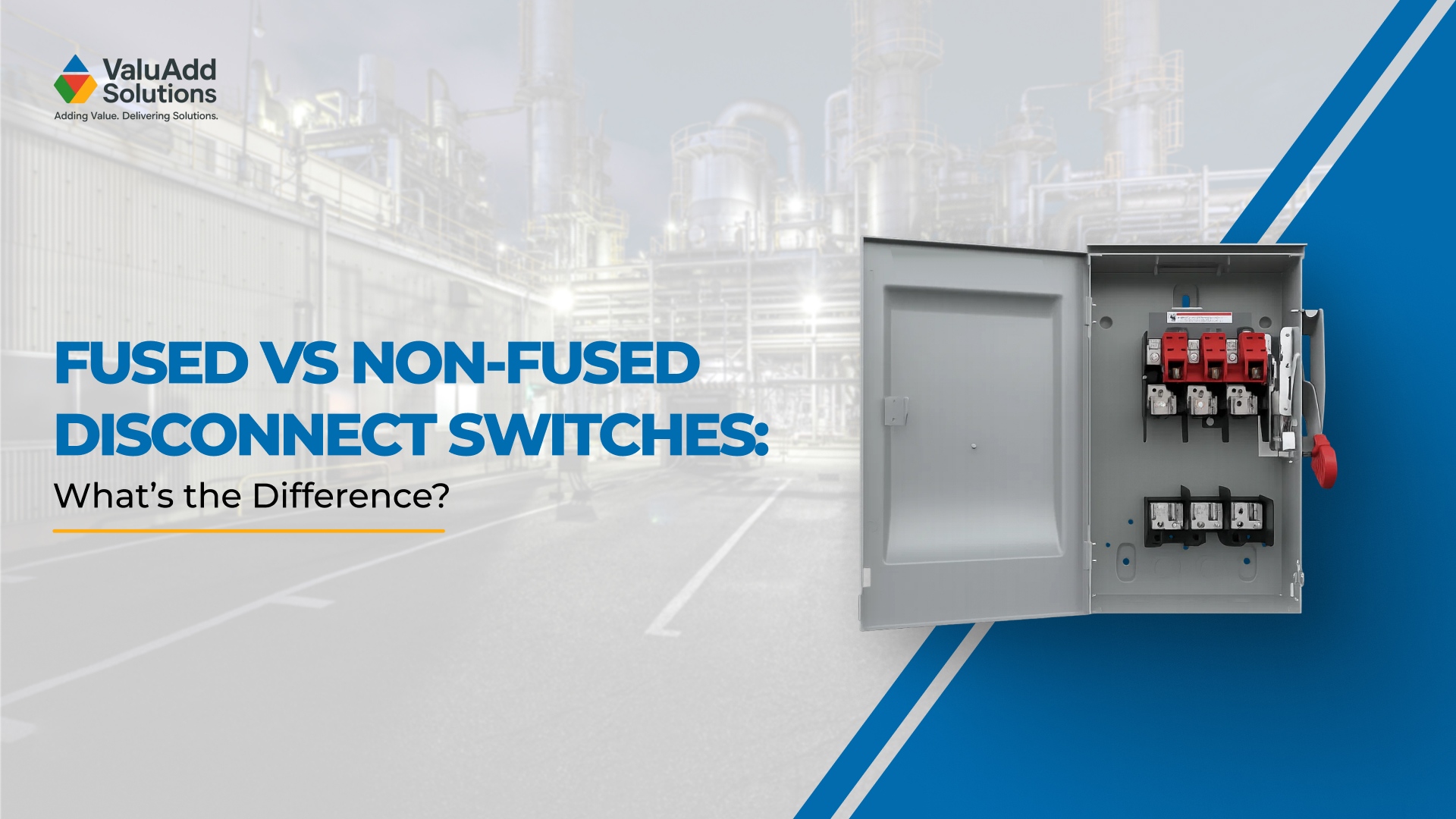
A fused disconnect switch will have visible fuse holders or cartridge fuse slots inside the enclosure, and its label will indicate fuse type and amperage ratings. A non-fused switch contains no fuse components and its label will note "non-fused" or show no fuse rating.
Can I replace a fused disconnect switch with a non-fused disconnect switch?
Yes, but only if a properly sized upstream overcurrent protection device — such as a circuit breaker or panel fuse — already exists for that circuit. Without it, removing the fused disconnect leaves the circuit and equipment unprotected against overloads and short circuits.
Are non-fused disconnect switches available in 30 amp ratings?
Yes, non-fused disconnect switches are widely available in 30A ratings and are commonly used for commercial and industrial applications such as HVAC systems, control panels, and small motor circuits in manufacturing and processing environments.