
Introduction
Fuse disconnect switches handle two jobs at once: manual power shutoff and overcurrent protection, packaged in a single enclosure. They show up at virtually every power isolation point in industrial systems—motor control panels, pump stations, HVAC equipment, and distribution boards alike.
The selection stakes are real. Poor choices lead to under-protected equipment, NEC non-compliance, and avoidable failures during maintenance or fault events.
Between 2017 and 2021, U.S. fire departments responded to an average of 36,784 fires annually at industrial or manufacturing properties, with electrical distribution equipment identified as the leading ignition source.
This guide breaks down what a fuse disconnect switch is, how it works through each stage of operation, how it compares to alternatives, and where it belongs in real industrial systems.
Key Takeaways
- A fuse disconnect switch combines a manual power shutoff (disconnect) with built-in overcurrent protection (fuse) in one UL 98-listed enclosure
- Fast-acting fuses interrupt almost instantly to protect sensitive equipment; time-delay fuses handle motor inrush currents (5–8× running current) without nuisance tripping
- Fused disconnects are preferred when no upstream overcurrent protection exists or when protecting high-value motor circuits
- They provide higher fault interruption capacity (up to 200 kA with Class J or CC fuses) than most circuit breakers
- Unlike circuit breakers, blown fuses must be physically replaced after a fault, requiring a deliberate repair step before power is restored
What Is a Fuse Disconnect Switch?
A fuse disconnect switch is a combination electrical device that serves two distinct functions. It allows technicians to manually de-energize a circuit or equipment (the disconnect function), and it automatically interrupts the circuit when current exceeds a safe threshold (the fuse function), all within a single enclosed unit.
Industrial equipment must be safely isolated during maintenance to meet lockout/tagout requirements, while also protected against overloads or short circuits during operation. A fuse disconnect addresses both needs with a single device.
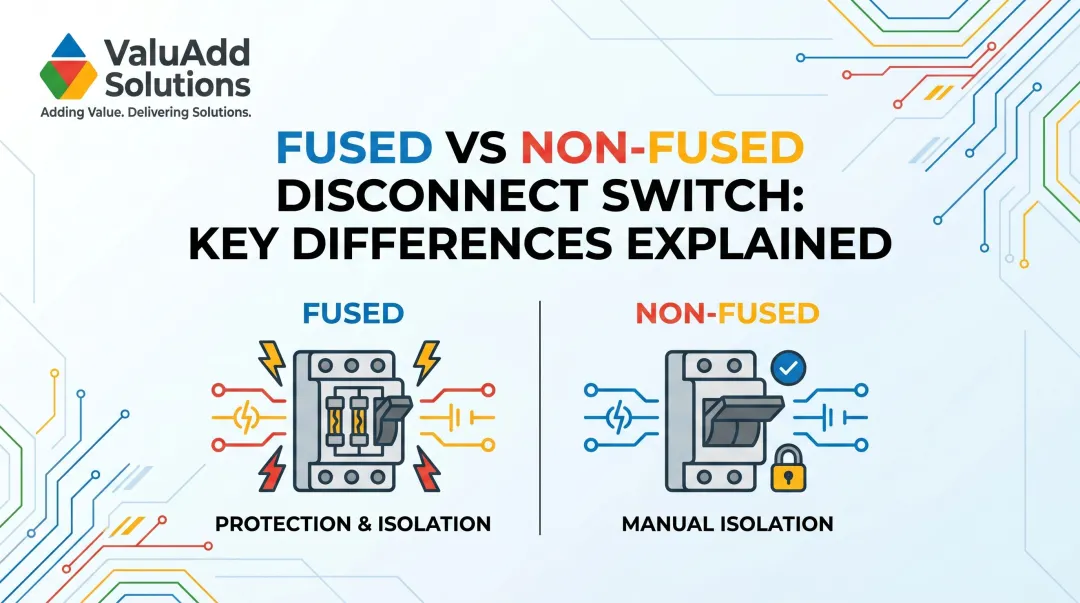
It differs from a general-purpose switch (which offers no fault protection) and from a circuit breaker (which is resettable and uses an electromagnetic mechanism rather than a sacrificial fuse element). In the field, "safety switch" and "fusible disconnect" are used interchangeably.
Main Types for Industrial Applications
Standard Fused Disconnects:
- Single-phase and three-phase configurations
- Ampacity ranges from 30A to 800A (ValuAdd's FUSERBLOC UL covers this range)
- Governed by UL 98 standard for enclosed and dead-front switches
Heavy-Duty Fused Disconnects:
- Rated for high-amperage motor circuits (400A, 800A, 1000A)
- Designed for continuous-duty industrial loads
- Meet NEMA KS-1 specifications for heavy-duty enclosed switches
Enclosed Fused Disconnects with NEMA Ratings:
| NEMA Type | Protection Scope | Typical Use |
|---|---|---|
| NEMA 1 | Indoor; protects against falling dirt and accidental contact | Clean indoor electrical rooms |
| NEMA 12 | Indoor; protects against dust, lint, fibers, oil splashing | Machining centers, oily manufacturing floors |
| NEMA 4X | Indoor/outdoor; protects against rain, snow, corrosion, hose-directed water | Food processing washdown, coastal water treatment plants |
Enclosure type affects where the device can be installed, not how the fuse mechanism operates.
Why Fused Disconnects Remain Widely Used
Despite circuit breaker prevalence, fused disconnects remain preferred in manufacturing, oil and gas, and processing plants for three critical reasons:
- UL 98 fused disconnects achieve up to 200 kA interrupting rating with Class CC, J, or L fuses, surpassing the interrupting capacity of many standard MCCBs
- Time-delay fuses can be sized at 175% of motor full-load current per NEC 430.52, giving engineers precise, field-replaceable protection coordination
- A single unit satisfies both the disconnecting means and branch circuit overcurrent protection requirements under NEC Article 430 for motor circuits
How Does a Fuse Disconnect Switch Work?
A fuse disconnect switch operates in two distinct modes: controlled (manual) and automatic (fault-triggered). Understanding both is essential to selecting and maintaining the device correctly.
Manual Actuation
The operator physically engages a handle or rotary actuator on the enclosure to open or close the electrical contacts, disconnecting the load from the power supply. The action is purely mechanical — it does not involve the fuse at all. Manual operation is the intended method for planned shutdowns, maintenance isolation, and lockout/tagout compliance under OSHA 29 CFR 1910.147.
Fuse Monitoring During Normal Operation
The fuse element — a thin calibrated metal filament inside a glass or ceramic cartridge — sits in series with the circuit conductors at all times. Under normal load, current flows through the filament without generating excess heat. The fuse's ampacity rating is matched to the circuit's design current, so everyday operation produces no thermal effect on the filament.
Fuse type selection at this stage directly affects how the device handles transient overcurrents, particularly in motor circuits:
- Time-delay (dual-element) fuses: Hold 500% of rated current for at least 10 seconds per UL standards. Designed for motor circuits that draw seven to eight times full-load current on startup.
- Fast-acting fuses: Interrupt almost instantaneously on overcurrent (0.05 to 2 seconds at 500% rating). Suited for sensitive electronics or resistive loads.
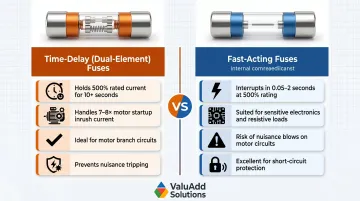
Using a fast-acting fuse on a motor circuit will cause repeated nuisance blows during normal starts. If oversized to 300% to compensate, it sacrifices overload protection — sustained overloads can then damage the motor before the fuse ever opens.
Overcurrent Response and Circuit Isolation
When current exceeds the fuse's rated ampacity for sufficient duration (based on the fuse's time-current characteristic), the filament heats to its melting point and opens the circuit permanently. This happens in milliseconds to seconds depending on fault magnitude and fuse type.
Unlike a circuit breaker, the blown fuse provides a one-time, non-resettable interruption. Power cannot be restored by flipping a switch. The blown fuse must be physically replaced with one of identical rating after the fault cause has been identified and corrected — forcing deliberate corrective action before re-energization and preventing recurring faults from damaging equipment.
Fused vs. Non-Fused vs. Circuit Breaker: Choosing the Right Protection
Selecting the wrong protective device causes equipment damage, NEC non-compliance, and unsafe maintenance conditions — problems common enough in industrial facilities that the choice deserves deliberate attention. Each option below fills a distinct role; matching the device to the application is what keeps facilities protected and inspections clean.
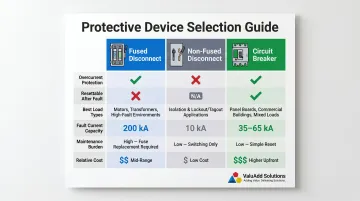
Comparison Table
| Attribute | Fused Disconnect | Non-Fused Disconnect | Circuit Breaker |
|---|---|---|---|
| Built-in Overcurrent Protection | Yes (sacrificial fuse) | No | Yes (resettable) |
| Resettable After Fault | No (fuse replacement required) | N/A | Yes |
| Best Suited Load Types | Motors, high-fault current circuits, VFD line-side | Isolation only (with upstream OCPD) | General branch circuits, frequent resets |
| Typical Fault Current Capacity | Up to 200 kA (Class J/CC fuses) | 10 kA (if protected upstream) | 35-65 kA (standard MCCB at 480V) |
| Maintenance Burden | Moderate (fuse replacement) | Low (mechanical only) | Low (reset only) |
| Relative Cost | Moderate | Low | Moderate to High |
When a Fused Disconnect Is the Right Choice
Use a fused disconnect when:
- Equipment has no upstream overcurrent protection
- Load is a high-horsepower motor requiring precise time-delay fuse sizing (175% of FLC per NEC 430.52)
- High fault current interruption capacity is needed (≥100 kA)
- NEC Article 430 motor branch circuit compliance is required
- Standalone machines arrive at a facility without upstream panel protection
When Non-Fused or Circuit Breaker Is Appropriate
Non-fused disconnect — Use when a circuit breaker upstream already provides overcurrent protection and the disconnect serves maintenance isolation only.
Circuit breaker — Preferred when frequent resetting is expected, such as process equipment prone to nuisance trips, or when a simpler reset process is the priority for three-phase circuits.
Where Fuse Disconnect Switches Are Used
Industrial Motor Applications
Fuse disconnects are standard in these industrial workflows:
- Motor branch circuits: Conveyors, compressors, pumps, and fans in manufacturing
- Feeder disconnects: Process control panels
- VFD input circuits: Water treatment and oil and gas facilities
In VFD applications, the fuse disconnect serves as the required line-side disconnect and upstream fault protection. Major VFD manufacturers like Rockwell Automation explicitly state their drives do not provide branch short-circuit protection and mandate external input fuses or circuit breakers.
Environmental and Installation Conditions
NEMA 4X enclosed fused disconnects:
- Washdown environments
- Outdoor installations
- Corrosive environments (municipal water/wastewater, chemical processing)
For indoor environments with dust, oil mist, or airborne particulates, NEMA 12 enclosures are the appropriate choice:
- Indoor industrial locations with dust and oil exposure
- Machine shops with cutting fluid spray
- Manufacturing floors with airborne particulates
Selecting the correct enclosure rating is as important as the electrical rating — the wrong enclosure in a washdown environment will fail regardless of how well the fuse disconnect is sized. ValuAdd's UL Listed fuse disconnect switches are available in both NEMA Type 4X and 12 configurations for these demanding environments.
NEC Compliance Context
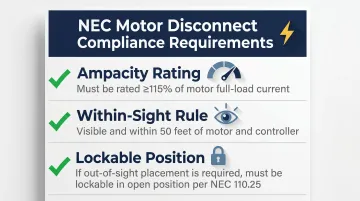
NEC Article 430.102 requires a disconnecting means within sight of motor controllers. Fused disconnects satisfy this requirement while simultaneously providing branch circuit overcurrent protection. The device must be rated for the load it serves—undersized disconnects create both compliance violations and safety hazards.
Key requirements:
- Disconnect must be rated at least 115% of motor full-load current
- Must be "within sight" (visible and ≤50 feet) of the motor and controller
- If out-of-sight placement is necessary due to hazards, the controller disconnect must be lockable in the open position per NEC 110.25
Frequently Asked Questions
What is a fuse switch disconnector?
A fuse switch disconnector is another term for a fused disconnect switch: a device that combines a manual isolation mechanism with an integrated fuse element that interrupts current during overloads or short circuits. The term originates from IEC 60947-3 (European/international standards) and refers to the same functional device used in North American industrial applications.
What is the difference between a circuit breaker and a fuse disconnect?
Both provide overcurrent protection, but a circuit breaker uses an electromagnetic or thermal-magnetic mechanism that can be reset after tripping, while a fused disconnect uses a sacrificial fuse element that must be physically replaced after it blows. Fused disconnects generally offer higher fault current interrupting capacity—up to 200 kA versus 35-65 kA for standard MCCBs at 480V.
When must a fused disconnect switch be used?
NEC Article 430 requires a disconnecting means for motor circuits, and a fused disconnect satisfies both the disconnect and overcurrent protection requirements in a single device. It is required when no upstream overcurrent protection exists, when equipment specifications mandate a fused device, or when the AHJ requires it for high-fault-current installations.
How to tell if a disconnect is fused or not?
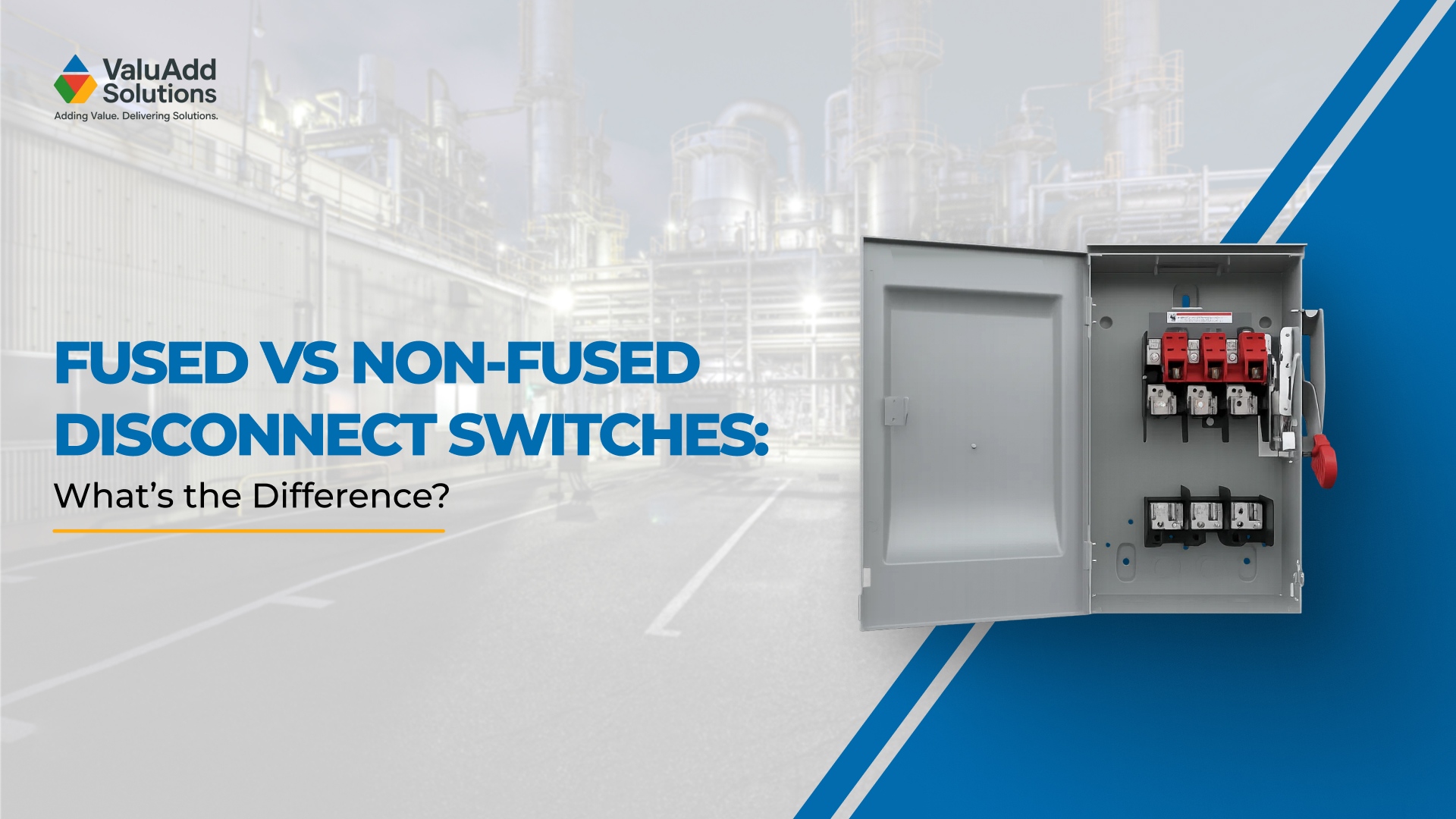
A fused disconnect will have cartridge fuses visible (or accessible via a pull-out fuse block) inside the enclosure when the door is opened, and is often labeled "Fusible". A non-fused disconnect will have no fuse holders inside—only bare electrical contacts and the actuator mechanism.
What types of fuses are used in a fuse disconnect switch?
Fast-acting fuses (Class R, J, or CC) suit resistive and sensitive electronic loads; time-delay fuses (Class RK5, J time-delay) handle motor circuits that must tolerate startup inrush current. Fuse class and ampacity must match circuit requirements and NEC guidelines. ValuAdd's FUSERBLOC UL supports Class CC, J, and L fuses with breaking capacities up to 200 kA.
What enclosure rating should I look for in a fuse disconnect switch?
NEMA 4X suits outdoor, washdown, or corrosive environments; NEMA 12 covers indoor industrial locations with dust, lint, or oil; NEMA 1 is acceptable only for clean, general-purpose indoor use. Always match the enclosure rating to the installation environment—improper selection risks equipment failure and code violations.