Introduction
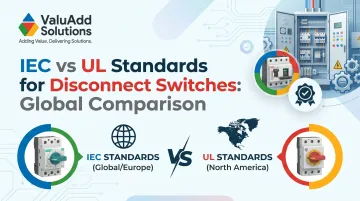
Electrical engineers and plant managers sourcing disconnect switches for industrial facilities face a critical compliance fork in the road: IEC or UL. The wrong choice can mean failed inspections, costly redesigns, and unexpected project delays—especially when equipment crosses borders. According to NFPA 790/791 field evaluation standards, using non-listed equipment in North America can trigger time-consuming field evaluations that add substantial cost and delay commissioning timelines.
Unlike general switchgear, disconnect switches carry specific rating systems—utilization categories versus horsepower/ampere ratings—along with isolation visibility requirements and enclosure standards that differ sharply between IEC and UL frameworks. The two regulatory paths are not interchangeable. An IEC-rated disconnect switch may carry an AC-23A utilization category marking, while its UL equivalent requires specific horsepower and continuous ampere ratings aligned to NEC Article 430.
Getting that distinction wrong at the specification stage is where projects stall. What follows breaks down the technical differences, identifies when each standard applies, and helps you match the right specification to your installation region and operating environment.
Key Takeaways
- IEC disconnect switches (IEC 60947-3) use performance-based testing and are the standard across most international markets
- UL standards (UL 98, UL 508A) are prescriptive, NEC-aligned, and required for North American installations
- IEC uses utilization categories (AC-22, AC-23); UL uses horsepower and ampere ratings — the two systems are not directly interchangeable
- Enclosure ratings use different scales: IEC assigns IP codes; UL assigns NEMA Type designations
- Choosing the right standard depends on installation region, project specifications, and whether equipment operates across multiple markets
IEC vs. UL Disconnect Switch Standards: Quick Comparison
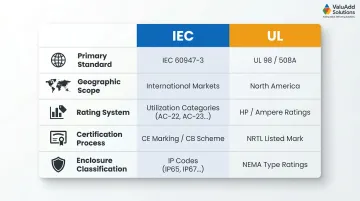
The five key differences below cover what engineers and system integrators most often need to compare when selecting disconnect switches for domestic or international projects.
| Aspect | IEC | UL |
|---|---|---|
| Primary Governing Standard | IEC 60947-3 / IEC 60947-1 | UL 98, UL 508A, UL 508 |
| Geographic Scope | Europe, Asia-Pacific, Middle East, Africa | US, Canada, parts of Latin America |
| Rating System | Utilization categories (AC-20 through AC-23) | Horsepower and continuous ampere ratings aligned to NEC |
| Certification/Marking Process | Performance-based testing by accredited lab, CE marking | NRTL listing (UL, CSA, Intertek, etc.), UL Listed mark |
| Enclosure Protection Classification | IP ratings (e.g., IP65, IP66, IP68) | NEMA Type ratings (e.g., Type 4X, Type 12) |
Real-world projects often require national adaptations, local code compliance, or dual-rated equipment. Always confirm requirements with the authority having jurisdiction (AHJ) before specifying disconnect switches for installation.
What Are IEC Standards for Disconnect Switches?
IEC 60947-3 is the primary international standard governing switches, disconnectors, switch-disconnectors, and fuse-combination units for industrial and commercial electrical systems. IEC 60947-1 covers general low-voltage switchgear and controlgear requirements that underpin it. IEC itself does not certify products—it publishes performance criteria, and accredited third-party labs conduct testing to issue CB certificates or test reports used for CE marking.
IEC utilization categories explained
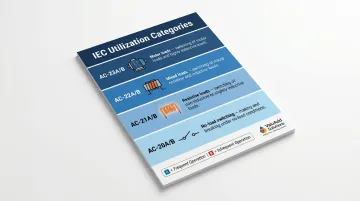
IEC utilization categories classify switching devices by duty severity and load type:
- AC-20A/B: No-load switching for isolating circuits without current flow
- AC-21A/B: Resistive loads, including moderate overloads (e.g., heating elements)
- AC-22A/B: Mixed resistive and inductive loads with moderate overloads
- AC-23A/B: Motor and highly inductive loads requiring the highest breaking performance
The suffix "A" indicates frequent operations; "B" indicates infrequent operations. Selecting the wrong utilization category—such as using an AC-21 rated unit in an AC-23 motor isolation application—can cause contact degradation, arc damage, and unsafe conditions.
IP ratings for enclosures
IEC's IP (Ingress Protection) rating system uses a two-digit code where the first digit indicates solid particle protection (0-6) and the second indicates liquid ingress protection (0-9). IEC 60529 governs these ratings. Common industrial disconnect applications require:
- IP65: Dust-tight and protected against low-pressure water jets
- IP66: Dust-tight and protected against strong jets of water from all directions
- IP68: Dust-tight and protected against continuous submersion under specified conditions
Performance-based philosophy
IEC standards are performance-based, meaning manufacturers have more freedom in construction details as long as they meet defined test outcomes. This results in more compact designs that can appear "undersized" to North American engineers accustomed to UL-prescribed construction rules — specific spacing, materials, and construction methods are not mandated.
The focus is entirely on verified performance under standardized test sequences, which is why IEC-rated equipment often looks different from its UL-listed counterpart while meeting equivalent functional requirements.
Where IEC disconnect switches are specified
That performance-based approach makes IEC disconnect switches the default specification in most markets outside North America. They dominate in:
- European manufacturing plants and industrial facilities
- Middle Eastern oil and gas installations
- Asian processing facilities and infrastructure projects
- Any global project where CE marking or CB scheme acceptance is the required compliance path
Industries where IEC-rated disconnect switches are standard specifications include chemical processing, renewable energy (IEC 60947-3 switch-disconnectors are common in solar combiner boxes rated up to 1500V DC), water treatment plants in IEC-market countries, and export-driven equipment assemblies. For US-based system integrators building equipment destined for export, sourcing disconnect switches with both IEC 60947-3 compliance and CE certification avoids costly re-engineering when projects ship to IEC-market countries — something ValuAdd's product line supports.
What Are UL Standards for Disconnect Switches?
UL 98 is the primary standard for enclosed and dead-front switches used as disconnect devices in North American electrical systems. UL 508A covers Industrial Control Panels, which frequently house disconnect switches as integral components, while UL 508 covers the components within.
UL is not the sole authority — other NRTLs (CSA, Intertek, KEMA) can perform equivalent listing evaluations — but UL is the most recognized by Authorities Having Jurisdiction (AHJs) across the US.
UL rating approach
UL rates disconnect switches using continuous current ampere ratings and horsepower (HP) ratings specific to motor applications, aligned with NEC Article 430 (motor circuit disconnects) and Article 404 (general switch requirements). A plant engineer specifying a 30HP motor disconnect in the US works from UL HP tables; specifying the same for a European plant works from IEC AC-23A utilization category tables. These are not interchangeable systems.
Prescriptive construction philosophy
UL specifies creepage and clearance distances, conductor types, terminal ratings, insulation materials, and temperature-rise limits assuming worst-case North American installation practices. For example, UL 98 switches require two inches spacing over surface for 600V devices, while UL 508 switches require 0.5 inches. This prescriptive approach often results in larger physical footprints compared to IEC-equivalent devices.
NEMA Type enclosure ratings
That construction philosophy extends to environmental protection. NEMA Type enclosure ratings serve as the UL-aligned environmental classification system:
- Type 12: Indoor industrial use protecting against dust, dirt, and dripping non-corrosive liquids
- Type 4X: Corrosion-resistant, indoor/outdoor use with watertight and dust-tight protection
There is no exact 1:1 conversion between NEMA Types and IP ratings, which is why serious industrial suppliers provide both designations. ValuAdd's disconnect switches carry NEMA Type 4X and 12 compliance alongside UL Listing — making them specification-ready for demanding US industrial environments. For NEMA 4X variants, ValuAdd uses polycarbonate and glass fiber reinforced polyester enclosures that provide proven corrosion resistance in oil and gas or chemical processing environments.
UL listing and follow-up inspection
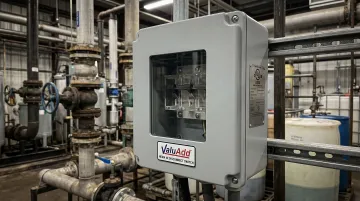
After initial testing, manufacturers enter an ongoing audit/inspection program to maintain the UL mark. This creates accountability beyond initial certification, which AHJs and industrial insurers rely on when approving North American installations. ValuAdd's disconnect switches carry the UL Listed mark physically on the product, so field inspectors can verify compliance on the spot without additional documentation.
Use Cases of UL Disconnect Switches
UL-listed disconnect switches are required for:
- US manufacturing facilities and industrial plants
- Industrial control panels built to UL 508A
- Motor control centers in water treatment plants
- Oil refinery electrical systems under NEC
- Any project where a US Authority Having Jurisdiction (AHJ) must approve the installation
AHJs typically reject unlisted equipment outright or require a costly field evaluation by an NRTL — adding project delays and engineering expenses that unlisted equipment rarely accounts for upfront. ValuAdd's UL-listed disconnect switches eliminate this risk for North American installations.
Key Technical Differences That Impact Industrial Operations
Rating Translation Problem
IEC utilization categories and UL HP/ampere ratings are not directly interchangeable. A disconnect switch rated AC-23A at a given current under IEC does not automatically carry an equivalent UL horsepower rating. The two systems use different test methodologies, spacing requirements, and acceptance criteria. Engineers specifying for dual-market projects must verify ratings independently under each system—never assume equivalency.
Short-Circuit Withstand and Breaking Capacity
IEC 60947-3 defines performance using:
- Icm (making capacity): Highest instantaneous peak current the device can establish
- Icu (ultimate breaking capacity): Maximum fault-current the device can interrupt without damage
- Ics (service breaking capacity): Expressed as a percentage of Icu (25%, 50%, 75%, 100%)
UL 98 defines short-circuit current ratings and interrupting capacity using different test sequences aligned to NEC fault current assumptions. A disconnect switch approved for a given fault current under IEC may need a different frame or additional testing to achieve UL equivalence.
Visible Isolation Requirements
Both IEC and UL require disconnect switches to provide a visible break or reliable indication of the open position for lockout/tagout (LOTO) safety. IEC 60947-3 addresses this through position indication requirements, while NEC Article 430.102 mandates that motor disconnects be within sight of the motor controller. The safety goal is identical, but construction and labeling details diverge enough that US facilities must verify OSHA-compliant LOTO procedures against whichever standard governs the installed equipment.
Enclosure and Environmental Ratings Gap
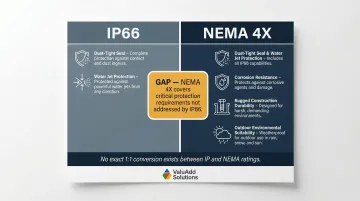
IP ratings (IEC 60529) and NEMA/UL Type ratings measure related but not identical characteristics. IP66 and NEMA 4X are frequently cited as approximate equivalents for outdoor industrial use, but the comparison breaks down in practice:
- IP66 confirms protection against powerful water jets and dust ingress
- NEMA 4X adds requirements for corrosion resistance and construction durability not covered by IP66
- Consequence: In oil and gas, chemical processing, or outdoor installations, specifying IP66 where NEMA 4X is required can accelerate corrosion and drive unplanned downtime.
Certification Documentation for Field Inspection
CE Declarations of Conformity, test reports, and technical files demonstrate IEC compliance. The NRTL Listed mark physically on the product demonstrates UL compliance. In North American inspections, inspectors look for that physical mark on the equipment—a CE declaration alone will not satisfy a US AHJ. When UL-listed equipment is unavailable, NFPA 790/791 field evaluations can add significant cost and delay.
These five differences—rating translation, fault-current testing, isolation indication, enclosure ratings, and certification documentation—don't exist in isolation. On a dual-market project, each one represents a separate verification step. Treating any of them as automatically equivalent between IEC and UL is where specification errors begin.
Choosing the Right Disconnect Switch Standard for Your Application
Decision factors
Evaluate these key factors when selecting between IEC and UL standards:
- Installation region and local electrical code (NEC vs. IEC/EN framework)
- Project specification language (does the spec explicitly call for UL Listed or CE marked?)
- Environmental conditions (enclosure IP or NEMA Type requirement)
- Multi-market operation (equipment that will operate across multiple jurisdictions)
Situational recommendations
Choose IEC-governed (IEC 60947-3) disconnect switches for:
- Global projects and export equipment
- CE-compliant assemblies
- Installations outside North America where IP-rated enclosures are standard
- Renewable energy projects requiring up to 1500V DC ratings
Opt for UL-listed (UL 98/UL 508A) disconnect switches for:
- All North American installations where AHJ approval is required
- Motor circuit disconnect applications under NEC Article 430
- Industrial control panels built to UL 508A
- Projects where inspectors expect the UL Listed mark on equipment
Consider dual-rated switches for:
- Global OEMs supplying multiple markets
- Manufacturers where maintaining separate product lines adds cost and complexity
- Projects requiring documentation flexibility
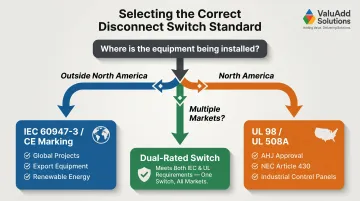
ValuAdd's UL Listed, CE Certified disconnect switches with Class E2 load break compliance meet this dual-market need directly for industrial integrators and manufacturers. Class E2 load break certification falls under IEC standards and confirms the switches can safely interrupt electrical loads under normal operating conditions, which matters most in medium voltage motor control and machinery protection applications.
Common mistake to avoid
Two compliance errors come up repeatedly in the field:
- Using an IEC-rated switch in a North American installation because it looks similar to a UL-listed unit — this can void warranties, fail inspections, and expose facilities to liability
- Forcing UL-specification designs into IEC-market projects — which adds unnecessary size, cost, and documentation burden
Always start with the target market's regulatory requirement.
Conclusion
IEC and UL are not competing quality systems—they are parallel compliance frameworks built for different markets with different regulatory environments. For disconnect switches specifically, the decision flows from where the equipment will be installed and inspected, not which standard is "better." IEC 60947-3 gives engineers a globally recognized, performance-based framework ideal for international projects; UL 98 and UL 508A align directly with NEC requirements and AHJ expectations that govern North American installations.
That standard selection has real operational consequences. In manufacturing, oil and gas, and water treatment environments, specifying the correct standard upfront reduces project delays, avoids costly field evaluations, supports LOTO compliance, and ensures enclosure ratings match actual site conditions. For facilities and integrators sourcing equipment across multiple markets, dual-rated disconnect switches remove the need for parallel product lines and consolidate documentation—letting procurement focus on performance requirements rather than paperwork.
Frequently Asked Questions
Are UL and IEC the same?
No, UL and IEC are not the same. IEC is an international standards body that publishes performance-based technical standards, while UL is a US-based safety organization that develops prescriptive standards and certifies products. IEC does not issue product marks; UL listing requires testing and ongoing follow-up inspection by an NRTL.
What is the IEC equivalent of UL 508A?
The closest IEC equivalent to UL 508A is IEC 61439-1 and IEC 61439-2, which govern low-voltage switchgear and controlgear assemblies. The two are not directly interchangeable—UL 508A includes NEC-aligned wiring rules that IEC 61439 does not prescribe, so panels built to one standard typically require re-evaluation for the other.
What is IEC 61439 UL equivalent?
IEC 61439 (low-voltage switchgear and controlgear assemblies) is most closely paralleled by UL 845 (Motor Control Centers) and UL 891/UL 1558 (switchboards and switchgear) in the US. The standards differ in testing methodology, busbar sizing rules, and short-circuit verification approaches, so a direct one-to-one mapping does not exist.
What is the IEC standard for disconnectors?
IEC 60947-3 is the primary standard for switches, disconnectors, switch-disconnectors, and fuse-combination units in industrial low-voltage applications. It defines utilization categories (AC-20 through AC-23), making and breaking capacity, and isolation requirements—and operates within the broader IEC 60947-1 general requirements framework.
What is the difference between IEC 60898 and 60947?
IEC 60898 covers miniature circuit breakers (MCBs) for household and similar final circuits up to 125A. IEC 60947 is the industrial-grade series—covering circuit breakers (60947-2), contactors (60947-4), and disconnect switches (60947-3)—designed for control panels, motor starters, and distribution equipment rather than residential end-user applications.
What is an IEC switch?
An "IEC switch" is a disconnect switch or switch-disconnector designed and tested to IEC 60947-3, which governs performance, utilization categories, breaking capacity, and isolation requirements for industrial switching applications. These switches are rated by utilization category (e.g., AC-22A for mixed loads, AC-23A for motor loads) and are standard in European, Asian, and globally exported industrial equipment.