Introduction
Walk into any industrial electrical supply house and you'll find two disconnect switches sitting side-by-side on the shelf—same voltage rating, similar amperage range, nearly identical appearance. Yet installing the wrong one can trigger a failed UL inspection, a month-long project delay, and a costly panel redesign. The distinction is a compliance issue with direct financial consequences.
For electrical system integrators, OEM panel builders, and plant engineers in manufacturing, water treatment, and oil and gas, this choice comes up on nearly every project. Misapplying a UL 508 switch in a feeder circuit typically results in UL inspection rejection and project delays exceeding a month.
The root cause: both standards meet functional specs on paper, but their permitted circuit locations are fundamentally different.
This article covers the definitions, key differences, permitted vs. prohibited circuit locations, and a practical decision framework for NEC-compliant selection—so you can specify confidently and avoid expensive rework.
Key Takeaways
- UL 98 covers service entrance, feeder, and branch circuits; UL 508 is limited to branch circuits for motor disconnecting only
- Feeder circuits require UL 98; branch circuits may use either standard depending on the application
- UL 508 switches cost less and take up less panel space due to reduced creepage and clearance requirements
- Using a UL 508 switch in a feeder circuit violates NEC and is a common cause of UL inspection failures
- Correct selection depends on identifying the last upstream overcurrent protective device relative to your switch
UL 98 vs UL 508: Quick Comparison
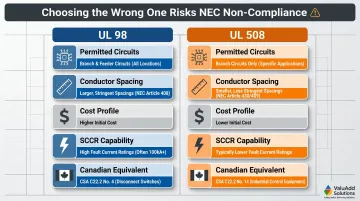
| Criterion | UL 98 | UL 508 |
|---|---|---|
| Primary Standard Purpose | Enclosed and Dead-Front Switches for general-purpose disconnecting | Industrial Control Equipment for motor starting, stopping, and control |
| Permitted Circuit Locations | Service entrance, feeder, and branch circuits | Branch circuits only (motor disconnect use) |
| Minimum Conductor Spacing | 2" surface / 1" air clearance (600V) | 0.5" surface / 0.375" air clearance (600V) |
| Relative Cost Profile | Higher cost, larger footprint due to robust construction | Lower cost, compact design with reduced spacing requirements |
| Typical SCCR Capability | Higher ratings suited to feeder-level fault currents | Lower ratings for branch-circuit motor applications |
| Canadian Equivalent | CSA C22.2 No. 4 | CSA C22.2 No. 14 |
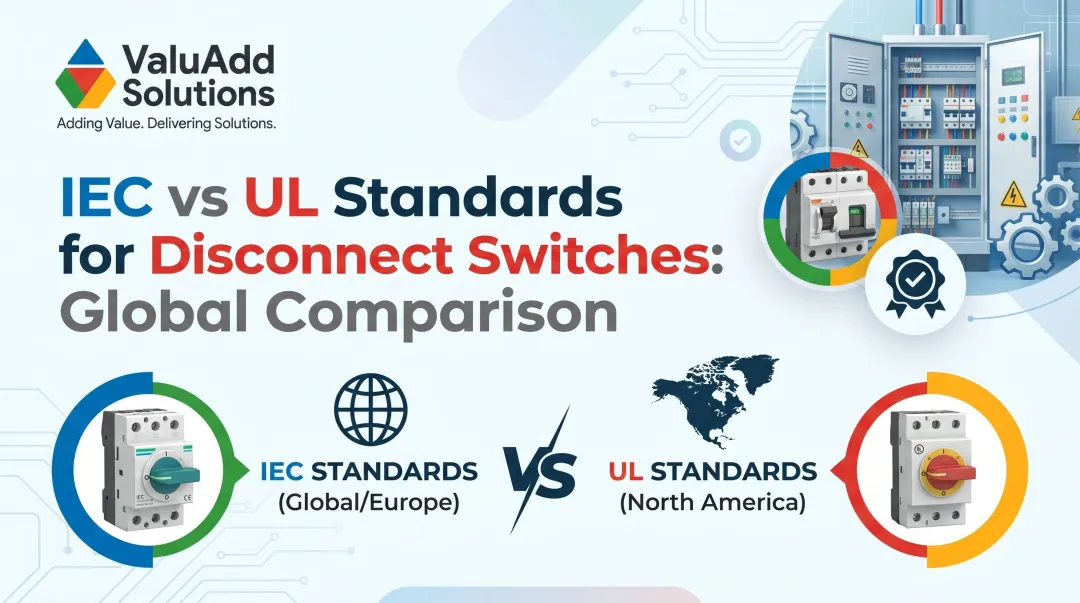
These differences play out in practice across two common form factors: traditional hard-wired and receptacle-interlock configurations. The receptacle-interlock UL 508 variant—featuring a rotating dial and cord-and-receptacle connection—is the most frequently misapplied device, with installers often selecting it for convenience without confirming circuit location compliance.
What is UL 98?
UL 98, the Standard for Enclosed and Dead-Front Switches, governs general-purpose disconnect switches and fused safety switches evaluated for service entrance, feeder, and branch circuits up to 600V AC/DC. The standard's construction requirements(including service-entrance spacing) qualify UL 98 devices where UL 508 cannot be used.
Physical Characteristics
UL 98 switches are recognizable by:
- Larger enclosure bodies with side-mounted handles for hard-wired installations
- Minimum 2-inch surface and 1-inch air clearance between uninsulated live parts of opposite polarity (600V rated)
- Higher short-circuit current ratings (SCCR) suited to feeder-level fault currents
- Robust construction with glass fiber reinforced polyester for mechanical and thermal resistance
Two Main Subtypes
UL 98 devices come in two configurations:
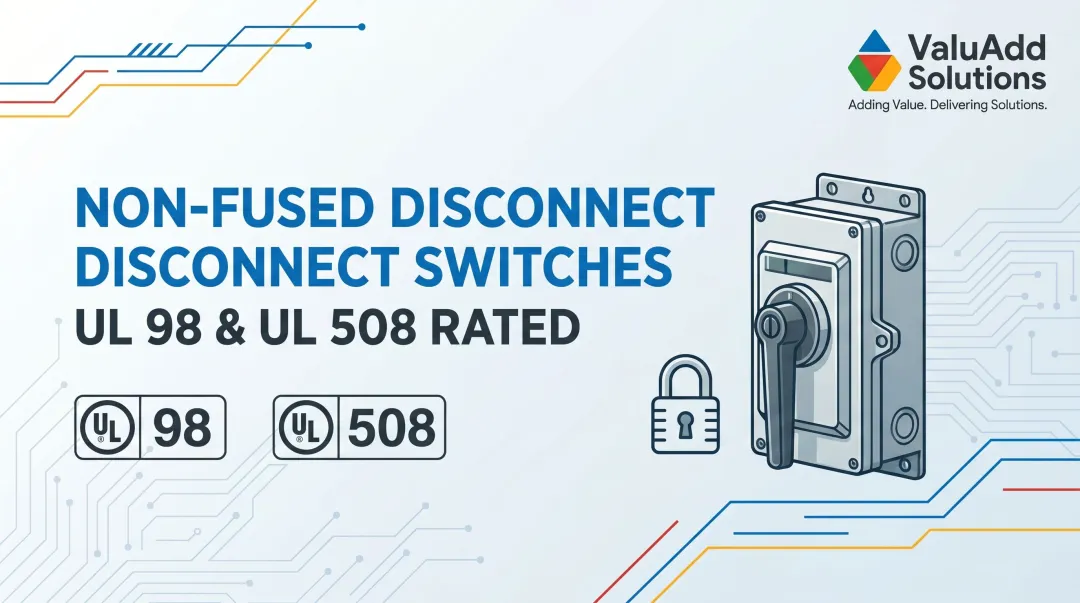
- Non-fused disconnect switches — used where upstream OCPDs already exist, providing isolation and switching without overcurrent protection
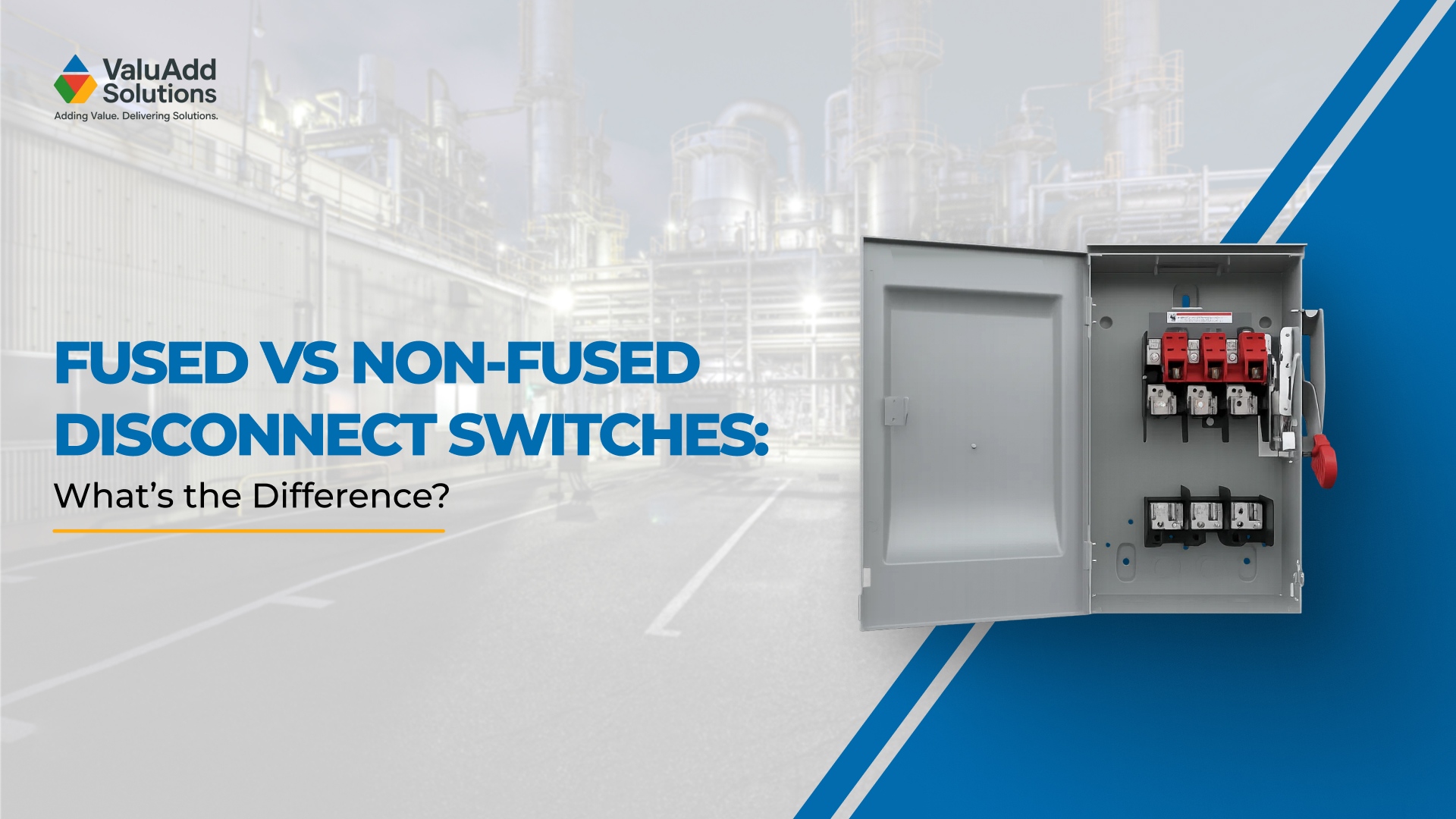
- Fused safety switches — incorporate branch-circuit overcurrent protection in a single enclosure, eliminating the need for a separate upstream fuse panel
Use Cases of UL 98
UL 98 is required for feeder circuits(everything upstream of the last OCPD), including:
- Main control panel feeders
- Multi-motor control panels fed by a single breaker
- Machine supply circuit disconnecting means (MSCD) per NFPA 79 Chapter 5
Industries where UL 98 dominates:
- Service entrance disconnects in manufacturing facilities
- Main disconnects on compressor skids (no dedicated per-motor branch OCPD)
- OEM equipment panels requiring third-party UL listing for industrial customers in oil and gas and water treatment
For system integrators specifying these applications, ValuAdd carries the SIRCO UL 98 C line rated up to 800 VAC and 1000A, available in NEMA 4X and IP66-rated enclosures for feeder-circuit use.
What is UL 508?
UL 508, the Standard for Industrial Control Equipment, covers manual motor controllers, motor starters, and control equipment designed to start, stop, regulate, control, or protect electric motors. A UL 508 switch marked "Suitable as Motor Disconnect" has been evaluated as a motor disconnect device—but this marking does not change its fundamental classification as industrial control equipment restricted to branch circuits.
Why UL 508 Switches Cost Less
UL 508 switches are smaller and less expensive because they're not required to meet service-entrance creepage and clearance standards:
- Minimum 0.5-inch surface and 0.375-inch air clearance (vs. UL 98's 2" surface / 1" air)
- Smaller construction reduces material cost and panel footprint
- Lowers panel cost when installed downstream of a dedicated branch OCPD
The "Supplementary Device" Principle
A UL 508 switch can serve as a local motor disconnect on the load side of an upstream UL 98 or UL 489 OCPD—but it cannot stand alone as sole branch-circuit overcurrent protection. A separate upstream device is always required.
Receptacle-Interlock Variant
The receptacle-interlock UL 508 variant features:
- Rotating on/off dial
- Cord-and-receptacle connection for machine portability
- Safety interlock forcing de-energization before unplugging
Contractors sometimes misapply this variant in general-purpose or feeder locations where UL 98 is required.
Use Cases of UL 508
UL 508 belongs in these scenarios:
- Within sight of the motor (per NEC 430.102, within 50 feet)
- On the load side of a dedicated per-motor branch OCPD (UL 98 fused disconnect or UL 489 circuit breaker)
- Compact control panel branches where cost and space savings matter
These conditions are common across several industrial sectors:
- Packaging lines with many individual motor branches
- Conveyor systems
- Pump panels in water treatment
- Machine tool panels where dozens of small motors share a panel fed by a single feeder—each motor gets its own UL 508 disconnect downstream of the panel's main UL 98 device
For these branch-circuit applications, ValuAdd carries the SIRCO M Non-Fusible Disconnect Switch—UL 508 listed, rated 16A to 100A at up to 600 VAC, and marked suitable for motor disconnection.
UL 98 vs UL 508: Which One Should You Choose?
The Primary Decision Question
"Where is the last upstream overcurrent protective device relative to my disconnect?"
- If the disconnect is on the load side of a dedicated per-motor branch OCPD → either UL 98 or UL 508 may apply
- If the disconnect is at or upstream of that OCPD—or in a feeder → only UL 98 or UL 489 is permitted
The answer to that question determines which standard applies in almost every scenario. The two frameworks below cover the most common installation configurations.
Two-Scenario Decision Framework (NEC Article 430)
| Installation Scenario | Required Disconnect Standard |
|---|---|
| Dedicated branch circuit per motor | UL 508 acceptable as local disconnect |
| Single feeder breaker feeding multi-motor panel (no individual branch OCPDs) | UL 98 or UL 489 required for each disconnect |
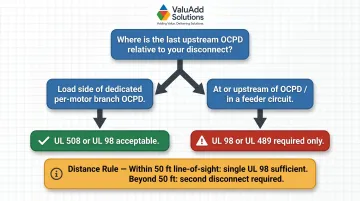
Physical distance adds another layer to this decision — even when OCPD placement is resolved, sight-line and distance requirements under NEC 430.102 can change what you need at the motor end.
Location/Distance Rule
Per NEC 430.102 (reference article):
- If the disconnect is within sight of the motor and controller (≤50 feet) → a single UL 98 switch can serve both
- If distance exceeds 50 feet or sight line is obstructed → a second disconnect is needed:
- UL 98 for the motor-controller circuit
- UL 508 recommended for the motor end (or a lockable UL 98 per NEC 430.102(B))
Situational Recommendations
Choose UL 98 when:
- Designing feeder disconnects
- Specifying main panel disconnects
- Meeting machine supply circuit disconnect requirements per NFPA 79
- Requiring NEMA 4X/IP66 outdoor-rated enclosures with high SCCR
Choose UL 508 when:
- Cost and panel space are priorities
- A dedicated upstream branch OCPD is confirmed in design documentation
- Application is strictly branch-circuit motor disconnect use
Compliance Verification Checklist
- Document upstream OCPD location in installation drawings
- Verify conductor sizing meets NEC 430.52 requirements for motor branch circuits
- Verify disconnect is properly marked on device nameplate
- Cross-check the specified standard against AHJ requirements before finalizing drawings
The Real Cost of Getting It Wrong
The Misapplication Pattern
According to Electrical Engineering Resource, misapplication of UL 508 switches in feeder circuits requiring UL 98 is common—both devices match voltage and amperage ratings on paper, but their listed application scope is not interchangeable.
Real-World Consequences
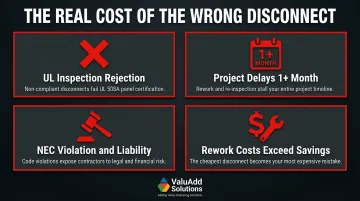
A panel builder who uses a UL 508 switch as the main panelboard disconnect will face:
- UL inspection rejection requiring full panel redesign and modification
- Project delays exceeding one month
- NEC violation risks and potential liability exposure in the event of an electrical fault
- Rework costs—replacement components plus labor that typically exceed the original price difference many times over
Correct Specification Practice
Avoiding these outcomes comes down to verification before purchase, not after:
- Confirm circuit type (feeder vs. branch) before component selection
- Review the UL listing mark and standard designation on the device nameplate
- When circuit location is ambiguous, specify UL 98—the modest cost premium is far less than a project delay
Conclusion
UL 98 and UL 508 are not interchangeable alternatives—they serve distinct circuit locations defined by the NEC. The right choice depends entirely on whether the disconnect sits in a feeder circuit (always UL 98 or UL 489) or a branch circuit with a confirmed upstream OCPD (UL 98 or UL 508 both acceptable).
Getting this right has real consequences for your project. Specifying the correct standard:
- Reduces redesign risk before inspection
- Ensures approval without costly rework
- Keeps panel cost and footprint in check
- Limits liability exposure from downstream fault events
For system integrators and facility engineers working in manufacturing, water treatment, or oil and gas, that distinction is worth confirming before the panel design is finalized.
Frequently Asked Questions
What is the difference between UL 98 and UL 508?
UL 98 covers enclosed switches permitted in service entrance, feeder, and branch circuits with robust construction and larger creepage/clearance spacing. UL 508 covers industrial control equipment (motor controllers) restricted to branch circuits only. The key distinction is circuit location and spacing requirements.
What is UL 98?
UL 98 is the Standard for Enclosed and Dead-Front Switches, covering general-purpose, fused, and non-fused disconnect switches rated up to 600V AC/DC. These switches meet service-entrance spacing requirements and can serve feeder or branch circuits in industrial, commercial, and utility applications.
What is UL 508?
UL 508 is the Standard for Industrial Control Equipment, covering motor controllers and manual motor starters. A UL 508 switch marked "Suitable as Motor Disconnect" may serve as a branch-circuit motor disconnect only, and cannot be used in feeder circuits or as a main/branch-circuit overcurrent protective device.
What is the difference between UL 489 and UL 508?
UL 489 covers industrial circuit breakers that serve as branch-circuit overcurrent protective devices, similar in permitted locations to UL 98 switches. UL 508 covers motor control equipment limited to branch-circuit motor disconnect use. Both UL 98 and UL 489 are permitted in feeder applications; UL 508 is not.
What are the NEC requirements for disconnect switches?
NEC Article 430.109 requires a disconnect for every motor and controller, located within sight of the motor (within 50 feet per NEC 430.102) or lockable open. Feeder-circuit disconnects must be UL 98 or UL 489 listed; branch-circuit motor disconnects may use UL 508 when an upstream OCPD is present.
Where are fused disconnects required?
UL 98 fused safety switches are required when no upstream overcurrent protective device exists, such as when a single feeder supplies a multi-motor panel. They combine disconnect and overcurrent protection in one enclosure, satisfying NEC 430 without a separate fuse panel.