This guide covers what industrial submetering is, how to calculate its financial return, which compliance frameworks require it, and a step-by-step deployment process that works for manufacturing plants, processing facilities, and other energy-intensive operations.
TLDR:
- Industrial submetering measures energy at the machine, line, or department level—visibility the utility bill can't provide
- Demand charge reduction delivers the fastest ROI, often achieving payback in 1-3 years
- ASHRAE 90.1-2022, ISO 50001, and state benchmarking laws now mandate granular monitoring
- Successful deployment requires industrial-grade hardware rated for harmonics, dust, and temperature extremes
- ValuAdd offers IEEE 519-compliant meters and NEMA 4X/12-rated enclosures designed for these demanding environments
What Is Industrial Energy Submetering?
Industrial energy submetering is the installation of secondary meters downstream of the utility master meter to measure energy consumption at the machine, circuit, production line, or department level. While the utility meter determines what you owe the energy provider, submeters determine where inside the facility that energy is consumed and whether that usage is justified.
What Gets Metered in Industrial Facilities
Industrial submetering focuses on equipment that drives the highest loads and operational costs:
- Pumps, compressors, conveyors, and fans (primary motor-driven loads)
- Chillers, air handlers, and rooftop HVAC units
- Compressed air compressors and distribution networks
- Furnaces, ovens, injection molding machines, and coating lines
- High-bay and process lighting circuits
- Distribution panels, transformers, and other critical infrastructure
This differs from commercial submetering, which focuses on tenant allocation and shared utility cost recovery. Industrial submetering prioritizes production equipment, process optimization, and demand management.
Utility Meter vs. Submeter: The Key Distinction
The utility (fiscal) meter measures total site consumption for billing by the energy provider. It answers one question: "What do we owe?"
Submeters are installed internally to measure consumption at specific loads or areas. They answer: "Where is that energy going, and is it being used efficiently?" Unlike utility meters, submeters serve internal purposes:
- Allocating energy costs across departments or production lines
- Identifying inefficiencies and waste at the equipment level
- Supporting predictive maintenance through consumption trend data
- Generating documentation for energy compliance reporting
The ROI Case for Industrial Energy Submetering
Demand Charge Reduction: The Fastest Payback
Industrial facilities on demand-rate tariffs pay a premium based on peak 15- or 30-minute consumption windows. Demand charges typically account for 30% to 70% of commercial and industrial electric bills, making them the single largest controllable cost component.
Without submetering, facilities have no visibility into which equipment creates demand spikes. A single motor start, a simultaneous load event, or equipment running during peak hours can set the billing tier for the entire month. Submetering exposes these patterns, enabling load-scheduling changes that measurably cut demand charges—often by 10-20% in the first year.
Identifying Energy Hogs and Waste
Energy audits without submeter data rely on estimates and assumptions. With granular data, facilities can:
- Rank loads by actual consumption
- Identify equipment running outside production hours
- Detect abnormal draw levels indicating inefficiency or malfunction
Example: A compressed air system left running overnight at a manufacturing plant consumed 18% of the facility's total energy—discovered only after submetering revealed the pattern. Scheduling changes and automatic shutdowns eliminated $47,000 in annual waste.
Predictive Maintenance Through Power Monitoring
Abnormal power draw, power factor degradation, or current imbalance on a motor circuit are early warning signs of mechanical problems. Common indicators include:
- Worn bearings drawing higher-than-normal current
- Failing insulation showing up as power factor drift
- Pump cavitation or belt slippage creating irregular load signatures
Submetering connects these energy signals to equipment health, enabling predictive maintenance before failures escalate. Unplanned downtime costs range from $39,000 per hour in consumer goods manufacturing to approximately $2.3 million per hour in the automotive sector. Catching a failing motor before it seizes eliminates both the repair cost and the far larger production losses behind it.
Utility Rebates and Incentive Programs
Submetering creates the measurement and verification (M&V) documentation that utility rebate programs require — without it, most incentives are inaccessible. Two major funding sources to evaluate:
- PG&E and similar utility programs offer energy efficiency rebates sometimes valued up to $2,000 per kW reduced
- The U.S. DOE's 50001 Ready program helps facilities build ISO 50001-aligned energy management systems, which qualify for Strategic Energy Management (SEM) incentives from many utilities
Payback Period Framework
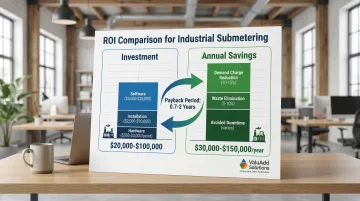
These savings stack. Combined, demand charge reduction, waste elimination, and rebate capture typically shorten the overall payback timeline considerably — here's how the numbers break down for a mid-sized facility with 10-20 metering points:
- Hardware costs: Meters, CTs, enclosures ($500-$3,000 per metering point)
- Installation costs: Electrical labor, communication infrastructure ($2,000-$10,000)
- Software/integration: Energy management platform, dashboards, reporting ($5,000-$25,000)
Total investment: $20,000-$100,000 for a mid-sized facility with 10-20 metering points.
Annual savings from demand charge reduction (10-15%), waste elimination (5-10%), and avoided downtime (varies) range from $30,000 to $150,000.
Industry studies show payback periods ranging from 0.7 to 2 years, with ongoing savings compounding afterward. Facilities on demand-heavy tariffs — particularly those in automotive, food processing, or continuous manufacturing — sit at the high end of that savings range and consistently hit payback in under 12 months.
Compliance Requirements Every Industrial Facility Should Know
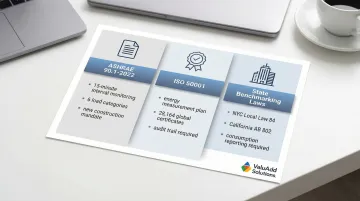
ASHRAE 90.1-2022 Section 8.4.3
ASHRAE 90.1-2022 mandates electricity monitoring by load type in new commercial and industrial construction. Facilities built or significantly renovated to comply with ASHRAE 90.1 must treat submetering as a design requirement, not an afterthought.
Section 8.4.3 requires measurement devices to monitor electrical energy use separately for:
- Total electrical energy
- HVAC systems
- Interior lighting
- Exterior lighting
- Receptacle circuits
- Refrigeration systems
Data must be recorded at least every 15 minutes and reported hourly, daily, monthly, and annually. Categories with design loads less than 10% of the whole-building load may be combined.
Facilities that go beyond minimum compliance — monitoring additional load categories or integrating with a SCADA system — capture operational insights that directly reduce energy spend.
ISO 50001 Energy Management Standard
ISO 50001 is the international energy management standard requiring systematic monitoring and measurement of energy performance. Submetering is the primary mechanism for meeting its measurement and verification requirements.
The standard requires an energy measurement plan covering key operational characteristics that drive energy use. As of 2022, 28,164 active ISO 50001 certificates were in force globally across 55,883 sites — a measure of how seriously energy-intensive industries take structured monitoring.
Industries most commonly pursuing ISO 50001 certification:
- Oil and gas
- Manufacturing (automotive, metals, chemicals)
- Food and beverage processing
- Pulp and paper
- Pharmaceuticals
Beyond the certification itself, ISO 50001 compliance frequently qualifies facilities for utility demand-response incentives and favorable treatment in supply chain audits.
The audit trail a submetering system generates also shortens insurance review cycles — documented consumption data reduces underwriter uncertainty and can accelerate policy renewals.
How to Deploy Industrial Energy Submetering: A Step-by-Step Process
Step 1 — Conduct an Energy Load Audit
Before selecting hardware, map all significant electrical loads on the facility's single-line diagram. Prioritize metering points by:
- Load size: Focus on circuits drawing >50 kW
- Production criticality: Meter equipment that impacts throughput
- Compliance requirements: Cover ASHRAE 90.1 categories (HVAC, lighting, etc.)
Identify which circuits feed dedicated equipment versus shared infrastructure. CT sizing, meter placement, and communication architecture all follow from that distinction.
Step 2 — Select Meter Hardware Appropriate to the Environment
Industrial environments impose conditions that commercial meters cannot handle:
- High-voltage circuits (480V, 600V)
- Harmonic distortion from VFDs
- Dusty or wet enclosure areas
- Ambient heat and vibration
Hardware selection must account for:
- Accuracy class: Revenue-grade (0.2% to 0.5%) for cost allocation
- Communication protocol support: Modbus RTU/TCP, BACnet, PROFIBUS
- Environmental ratings: NEMA 4X/12 or IP65/IP66/IP68
Many projects fail by specifying analog-only meters that cannot transmit data remotely. Choose meters with built-in communication and integration capabilities from the start.
Step 3 — Design the Communication Architecture
Choose between wired (RS-485, Ethernet) and wireless (LoRaWAN, cellular, Wi-Fi) communication based on:
- Site layout and distances
- Existing infrastructure
- Data security requirements
Plan integration with existing SCADA, DCS, or building automation systems from the design phase — not as an afterthought. When submeter data flows into platforms operators already use, separate dashboards become unnecessary and response times improve.
Step 4 — Commission and Validate the System
After installation, compare submeter readings against known loads and utility bills to verify accuracy. Check for:
- Reversed CT orientation — polarity errors produce negative readings that corrupt baselines
- Phase assignment mistakes — incorrect mapping skews load calculations across the entire circuit
- Communication dropouts — test every data path under normal operating conditions before go-live
Document the validated baseline consumption for each metered point. Without a verified baseline, claimed energy savings have no credible benchmark.
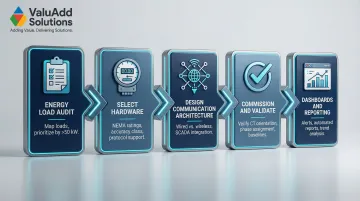
Step 5 — Set Up Dashboards, Alerts, and Reporting Workflows
Configure energy management software to turn meter readings into actionable intelligence:
- Display consumption by machine, shift, and production unit
- Set up threshold alerts for abnormal draw
- Schedule automated compliance reports
Weekly dashboard reviews, monthly trend analysis, and quarterly performance reports are what separate a submetering system that pays for itself from one that collects data nobody reads.
Choosing the Right Hardware for Industrial Submetering
Why Industrial-Grade Hardware Ratings Matter
Standard commercial meters fail prematurely in environments with high humidity, dust, corrosive atmospheres, or extreme temperatures. Look for:
- NEMA Type 4X enclosures: Protection against corrosion, windblown dust, rain, splashing water, and hose-directed water. Best for washdown areas, outdoor processing, or corrosive environments.
- NEMA Type 12 enclosures: Protection against circulating dust, falling dirt, and dripping/light splashing of non-corrosive liquids. Best for indoor manufacturing floors and electrical rooms.
- IP ratings: IP65/IP66/IP68 provide comparable protection levels for international applications.
Harmonic Compliance for VFD Environments
Variable Frequency Drives (VFDs) and other non-linear loads generate harmonic distortion that can cause inaccurate readings in low-quality meters. Meters should comply with IEEE 519 to ensure measurement accuracy in the presence of harmonics.
IEEE 519-2022 establishes limits for voltage and current distortion:
- Voltage distortion: For bus voltages ≤ 1.0 kV, individual harmonics limited to 5.0%, Total Harmonic Distortion (THD) limited to 8.0%
- Current distortion: Total Demand Distortion (TDD) typically capped between 5.0% and 20.0%
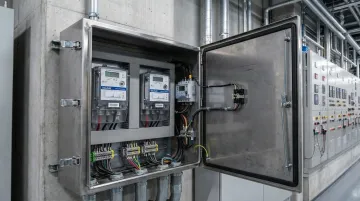
ValuAdd's IEEE 519-compliant meters and NEMA Type 4X/12-rated enclosures meet these distortion thresholds, making them a practical fit for facilities running heavy VFD loads.
Communication and Integration Criteria
Meters should support open industrial protocols to avoid vendor lock-in and enable seamless integration:
- Modbus RTU/TCP: De facto standard for industrial automation, widely supported by PLCs and gateways
- BACnet: Dominant in Building Automation Systems (BAS), managed by ASHRAE
- PROFIBUS/PROFINET: Purpose-built protocols for heavy industrial automation and process control
Beyond protocol compatibility, confirm that meters match the CT ratios and voltage levels in your facility's distribution system. Mismatched inputs introduce measurement errors that compromise the entire submetering installation.
Frequently Asked Questions
What is an energy submeter?
An energy submeter is a secondary metering device installed downstream of the main utility meter to measure electricity (or gas, water, steam) consumption at a more granular level—such as by machine, department, or circuit. It gives facility operators visibility the utility bill alone cannot provide.
What are the benefits of energy submetering?
Submetering delivers measurable impact across several areas:
- Identifies energy waste at the machine or circuit level
- Reduces demand charges through targeted load management
- Supports predictive maintenance by flagging abnormal consumption patterns
- Simplifies compliance reporting for ISO 50001, ASHRAE, and benchmarking laws
- Enables data-driven decisions that lower operating costs over time
What is submetering income?
Submetering income typically refers to revenue generated by property owners or facility operators who bill individual tenants, departments, or cost centers for their actual energy use based on submeter readings—as opposed to allocating shared utility costs by square footage or another proxy method.
What compliance standards require industrial energy submetering?
Key standards include:
- ASHRAE 90.1-2022: Mandates electricity monitoring by load type in new construction
- ISO 50001: Requires systematic energy measurement for certified facilities
- State/local benchmarking laws: NYC Local Law 84 and California AB 802 require consumption reporting
Requirements vary by jurisdiction and building type.
How long does it take to see ROI from industrial energy submetering?
Payback periods vary by facility size and energy costs, but industrial submetering projects commonly achieve payback within 1-3 years through demand charge reduction, waste elimination, and avoided unplanned downtime—with ongoing savings thereafter.
What is the difference between a utility meter and a submeter?
The utility (fiscal) meter measures total site consumption for billing by the energy provider. Submeters are installed internally to measure consumption at specific loads or areas—they handle internal cost allocation, efficiency analysis, and compliance reporting, not utility billing.