Introduction
When the grid goes down, one decision determines whether critical equipment restarts in seconds or sits idle until someone drives to the site: manual transfer switch or automatic transfer switch. For industrial and commercial operations—manufacturing lines, pump stations, water treatment facilities—that choice has direct consequences for uptime, safety, and regulatory compliance.
The wrong choice means either overspending on automation you don't need or watching production halt because no one was on-site to flip a switch. According to recent industry data, unplanned downtime costs U.S. manufacturers an average of $260,000 per hour, with automotive operations losing up to $2.3 million per hour.
At that cost exposure, transfer switch selection is a financial risk decision. This guide breaks down how each option works, where each fits, and how to match the right switch to your operation.
Key Takeaways
- Manual Transfer Switch (MTS) requires an operator to physically swap utility for generator power—cost-effective, but needs someone on-site
- Automatic Transfer Switch (ATS) detects outages and completes the transfer sequence without intervention, critical for unmanned facilities
- MTS suits budget-constrained applications with reliable on-site personnel during outages
- ATS is required for code-mandated standby loads and any operation where unplanned downtime has real financial or regulatory consequences
- Both switches prevent dangerous backfeeding—the only real difference is who (or what) initiates the transfer
MTS vs ATS: Quick Comparison
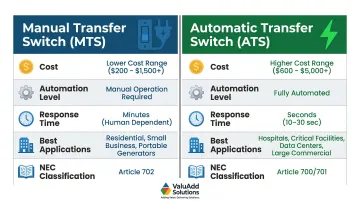
| Feature | Manual Transfer Switch (MTS) | Automatic Transfer Switch (ATS) |
|---|---|---|
| Cost | Lower upfront hardware and installation cost; straightforward wiring | Higher unit cost and installation labor due to monitoring circuits, generator start wiring, and control logic |
| Automation | Zero automation — operator detects outage, starts generator, and transfers load manually | Monitors utility voltage, signals generator start, verifies stable output, then transfers load automatically |
| Response Time | Variable — depends entirely on how quickly the operator responds | Generator start plus stabilization: typically 10–30 seconds; switching mechanism operates in milliseconds |
| Best Applications | Portable generators, smaller facilities, light commercial, budget-constrained projects, sites with reliable on-site staff | Permanent standby generators, unmanned facilities, critical operations (manufacturing, water treatment, data infrastructure), legally required standby systems |
| NEC Classification | Permitted for optional standby systems (NEC Article 702) — non-life-safety and convenience loads | Required for legally required standby (Article 701) and emergency systems (Article 700) — fire pumps, emergency lighting, critical operations power |
What is a Manual Transfer Switch (MTS)?
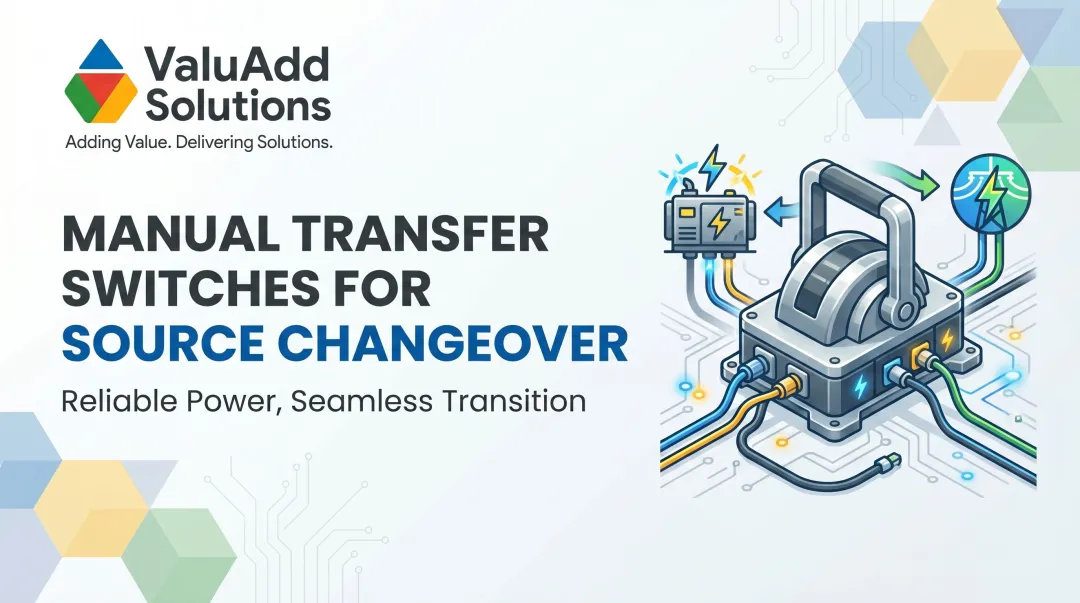
A Manual Transfer Switch is a standalone switching device that isolates selected circuits from the utility grid and connects them to a generator entirely through human action. "Manual" means no sensors, no control logic, no automation—a person must initiate every step of the transfer sequence.
The operational sequence:
- Utility power fails
- Operator detects the outage
- Operator starts the generator manually
- Operator goes to the transfer switch location
- Operator physically disconnects utility circuits
- Operator transfers selected circuits to generator
- When utility returns, operator reverses the entire process
If no one is present, nothing happens—the facility remains without power indefinitely.
Core benefits tied to operational impact:
- Lower fabrication and installation cost makes MTS accessible for tighter capital budgets
- Fewer components means fewer potential failure points and simpler maintenance schedules
- Operator control lets qualified staff assess site conditions before committing equipment to generator load
Use Cases of MTS
MTS fits best where qualified staff are always on-site during business hours and outages are predictable or infrequent. Typical applications include:
- Smaller processing plants running single-shift operations
- Workshops and light industrial buildings with portable or towable generators
- Construction site temporary power installations
- Agricultural operations with defined working hours
- Smaller municipal buildings where staff presence is guaranteed during emergencies
Critical limitation for industrial operations: An MTS becomes a liability in multi-shift manufacturing facilities, unmanned pump stations, or any 24/7 operation where immediate operator presence cannot be guaranteed. In 2026, a Pasquotank County pump station incident resulted in a 75,000-gallon sanitary sewer overflow after backup power failed to transfer. Even where automation is present, failure has consequences. Where it isn't, delay is certain.
What is an Automatic Transfer Switch (ATS)?
An Automatic Transfer Switch continuously monitors incoming utility power and, upon detecting voltage loss or a drop outside acceptable parameters, initiates the full transfer sequence (generator start signal, output verification, and load transfer) without operator involvement. When utility power recovers, the ATS monitors for stability before retransferring and shutting the generator down.
The operational sequence in technical terms:
- Voltage monitoring detects utility failure (typically 85% of rated voltage or less)
- ATS sends start signal to generator controller
- ATS waits for generator to reach rated voltage and frequency
- Transfer contacts switch load from utility to generator (milliseconds)
- Upon utility recovery, ATS monitors for stabilization delay (programmable)
- Retransfer occurs automatically
- Generator cools down and shuts off
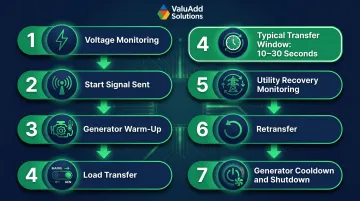
Total transfer time including generator startup typically ranges from 10–30 seconds depending on warm-up timer settings. The switching mechanism itself operates in milliseconds — NEC Article 700.12 requires emergency power within 10 seconds for life-safety applications.
That speed translates directly into operational resilience. For industrial facilities, the key advantages are:
Core benefits for industrial operations:
- Eliminates dependency on operator presence—critical for unmanned facilities
- Prevents backfeeding electronically without relying on procedure compliance under stress
- Enables permanent standby generators to function as designed
- Supports NEC compliance for legally required standby and emergency systems
Technical Specifications Industrial Buyers Should Evaluate
Key specifications for demanding applications:
- Size amperage to full connected load, not just typical operating load
- Specify 4-pole configuration for three-phase systems when the generator is a separately derived source requiring neutral switching
- Match SCCR (withstand) rating to available fault current at the installation point — UL 1008 requires transfer switches to withstand and close on fault currents without creating hazardous conditions
- Select enclosure rating for the actual environment — outdoor installations, washdown areas, and dusty processing plants require NEMA Type 4X or IP66-rated enclosures
ValuAdd offers the ATyS FT transfer switch for legally required standby systems (NEC Article 701) and emergency systems (NEC Article 700). UL 1008 and CSA-certified, it carries short-circuit ratings up to 100 kA. Configurations run from 100A to 400A with multiple pole options.
Use Cases of ATS
ATS is the engineered solution for operations where power interruption directly threatens production, compliance, or safety:
- Manufacturing facilities where mid-shift outages halt production lines
- Municipal water treatment plants where pump stations must maintain flow 24/7 regardless of staffing
- Oil and gas sites with unmanned remote equipment requiring continuous operation
- Data infrastructure and control rooms running PLCs and SCADA systems that cannot tolerate uncontrolled power loss
NEC-driven requirement: For legally required standby systems (Article 701) and emergency systems (Article 700)—fire pumps, emergency lighting, life-safety ventilation—an ATS is not just preferred, it is a code requirement. Facilities in these categories have no choice; specifying an MTS would fail inspection.
MTS vs ATS: Which One Do You Actually Need?
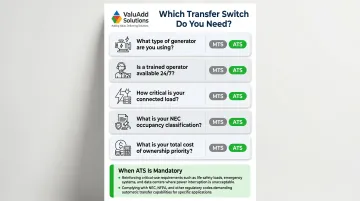
After weighing the technical and operational differences, the right choice comes down to five factors:
1. Generator type: Portable generators typically pair with MTS; permanent standby generators require ATS to function as intended.
2. Operator availability: Is someone always on-site and able to respond within minutes? If no, ATS is mandatory.
3. Load criticality: What happens if power stays off for 10 minutes? If the answer involves production loss, regulatory violation, or safety risk, choose ATS.
4. NEC classification: Optional standby (Article 702) permits MTS. Legally required standby (Article 701) and emergency systems (Article 700) mandate ATS.
5. Total cost of ownership: Compare the ATS premium against the cost of a single outage event.
Situational Recommendations
Choose MTS if:
- Portable or towable generator
- Qualified staff reliably on-site during operating hours
- Budget is constrained
- Loads are optional standby category (convenience, not compliance)
- Brief outages cause inconvenience but not operational or financial loss
Choose ATS if:
- Permanent standby generator is installed
- Facility runs unmanned shifts or is remotely located
- Any load is legally required standby or emergency-classified
- Downtime costs exceed the price difference between MTS and ATS
Industrial Cost-of-Downtime Context
For manufacturing, water treatment, or oil and gas operations, frame the decision with this data: Fortune Global 500 companies lose $1.4 trillion annually to unplanned downtime, representing 11% of total revenues. Heavy industry averages $187,500 per hour in downtime costs—four times higher than 2019 levels. In this context, a $5,000–$15,000 ATS investment is recovered in the first outage it prevents.
Real-World Scenario
A municipal water treatment facility installs an MTS on its primary pump station to save on upfront costs. A nighttime utility failure occurs with no operators on-site. The pumps stay offline for several hours until staff arrives, resulting in system pressure dropping below the 20 psi regulatory minimum, triggering a mandatory Boil Water Notice and potential EPA enforcement action.
The same facility upgrades to an ATS. The next outage triggers automatic switchover within 30 seconds. Operations continue uninterrupted, pressure remains compliant, and no public notification is required.
The cost of the ATS was recovered in the first outage it prevented.
For industrial and commercial operations selecting ATS equipment, ValuAdd carries UL Listed, NEMA-compliant ATS solutions built for critical applications across manufacturing, water treatment, and oil and gas environments.
Conclusion
MTS and ATS solve fundamentally different problems. Manual transfer switches are the right tool when manual oversight is reliable and loads are non-critical. Automatic transfer switches are the right tool when automation is the only way to guarantee continuity.
The correct choice depends on generator type, operator availability, load classification, and what downtime actually costs the operation.
For facilities where power loss means stopped production lines, failed pump stations, or NEC non-compliance, ATS is not a preference — it is the engineering requirement. Specify accordingly, and the switch will perform when the grid doesn't.
Frequently Asked Questions
What is the difference between a manual and automatic transfer switch?
An MTS requires an operator to physically perform the utility-to-generator transfer by manually operating switching handles. An ATS detects the outage through voltage monitoring and completes the full transfer sequence—generator start, stabilization verification, and load switching—without human involvement. Both prevent dangerous backfeeding, but only ATS eliminates dependency on human response time.
Why use a manual transfer switch?
Manual transfer switches offer lower upfront cost, simpler installation and maintenance, and fewer components that can fail. They give operators direct control over when generator load is engaged, making them practical for industrial facilities with 24/7 staffing or for non-critical auxiliary systems where a brief transfer delay is acceptable.
How much does an electrician charge to install a manual transfer switch?
Industrial manual transfer switch installation typically ranges from $1,200 to $3,000+, depending on amperage rating, circuit count, enclosure requirements, and local labor rates. Higher-complexity installations with specialized enclosures or large service entrances will fall toward the upper end of that range.
What does MTS stand for in construction?
MTS stands for Manual Transfer Switch—a device used in construction and building electrical systems to manually switch a load between the utility grid and a backup generator. It appears on electrical drawings and specifications as MTS.
How does an ATS differ from an STS?
An ATS (Automatic Transfer Switch) switches between a utility source and a generator with transfer time measured in seconds (typically 10–30 seconds including generator startup). An STS (Static Transfer Switch) uses solid-state electronics to switch between two utility-grade or UPS sources in milliseconds (typically under 20 ms), making STS the choice for loads that cannot tolerate even brief interruptions, such as data centers and semiconductor fabrication facilities.