Introduction
In oil and gas operations, electrical failures don't just cause downtime — they cascade into safety incidents, environmental violations, and equipment losses costing operators roughly $260,000 per hour.
Standard commercial components aren't built for these conditions. Corrosive hydrogen sulfide atmospheres, explosive gas concentrations, extreme temperature swings, and constant mechanical vibration across refineries, offshore platforms, and pipeline compressor stations demand a different class of hardware entirely.
This guide breaks down what engineers and procurement teams need to know:
- Critical electrical component categories for oil and gas environments
- Enclosure and certification standards that actually protect equipment
- Motor control considerations for pumps and compressors
- A practical framework for evaluating components on harsh-environment suitability — not marketing claims
Key Takeaways
- Oil and gas environments expose electrical components to H₂S corrosion, explosive atmospheres, temperature extremes, and high vibration—standard components aren't built to survive
- Critical categories include motor control systems (VFDs, soft starters), rated enclosures, sensors, switchgear, and power distribution equipment
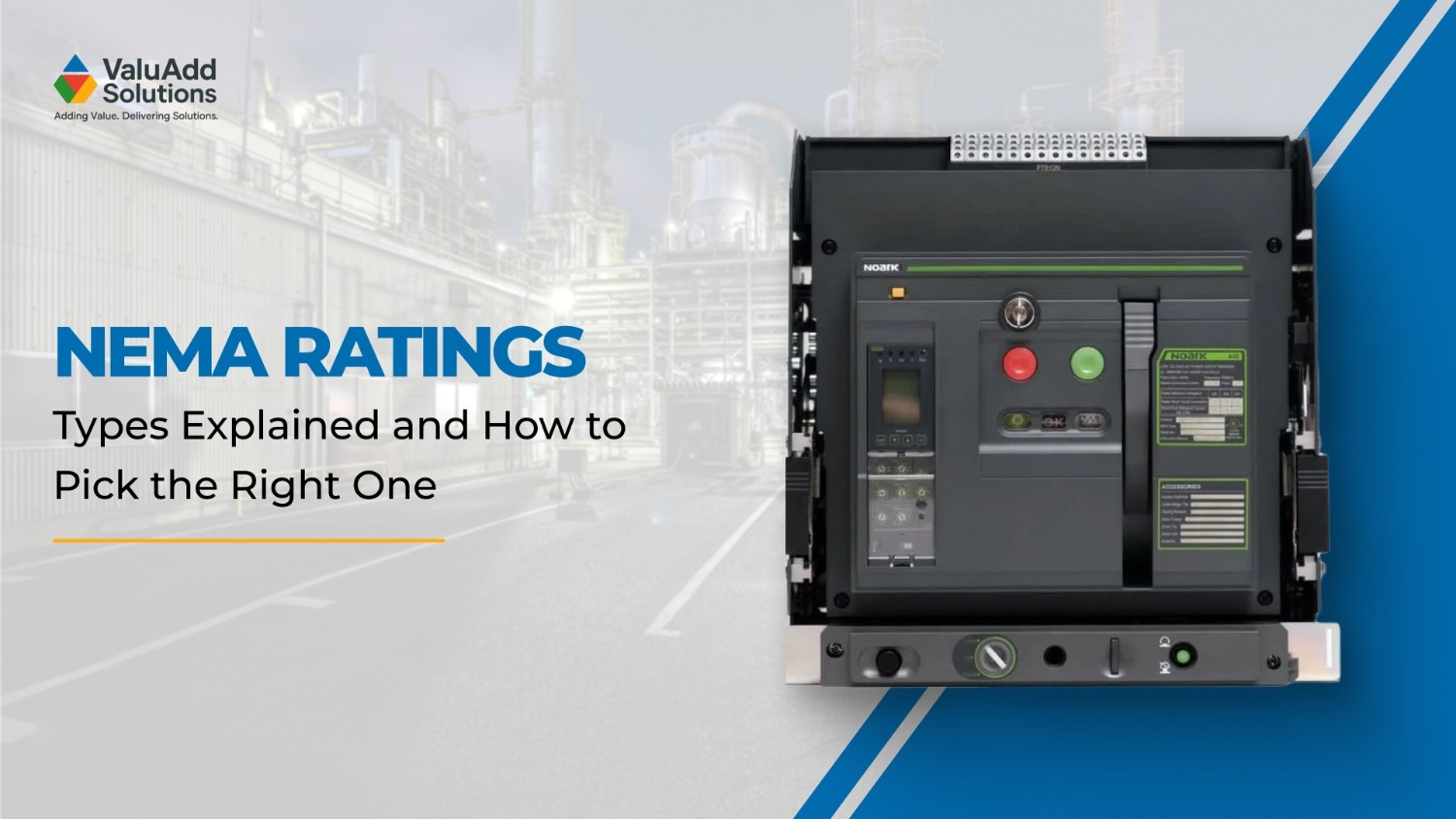
- NEMA 4X includes corrosion testing that IP66 omits — choose the right rating for your environment before specifying enclosures
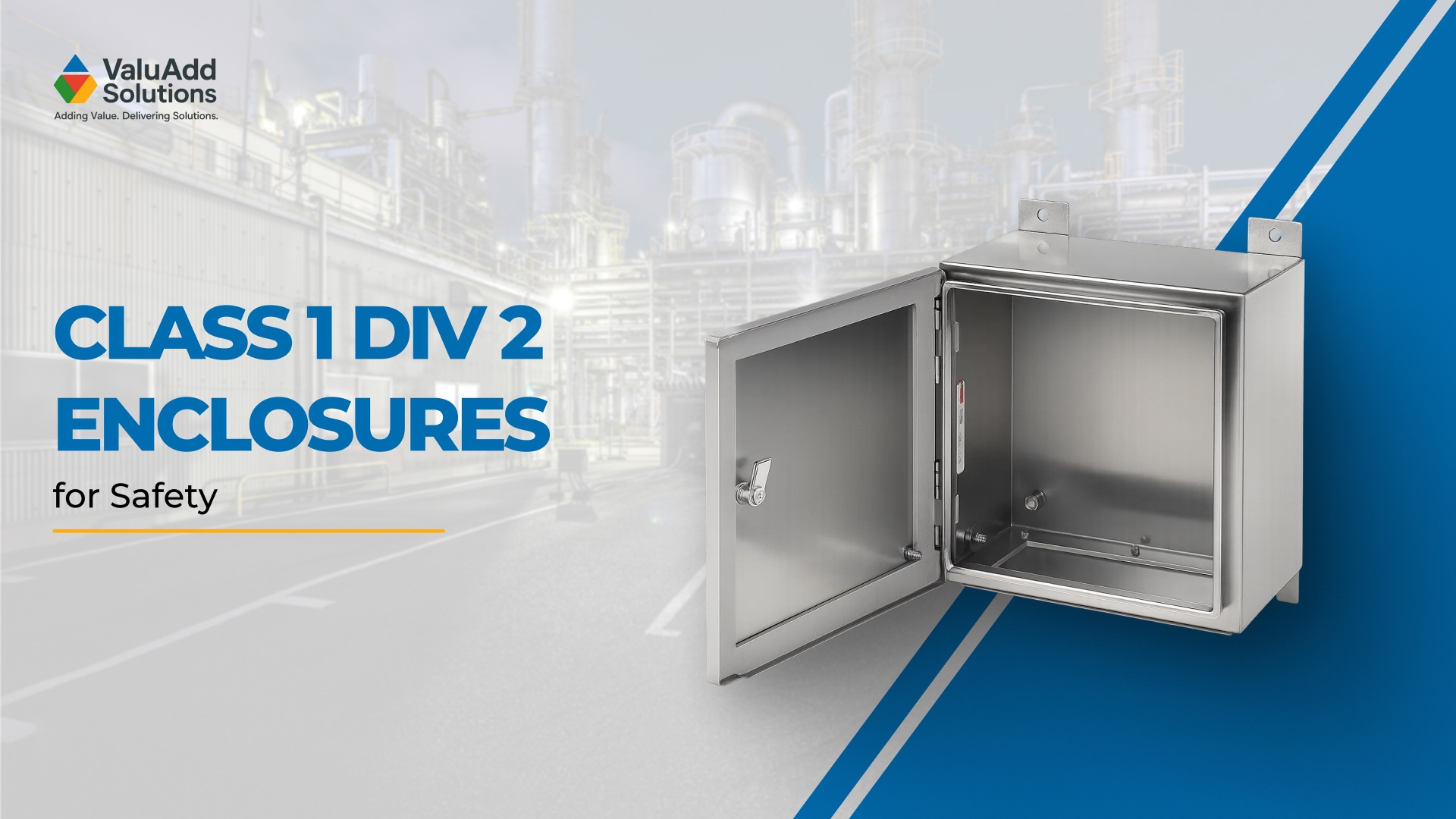
- Hazardous area classifications (Class I Div 1/2 or Zone 0/1/2) dictate explosion-proof or intrinsically safe requirements
- VFDs deliver 30–50% energy savings on pump loads while eliminating mechanical shock from direct starts
Why Oil & Gas Environments Are Uniquely Demanding for Electrical Components
Oil and gas facilities subject electrical equipment to five environmental stressors that commercial-grade components cannot survive:
Extreme temperature swings: Arctic offshore platforms and desert midstream operations expose equipment to temperature ranges spanning -40°F to 140°F, cycling materials through repeated thermal expansion and contraction that degrades seals and insulation.
Corrosive atmospheres: Hydrogen sulfide (H₂S) in sour gas environments and salt-laden air on offshore platforms accelerate contact corrosion and insulation breakdown at rates orders of magnitude faster than standard industrial settings.
Mechanical vibration: Constant vibration from pumps, compressors, and reciprocating equipment loosens connections, fatigues solder joints, and causes sensor drift—failures that may go undetected until catastrophic equipment damage occurs.
Moisture and water ingress: Rain, flooding, washdowns, and condensation penetrate inadequately sealed enclosures, creating short circuits and ground faults in control systems.
Explosive atmospheres: Flammable gas concentrations require electrical equipment that will not become an ignition source under normal or fault conditions.
Each of these stressors carries a direct cost. The oil and gas production industry faces an estimated $1.372 billion in annual corrosion costs, with $589 million attributed to surface pipeline and facility expenses alone. Unplanned downtime runs approximately $260,000 per hour in upstream and midstream operations—meaning a single component failure can erase a week of operational margin in hours.
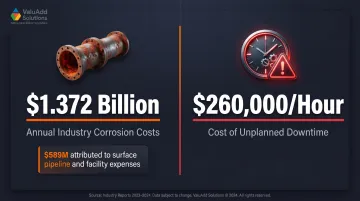
That financial exposure is why component selection has to start with environmental ratings and zone-specific certifications, not price point or appearance.
Essential Electrical Component Categories for Oil & Gas
Sensors, Transmitters, and Instrumentation
Pressure, temperature, and flow sensors form the nervous system of oil and gas operations, providing the data required for leak detection, pipeline monitoring, and process control. These instruments must meet strict standards for harsh-environment deployment:
- Fully sealed against moisture and dust ingress (minimum IP65)
- Constructed from corrosion-resistant materials (316 stainless steel housings, gold-plated contacts)
- Rated for high-vibration operation without drift or calibration loss
- Capable of operating across the full facility temperature range
Failed sensors don't just cause nuisance alarms—they mask actual process upsets and safety conditions until physical damage occurs.
Motor Control Centers (MCCs) and Switchgear
MCCs consolidate motor starting, protection, and control functions into a single assembly, reducing panel space requirements and simplifying wiring. Enclosed, properly rated switchgear is non-negotiable where corrosive atmospheres and moisture are daily realities.
Key requirements include:
- NEMA 4X or IP66 minimum enclosure ratings for outdoor installations
- Arc flash protection integration within assemblies
- Proper fault current ratings for high-demand electrical systems
- Corrosion-resistant bus bars and hardware
Control Panels and PLCs
Programmable logic controllers (PLCs) and integrated control panels automate critical process functions—managing pump cycles, compressor operations, valve actuation, and safety shutdowns. For oil and gas environments, expect these specifications:
- Housed in properly rated enclosures (NEMA 4X for outdoor, NEMA 12 for indoor clean areas)
- Designed for fail-safe behavior during power loss or fault conditions
- Equipped with surge protection on all I/O circuits
- Rated for the facility's ambient temperature range
Power Distribution Equipment
Transformers, disconnect switches, and distribution panels deliver on-site power to all facility loads. For oil and gas applications, these components require:
- Class E2 load break compliance for medium voltage switchgear (maintenance-free operation over 25-year service life)
- Proper fault current ratings for high-capacity electrical systems
- Corrosion-resistant construction for outdoor installations
- Visible isolation and lockout/tagout capability for safe maintenance
Emergency and Backup Power Systems
UPS systems and backup generators maintain control system function and enable safe shutdown procedures during grid or primary power loss. In remote oil and gas installations, these systems carry defined minimum requirements:
- Sufficient runtime to complete all safety shutdown sequences (typically 30–120 minutes depending on facility size)
- Automatic transfer switching with sub-cycle switchover for critical control loads
- Battery management systems rated for wide ambient temperature ranges
- Generator fuel systems sized for extended grid outage scenarios
Without reliable backup power, even well-designed control systems cannot execute orderly shutdowns when primary power fails.
Motor Control Solutions: VFDs and Soft Starters in Harsh Environments
Pumps, compressors, fans, and conveyors represent the majority of electrical energy consumption in oil and gas facilities. How motors are started and controlled directly impacts both equipment longevity and energy costs.
Variable Frequency Drives (VFDs)
VFDs regulate motor speed by varying output frequency, enabling precise flow control in pumps and compressors without mechanical throttling. The U.S. Department of Energy reports that energy savings of 30% to 50% have been achieved in many pump installations by using variable speed drives.
Beyond energy savings, VFDs deliver critical operational benefits:
- Eliminates pipeline pressure surges through controlled ramp-up and ramp-down
- Extends pump seal, bearing, and impeller life with soft acceleration
- Maintains optimal operating points across varying loads with precise speed control
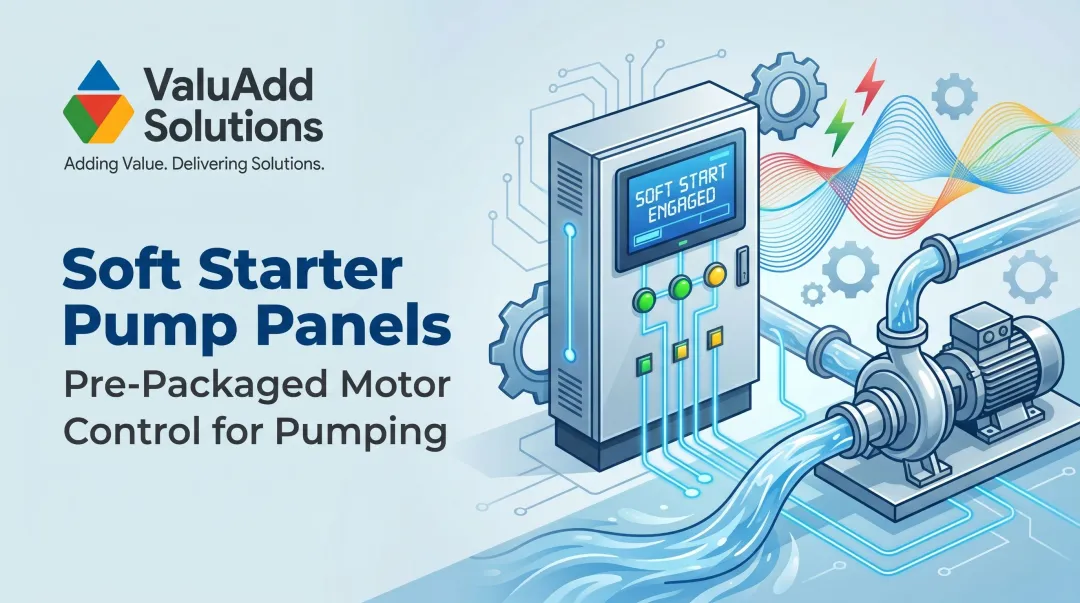
Soft Starters
Soft starters control voltage ramp-up during motor starting to eliminate inrush current spikes and reduce mechanical shock. Direct-on-line (DOL) starting generates inrush currents 6 to 10 times rated current, while soft starters reduce this to roughly 2-4 times rated current. Case studies show soft starters reducing inrush current by approximately 42%, preventing mechanical shock to couplings, impellers, and gearboxes.
Soft starters are ideal for high-inertia loads like pipeline pumps where continuous speed variation isn't required but controlled starting is critical.
Harsh Environment Requirements for Motor Control
VFDs and soft starters generate significant heat and are sensitive to humidity and conductive dust. For reliable operation in outdoor or washdown-prone oil and gas settings, these drives require:
- NEMA 4X or IP66/68-rated enclosures with gasket seals and corrosion-resistant hardware
- Ventilation, heat sinks, or active cooling to manage drive heat output
- IEEE 519 harmonic compliance to protect facility power quality
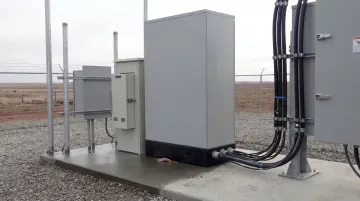
ValuAdd's VFD line uses H-Bridge multi-level technology to meet IEEE 519 harmonic compliance without external filters. Its medium voltage soft starters deliver stepless acceleration with Class E2 load break compliance, protecting motors and connected mechanical systems in oil and gas applications.
Enclosure Ratings and Certifications: What to Look For
IP Ratings Explained
The IEC 60529 standard defines Ingress Protection (IP) ratings using a two-digit code: the first digit indicates protection against solids, the second against liquids.
Common ratings for oil and gas applications:
- IP65: Dust-tight, protected against low-pressure water jets (typical for outdoor electrical enclosures not subject to washdown)
- IP66: Dust-tight, protected against powerful water jets and heavy seas (recommended for high-pressure washdown areas)
- IP68: Dust-tight, protected against continuous submersion at manufacturer-specified depth (required for below-deck offshore installations and flooded pump stations)
Critical limitation: IEC 60529 does not specify protection against corrosive vapors, mechanical damage, or explosive atmospheres. An IP66 rating does not guarantee survival in H₂S environments.
NEMA Enclosure Types
NEMA 250 provides more comprehensive environmental protection specifications than IP ratings alone:
- NEMA Type 12: Indoor use, protection against circulating dust, lint, and dripping water
- NEMA Type 4X: Indoor/outdoor use, protection against windblown dust, rain, hose-directed water, and corrosion
The "X" designation is critical for oil and gas applications. NEMA 4X enclosures must pass a 200-hour salt spray test after a baseline 600-hour test to verify corrosion resistance—a requirement that IP ratings do not include.
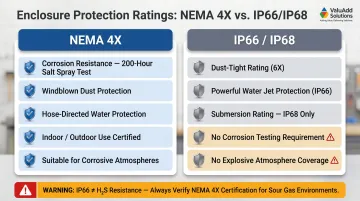
NEMA 4X is the baseline for outdoor upstream and midstream applications where corrosive atmospheres are present.
Enclosure ratings address physical and environmental protection — but procurement for oil and gas also requires verifying compliance with electrical safety, power quality, and fire standards. These certifications work alongside NEMA and IP ratings to cover the full risk picture.
Key Certifications to Require
Specify electrical components with the following certifications for oil and gas applications:
- UL Listing: Confirms independent third-party safety testing — required by most facility insurance and AHJ approvals
- CE/FCC marking: Verifies international regulatory compliance for components sourced or deployed across multiple jurisdictions
- IEEE 519 compliance: Limits harmonic distortion (≤8% THDv, ≤5% TDDi) to protect sensitive instrumentation and upstream grid equipment
- Class E2 load break rating: Confirms medium voltage switchgear can interrupt load current without maintenance intervention between operations
- Halogen-free construction: Reduces toxic gas emissions during fire events — a code requirement in many enclosed offshore and subsea installations
ValuAdd's product portfolio carries UL Listed, CE, FCC, IP65/66/68, NEMA 4X/12, and IEEE 519 certifications, so procurement teams can confirm compliance without chasing individual datasheets across multiple suppliers.
Hazardous Area Classifications and Compliance
In oil and gas operations, selecting the wrong electrical equipment for a hazardous area isn't a paperwork problem — it's a safety failure. The NEC hazardous area classification system defines the conditions under which flammable atmospheres may exist, and those conditions directly determine what equipment is permitted on site. This section focuses on Class I environments, which cover flammable gases and vapors most common to upstream and midstream operations.
Class I: Flammable gases or vapors are present
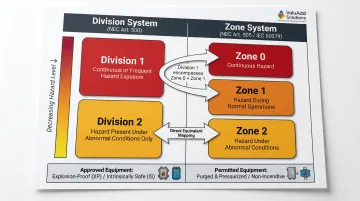
Division system (NEC Article 500):
- Division 1: Hazardous concentrations exist under normal operating conditions or frequently due to maintenance/leakage
- Division 2: Hazardous concentrations exist only under abnormal conditions (equipment rupture, ventilation failure)
Zone system (NEC Article 505, IEC 60079):
- Zone 0: Ignitable concentrations present continuously or for long periods
- Zone 1: Ignitable concentrations likely under normal operating conditions
- Zone 2: Ignitable concentrations unlikely during normal operation, exist briefly during abnormal conditions
The two systems overlap: Division 1 encompasses both Zone 0 and Zone 1, while Division 2 corresponds to Zone 2. Facilities using IEC-aligned equipment must map between systems carefully.
Equipment Selection Requirements
- Division 1/Zone 0-1 areas: Require explosion-proof (XP) or intrinsically safe (IS) equipment
- Division 2/Zone 2 areas: May allow purged/pressurized enclosures or non-incendive equipment
Installing equipment rated for Division 2 in a Division 1 area violates NEC Article 500/505 and can result in failed inspections, facility shutdowns, and direct liability in the event of an incident.
Arc Flash Studies and Labeling
Hazardous area classification addresses ignition sources from equipment — but arc flash is a separate and equally serious compliance domain. Arc flash incidents produce temperatures exceeding 35,000°F, and between 5 and 10 arc flash explosions occur daily in the United States. NFPA 70E requires:
- Arc flash studies and equipment labeling showing nominal voltage, arc flash boundary, and incident energy or PPE category
- Documented worker training on electrical safety, verified annually and retrained at least every three years
Well pads, compressor stations, and water treatment facilities must comply with NFPA 70E arc flash labeling and training requirements.
How to Select the Right Electrical Components for Your Oil & Gas Application
Follow this systematic selection process:
1. Define the environmental zone:
- Indoor or outdoor installation?
- Corrosive agents present (H₂S, salt spray)?
- Ambient temperature range?
- Washdown or submersion risk?
2. Determine hazardous area classification:
- Class I Division 1, Division 2, or non-classified?
- IEC Zone 0, 1, 2, or safe area?
3. Match required enclosure ratings:
- NEMA 4X for outdoor corrosive environments
- NEMA 12 for indoor clean industrial areas
- IP66 minimum for high-pressure washdown
- IP68 for submersion scenarios
4. Verify required certifications:
- UL Listed for safety compliance
- IEEE 519 for harmonic limits (VFDs)
- Class E2 for medium voltage load break applications
- Hazardous area certifications (XP, IS) where required
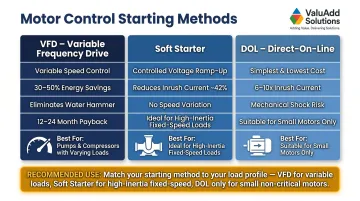
5. Assess motor control needs:
- VFD for variable speed, maximum energy savings, and precise control
- Soft starter for fixed-speed loads requiring controlled starting
- DOL only for small motors where inrush current and mechanical shock are acceptable
Over-Specifying vs. Under-Specifying
Once you've worked through those five steps, calibrating your specification level is just as critical as completing the checklist. Getting it wrong in either direction carries real cost:
- Under-specifying risks premature failure, unplanned downtime at $260,000/hour, and safety incidents with million-dollar liability exposure
- Over-specifying increases upfront cost without operational benefit — specifying IP68 for an indoor MCC wastes budget that could fund additional monitoring or redundancy
An engineering review before procurement catches these mismatches before they become field problems.
Total Cost of Ownership
Components with higher upfront ratings reduce maintenance cycles, extend service intervals, and prevent unplanned downtime. Consider:
- Corrosion mitigation: NEMA 4X vs. standard enclosures prevents the $1.372 billion annual corrosion cost burden
- Energy savings: VFDs deliver 30-50% pump energy reduction, paying back capital cost in 12-24 months
- Downtime prevention: Proper ratings and harmonic compliance prevent failures that trigger cascading production losses
When comparing options, run the numbers over a 5-year horizon — the component that looks expensive at purchase often costs the least to own.
Frequently Asked Questions
What does an oil and gas electrician do?
Oil and gas electricians install, maintain, and troubleshoot electrical systems across well pads, compressor stations, refineries, and pipelines—including motor controls, instrumentation, switchgear, and hazardous area wiring. Their work requires strict adherence to NFPA 70E electrical safety standards and NEC hazardous location requirements.
What is an oil and gas controller?
An oil and gas controller is an automated device—ranging from simple timer-based boxes to PLCs and SCADA systems—that manages pump cycles, valve actuation, and compressor starts using programmable logic to respond automatically to process conditions.
What are the steps of motor control?
Motor control follows five core steps: power isolation, overload protection, motor starting (direct-on-line, soft start, or VFD ramp-up), running protection via current and thermal monitoring, and safe shutdown or braking. Starting method selection depends on load type and facility standards.
What IP rating is required for electrical equipment in oil and gas?
IP65 is the general minimum for outdoor installations, IP66 is recommended where high-pressure washdowns occur, and IP68 is required for submersible or flood-prone applications. The appropriate rating depends on the specific installation environment and local regulatory requirements.
What is the difference between NEMA 4X and IP68 ratings?
NEMA 4X covers corrosion resistance, watertightness, and dust exclusion for indoor/outdoor use—roughly equivalent to IP66—while IP68 rates continuous submersion at defined depths. Use NEMA 4X as the baseline for most outdoor oil and gas enclosures; specify IP68 only where prolonged liquid exposure is a documented risk.
Why are VFDs used in oil and gas applications?
VFDs allow precise speed control of pumps and compressors, reducing energy consumption by 30–50% at partial loads, preventing pipeline water hammer, and extending motor and mechanical component life. In most pump and compressor applications, payback on a VFD installation occurs within 12–24 months through energy savings alone.