Introduction
Picture this: A 100 HP municipal booster pump kicks on at 6 AM. The voltage dips across the entire facility. The sudden torque jolts the pump shaft and coupling. A pressure wave hammers through 3,000 feet of water main. Thirty seconds later, a joint two miles away begins to weep.
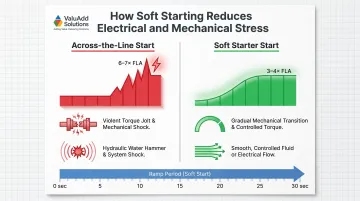
Across-the-line motor starts create three simultaneous problems:
- Electrical stress: 6–7× rated current surging into switchgear
- Mechanical shock: instantaneous full torque straining shafts and seals
- Hydraulic transients: fluid velocity jumping from zero to full flow in under a second
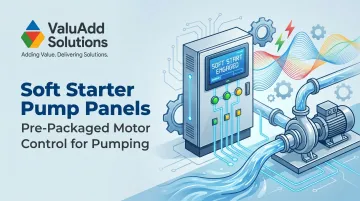
Soft starter pump panels solve all three by controlling how voltage ramps up to the motor and how it ramps back down when stopping.
This article focuses specifically on pre-packaged soft starter pump panels—not standalone soft starters you wire yourself. The factory-built panel format delivers motor control components already integrated, tested, and certified as a system. For industrial and municipal pumping operations, that difference means faster commissioning, lower field labor costs, and reliable UL 508A-listed protection that field-assembled solutions rarely achieve.
You'll learn what's inside a complete pump panel, which protections it provides, when it's the right choice over a VFD, and how to specify one that passes inspection and survives decades of duty-cycling service.
Key Takeaways
- Soft starter pump panels are factory-built enclosures combining a soft starter with all supporting motor control components—ready to install.
- The soft starter reduces inrush current from 6–7× to approximately 3–4× full-load amps and controls ramp-up speed, preventing water hammer, mechanical shock, and electrical stress.
- Pre-packaged panels ship UL 508A-listed with marked SCCR ratings—cutting field labor and commissioning time that field-assembled solutions can't match.
- Choose soft starters over VFDs when continuous speed control isn't needed—they're simpler, cost 50–60% less, and generate minimal harmonics.
What Is a Soft Starter Pump Panel?
A soft starter pump panel is a pre-engineered control enclosure designed specifically for pump motor applications. It combines a soft starter with complementary electrical protection and control components—delivered as a complete, factory-tested unit ready to install. This isn't a loose soft starter you mount and wire yourself; it's a system engineered to work together, certified as a unit, and shipped ready to connect.
The "Pre-Packaged" Advantage
The distinction matters:
- Loose soft starter: You design the panel, size the breaker, select the bypass contactor, calculate SCCR, wire everything, and hope the AHJ accepts your field assembly.
- Pre-packaged pump panel: The manufacturer has already done that work. The panel arrives pre-wired, pre-tested, with a UL 508A listing, and with SCCR marked per Supplement SB—ready for inspection and connection.
For system integrators and facility managers, this eliminates design burden, reduces installation time, and ensures code compliance without ambiguity.
How the Soft Starter Works
Inside the panel, the soft starter uses silicon controlled rectifiers (SCRs or thyristors) to gradually ramp voltage up to the motor during startup. Instead of applying full line voltage instantly (across-the-line starting), it progressively increases voltage from a reduced level (typically 30–50% initial voltage) up to 100% over a programmable ramp period of 5–30 seconds.
This controlled acceleration serves two purposes:
- Limits inrush current: NEMA MG 1 defines locked-rotor current as the steady-state current drawn with the rotor locked and rated voltage applied. DOL starts typically draw 6 to 7 times rated motor current, with peaks up to 9 or 10 times. The soft starter reduces this to approximately 3–4× full-load amps.
- Eliminates torque shock: Full-voltage starting applies instantaneous full torque to the pump shaft, coupling, and impeller. Soft starting distributes this load smoothly over the ramp period, directly reducing mechanical stress.
Controlled Deceleration (Soft Stop)
Many models also provide controlled deceleration (soft stop). When the stop command is issued, the soft starter gradually reduces voltage rather than dropping it instantly. This prevents reverse flow and pressure surges when a pump stops abruptly and check valves slam shut, which is how water hammer starts.
Why Pump Panels Are Distinct
Pumping loads have unique start/stop concerns that general motor control panels don't always address:
- Liquid mass in the piping resists sudden velocity changes, amplifying acceleration stress
- Pressure transients travel through the full piping network when flow changes abruptly
- Check valves closing suddenly generate destructive pressure spikes throughout the system
Pre-packaged pump panels address these hydraulic realities through built-in soft starter tuning, adjustable ramp profiles, and protective functions sized for pump loads. That specificity is what separates them from general-purpose motor control enclosures.
How Soft Starters Protect Pumping Systems
Water Hammer and Hydraulic Shock
Water hammer occurs when a pump starts or stops abruptly, creating a sudden change in fluid velocity. This generates a pressure wave through the piping system governed by the Joukowsky equation, which relates pressure change to fluid density, wave speed, and instantaneous velocity change. These pressure spikes can:
- Crack pipes and damage fittings
- Shorten pump and seal life
- Cause check valves to slam violently
The soft starter prevents this by bringing flow up gradually during start and down gradually during stop, keeping velocity changes smooth and pressure transients within safe limits. ANSI/HI 9.6.6 explicitly notes that sudden closures reflect high pressure spikes back to the pump. Soft stop features directly address this by controlling deceleration rate.
Inrush Current Suppression
Across-the-line motor starts draw 6 to 7 times the motor's full-load amperage, with peaks up to 9 or 10 times for a brief period. This massive surge stresses:
- Utility transformers and service connections
- Switchgear and protective devices
- Branch circuit cabling and terminations
The soft starter limits this peak to approximately 3–4× full-load current, reducing stress on all upstream electrical infrastructure. Utilities increasingly mandate this: Seattle Public Utilities requires reduced voltage starters for constant speed motors 15 HP and larger.
Mechanical Stress Reduction
Sudden full-voltage starts create high torque that strains:
- Pump shafts and couplings
- Impellers and wear rings
- Mechanical seals and bearings
Ramping up over 10–30 seconds distributes torque load gradually, reducing wear on shafts, seals, and bearings. In a municipal flood-control project, installing soft starters reduced mechanical wear costs by up to 30%.
Soft Stop Function for Pumps
Many pump panels include a deceleration ramp feature (pump stop or coast-to-stop control) that allows the pump to slow gradually. This prevents:
- Reverse flow through the pump when it stops suddenly
- Pressure surges when check valves slam shut
- Column separation and rejoining in vertical piping
In systems with long discharge runs or significant vertical lift, controlled deceleration is often the difference between a routine stop and a piping failure.
Thermal and Overload Protection
A pump panel's integrated overload relay and thermal protection monitor motor current during each start, guarding against:
- Repeated starts in quick succession that overheat the motor
- Overload conditions during operation
- Phase loss or imbalance that can destroy windings
Duty-cycling applications — where a pump starts and stops dozens of times daily — put the most cumulative thermal stress on motor windings. Integrated protection catches this before damage occurs.
What's Inside a Pre-Packaged Soft Starter Pump Panel
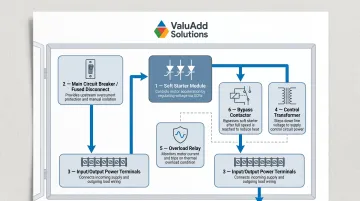
A complete soft starter pump panel integrates six core components:
- Soft starter module: The SCR-based controller that manages voltage ramp-up and ramp-down
- Main circuit breaker or fused disconnect: Provides branch circuit protection and a disconnecting means
- Input/output power terminals: Factory-wired connections ready for field power and motor leads
- Control transformer: Steps down line voltage (typically to 120VAC or 24VDC) for logic circuits and operator controls
- Overload relay or electronic motor protection relay: Monitors current and provides Class 10 or Class 30 thermal protection
- Bypass contactor: Closes after acceleration to run the motor across-the-line at full voltage, bypassing the SCRs
Why the Bypass Contactor Matters
The bypass contactor is critical for thermal management. SCRs generate heat under continuous load due to their forward voltage drop (typically 1.5–2.0V per SCR). Once the motor reaches full speed, the bypass contactor closes, directing current around the SCRs and running the motor directly across the line.
Benefits:
- Reduces heat dissipation: Eliminates steady-state power losses in the SCRs
- Extends soft starter life: SCRs run cool, extending component life significantly
- Lowers enclosure cooling requirements: Less internal heat means smaller, less expensive enclosures
Soft starters are rated for different duty:
- AC-53a: Designed for continuous operation without a bypass (higher cost, larger thermal capacity)
- AC-53b: Designed for intermittent duty with a bypass contactor during runtime (standard for most pump applications)
ValuAdd's CSXi Series Pump Panels include an internal bypass soft starter as standard, eliminating SCR conduction losses during fixed-speed operation and extending equipment life.
Operator Interface and Control Options
Beyond the power circuit, the control layer determines how operators and external systems interact with the panel. Pre-packaged panels typically include:
- Door-mounted operator controls: Start/stop pushbuttons, run/fault indicator lights
- Remote start/stop terminals: For integration with float switches, pressure switches, or SCADA systems
- Analog inputs: For speed feedback or process signals (on advanced models)
- Network communication: Modbus RTU, EtherNet/IP, or PROFINET options for SCADA/PLC integration
Enclosure Ratings for Pump Environments
Pump environments range from climate-controlled mechanical rooms to outdoor chemical facilities — enclosure selection must match the installation conditions:
| Enclosure Type | Protection | Typical Applications |
|---|---|---|
| NEMA Type 4X | Windblown dust, hose-directed water, corrosion resistance | Outdoor pump stations, chemical processes, washdown areas |
| NEMA Type 12 | Circulating dust, falling dirt, dripping non-corrosive liquids | Indoor industrial plants, mechanical rooms |
| NEMA Type 3R | Rain, sleet, snow, ice formation | Outdoor installations without corrosive exposure |
NEC Table 110.28 provides enclosure selection guidelines for specific locations. For outdoor or corrosive environments, NEMA 4X is essential. ValuAdd's pre-packaged pump panels are available with NEMA 4X and 12-compliant enclosures, UL Listed and built for demanding industrial and municipal environments.
Optional Protective Add-Ons
Factory-built panels simplify specifying protective features that would otherwise require separate field components:
- Phase loss/reversal protection: Prevents motor damage from utility phase issues
- Ground fault protection: Detects leakage current to ground
- Thermistor input: Monitors winding temperature directly via embedded sensors
- Run-dry (loss of prime) protection: Detects low current indicating no fluid flow, shutting down before seal damage
ValuAdd's CSXi Series includes comprehensive motor protection: phase loss, phase sequence, current imbalance, motor thermistor input, excess start time protection, and instantaneous overcurrent protection—all as standard.
Common Applications Across Pumping Industries
Municipal Water and Wastewater
Soft starter pump panels are standard in municipal water infrastructure, where aging systems and strict utility requirements make controlled motor starting essential.
- Protect aging lift station infrastructure with smooth, controlled acceleration
- Reduce pressure transients in booster pump distribution mains
- Meet utility power quality requirements across distribution systems
Seattle Public Utilities mandates reduced voltage starters for motors 15 HP and larger, explicitly requiring isolation and bypass contactors to minimize inrush current.
Oil and Gas and Industrial Process Pumping
Demanding process environments place stricter requirements on panel design — reliability, compliance, and enclosure ratings all factor into the application.
- Pipeline booster pumps demand mechanical reliability to prevent costly unplanned downtime
- Cooling water pumps cycle frequently, requiring robust thermal management in the soft starter
- Chemical transfer pumps benefit from NEMA 4X enclosures that resist corrosive atmospheres
IEEE 519-compliant designs and explosion-proof enclosures are common specifications in these sectors.
Agricultural Irrigation and Dewatering
Rural and agricultural sites add their own challenges — limited grid capacity, outdoor exposure, and motors that cycle on and off throughout the day.
- Handle multiple daily starts without overheating or tripping
- Limit inrush current to maintain power quality on rural distribution circuits
- Survive outdoor conditions with NEMA 3R or 4X weatherproof enclosures
Soft Starter Pump Panel vs. VFD Panel
The Fundamental Difference
- Soft starter pump panel: Manages only the start and stop transition. Once the motor is running, it operates at full line frequency and fixed speed.
- VFD pump panel: Continuously varies motor speed throughout operation by adjusting frequency and voltage.
For fixed-speed pumping—the majority of municipal and industrial pump applications—a soft starter pump panel is simpler and more cost-effective.
When a VFD Panel Is the Better Choice
Specify a VFD when the application requires:
- Variable flow control: Output must adjust dynamically to match shifting demand
- Constant pressure maintenance: System pressure needs to hold steady as flow rates change
- Speed-based energy savings: Centrifugal pump power follows the cube law — 50% speed delivers only 12.5% power draw
Examples: Variable demand water systems, HVAC chilled water pumps, pressure-boosting applications with fluctuating loads.
If the pump always runs at full speed and the goal is protecting the motor and system during start/stop, a soft starter pump panel is the right answer.
Cost and Complexity Tradeoff
| Feature | Soft Starter Panel | VFD Panel |
|---------|-------------------|-----------|
| Initial Cost (30 kW example) | $6,000–$10,000 | $16,000–$24,000 (2–3× higher) |
| Energy Savings (Operation) | None (fixed speed) | 20–50% on variable torque loads |
| Harmonic Generation | Minimal (transient during start/stop) | Significant continuous distortion; often requires filtering |
| Maintenance | Low; simple programming | Moderate; complex programming and cooling system maintenance |
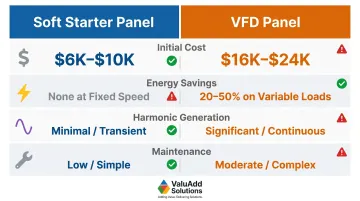
Soft starter panels generate harmonics only during the brief acceleration and deceleration ramps. Once bypassed at full speed, they produce virtually no harmonics. VFDs continuously draw non-linear current, producing significant 5th, 7th, and 11th harmonics that often require line reactors or active filters to meet IEEE 519 limits.
IEEE 519 harmonic limits apply broadly across utility interconnection requirements — PG&E's Electric Rule 2 is one example of how utilities formally incorporate these standards into customer obligations. In facilities with sensitive electrical environments or strict utility requirements, soft starters significantly simplify compliance.
How to Choose the Right Soft Starter Pump Panel
Key Electrical Specifications
Start with these four electrical parameters before evaluating any panel:
- Full-load amps (FLA): The soft starter's continuous current rating must meet or exceed motor FLA
- Motor HP and voltage: 230V, 460V, 575V, or medium voltage (2.3kV–15kV for large pumps)
- Phase count: Three-phase is standard; single-phase soft starters exist but are uncommon
- Starts per hour: Determines thermal duty cycle and whether a larger frame size is needed
Critical: If the application requires more than 6–10 starts per hour, or if DOL starting time exceeds 5 seconds (heavy duty), select a soft starter one frame size larger than the motor's rated power and use a Class 30 overload setting. Undersizing the soft starter for the pump's duty cycle is a common and costly mistake.
Protective Features and Enclosure Requirements
Enclosure selection depends on where the panel will be installed:
- NEMA 4X: Wet, outdoor, or corrosive environments — pump stations, chemical processes
- NEMA 12: Indoor industrial locations with dust or drip exposure
- UL 508A listing: Confirm the panel is UL Listed with a marked SCCR for code compliance
Two protection features are non-negotiable for most pump applications:
- Run-dry protection: Essential for well pumps where loss of prime destroys seals
- Phase monitoring: Prevents single-phasing damage on three-phase utility service
For applications that fall outside standard configurations — combined duty cycles, unusual voltage classes, or site-specific NEMA requirements — ValuAdd's engineers can work through the specification with system integrators and facility managers directly.
Integration and Installation Considerations
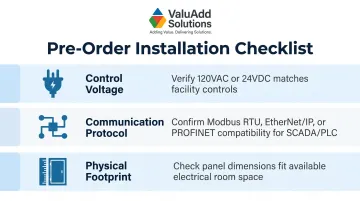
Pre-packaged panels ship ready to connect, but three installation details need to be confirmed before ordering:
- Control voltage: Verify the panel's control voltage (120VAC or 24VDC) matches your facility controls
- Communication protocol: For SCADA/PLC integration, confirm Modbus RTU, EtherNet/IP, or PROFINET compatibility
- Physical footprint: Check that panel dimensions fit the available electrical room or enclosure space
Protocol support varies by soft starter platform:
- Schneider Electric Altistart 48: Modbus RTU natively via RJ45
- Rockwell Automation SMC-50: EtherNet/IP via optional communication adapters
- Eaton DS7/S811: PROFINET and Modbus
Frequently Asked Questions
What is the function of a soft starter pump panel?
A soft starter pump panel controls how a pump motor accelerates and decelerates—gradually ramping voltage up on start and down on stop to eliminate inrush current, mechanical shock, and water hammer. All control components are pre-wired in a complete enclosure ready for field installation.
Can I use a soft starter pump panel on a well pump or heat pump?
Yes, soft starter pump panels work well for well pump motors (submersible or above-ground)—smooth starting prevents water hammer and reduces stress on drop pipe and motor windings. Heat pump compressor motors have different requirements; scroll and reciprocating compressors typically require compressor-rated soft starters rather than standard pump panels.
Is a soft starter pump panel just a capacitor?
No. A soft starter is an active electronic device using SCRs (thyristors) to progressively control motor voltage during start and stop, managing acceleration profile and providing motor protection. A power factor correction capacitor is a passive component that only improves reactive power—the two serve entirely different purposes.
What is the difference between a soft starter pump panel and a VFD pump panel?
A soft starter pump panel only controls the start and stop transition while the motor runs at fixed speed. A VFD panel continuously varies motor speed during operation—making VFD panels better for variable flow applications but soft starter panels simpler and more cost-effective (50–60% lower initial cost) for fixed-speed pumping duty.
What enclosure rating do I need for my pump panel?
NEMA Type 4X is recommended for wet, outdoor, or corrosive environments (outdoor pump stations, chemical processes). NEMA Type 12 suits indoor industrial locations with dust or drip exposure. Always verify local code requirements per NEC Table 110.28 and confirm the panel's UL 508A listing.
How does a soft starter prevent water hammer in pumping systems?
By ramping voltage up gradually, the soft starter builds fluid velocity slowly rather than jumping to full flow instantly. The soft stop function decelerates the pump at a controlled rate, preventing the abrupt pressure wave that damages pipes, joints, and pump components.