](https://file-host.link/website/gush-ja3yyx/assets/blog-images/f3f51e90-91cf-4692-8c53-37b566257274/1778577597456899_5c72141a4a584a90a44e72013044c245/360.webp)
Introduction
Wrong meter selection creates real operational consequences: utility billing disputes, missed efficiency opportunities, regulatory compliance gaps, and equipment faults that go undetected until they cause costly downtime. For manufacturing plants, water treatment facilities, and oil and gas operations, these failures translate directly to lost revenue and production risk.
The right energy meter determines whether you can allocate costs accurately to production lines, verify contractor work, comply with IEEE 519 harmonic standards, and detect power quality problems before they damage sensitive equipment.
This guide covers what power meters measure, how different meter types compare, and the six critical factors that should drive selection decisions for industrial and commercial applications.
Key Takeaways
- Power meters measure voltage, current, energy (kWh), power factor, and harmonics — enabling billing accuracy, energy management, and load monitoring
- Meter types range from analog (largely obsolete) to digital multifunction and smart networked meters, with the latter offering the best fit for energy management system integration
- Choosing the right meter comes down to six criteria: application type, accuracy class, CT compatibility, communication protocols, environmental rating, and total installed cost
- Three-phase and harmonic-heavy industrial loads require Class 0.5 accuracy and IEEE 519 compliance
- Upfront meter selection reduces rework, improves visibility, and delivers ROI through 10–25% energy savings
What is a Power Meter?
A power meter is an electronic device that monitors, analyzes, and controls electrical systems in industrial and commercial facilities. It measures key parameters including real power (kW), reactive power (kVAR), apparent power (kVA), energy consumption (kWh), power factor, and voltage. These devices range from simple single-circuit submetering units to multifunction networked analyzers capable of capturing harmonic distortion, demand peaks, and bidirectional energy flow.
The right choice depends on what needs to be measured and how that data will be used. A facility pursuing basic tenant billing has different requirements than a manufacturing plant troubleshooting VFD harmonic issues or a water treatment facility optimizing pump sequencing.
Key Measurement Parameters
Beyond basic kWh consumption, industrial-grade meters should capture power factor, demand (kW peak), and harmonic distortion to support energy audits, equipment protection, and compliance with power quality standards like IEEE 519. IEEE 1459-2010 defines these three core quantities: real power (energy flowing unidirectionally from source to load), reactive power (oscillating power from inductive/capacitive loads), and apparent power (maximum transmittable active power at constant voltage).
Understanding which parameters matter for a given application determines minimum feature requirements. For example:
- Motor-heavy manufacturing lines need reactive power tracking to avoid utility penalties
- Facilities with on-site generation require bidirectional energy metering
- Harmonic-heavy environments must evaluate up to the 50th harmonic order per IEEE 519-2022
- Tenant submetering applications require demand tracking for accurate cost allocation
Types of Power Meters
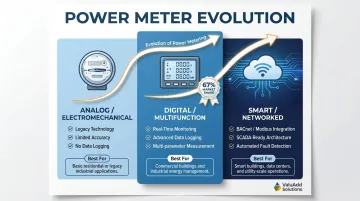
Three main categories define the market:
Analog (Electromechanical): Legacy rotating-disc meters industrial facilities have largely phased out due to limited functionality, poor accuracy at low loads, and inability to log data.
Digital/Multifunction: Solid-state meters with LCD displays and advanced parameter logging. Digital meters hold 67% market share due to real-time monitoring, data analysis capabilities, and accuracy maintained across load ranges. Common in commercial and industrial submetering applications.
Smart/Networked: Integrated communication capabilities for BACnet, Modbus, or cloud platforms. Suited for facilities with Energy Management Systems (EMS) or Building Automation Systems (BAS). These meters enable automated fault detection, demand response, and integration with SCADA systems.
For industrial applications—particularly three-phase systems in manufacturing, water treatment, and processing plants—multifunction or smart meters are the standard choice. Three-phase meters dominate the industrial market with 71% share, capturing the full operational data needed for equipment protection and system optimization.
Key Factors to Consider When Selecting an Energy Meter
Meter selection varies significantly based on application type, service voltage, load profile, and data infrastructure. A choice that fits commercial building submetering may be entirely wrong for a high-current industrial process line. The following six factors connect meter specifications directly to measurable operational outcomes: accurate cost allocation, reduced downtime, regulatory compliance, and system integration efficiency.
Application and System Type
Define the application first: single-phase light commercial load, three-phase industrial motor drive, distribution panel, or building main. This determines service type, number of circuits to monitor, and whether single-load or multi-load meters are required.
Three-phase loads—chillers, air handling units, pumps, and variable frequency drives common in manufacturing and water treatment—require three-phase meters with appropriate CT inputs. Single-phase circuits need only single-CT configurations. Mismatching meter to service type is one of the most common and costly selection errors.
A three-phase meter incorrectly applied to single-phase loads wastes budget and panel space. Conversely, attempting to monitor a 480V three-phase motor with a single-phase meter produces incomplete, misleading data that can mask developing faults.
Accuracy Class
Accuracy class defines how closely the meter's reading reflects actual electrical consumption—critical for both tenant submetering (billing accuracy) and energy management (identifying waste). ANSI C12.1-2022 defines Class 0.1, 0.2, and 0.5 as US standards; IEC 62053 provides international equivalents.
Industrial facilities requiring revenue-grade billing or high-precision demand monitoring should target Class 0.5 or better. Energy audits and load studies can typically operate with Class 1.0. GSA evaluations found that full-panel systems with revenue-grade CTs achieved <3% error, while systems with standard CTs showed ~16% error under non-standard loads.
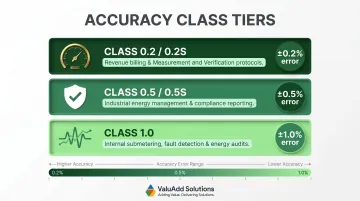
Key accuracy classes:
- Class 0.2/0.2S: Revenue billing, M&V protocols
- Class 0.5/0.5S: Industrial energy management, compliance reporting
- Class 1.0: Internal submetering, fault detection, audits
ValuAdd's DIRIS B meters achieve Class 0.2 accuracy at the meter level and Class 0.5 system accuracy when paired with compatible sensors—suitable for demanding industrial applications where measurement precision directly impacts financial and operational decisions.
Current Transformer (CT) Compatibility
The type and rating of current transformers used with the meter directly determines whether the meter can safely and accurately handle the facility's current range. CT selection impacts both installation feasibility and long-term accuracy.
| CT Type | Amperage Range | Best Use Case | Installation Notes |
|---|---|---|---|
| Solid-core | 50A–6000A | Highest accuracy (Class 0.5/1); new construction | Requires conductor disconnection |
| Split-core | 100A–2000A | Retrofits, lower amperage | Swing-open design; slightly lower accuracy at low loads |
| Rogowski coil | 100A–5000A+ | High-current industrial; irregular cable bundles | Flexible, no magnetic saturation; requires active integrator |
Rogowski coils provide wide dynamic ranges up to 12kA without magnetic saturation and are ideal for space-constrained installations or bundled cables common in heavy industrial facilities. When paired with appropriate meters, Rogowski systems achieve Class 0.5 accuracy.
Select meters compatible with both conventional CTs and Rogowski coils—or confirm CT type in advance—to avoid field installation problems, particularly in retrofits where existing CTs may already be in place. ValuAdd meters support TE sensors (5-2000A), TR/iTR sensors (25-600A), and TF sensors (100-6000A), plus Rogowski coils for maximum installation flexibility.
Communication Protocols and Data Integration
The meter's communication capability determines how consumption data flows into energy management systems, building automation platforms, or cloud dashboards. Protocol mismatch creates costly integration workarounds.
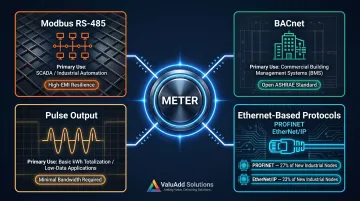
Common industrial protocols:
- Modbus RS-485: Widely deployed for SCADA and industrial automation due to resilience in high-EMI environments (refineries, manufacturing)
- BACnet: Standard in commercial building management systems
- Pulse output: Simple, lower-data applications requiring basic kWh totalization
- Ethernet-based: PROFINET and EtherNet/IP account for 27% and 23% of new industrial nodes, respectively
Selecting a meter with the wrong protocol—or one that doesn't support the facility's existing data infrastructure—creates integration delays and additional hardware costs. Meters with dual-protocol capability (both BACnet and Modbus) protect that investment as systems evolve.
That flexibility has measurable financial impact. Analysis of over 300 case studies showed average 11% energy savings within the first years of EMS implementation, with industrial facilities routinely achieving 10–25% reductions and simple paybacks of 2.5–4.5 years.
Environmental Rating and Field Configurability
Industrial environments expose meters to dust, moisture, vibration, and temperature extremes. Meters must carry appropriate IP ratings and NEMA enclosure standards to ensure reliable long-term operation.
Environmental protection standards:
- IP65: Dust-tight; protected against low-pressure water jets
- IP66: Dust-tight; protected against powerful water jets
- IP68: Dust-tight; protected against continuous immersion
- NEMA 4X: Corrosion-resistant; for washdown or outdoor environments
- NEMA 12: Indoor industrial; protects against dust and oil
ValuAdd's product portfolio includes solutions certified to IP65, IP66, and IP68 as well as NEMA Type 4X and 12 compliance, directly addressing harsh installation requirements in processing plants, water treatment facilities, and outdoor substations.
Field configurability—the ability to adjust CT type, communication protocol, or voltage service settings after installation—directly reduces risk when site conditions differ from design specs. Pre-configured meters with no in-field adjustment capability create significant replacement costs and installation delays. ValuAdd's DIRIS series meters offer configuration wizards with automatic CT detection and multi-protocol support, enabling adjustments without equipment replacement.
Total Installation Cost
Total installation cost goes beyond the meter purchase price. It includes labor, auxiliary components (fused voltage leads, NEMA-rated enclosures, conduit), commissioning time, and ongoing data platform or subscription fees.
GSA cost analysis revealed significant TCO differences:
| System Type | Equipment Cost | Installation Labor | Annual SaaS | Accuracy |
|---|---|---|---|---|
| Full-panel (standard CTs) | $1,956 (3 meters) | ~$890 (14 hours) | $420/meter | ~16% error |
| Full-panel (revenue CTs) | $2,415 (3 meters) | ~$890 (14 hours) | $420/meter | <3% error |
| Single-circuit | $200/meter + $300 gateway | $431 (6 loads) | $12–$48/meter | <2% error |
For multi-load installations, multi-circuit meters that consolidate monitoring into fewer units significantly reduce per-point metering cost. ValuAdd's DIRIS Digiware BCM monitors up to 21 circuits simultaneously with integrated current sensors, reducing installation time by up to three times compared to standard solutions.
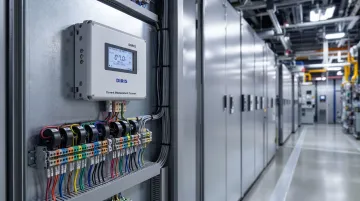
Meters with integrated NEMA-rated enclosures or built-in web portals also reduce long-term maintenance burden—which often exceeds initial hardware cost over the system lifecycle.
ValuAdd's DIRIS Digiware M series includes a built-in web server for configuration and visualization, eliminating the need for auxiliary displays or communication modules.
How ValuAdd Can Help
ValuAdd works directly with system integrators, plant engineers, and facility managers to match the right metering equipment to their specific application — whether that's a single-circuit subpanel, a multi-circuit VFD environment, or a facility-wide energy monitoring rollout.
Our products carry the certifications industrial facilities require for safety, accuracy, and regulatory compliance:
- UL Listed, CE, and FCC certified products for safety and regulatory compliance
- IEEE 519 compliant solutions for harmonic-heavy VFD and motor-control environments
- NEMA Type 4X/12 and IP65/IP66/IP68 rated enclosures for harsh environments
- Class 0.2 and 0.5 accuracy meters meeting ANSI C12.20 and IEC 62053 standards
Beyond certifications, our team provides hands-on application support to help you size and specify correctly the first time:
- Technical guidance for complex VFD and motor-control environments where harmonic distortion affects meter accuracy
- Full product range covering single and three-phase applications from 5A to 6000A
- Multi-circuit meters (up to 21 circuits) that reduce per-point metering cost in dense panel installations
- Dual-protocol communication (Modbus, BACnet, Ethernet) for flexible integration into existing systems
- Field-configurable meters with automatic CT detection and in-field protocol adjustment
- Custom engineering support for non-standard or retrofit installations
- Territory-based service and fast shipping for time-sensitive projects
Conclusion
Selecting the right energy meter is an engineering decision with direct consequences for billing accuracy, energy cost management, equipment protection, and regulatory compliance. The six factors in this guide provide a structured framework for matching meter specifications to your facility's needs:
- Application type — determines the measurement parameters required
- Accuracy class — sets acceptable error margins for billing or monitoring use
- CT compatibility — ensures correct signal conditioning at the panel level
- Communication protocols — defines integration with SCADA or energy management systems
- Environmental rating — matches IP/NEMA protection to installation conditions
- Total installed cost — accounts for hardware, wiring, integration, and commissioning
Meter selection should be revisited as facilities evolve. Adding new loads, upgrading to an energy management system, or expanding to multi-circuit monitoring are all signals that existing infrastructure may no longer fit. The right meter pays for itself through reduced energy costs, avoided utility penalties, and early detection of equipment faults before they become failures.
Frequently Asked Questions
How do you select an energy meter?
Define your application first — service type, voltage, load count, and required accuracy class. Then confirm:
- CT compatibility and amperage range
- Communication protocol match (Modbus, BACnet, pulse)
- Environmental ratings (IP/NEMA) for the install site
- Total cost including labor, auxiliaries, and subscription fees
What is the difference between single-phase and three-phase energy meters?
Single-phase meters are used for residential or light commercial loads operating at 120-240VAC with a single hot conductor. Three-phase meters are required for industrial equipment—motors, chillers, VFDs—operating at 208V, 480V, or 600V with three hot conductors. Using the wrong type results in inaccurate or incomplete energy data and inability to detect phase imbalances or equipment faults.
What accuracy class do I need for an industrial power meter?
Class 0.5 (ANSI C12.20 or IEC 62053-22) is required for revenue-grade billing and industrial energy management. Class 1.0 is sufficient for load studies and energy audits. Any facility with utility cost allocation or M&V compliance obligations should not go below Class 0.5 — errors compound and create billing disputes.
What communication protocols do industrial power meters use?
The most common industrial protocols are Modbus RS-485 for SCADA and automation systems, BACnet for building management systems, and pulse output for simple single-point applications. Ethernet-based protocols like PROFINET and EtherNet/IP account for 76% of new industrial network nodes. Dual-protocol meters offer greater integration flexibility as facility systems evolve.
What are current transformers and why do they matter in meter selection?
CTs scale high current down to a 1A or 5A signal the meter can read. Split-core or solid-core CTs suit circuits under 200A; Rogowski coils handle applications up to 5,000A or more and don't saturate magnetically. Meter compatibility with your CT type is non-negotiable — a mismatch means costly field rework.
What certifications should I look for in an industrial energy meter?
Key certifications to verify:
- UL Listing (UL 2735 or UL 61010-1) for US safety compliance
- NEMA 4X / 12 for corrosive, washdown, or dust/oil environments
- IP65/IP66/IP68 for moisture and dust ingress protection
- IEEE 519 compliance for harmonic-heavy industrial installations