Introduction
Electrical fuses sit between your power source and everything worth protecting — from a simple lighting circuit to a $150,000 variable frequency drive running a critical pump in a water treatment facility. Get the fuse right, and it quietly does its job for years. Get it wrong, and you're looking at destroyed power electronics, unplanned downtime, or worse.
The problem is that fuses look deceptively simple. They're small, relatively inexpensive, and easy to overlook during panel design or equipment commissioning. But as anyone who has replaced an IGBT module in a VFD after a fuse mismatch knows, that oversight is expensive.
So this guide covers the main types of electrical fuses, how each one works, where each type belongs, and the selection criteria that matter most for industrial applications — motor branch circuits, semiconductor protection, distribution panels, and everything in between.
Key Takeaways
- A fuse is a sacrificial overcurrent protection device that melts and breaks a circuit when current exceeds its rated limit
- Fuse types are not interchangeable — response speed, voltage class, and AC vs. DC rating all determine the right fit
- Match fuse type to load: time-delay for motors, fast-acting current-limiting for semiconductors, cartridge or HRC for general distribution
- Correct amp rating alone isn't enough — the wrong fuse type still leaves equipment unprotected
- Before selecting, verify voltage rating, current rating, breaking capacity, and I²t value
What Is an Electrical Fuse and Why Does It Matter?
A fuse is an overcurrent protective device with a circuit-opening fusible element that is heated and severed by excess current — this definition comes directly from NFPA 70 (NEC). In practice, that means a thin conductive element (copper, silver, or zinc alloy) enclosed in a housing and wired in series with the circuit. When current exceeds the rated limit, the Joule heating effect raises the element past its melting point and opens the circuit.
That physical opening is the key distinction. Unlike a breaker that trips and resets, a fuse removes the current path entirely — protecting downstream equipment before damage accumulates.
Why Fuse Selection Errors Are Costly
In industrial environments, fuse selection errors show up in three ways:
- Undersized fuses trip during normal motor startup inrush, causing nuisance shutdowns and lost production
- Oversized fuses may never blow during a genuine fault, allowing dangerous overcurrent to reach downstream equipment
- Wrong fuse type — even at the correct amp rating — can allow fault energy to destroy components like VFDs, transformers, or motor windings before the fuse responds
According to UL 248-1, low-voltage fuses rated 1,000V or less can carry interrupting ratings up to 300 kA. A fuse must also be specifically listed for its intended voltage and current type — an AC-rated fuse used in a DC circuit creates a genuine safety hazard, not just a spec mismatch.
Types of Electrical Fuses
Fuses differ by current type (AC vs. DC), construction, response speed, voltage class, and intended application. Understanding the category before selecting a specific part prevents the kind of costly mismatches that show up in VFD warranty claims and post-fault investigations.
AC Fuses vs. DC Fuses
AC fuses are designed for alternating current circuits. Because AC voltage naturally crosses zero 50–60 times per second, the arc created when the element blows is easier to extinguish. This allows AC fuses to be more compact and is why the majority of standard industrial fuses — those protecting distribution panels, motor branch circuits, and HVAC equipment — are AC-rated, typically from 120V to 600V AC.
DC fuses face a different problem. Without a natural voltage zero, the arc that forms when the element blows is continuous and harder to interrupt. Mersen confirms that DC fault interruption is inherently more difficult than AC. As a result, DC fuses require:
- Larger physical separation between contacts
- More robust arc-quenching fill materials
- DC-specific listings — UL 2579 PV fuses, for example, are rated up to 1,500 Vdc and are DC-only
Solar PV systems, battery banks, and DC drive bus applications all require fuses specifically listed for DC service.
The common mistake: using an AC-rated fuse in a DC circuit because the voltage and current ratings appear compatible. They are not.
Cartridge Fuses and HRC Fuses
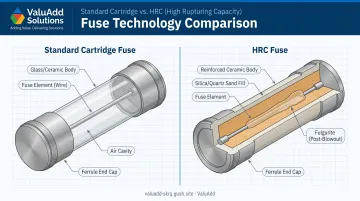
Cartridge fuses enclose the fuse element inside a cylindrical body (glass, ceramic, or porcelain), with contact caps or ferrules at each end. They are the most widely deployed fuse type in industrial low-voltage applications.
High Rupturing Capacity (HRC) fuses are a reinforced cartridge design filled with silica sand or quartz. When the element blows, the filling material absorbs arc energy and prevents the explosive rupture that can occur with standard cartridges under high fault current. Eaton's Fuseology handbook describes the quartz filler and the formation of fulgurite — the vitrified sand that encapsulates and extinguishes the arc.
Best suited for:
- Industrial distribution panels
- Motor branch circuit protection
- HVAC equipment, pumps, compressors
- Applications requiring reliable protection up to 600V AC with high available fault current
Limitations:
- Non-resettable — replace after every operation
- HRC fuses require specific fuse holders and are not field-rewirable
- Higher unit cost than basic cartridge types
ValuAdd supplies the RMS Modular Fuse Holders from Socomec — a 45mm modular format that accommodates cylindrical fuses in 14×51mm and 22×58mm sizes, rated to 100 kA rms breaking capacity and certified to UL 4248-1, CSA C22.2, and IEC 60269-2 standards. These pair well with cartridge-type fuses in industrial motor control and distribution applications.
Time-Delay (Slow-Blow) Fuses
Time-delay fuses incorporate a deliberate thermal lag that allows them to absorb brief overcurrent spikes without blowing, while still responding decisively to sustained overloads or dead-short conditions. This makes them indispensable wherever motor loads are involved.
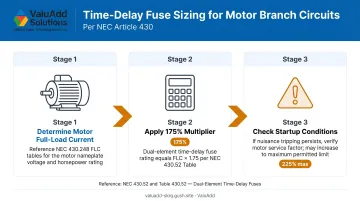
Per NEC Table 430.52(C)(1), dual-element time-delay fuses for motor branch-circuit short-circuit and ground-fault protection can be sized up to 175% of motor full-load current, compared to 300% for non-time-delay fuses. Where 175% doesn't allow the motor to start, NEC Article 430 permits increasing that limit — but not beyond 225% of motor FLC.
Best suited for:
- Motor branch circuit protection
- Transformer primary protection
- Compressor and pump starters
- Input-side protection for VFDs and soft starters, where startup inrush would false-trip a fast-acting fuse
Limitations:
- Slower response offers less protection against very low-level sustained overloads in sensitive equipment
- Dual-element designs cost more than standard fast-acting fuses
- An oversized time-delay fuse provides no meaningful protection — correct sizing is not optional
In practice, sizing to 175% works for most standard induction motors. If a motor consistently trips during startup at that threshold, verify the motor's service factor and acceleration time before upsizing the fuse — jumping straight to 225% without that check is one of the more common coordination errors in VFD panel design.
Semiconductor / Fast-Acting Fuses
Semiconductor fuses (also called ultra-rapid or current-limiting fuses) must interrupt fault current within the first half-cycle, before it reaches its destructive peak. Littelfuse and Eaton both confirm that SCRs, IGBTs, and diodes have very low transient thermal capacity — they are destroyed in microseconds if fault current reaches its peak.
The selection criterion is not just amperage. It is the I²t let-through energy, measured as melting I²t plus arcing I²t.
Best suited for:
- Protection of IGBTs and SCRs inside VFDs, soft starters, UPS systems, and rectifiers
- Power converters and controlled rectifier bridges
- Any application where the semiconductor device's I²t withstand rating must not be exceeded
Limitations:
- Must be precisely matched to the semiconductor device's I²t rating — wrong I²t means no real protection
- Higher cost than general-purpose fuses
- Never interchangeable with time-delay fuses; inrush current would blow a semiconductor fuse immediately on motor start
Other Fuse Types at a Glance
| Type | Application | Key Standard |
|---|---|---|
| High Voltage (HV) Fuses | Power and distribution transformers, substation switchgear, above 1,000V | IEEE C37.40; IEC 60282-1 for current-limiting HV fuses |
| Thermal Fuses (TCOs) | Consumer appliances — hair dryers, coffee makers; trip on temperature, not current | IEC 60691:2023 |
| Resettable PTC (Polyfuses) | Electronics, telecom, automotive — self-reset after cooling | Littelfuse PolySwitch series |
| Rewireable (Kit-Kat) | Legacy low-voltage residential and light commercial wiring | Limited to older installations; not relevant to industrial panel design |
HV fuses are within scope for industrial distribution engineers managing medium-voltage switchgear. Thermal and resettable fuses are useful context but are not substitutes for branch-circuit industrial fuses.
How to Choose the Right Fuse for Your Application
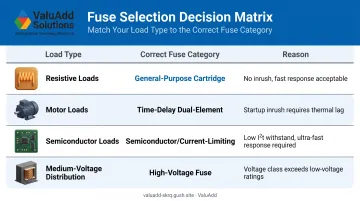
Fuse selection starts with one question: what kind of load is this circuit feeding?
Step 1: Identify the Load Type
| Load Type | Correct Fuse Category | Why |
|---|---|---|
| Resistive (heaters, lighting) | General-purpose cartridge | No inrush; fast response acceptable |
| Motor loads (pumps, fans, compressors) | Time-delay (dual-element) | Startup inrush requires thermal lag |
| Semiconductor loads (VFDs, soft starters) | Semiconductor / current-limiting | Low I²t withstand demands ultra-fast response |
| Medium-voltage distribution | High-voltage fuses | Voltage class exceeds low-voltage ratings |
Step 2: Match Voltage and Current Ratings
The fuse voltage rating must equal or exceed the circuit's maximum voltage. For current rating:
- Motor circuits: Apply NEC Article 430 and Table 430.52 — multipliers are motor-type specific (175% of FLC for dual-element time-delay fuses as a starting point)
- Resistive loads: Size at 125% of full-load current per NEC 210.20
- Semiconductor loads: Coordinate against the device manufacturer's specified I²t withstand, not just amperage
Step 3: Verify Breaking Capacity
The fuse interrupting rating must meet or exceed the maximum available short-circuit current at the installation point. Eaton's IAEI publication on SCCR cites NEC 110.10: equipment must carry a Short Circuit Current Rating (SCCR) adequate for available fault current. Industrial facilities commonly require 65 kA SCCR; grid-connected downtown locations can require up to 200 kA.
Undersizing the breaking capacity is a code violation — and a physical hazard. A fuse that cannot safely interrupt available fault current may rupture explosively.
Step 4: Confirm Environmental and Compliance Requirements
For US industrial installations:
- Motor branch circuits: NEC Article 430 governs fuse type and sizing
- Enclosure environments: ANSI/NEMA 250-2020 defines Type 4X (corrosion-resistant, washdown) and Type 12 (dust and oil) ratings — fuse holders must match the enclosure's environmental requirements
ValuAdd's portfolio includes the SIRCO UL 98 C disconnect switches (glass fiber reinforced polyester construction, rated to 800 VAC) and the Enclosed FUSERBLOC line (30A–800A, UL 489/UL 98/CSA 22.2 compliant) for applications in water treatment facilities, oil and gas environments, and manufacturing plants where harsh conditions demand rated hardware.
What to Check Before Finalising Your Fuse Selection
What to Check Before Finalizing Your Fuse Selection
Three mistakes account for most fuse-related equipment damage in the field:
1. Upsizing a fuse to stop nuisance tripping If a fuse blows during motor startup, the answer is not a higher-rated fuse — it is the correct fuse type. Switching from a fast-acting to a properly sized time-delay fuse resolves startup tripping without compromising fault protection. An oversized fast-acting fuse may never operate during a real fault.
2. Ignoring I²t when protecting semiconductor devices A fuse can have the correct amp rating and still fail to protect a VFD's IGBT modules if its I²t let-through energy exceeds the device's withstand rating. Always verify the I²t value against the semiconductor manufacturer's specified limit — not just the current rating on the fuse label.
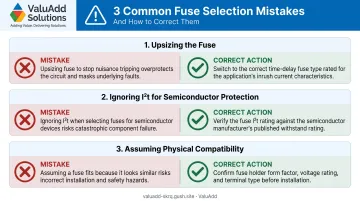
3. Assuming physical compatibility Fuse holders and fuse blocks are size-specific. A ferrule-type holder will not accept a knife-blade fuse. Mismatched physical form factors create poor contact resistance, localized heating, and unreliable protection. As Littelfuse's fuseholder guide notes, significant heat is generated by fuse holder clip contact resistance — a problem that compounds under high-current conditions.
Confirming physical compatibility before installation — not during commissioning — is where matched components make a practical difference. ValuAdd supplies fuse holders alongside protection components for this reason. The RMS Modular Fuse Holders and RM CC series (for UL Class CC fuses, up to 30A at 600V with 200 kA breaking capacity) ensure form factor compatibility is verified upfront.
Conclusion
Electrical fuses are engineered devices, not generic safety hardware. A cartridge fuse, a time-delay fuse, and a semiconductor fuse can all share the same amperage rating and still be completely wrong for each other's application. Those differences — response speed, I²t let-through energy, arc-quenching design, AC vs. DC listing — reflect the distinct failure modes each fuse type is built to handle.
Reliable circuit protection comes from matching each variable to the application:
- Fuse type to the load characteristics (resistive, inductive, motor, semiconductor)
- Voltage rating to the circuit operating voltage, including AC vs. DC listing
- Breaking capacity to the available fault current at the installation point
- Physical form factor to the fuse holder and panel hardware
For motor control and drive applications especially, that coordination is not optional. Get it wrong, and the fuse clears on startup inrush instead of on a fault — or worse, fails to clear at all.
Frequently Asked Questions
What are the different types of electrical fuses?
The main categories are: AC and DC fuses (by current type), cartridge and HRC fuses (general-purpose and high fault-current industrial use), time-delay fuses (motor and transformer loads), semiconductor fast-acting fuses (VFDs, rectifiers, power electronics), high-voltage fuses (distribution and substation applications), and thermal or resettable fuses (appliances and electronics).
How do I identify a fuse type?
Check the physical form factor (cartridge, blade, bottle shape), the markings on the fuse body (amperage, voltage, speed designation), and the UL or IEC standard printed on the label. When replacing a fuse, match the original equipment's fuse holder specification exactly — form factor, voltage class, and current rating all matter.
What is the difference between a fast-acting and a time-delay fuse?
Fast-acting fuses blow almost immediately when current exceeds their rating, making them suitable for resistive loads and sensitive electronics. Time-delay fuses tolerate brief inrush spikes and are essential for motor branch circuits, where startup currents can reach several times the running current without indicating a fault.
What is the difference between a fuse and a circuit breaker?
A fuse is a one-time device replaced after it operates; a circuit breaker resets. Fuses respond faster — current-limiting fuses can interrupt within the first half-cycle — making them the preferred choice for protecting semiconductor devices where response speed is critical.
How do I calculate the right fuse rating for my circuit?
For motor circuits, NEC Article 430 Table 430.52 sets the multipliers — 175% of full-load current is a common starting point for dual-element time-delay fuses. For resistive loads, use 125% of full-load current. Always confirm against the equipment manufacturer's specified fuse rating.
Can I replace a blown fuse with a higher-rated one?
No. A higher-rated fuse may not operate during a fault, allowing overcurrent to damage wiring, equipment, or start a fire. Always replace with an identical type and rating — if a fuse keeps blowing, find the underlying cause rather than upsizing.