
Component selection isn't just about matching specifications—it's the most critical step in UL 508A panel assembly. UL 508A compliance starts before the first wire is cut: with understanding exactly which components are approved, how to verify their listing status, and which application factors drive the right selection. This guide covers the UL 508A component framework, the verification methodology every OEM should use, and the six key selection factors that connect technical specs to real-world outcomes.
Key Takeaways
- UL 508A governs industrial control panels at 1,000V or less; every internal component must be UL Listed or UL Recognized
- Check Category Control Numbers (CCNs) in UL's Product iQ tool against Supplement SA before specifying any part
- SCCR, calculated via Supplement SB, is scrutinized during inspection—component selection directly determines this value
- Enclosure type, voltage/current ratings, and motor/drive requirements vary by application and environment
- Sourcing pre-vetted, UL-listed components shortens compliance verification and reduces project risk
What Is a UL 508A Industrial Control Panel?
UL 508A is the North American product safety standard for industrial control panels used in ordinary (non-hazardous) locations at 1,000V AC/DC or less. Developed by Underwriters Laboratories, it standardizes construction methods, wiring practices, component suitability, markings, and documentation for assembled control systems.
Critical distinction: UL 508A evaluates the assembled panel as a complete system—not individual components in isolation. An enclosed industrial control panel includes the enclosure, all components inside it, and all components mounted to its walls. Each component must individually meet its own UL listing requirements and be appropriate for use within a 508A context.
Three regulatory requirements drive UL 508A adoption across North American industrial facilities:
- NEC Article 409.110(4) requires industrial control panels to be marked with an SCCR
- OSHA 1910.303(a) requires electrical equipment to be "approved," meaning accepted by a Nationally Recognized Testing Laboratory (NRTL) like UL
- NEC Article 409.22 prohibits installing panels where available fault current exceeds the marked SCCR
Core Component Categories in a UL 508A Panel
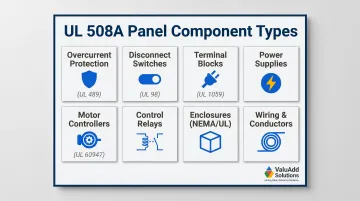
Every UL 508A panel requires careful selection across these primary component categories:
- Overcurrent protection devices: Circuit breakers (UL 489), fuses
- Disconnect switches: UL 98-listed switches for isolation
- Terminal blocks: UL 1059-listed connection points for field wiring
- Power supplies: Convert and distribute control circuit voltage
- Motor controllers: UL 60947 family components including contactors, soft starters, VFDs
- Control relays: Logic and switching devices
- Enclosures: NEMA/UL Type-rated housings
- Wiring and conductors: Sized and insulated per UL 508A requirements
ValuAdd carries UL Listed and CE-certified components across all of these categories, including NEMA 4X and Type 12 enclosures, IP65/66/68-rated devices, and IEEE 519-compliant VFDs and soft starters. For OEM panel builders, sourcing from a single catalog with verified listings reduces the time spent confirming individual component compliance.
Why UL 508A Compliance Matters for OEM Panel Builders
Non-compliant panels get red-tagged at inspection — and when that happens at the customer's site, you're absorbing expedited shipping costs, technician overtime, and project delays on top of the rework itself.
Core business benefits of UL 508A compliance:
- AHJs accept listed panels without extensive field evaluation, cutting permitting time
- Catching compliance issues early eliminates mid-project change orders and rework costs
- Listed panels demonstrate reliable workmanship to buyers and end users
- Proper component selection limits warranty exposure from field failures
- Many industrial insurers require listed equipment — unlisted panels can void coverage
The sections below cover how component selection decisions — from circuit protection to terminal blocks — directly determine whether your panel earns and keeps that listing.
How to Identify and Verify UL 508A-Compliant Components
The Two-Identifier System
Every UL-listed device carries two critical identifiers:
- Category Control Number (CCN) – Identifies the product category and applicable standard
- E-file number – Manufacturer-specific identifier linking to the UL listing record
Both can be cross-checked on UL's Product iQ database.
Understanding CCN Suffix Logic
The CCN suffix tells you the listing type:
- Four letters (XXXX): UL Listed for U.S./NEC use—complete product approved for field installation
- Four letters + "2" suffix (XXXX2): UL Recognized for U.S. use—incomplete device requiring special conditions of acceptability
Critical for OEMs: UL Recognized components require checking the "notes" column in Supplement SA for conditions of acceptability before use. Installing one outside its specified conditions triggers additional evaluation. If those limitations aren't verified upfront, the panel is treated as unlisted.
The Supplement SA Master Reference
Supplement SA is your master reference for UL 508A component compliance. It lists every acceptable CCN category—circuit breakers, power supplies, relays, enclosures—and any associated use restrictions.
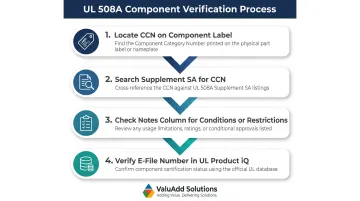
Verification process:
- Locate the CCN on your component's label
- Search Supplement SA for that CCN
- Check for any conditions or restrictions in the notes column
- Verify the manufacturer's E-file number in Product iQ
NEMA Compliance Does NOT Substitute for UL Listing
NEMA ratings are manufacturer self-declared—NEMA is not a testing laboratory or certification body, and its ratings do not substitute for UL listing. This distinction trips up OEMs more often than most expect.
Example: A wireway rated NEMA 12 may only carry a UL Type 1 listing, which limits the overall panel's environmental rating. Any component claiming only NEMA compliance—without a corresponding UL E-file number—should be treated as unverified for UL 508A purposes.
Always verify UL listing status directly in Product iQ. Your panel's environmental rating defaults to the lowest-rated attached component—one unverified part can downgrade the entire assembly.
Key Factors for Selecting Components in UL 508A Panels
While the CCN/E-file process confirms whether a component is permitted, OEM panel builders must evaluate six application-specific factors to ensure selected components perform reliably and support the panel's overall compliance profile.
UL Listing Status and CCN Match to Supplement SA
This is the non-negotiable first check. The component must be:
- UL Listed (not just NEMA-rated)
- Its CCN must appear in Supplement SA
- No disqualifying conditions apply
Common error: Using a UL Recognized component in place of a UL Listed one without checking conditions of acceptability. IAEI and UL guidance explicitly warn that Recognized components are only intended for factory installation where limitations of use are known and investigated. If conditions aren't met, certification is void.
Short-Circuit Current Rating (SCCR) Compatibility
SCCR is calculated using UL 508A Supplement SB methodology. It reflects the weakest link among all power circuit components—every component chosen affects the panel's marked SCCR value.
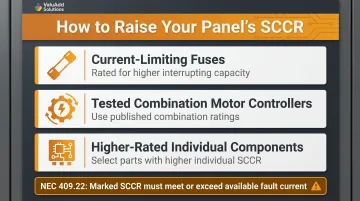
Critical compliance point: NEC 409.22 mandates that panels cannot be installed where available fault current exceeds the marked SCCR. Panels marked with insufficient SCCR values will fail inspection at installation, triggering red tags and full rework.
Strategies to raise SCCR:
- Use current-limiting fuses rated for higher interrupting capacity
- Specify tested combination motor controllers with published combination ratings
- Select components with higher individual SCCR ratings
AHJs actively enforce SCCR markings by requiring available fault current documentation and red-tagging inadequate equipment.
Voltage, Current, and Temperature Ratings
Components must be rated for actual operating conditions—not just nominal system voltage:
- Voltage rating must meet or exceed circuit voltage
- Current rating must handle continuous load plus safety margin
- Temperature rating must account for ambient temperature inside the enclosure (frequently overlooked)
Undersized current ratings cause overheating and premature failure. The 2025 UL 508A revision codified control circuit voltage limits at 120 Vac and 250 Vdc—control circuit components must be specifically rated for these conditions, not assumed equivalent to power circuit ratings.
Temperature derating: UL 508A Supplement SA requires that all components—Listed or Recognized—must not exceed marked electrical and environmental ratings when installed. Inside enclosed panels, ambient temperatures can exceed 40°C, requiring derating.
Enclosure Type and Environmental Rating
The enclosure's UL Type or NEMA rating must match the installation environment:
- NEMA Type 12: Indoor protection against falling dirt and dripping water
- NEMA Type 4X: Indoor/outdoor protection against corrosion, windblown dust, rain, and hose-directed water
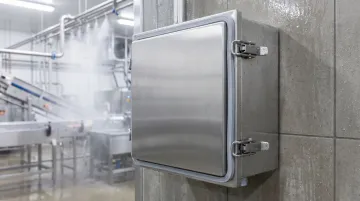
Critical principle: All components mounted to or attached to the enclosure must be compatible with that rating. Otherwise, the panel's environmental protection level defaults to the lowest-rated attached component.
ValuAdd's NEMA 4X and Type 12-compliant enclosures and IP65/66/68-rated devices are pre-matched for demanding environments in water treatment, oil and gas, and food processing. For example:
- SW Series Washdown Drives carry UL Type 4X (IP66) ratings for high-pressure washdown environments
- RX4E Series Packaged Soft Starters feature NEMA Type 12 enclosures for dust and drip protection
Pre-matched ratings eliminate the retrofit risk of a single non-compliant component downgrading the panel's environmental rating.
Wiring Method and Physical Mounting Compatibility
UL 508A mandates specific requirements for conductor sizing, insulation ratings, wire color coding, and separation between power and control circuits.
Key requirements:
- Wire color codes per UL 508A Section 66.9: Black for ungrounded supply voltage, Red for ungrounded AC control circuits, Blue for ungrounded DC control circuits
- Terminal blocks (UL 1059) must support field wiring conductor sizes and spacing requirements based on Use Group (A, B, or C)
- Physical mounting must allow proper spacing and maintenance access
DIN rail advantage: DIN rail-mountable (TS-35) components simplify layout, spacing compliance, and future maintenance access. Verify DIN rail compatibility early in BOM development to avoid late-stage layout changes.
ValuAdd offers DIN rail-compatible components including the GM2 Series General Purpose Micro Drives (up to 7.5HP), RMS Modular Fuse Holders, and SIRCO M compact switches.
Motor Control and Drive-Specific Component Requirements
Motor loads require coordinated branch circuit protection and overload protection under UL 508A. VFDs and soft starters introduce additional considerations:
VFD requirements:
- Must be rated for motor's full-load amps
- Must comply with UL 61800-5-1 (Edition 2) for adjustable speed drives
- Must be compatible with panel's overall SCCR
- Harmonic distortion must be managed per IEEE 519-2022 at the point of common coupling
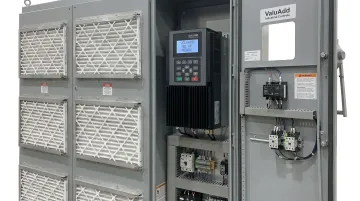
Harmonic compliance: Harmonic distortion from VFDs affects upstream components and panel ratings. Specifying IEEE 519-compliant drives eliminates downstream compliance complications for OEMs.
ValuAdd's Medium Voltage Variable Frequency Drives and Benshaw H2 519/519P Series Clean Power Drives are IEEE 519 compliant. The H2 519/519P Series uses an 18-pulse configuration with phase-shifting transformer to control harmonic distortion to less than 8% THDv and 5% TDDi, meeting IEEE 519-2022 standards.
Soft starter requirements:
- Coordinated branch circuit and overload protection
- UL 347 listing for combination solid-state starters
- Class E2 load break compliance for medium voltage applications
ValuAdd's MVE-P Series Medium Voltage Soft Starters (2.3 kV to 15 kV) and CFMVRMX Series carry both UL/cUL listing and Class E2 compliance, ensuring safe load break and isolation in demanding industrial applications.
How ValuAdd Can Help
ValuAdd provides UL Listed, CE-certified industrial control and automation components pre-vetted for UL 508A compliance. For OEM panel builders, the portfolio covers every major component category you'll encounter during design and inspection.
Components available for UL 508A panels:
- NEMA 4X/12-rated enclosures and IP65/66/68-rated devices
- IEEE 519-compliant VFDs with H-Bridge multi-level technology
- Class E2-compliant medium voltage soft starters with fiber-optic isolation
- Halogen-free options for safety-critical environments
Why OEM panel builders work with ValuAdd:
- Covers all major UL 508A component categories from a single source
- Provides BOM review, panel design input, and compliance consultation
- Offers territory-based service with on-site support when you need it
- Ships quickly to keep assembly timelines on track
ValuAdd's technical sales team works directly with manufacturing plants, OEMs, and system integrators on component selection and project support. Contact ValuAdd to review your panel BOM or get guidance on meeting specific compliance requirements.
Conclusion
UL 508A compliance for OEM panel builders is a component-level discipline. Every part selected must be verified through the CCN/E-file process against Supplement SA, rated appropriately for the application, and chosen with the panel's SCCR in mind.
The right component for a UL 508A panel is the one whose listing status, ratings, and physical characteristics align with the specific installation environment, available fault current, and load profile — not simply the most familiar option or the lowest-cost one on the shelf.
UL 508A requirements evolve, as shown by the 2025 revisions to control circuit voltage limits. OEMs who build a repeatable component verification process — instead of defaulting to NEMA-only claims — position themselves for consistent results:
- Deliver inspection-ready panels that clear audits the first time
- Reduce rework costs tied to non-compliant component substitutions
- Protect UL certification status through documented, repeatable selection practices
Frequently Asked Questions
What components are allowed in a UL 508A listed panel?
All components must be either UL Listed or UL Recognized per their applicable CCN and must appear in Supplement SA with no disqualifying conditions. Common examples include UL 489 circuit breakers, UL 98 disconnects, UL 1059 terminal blocks, and UL 60947-series motor controllers.
What is the difference between UL 508 and UL 508A?
UL 508 was an older standard covering individual industrial control equipment components (switches, relays, motor controllers), which transitioned to UL 60947-4-1 to align with international standards effective January 27, 2017. UL 508A covers the complete assembled industrial control panel—its construction, wiring, labeling, and documentation.
Is UL 508A required?
While no single federal law mandates UL 508A, compliance is effectively required because NEC Article 409 mandates SCCR marking, OSHA 1910.303 requires "approved" equipment, and most AHJs, insurers, and industrial purchasers require listed equipment or equivalent field evaluation.
How much does it cost to get UL 508A certified?
UL does not publish fee tables publicly. Costs for the Industrial Control Panel Shop Program — covering initial certification, annual fees, and unannounced audits — require a direct quotation from UL. Per-panel costs vary based on complexity.
What does the UL 508A standard cover?
UL 508A governs industrial control panels operating at 1,000V or less in ordinary locations. Covered areas include:
- Construction methods and component suitability (Supplement SA)
- Wiring methods and conductor sizing
- Enclosure types and environmental ratings
- Circuit protection and SCCR calculation (Supplement SB)
- Marking, documentation, and disconnecting means requirements