Soft starters directly address these risks by controlling voltage ramp-up during motor startup, reducing inrush current, eliminating mechanical shock, and extending equipment life across pumps, compressors, and conveyors in manufacturing, water treatment, oil and gas, and processing facilities. This 2026 buyer's guide examines the top soft starters on the market, what separates reliable industrial units from budget options, and the specific criteria U.S. plant engineers and procurement managers should prioritize when selecting equipment that will run for decades in demanding environments.
Key Takeaways
- Soft starters cut inrush current from 600–700% down to roughly 150–350% of full-load current, preventing voltage sags that disrupt facility operations
- Top 2026 industrial models include adjustable ramp control, integral overload protection, UL Listing, and NEMA compliance
- Selection hinges on matching voltage range, current rating, overload class, and enclosure type to motor nameplate data and environment
- ValuAdd's medium voltage soft starters excel in water treatment, oil and gas, and heavy manufacturing where IEEE 519 harmonic compliance is required
What Are Soft Starters and Why Do Industrial Facilities Need Them
A soft starter sits between the incoming power line and the motor, using silicon-controlled rectifiers (SCRs) or similar power electronics to gradually increase voltage and current during startup. Instead of applying full line voltage instantly, the soft starter ramps voltage from zero to full rated voltage over a programmable time period—typically 5 to 30 seconds—allowing the motor to accelerate smoothly without the destructive surge of full-voltage starting.
This controlled ramp matters because a typical NEMA Design B motor draws 600–700% of its full load amps (FLA) during locked-rotor startup. That instantaneous peak inrush current can reach 2.8 times the RMS locked-rotor value in the first half AC cycle after contact closure, frequently tripping instantaneous magnetic-only circuit breakers and causing nuisance shutdowns.
Voltage sags to approximately 80% of rated voltage during these starts trip process controllers and disrupt sensitive equipment on shared electrical buses. For facilities running continuous processes, that repeated stress translates directly into unplanned downtime and accelerated equipment replacement costs.
Modern industrial applications rely on five recognized reduced-voltage starting methods:
- Primary resistor – Uses resistors in each phase to drop voltage; provides smooth starts but generates significant heat
- Autotransformer – Uses voltage taps to control power, reducing starting current and torque simultaneously
- Part-winding – Energizes a portion of the motor winding to increase impedance and reduce starting current
- Wye-delta (star-delta) – Changes winding connections from wye to delta configuration to reduce voltage during startup
- Solid-state – Uses SCR/thyristor power electronics to regulate voltage and current steplessly throughout the start cycle
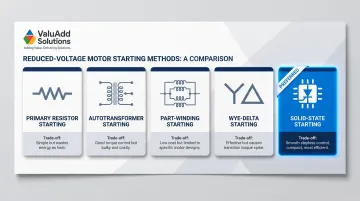
Of these methods, solid-state soft starters have become the default choice for fixed-speed motor applications. They eliminate electrical surges and spikes without the harmonic distortion concerns of variable frequency drives (VFDs), and their installation footprint is considerably smaller than electromechanical alternatives. The selection challenge isn't whether to use a solid-state starter—it's knowing which specifications and features actually matter for your application.
Best Soft Starters for Industrial Applications in 2026
The following five soft starters were evaluated on reliability, industrial certifications, voltage and current range, application fit for U.S. industrial sectors, and available technical support.
ABB PSTX Series
ABB is a global leader in industrial automation, and the PSTX represents their flagship soft starter line designed for AC induction motors in demanding industrial environments. The PSTX serves pumps, fans, compressors, and conveyors across water and wastewater, manufacturing, and processing facilities where reliability is non-negotiable.
Notable capabilities include intelligent motor protection functions, a built-in bypass contactor in select models to eliminate SCR losses during run mode, a wide current range covering small to very large motors, and direct compatibility with ABB's digital ecosystem for remote monitoring.
The series carries cULus certification (UL File E161428) and complies with EN 60947-4-2 standards. The detachable keypad is rated IP66 and UL Type 4X/12, making it suitable for harsh or washdown environments.
| Feature | Specification |
|---|---|
| Voltage & Current Range | 208–690 V AC; 30 to 1250 A (up to 2160 A inside-delta configuration) |
| Key Protection Features | Electronic overload (Class 10A, 10, 20, 30), dual overload, underload, locked rotor, current/voltage imbalance, phase reversal, PTC/PT100 input, over/under voltage, earth-fault protection |
| Certifications & Compliance | cULus (UL File E161428), CE, EN 60947-4-2; IP66 keypad with UL Type 4X and 12 rating |
Siemens SIRIUS 3RW5 Series
Siemens' SIRIUS 3RW5 is a compact, modular soft starter widely adopted in U.S. manufacturing and process industries for its native integration with the Siemens TIA Portal automation platform. This integration simplifies system-level programming and diagnostics, making it a preferred choice for facilities standardizing on Siemens control architecture.
Standout features include user-friendly parameterization via mobile apps or PC software, a compact footprint that saves valuable panel space in space-constrained installations, an integrated bypass relay to reduce losses during run mode, and advanced diagnostics including a "Trace" oscilloscope function for recording measured values and events. The 3RW5 series includes ATEX/IECEx certifications for hazardous locations, expanding its applicability to oil and gas and chemical processing environments.
| Feature | Specification |
|---|---|
| Voltage & Current Range | 200–480 V (varies by SKU); 3RW52 covers 5.5 to 560 kW, 3RW55 covers up to 1200 kW |
| Key Protection Features | Electronic motor overload (Class 10A, 10E, 20E, 30E), thermistor motor protection, phase asymmetry monitoring |
| Certifications & Compliance | IEC 60947-4-2, UL, CSA, CE, ATEX/IECEx/UKEX (3RW55) |
Schneider Electric Altistart 48 (ATS48)
The Schneider Electric ATS48 is a well-established solid-state soft starter commonly specified in North American industrial and infrastructure projects, particularly in water/wastewater treatment and HVAC applications where torque control and soft stop capabilities are critical to preventing equipment damage.
The ATS48's patented Torque Control System (TCS) delivers constant starting and stopping rates independent of motor loading — a direct solution to water hammer in pump applications. It also offers InTele braking for controlled motor deceleration without mechanical brakes, covering motors from 17 A to 1200 A.
The ATS48 carries UL, CSA, and CE certifications, with enclosed versions available in UL Type 1, 12, and 3R configurations.
| Feature | Specification |
|---|---|
| Voltage & Current Range | 208–690 V; 17 A to 1200 A |
| Key Protection Features | Thermal overload (selectable Class 10, 20, 30), phase failure/loss, underload, overcurrent |
| Certifications & Compliance | UL, CSA, CE, CCC, DNV, EN/IEC 60947-4-2; enclosed versions in UL Type 1, 12, and 3R |
Eaton S811 Series
Eaton's S811 series is a solid-state soft starter designed specifically with North American industrial environments in mind, emphasizing ease of installation and full compatibility with NEMA control panel standards. This focus on NEMA compliance simplifies panel design and reduces engineering time for system integrators and OEMs.
For U.S. buyers, the S811 offers integral overload protection that eliminates a separate overload relay (line-side short circuit protection is still required), diagnostic LED indicators for quick troubleshooting, and solid thermal stress management for applications with frequent start cycles. The S811 is UL 508 Listed (UL File E202571) and complies with CSA 22.2-14, IEC 60947-4-2, and NEMA ICS 1, ICS 2, ICS 5 standards.
| Feature | Specification |
|---|---|
| Voltage & Current Range | 200–690 V; 37 A to 1000 A |
| Key Protection Features | Electronic motor overload (adjustable, default Class 20), phase loss, phase imbalance, ground fault (optional), jam/stall, analog input for thermistor/PTC |
| Certifications & Compliance | UL 508 (UL File E202571), CSA 22.2-14, IEC 60947-4-2, CE, NEMA ICS 1, ICS 2, ICS 5 |
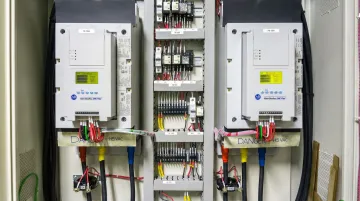
ValuAdd Advanced Medium Voltage Soft Starter
ValuAdd's medium voltage soft starters are purpose-built for high-power motor applications in municipal water treatment, oil and gas pumping stations, and large-scale industrial manufacturing where standard low-voltage units cannot handle the motor size or application demands.
Key differentiators:
- SCR-based solid-state technology with current ramp control to minimize voltage drop during startup
- IEEE 519 compliance for harmonic control at the Point of Common Coupling (PCC)
- NEMA Type 4X enclosures for corrosive washdown environments; Type 12 for dusty manufacturing facilities
- UL/cUL certification across the product line
- Territory-based technical support for application-specific configuration and on-site commissioning
ValuAdd's MVE-P Series supports mains voltages from 2.3 kV to 15 kV (±10%) with nominal current ratings from 110 A to 1200 A, handling maximum start currents of 400% full load current for up to 30 seconds. The CBMVRX Series is designed for motors operating at 6900V and 13800V, supporting motors up to 16,000 HP at 6900V and 25,000 HP at 13800V. Built-in motor protection includes overload protection, phase imbalance detection, motor thermistor input, and ground fault protection, with fiber-optic isolation of low-voltage circuits from medium-voltage power electronics for enhanced personnel safety.
| Feature | Specification |
|---|---|
| Voltage Range & Application Scope | MVE-P Series: 2.3 kV to 15 kV (±10%); CBMVRX Series: 6900V and 13800V; designed for water treatment, oil and gas, and heavy industrial manufacturing |
| Key Certifications & Standards | UL/cUL Listed, CE Certified, IEEE 519 Compliant, NEMA Type 4X and 12 enclosure ratings |
| Support & Customization | Custom engineering solutions, territory-based technical support, application-specific ramp tuning, panel integration design, on-site commissioning support |
ValuAdd has documented deployments across municipal water treatment facilities (CSXi Series pump panels), oil and gas pumping stations requiring precise harmonic control, and heavy industrial manufacturing facilities running 15,000 HP compressor systems and 20,000 HP production lines.
The modular design supports individual phase arm removal for simplified field maintenance. Built-in simulation modes allow engineers to verify power and control circuits without high-voltage exposure — a practical safety advantage during commissioning.
How We Chose the Best Industrial Soft Starters for 2026
We evaluated each soft starter on technical capability, industrial certifications, application fit for U.S. industrial sectors, and market reliability. The most common buyer mistake is selecting on price alone without matching voltage, current, and overload protection class to actual motor and load requirements—a decision that leads to nuisance trips, premature failures, and voided warranties.
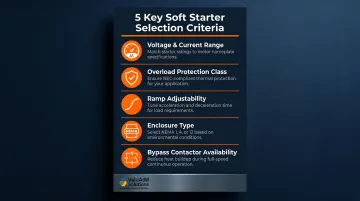
Key technical factors evaluated:
- Voltage and current range matched to motor nameplate data (full load amps and locked rotor amps)
- Overload protection class appropriate for load characteristics (Class 10 for light loads with short acceleration times, Class 20 for standard industrial loads, Class 30 for high-inertia loads like loaded conveyors and large fans)
- Ramp-up and ramp-down adjustability to fine-tune acceleration curves and prevent water hammer or mechanical shock
- Enclosure type matched to the operating environment (NEMA 4X for outdoor or washdown areas, NEMA 12 for indoor dusty environments)
- Availability of bypass contactors to eliminate SCR losses and heat generation during steady-state run mode
Technical fit is only half the equation. U.S. buyers also need to clear regulatory and certification hurdles that directly affect inspections, utility compliance, and long-term uptime.
Compliance and certification factors for U.S. buyers:
- UL Listing required by most U.S. facilities to satisfy insurance carriers and pass OSHA inspections
- IEEE 519 compliance critical for large facilities on shared utility grids, where exceeding harmonic limits triggers utility penalty charges
- NEMA enclosure ratings matched to the plant environment to prevent premature failures and reduce maintenance costs
Getting these selections wrong doesn't just affect equipment performance—it can invalidate your warranty, trigger utility fines, or fail your next safety inspection.
Conclusion
Selecting the right soft starter extends beyond brand recognition to matching technical specifications, certifications, and support capabilities to your facility's specific demands and application requirements. A soft starter sized incorrectly or lacking the appropriate overload protection class will fail prematurely, while one without proper enclosure ratings will corrode or accumulate contamination that leads to unplanned downtime.
Before finalizing your purchase, weigh three factors that often determine long-term success:
- Scalability: Confirm the soft starter can support future motor upgrades or facility expansions without requiring full replacement
- Total cost of ownership: Account for reduced maintenance intervals, extended motor bearing and winding life, and avoided production downtime — not just the purchase price
- Vendor support depth: For medium-voltage applications, commissioning assistance and application engineering can mean the difference between a clean installation and months of troubleshooting
For application-specific guidance on selecting or configuring the right soft starter for your industrial environment, contact ValuAdd's engineering team. ValuAdd specializes in medium-voltage applications requiring IEEE 519 compliance and offers custom engineering solutions tailored to water treatment, oil and gas, and large-scale manufacturing facilities where unplanned downtime carries serious operational and financial consequences.
Frequently Asked Questions
How do you choose the correct soft starter?
Match the soft starter to your motor's specs and operating conditions. Key selection criteria:
- Motor FLA and LRA from the nameplate
- Voltage range required by the installation
- Load type — high-inertia loads like loaded conveyors need Class 30 overload protection
- Starts per hour and duty cycle
- Enclosure type suited to the environment (NEMA 4X for washdown, NEMA 12 for dusty indoor)
Undersizing causes nuisance trips; oversizing wastes capital and panel space.
What is the difference between a soft starter and a variable frequency drive (VFD)?
A soft starter controls voltage only during motor startup and stopping to reduce inrush current and mechanical stress, then runs the motor at fixed speed. A VFD continuously varies frequency and voltage to provide precise speed control throughout operation. Soft starters cost less and are simpler to install where constant-speed operation is acceptable; VFDs are required when variable speed is needed.
What certifications should an industrial soft starter have for US applications?
UL Listing is the primary requirement for U.S. installations — it satisfies insurance and OSHA safety standards. IEEE 519 compliance matters where utilities enforce harmonic distortion limits. CE certification applies to imported equipment, and NEMA ratings (4X for washdown/outdoor, 12 for dusty indoor) determine enclosure suitability.
What is the difference between low voltage and medium voltage soft starters?
Low-voltage soft starters cover up to 690V and handle standard industrial motors. Medium-voltage units (2.3kV–15kV) are built for large, high-power motors — think municipal water treatment pumps, large compressors, and heavy industrial drives. They require more stringent isolation and protection features, including fiber-optic isolation and enhanced personnel safety measures.
Which industries benefit most from using soft starters?
Industries with large motors and demanding start conditions see the most value:
- Oil and gas — pumps and compressors benefit from reduced mechanical stress
- Municipal water treatment — controlled starts prevent water hammer in large pump systems
- Manufacturing — conveyors, mixers, and fans with high-inertia loads
- HVAC — large centrifugal equipment requires smooth ramp-up
- Food and beverage — sanitary washdown environments require NEMA 4X enclosures
In each case, the core benefit is the same: inrush current reduction and smooth startup extend equipment life and reduce unplanned downtime.
How do soft starters reduce maintenance and downtime costs?
Soft starters limit inrush current and eliminate mechanical shock at startup, reducing wear on motor windings, bearings, couplings, and belts. Longer service intervals and fewer unplanned shutdowns follow. Over the equipment lifecycle, this measurably lowers total repair costs compared to across-the-line starting.